Download the App and manage your eSIMs easily
Create your order quickly
See your eSIM details
Track your remaining data
Download the App and manage your eSIMs easily
Create your order quickly
See your eSIM details
Track your remaining data
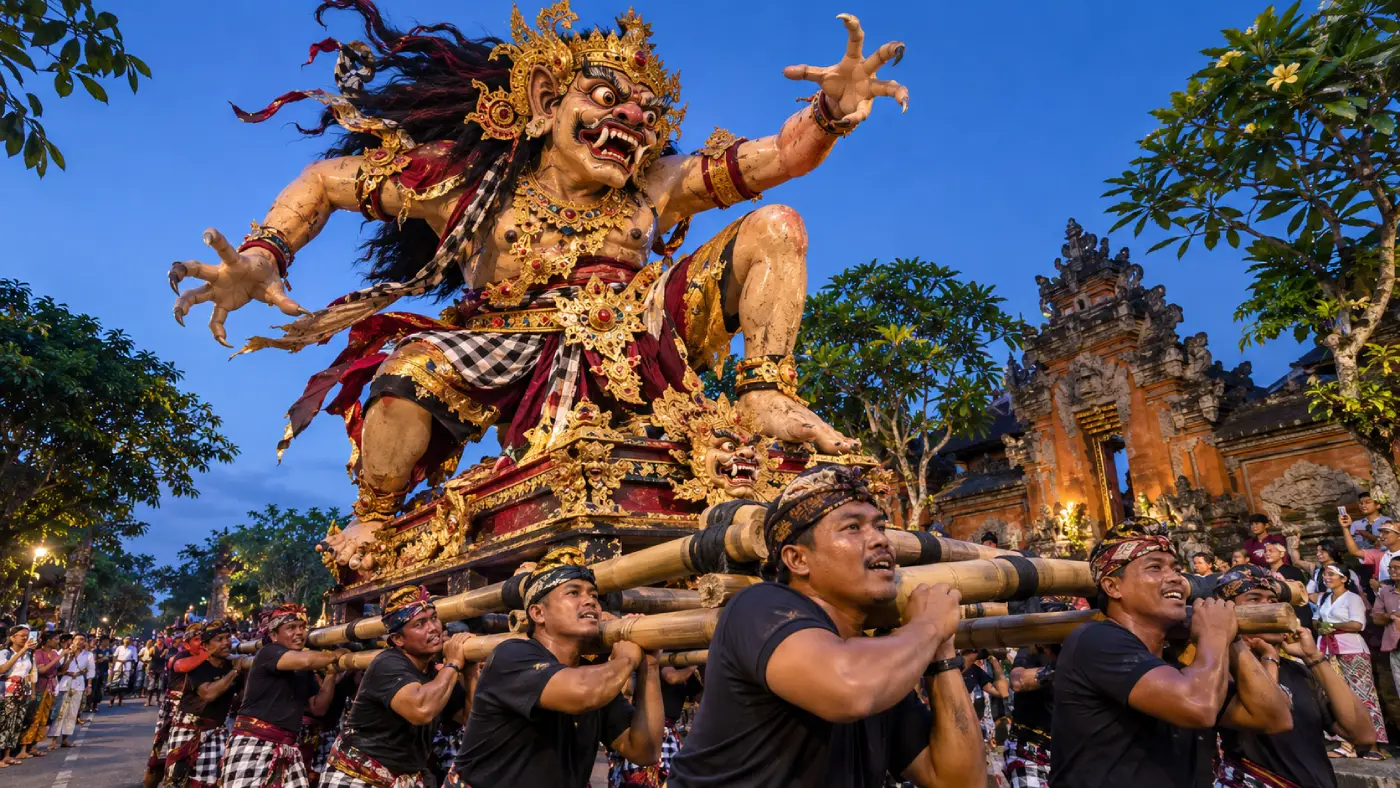
Towering Ogoh-ogoh figures fill Bali’s streets before Nyepi brings a day of quiet. Here’s how to experience the celebrations and arrange your stay around them.

Lena Hartley
Updated Nov 4, 2026
11 min read
Save 15% on your Roafly eSIM
Stay connected on your next trip. Use the code below at checkout.
View All DestinationsSave 15% on your Roafly eSIM
Stay connected on your next trip. Use the code below at checkout.
View All Destinations
Manage your eSIM in the app
Install, top up and track data.
Nyepi falls on Monday, 8 March 2027. To experience the celebrations, arrive before the Ogoh-ogoh processions expected on the evening of 7 March, then settle into accommodation where you will be comfortable spending the following day.
The change of pace is the reason to come. Neighborhoods bring their elaborate figures into the streets before Bali observes its Hindu New Year through stillness and reflection. Visitors share that quiet by remaining within their hotel or villa grounds and keeping noise and lighting low.
Nyepi suits a trip with room to pause. If your holiday depends on daily excursions, beach access or frequent hotel changes, arrange those around the observance. Thinking through whether Bali fits your trip is especially useful when your dates are fixed.
Indonesia’s official 2027 holiday calendar confirms 8 March as Nyepi, marking the start of Saka year 1949. The surrounding ceremonies follow a local rhythm: villages organize their own processions, and Melasti does not happen everywhere on one date.
| Occasion | When to plan for it | What it means for your visit |
|---|---|---|
| Melasti purification ceremonies | In the days before Nyepi; dates vary by community | Processions to the sea or other sacred water sites |
| Pengerupukan and Ogoh-ogoh | Sunday evening, 7 March 2027, following the customary eve-of-Nyepi timing | Local processions; exact routes and starting times depend on the community |
| Nyepi, the Day of Silence | Monday, 8 March 2027 — confirmed | Stay within your accommodation and observe the quiet |
| Ngembak Geni | Tuesday, 9 March 2027, the day after Nyepi | Family visits and reconciliation; plan onward travel around services reopening |
Nyepi usually runs from 6 a.m. until 6 a.m. the following morning, in Bali’s local time, WITA (UTC+8). Use that overnight period when arranging your stay. Transport operators issue their own closure and restart notices; the precise 2027 airport and port schedules are still to be announced.
March also needs to work for the rest of your route. Our guide to the best time to visit Indonesia covers the regional and seasonal choices beyond the festival.
Nyepi marks the Balinese Saka New Year. Its ceremonies move from purification and public activity toward a day devoted to restraint and reflection.
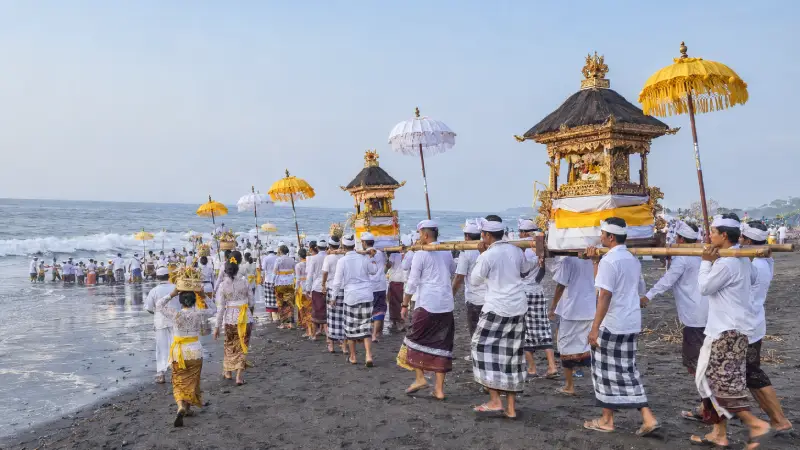
Before Nyepi, communities carry sacred temple objects to the sea, lakes or springs for purification. Melasti brings worshippers together around water, with processions and collective prayer forming part of the ceremony.
Visitors can observe from an appropriate public position, leaving space for worshippers and the objects they carry. Your accommodation can help identify a nearby ceremony and explain where spectators are welcome. Let the ceremony continue around you without stepping into the procession for a photograph.
Ogoh-ogoh are large, expressive figures representing Bhuta Kala, associated with negative or destructive forces. Their forms give local makers room for elaborate sculpture and dramatic movement as teams carry them through the streets.
The Ogoh-ogoh procession belongs to Pengerupukan, the day before Nyepi. Burning the figures is part of the tradition, although the exact sequence you see depends on the local event.
The quiet day centers on Catur Brata Penyepian: abstaining from work, travel, fire or light, and entertainment. Hindu observance can include meditation and other personal religious practices.
Visitors are expected to respect the conditions that make that observance possible. Staying within the property, lowering voices and keeping light from spilling outside are the practical essentials.
Ngembak Geni follows, with forgiveness and visits among family and neighbors. It is a gentle return to social life after the day of silence.
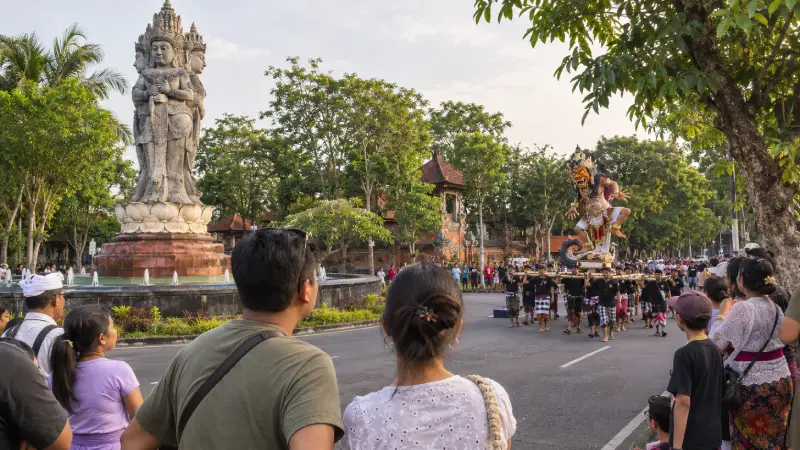
Central Denpasar is a useful starting point for a procession-focused visit. The Catur Muka statue and adjoining Puputan Badung area have been a gathering point for Ogoh-ogoh on Pengerupukan night. The 2027 route and traffic arrangements will determine the best place to stand.
If you are staying in Ubud, Sanur or another neighborhood, begin with the procession closest to your accommodation. Local viewing can make the evening much easier to organize, especially when you can return on foot along an agreed route.
Set your viewing plan and return journey together. Decide where you will meet your driver if access changes, or ask your hotel which walking route will remain practical. Keep children away from the moving carrying frames, leave room for participants and avoid standing where you block a junction. The broader advice on staying safe in Indonesia is useful for arranging transport and looking after belongings in crowds.
Denpasar’s Kasanga Festival is a separate organized showcase that can take place well before Nyepi eve. In 2026, it ran on 6–8 March, while the Pengerupukan processions took place on 18 March.
That distinction matters when choosing travel dates. A Kasanga Festival announcement refers to that festival’s program; the neighborhood processions on Nyepi eve follow their own arrangements. The 2027 Kasanga schedule has not yet been confirmed.
Nyepi is a religious observance across communities, with no single islandwide admission ticket. Hotel stays, guided outings and arranged transport are separate purchases.
If a seller offers an “Ogoh-ogoh experience,” look at the specific service: the procession location, transport, guide, meeting point and return arrangement. Any cancellation terms belong to that booking.
The most useful room is one that works for both halves of the experience: reaching a procession beforehand and spending a full quiet day comfortably afterward.
| Base | Why consider it? | What to arrange |
|---|---|---|
| Central Denpasar | A stay focused on the Catur Muka and Puputan Badung procession area | A practical return route and meals at your accommodation |
| Ubud | Local ceremonies combined with a stay in the surrounding area | Which procession is nearby, especially if your property is outside the center |
| Sanur | A base for a local celebration and a hotel-based Nyepi day | Meal inclusions and the property’s rules for facilities and outdoor areas |
Booking in Sanur or Ubud does not require a trip to central Denpasar. Staying close to the celebration you intend to watch can be more useful than choosing a hotel first and adding a long evening transfer later.
Hotels sometimes bundle Nyepi accommodation with meals. Viceroy Bali’s 7–9 March 2027 offer in Ubud includes the day’s breakfast, lunch and dinner. In Sanur, The Alantara’s Nyepi package covers a two-night stay with daily breakfast and lunch and dinner on 8 March for two guests.
Compare the actual inclusions with the number of people traveling. Children’s meals, dietary requirements and extra guests may need separate arrangements. Pool access, outdoor lighting and use of shared spaces also depend on the property’s Nyepi rules.
Private villas require a different preparation plan. Establish who will provide meals, whether staff will be available and which supplies you need to buy beforehand. Having a kitchen is useful only if you have arranged food and understand the property’s rules for using it.
Bali’s Ngurah Rai International Airport normally suspends regular commercial flights for Nyepi. Sea and road transport also stop during the observance, so keep 8 March free of transfers and hotel changes.
We would arrive on 6 March if the processions are a main reason for the trip. That gives you time to settle in and organize the following evening without combining an international arrival, hotel transfer and local event in one day.
Arriving on 7 March can still fit, but leave room for the journey from the airport before committing to an evening procession. Your airline’s operating flight and your transfer to the hotel are separate parts of that plan.
Departing on 9 March requires attention to the actual restart of both your flight or boat and the transport that takes you there. Arrange the hotel pickup around the operator’s confirmed service, rather than treating the end of the usual silence period as a universal departure time.
Indonesia’s official calendar places Eid al-Fitr public holidays on 10–11 March 2027, with collective leave on 9, 12 and 15 March. The religious dates remain subject to the Ministry of Religious Affairs’ determination.
If you are continuing to Java, Lombok or another island, consider that holiday period alongside Nyepi when booking the next leg. Giving yourself some flexibility after Bali makes the itinerary less dependent on the first available service.
Before departure, complete the separate checks for Indonesia entry requirements. Nyepi changes local transport and daily activity; your passport and entry preparations still need their own attention.

Stay within your accommodation throughout the observance. Beaches, streets and sightseeing trips are outside that boundary. Local community guards, known as pecalang, help maintain the quiet.
Inside the property, follow the hotel or villa’s instructions. Keep voices and personal entertainment low, use headphones and prevent bright room lights from shining outside. Curtains and subdued lighting can make a room comfortable while respecting neighboring homes.
Meals, reading, rest and quiet time together give the day its shape. Hotel facilities may be available under specific conditions, so use the property’s Nyepi arrangements when deciding what to plan.
Finish these practical tasks beforehand:
Arrange meals, drinking water and any dietary or children’s supplies.
Have the medication you need for the full stay; review Indonesia’s customs rules before bringing medication into the country.
Save your booking details and onward travel documents offline.
Keep the accommodation’s reception or assistance contact accessible.
Agree on your return plan before going out to the procession.
If you need urgent medical help during Nyepi, contact your accommodation for assistance arranging appropriate transport.
Previous Nyepi arrangements have included a suspension of mobile data while fixed internet remained available. The 2027 telecommunications instructions are still to be announced. Ask your accommodation about its own Wi-Fi arrangements and download anything essential before the quiet day.
Before the trip, compare the best eSIM for Indonesia while you still have time to choose a plan. Roafly’s Indonesia eSIM provides mobile data for tasks such as contacting your driver and accessing bookings before and after Nyepi. Plan the observance itself around offline access.
Saturday, 6 March: Arrive, check in and identify the nearby procession you want to watch. Settle meal arrangements and buy supplies. Melasti may fall earlier in the week, so extend your stay if witnessing it is a priority.
Sunday, 7 March: Keep the day flexible for local preparations and ceremonies. Attend an Ogoh-ogoh procession in the evening, following the community’s announced timing, then return to your accommodation.
Monday, 8 March: Spend Nyepi within the property. Rest, read, eat and enjoy a day without an excursion schedule.
Tuesday, 9 March: Resume your trip once local services reopen. Leave time for Ngembak Geni if you want to experience the day after Nyepi, or continue with an onward journey whose departure and transfer have been arranged.
This itinerary gives the procession and the quiet day equal space. Staying an additional night can make departure less dependent on services restarting that morning.
Yes. Visitors can eat within their accommodation. Arrange hotel meals or supplies in advance, since going out to shops and restaurants is not part of the day.
Pool access depends on the property’s rules and its surroundings. Ask about Nyepi specifically before booking if this matters to your stay; ordinary facilities listed on a hotel page do not establish the arrangements for that day.
Nyepi is a national public holiday, while Bali’s islandwide restrictions give it a distinct effect on travel. Hindu communities elsewhere also observe the occasion, but Bali’s visitor arrangements should not be applied to every Indonesian destination.
