

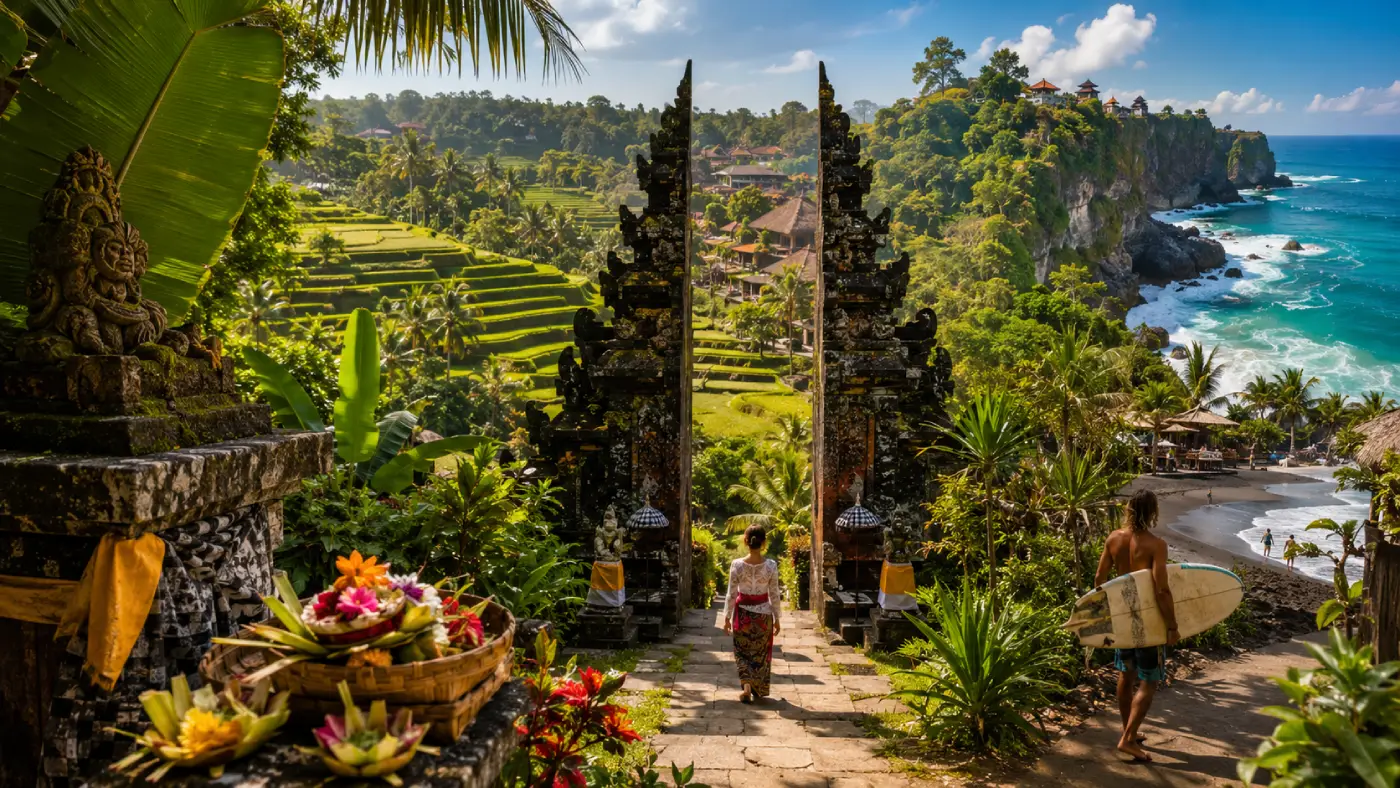

That range explains why Bali has outgrown the idea of a simple tropical holiday. Statistics Indonesia recorded nearly 6.95 million direct foreign arrivals to the province in 2025, an increase of 9.72% from the previous year. Yet popularity does not mean the experience works equally well for everyone.
Bali is worth visiting when the trip is built around the island that actually exists—not the frictionless paradise assembled from drone footage. Choose the right base, allow for slow roads, and look beyond the most photographed venues, and the hype starts to make sense.
Bali Became a Lifestyle, Not a Single Holiday
Beach tourism first placed Bali on international travel maps, but beaches no longer explain its reach. Surfers still come for breaks around Uluwatu, Canggu and the west coast. Couples book private villas and clifftop ceremonies. Families settle into Sanur or Nusa Dua, while yoga students, food-focused travelers and long-stay visitors build entirely different itineraries.
Few destinations package so many travel identities into a relatively compact island. Breakfast might be nasi campur from a roadside warung, followed by a massage, a coworking session, sunset surf and dinner at a polished restaurant serving ingredients from several continents. Bali can feel local, international, spiritual and highly commercial within a single afternoon.
Repeatability also drives its popularity. First-time visitors may divide a week between Ubud and the southern coast. Later trips move toward Amed, Sidemen, Munduk, Pemuteran or the offshore islands. Familiar infrastructure makes returning feel manageable, while another district supplies enough novelty to justify the flight.
Social media amplified particular corners, especially swings above rice fields, floating breakfasts and cliff-edge pools. It did not create Bali’s appeal. Long before short-form video, the island drew visitors through surfing, visual arts, dance, temple architecture and a distinctive Hindu culture embedded in everyday life.
Canggu, Ubud, Uluwatu and Sanur Are Different Trips
Calling Bali a single destination causes many of its worst planning mistakes. A traveler based in central Canggu experiences cafés, gyms, nightlife, construction and heavy traffic. Someone waking in Sidemen may hear roosters and irrigation channels instead of cocktail bars.
Even neighboring districts can produce different holidays. Berawa feels more developed and nightlife-oriented than parts of Pererenan. Central Ubud packs restaurants, markets and cultural sites into a busy core, while accommodation beyond town may sit beside forest, river valleys or rice fields.
| Area | Best for | Main trade-off |
|---|---|---|
| Canggu and Pererenan | Surf, cafés, fitness studios and social nightlife | Congestion, development and limited walkability |
| Ubud | Art, temples, wellness and inland scenery | Crowded center and slow transfers |
| Uluwatu and the Bukit Peninsula | Surf breaks, cliffs and dramatic sunsets | Steep beach access and spread-out attractions |
| Sanur | Families, calmer mornings and a beachfront promenade | Less late-night energy |
| Seminyak | Restaurants, shopping and established beach clubs | Dense development and higher tourist-area prices |
| Sidemen or Amed | Slower travel, rural scenery, snorkeling and diving | Longer journeys and fewer big-resort conveniences |
Canggu’s draw comes from the combination of surf culture and a dense hospitality economy. Batu Bolong, Berawa and Pererenan contain everything from Indonesian coffee shops to recovery studios and late-night venues. That convenience attracts solo travelers and long-stay visitors, but it also means the “quiet rice-field village” image is increasingly selective.
Ubud remains the strongest choice for travelers interested in Balinese art and inland landscapes. Museums, dance performances, temples and the Sacred Monkey Forest sit near restaurants and wellness businesses, although central roads can become intensely busy. Staying beyond the center changes the atmosphere considerably.
Uluwatu sells another Bali entirely. Roads cross the dry limestone Bukit Peninsula toward surf beaches, cliff clubs and Pura Luhur Uluwatu. Many coves require staircases rather than a casual walk from the hotel, and the area works better with planned transport than spontaneous wandering. Sanur, by contrast, appeals through gentler rhythms, sunrise views and its long coastal path.
Balinese Culture Is Not Holiday Decoration
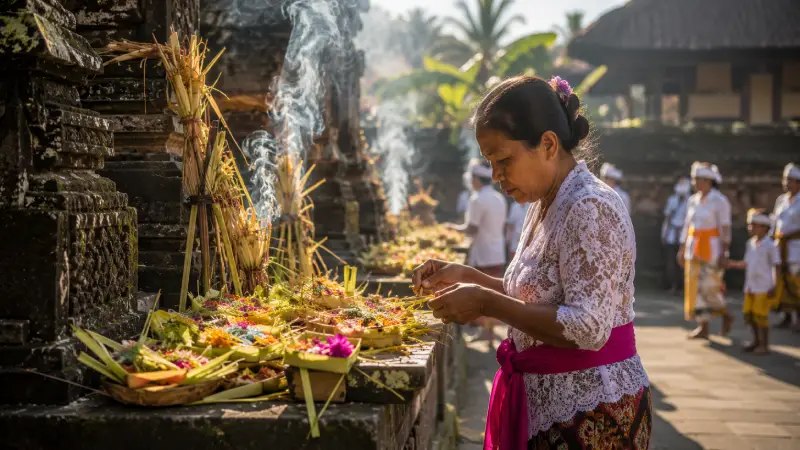
Bali’s visual language is so attractive that visitors sometimes mistake it for styling. Split gates, stone shrines, woven palm decorations and canang sari offerings are not props arranged for photographs. They belong to a living religious and community structure.
Small offerings appear outside homes, shops and restaurants each morning. Temple anniversaries, cremation ceremonies and village processions can redirect traffic or change opening schedules. Local banjar organizations remain central to community life, even in districts surrounded by villas and international businesses.
Rice terraces also carry more meaning than their appearance suggests. Bali’s subak system connects cooperative water management, farming communities and water temples. UNESCO describes the wider cultural landscape through the philosophy of Tri Hita Karana, which links spiritual life, human relationships and nature.
Respect becomes practical rather than abstract at sacred sites. Dress requirements matter, ceremonial areas may be restricted, and posing inappropriately around shrines can cause real offence. Bali’s official tourism guidance also tells foreign visitors to follow traffic laws, use authorized services, respect sacred symbols and avoid working without the correct permission. Indonesia Tourist Bans & Laws covers the broader rules visitors should understand.
Foreign tourists are also subject to Bali’s IDR 150,000 tourism levy, paid per person during a trip to the province. The provincial government administers the payment through the Love Bali system.
The Bali in Photos and the Island on the Ground
Online Bali is often empty. Real Bali contains delivery bikes, school traffic, ceremonies, building work, tour vans and travelers trying to reach the same sunset viewpoint.
Traffic changes the experience more than distance suggests. A route that looks short on a map may take much longer through the developed south, particularly around airport approaches and popular districts. Packing several coastal areas into day can turn a holiday into a sequence of car rides.
Beach expectations also need adjustment. Bali is not uniformly lined with calm, white sand. Canggu and much of the southwest have darker volcanic sand and surf conditions. Bukit beaches may be spectacular but involve steep steps, reefs, strong waves or limited shade. Sanur and parts of Nusa Dua suit gentler beach days better, though tides affect swimming depth.
Seasonal conditions matter. Indonesia’s wetter months generally fall around October to March, although timing and rainfall vary. West-coast beaches can also receive marine debris during wetter, windier periods; Bali’s provincial government organizes additional clean-up operations when seasonal waste reaches areas such as Kuta.
Cost creates another expectation gap. Bali can still be economical when eating at warungs, choosing simple guesthouses and limiting private transfers. Imported brunches, boutique fitness memberships, fashionable villas and beach-club spending belong to a different budget. “Affordable luxury” often means a polished setting costs less than in some global resort destinations—not that every polished experience is cheap.
Safety concerns are similarly uneven. Scooter crashes, poor road judgment, unsecured valuables and dishonest money-changing practices are more realistic worries than dramatic visions of island-wide danger. Is Indonesia Safe to Visit? Guide to Scams, Scooters & Bali gives these risks more context.
In Bali, Maps Matter More Than Distance
Bali has no island-wide rail system, and public transport does not connect visitor districts with the convenience many first-time travelers expect. Private drivers, taxis, ride-hailing services, hotel transfers and scooter rentals fill the gap.
Mobile data becomes useful almost immediately. Airport pickup points can be confusing, villas may sit down narrow lanes, and a driver may need a location pin rather than a street address. Maps also help with restaurant reservations, ferry information, weather checks, translation and messages to accommodation hosts.
Preparing a Roafly Indonesia eSIM before departure can reduce the number of tasks waiting after landing. It is particularly useful when arranging transport from the airport or contacting a host without relying on terminal Wi-Fi.
Need data in Indonesia? Get an eSIM!
Choose the perfect data plan for your trip
Who Will Love Bali—and Who May Prefer Somewhere Else
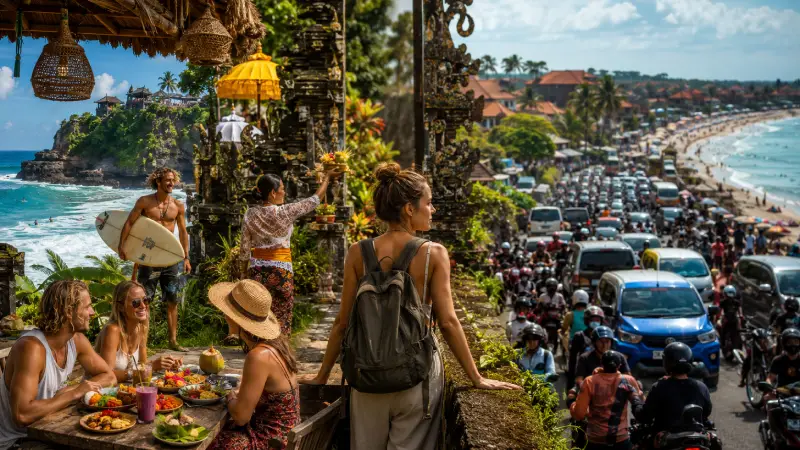
Bali works best for travelers who enjoy variety and are willing to trade some simplicity for it. Surf, culture, restaurants, wellness, nightlife and rural scenery can coexist within itinerary, but not always within neighborhood.
Bali may suit travelers who:
-
Want to combine beaches, culture and food rather than prioritize theme.
-
Prefer choosing from many accommodation styles and travel budgets.
-
Enjoy cafés and international dining alongside Indonesian food.
-
Can divide the trip between two or three bases.
-
Accept that popular areas will feel developed and busy.
Bali may disappoint travelers who:
-
Expect empty tropical beaches throughout the island.
-
Need reliable public transport and easy walkability.
-
Plan to cross between distant districts every day.
-
Dislike visible tourism development, nightlife or construction.
-
Treat the island mainly as a backdrop for photographs.
Beach purists may question the hype after staying in the wrong district. Culture-focused visitors may find Bali far more rewarding after leaving the southern resort belt. Neither reaction is necessarily wrong; each reflects a different slice of the island.
Bali FAQs
Is Bali worth visiting if I dislike crowds?
Yes, but location matters. Crowding is concentrated around the developed south, central Ubud and famous attractions at predictable times. Sidemen, Amed, Munduk, Pemuteran and parts of north or west Bali create slower trips, although reaching them takes longer.
Bali’s tourism office has argued that visitor pressure is unevenly distributed rather than identical across the whole province. That distinction matches the experience on the ground: central Canggu and rural Karangasem can feel like separate destinations.
How many days do you need in Bali?
Seven to ten days gives most first-time visitors enough room for two contrasting bases, such as Ubud with Sanur or Uluwatu. Four or five days works better when focused on region.
Changing hotels too frequently wastes time because transfers are slower than the map implies. A longer stay does not require circling the whole island; spending several days within district often produces a better trip than collecting distant landmarks.
Which part of Bali is best for first-time visitors?
Ubud suits travelers prioritizing culture, restaurants and inland scenery. Sanur is a gentler introduction for families or anyone who values a coastal promenade. Uluwatu fits surf and cliff scenery, while Canggu works for social travelers interested in cafés, fitness and nightlife.
No district represents Bali as a whole. Combining inland base with coastal base usually creates the clearest introduction.
When is the best time to visit Bali?
Dryer conditions usually occur from roughly April to October, with July and August among the busiest periods. Wetter months bring humidity, heavier showers and greener inland landscapes rather than guaranteed all-day rain.
Weather patterns can shift, so conditions should be checked close to departure. Best Time to Visit Indonesia explains how Bali’s pattern fits within Indonesia’s wider regional climate.
Is Bali still cheap?
Bali can be inexpensive, mid-range or very costly within the same neighborhood. Guesthouses, warung meals and simple beach days keep spending controlled. Private pool villas, destination restaurants, wellness treatments, drivers and beach clubs raise the total quickly.
Budget reputation becomes misleading when travelers copy luxury-focused itineraries from social media. Decide which indulgences matter before assuming the island itself will be cheap.
What should tourists arrange before arriving?
Check Indonesia’s current entry requirements for the passport being used, complete any required arrival forms, and understand the Bali tourism levy. Keep proof of travel when applicable and review restrictions on medication, alcohol, electronics and other controlled goods.
Indonesia Airport Customs Rules 2026: Alcohol Limits, IMEI Tax & Drugs covers common arrival questions. those formalities are handled, choosing the right base matters far more than collecting a long list of attractions.
