

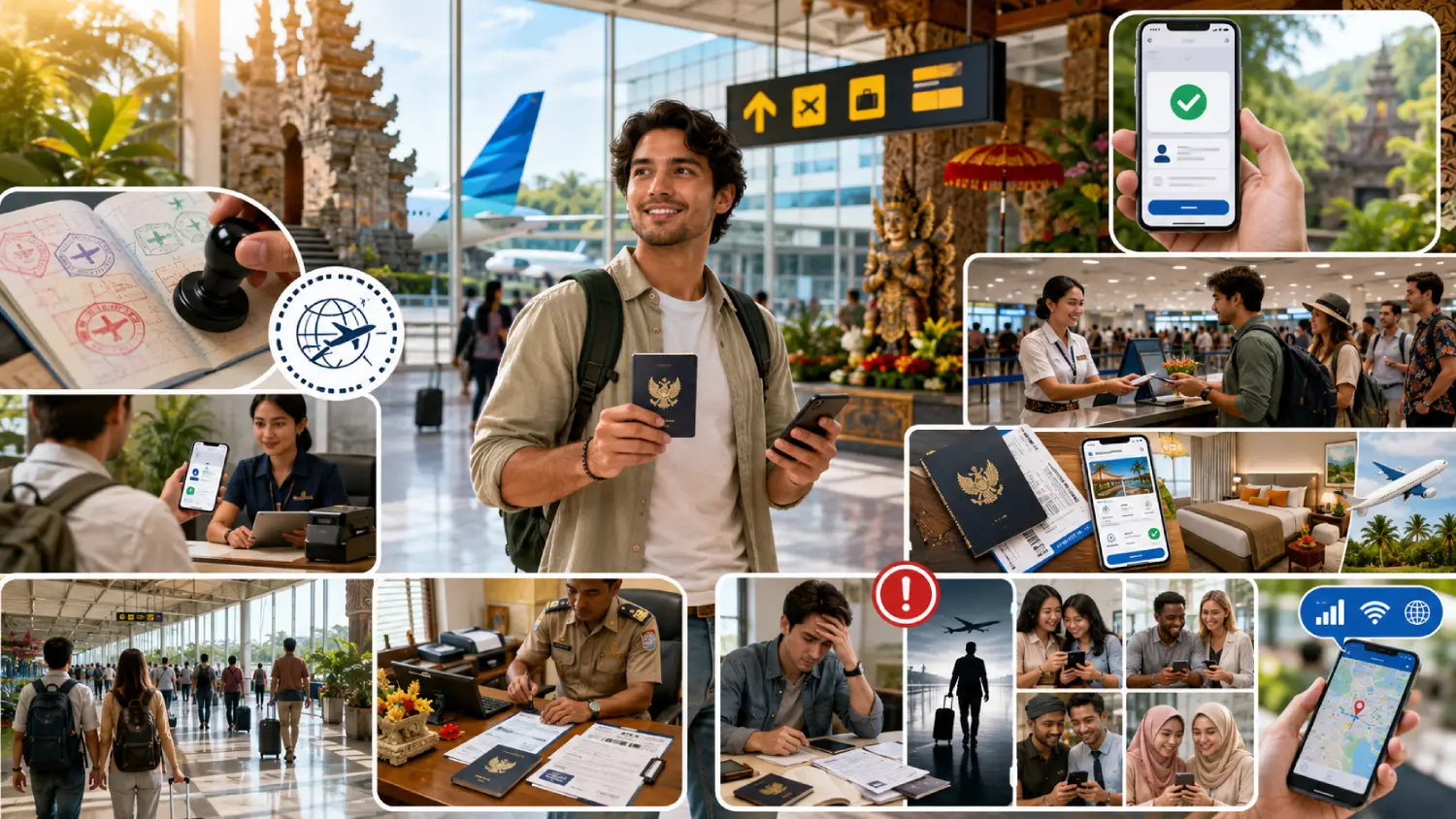

Visa exemption, Visa on Arrival, eVisa and the arrival card are different entry tools and should not be treated as interchangeable.
Rules depend on nationality, passport or travel document, purpose, residence and intended stay length. This guide covers tourism using ordinary passports; diplomatic, service and other special-passport arrangements may follow different bilateral rules.
Indonesia entry rules at a glance
| Passport situation | Main entry route | Initial stay | Main requirement |
|---|---|---|---|
| Passport appears on the visa-exemption list | Visa-free entry | Up to 30 days | Six months’ passport validity and or return travel |
| Passport appears on the VOA list | B1 Visa on Arrival or eVOA | Up to 30 days | Rp500,000 fee, eligible passport and or return ticket |
| VOA-eligible traveler who may need more time | B1 VOA or eVOA | 30 days, extendable | Apply for an extension before the first stay expires |
| Traveler outside the exemption and VOA groups | Advance visa, usually the C1 tourist visa | Up to 60 days initially | Approval before departure and required application documents |
| Passenger arriving at an airport or seaport | All Indonesia arrival card | Not a stay permission | Submit within the three-day period before arrival |
The table is a starting point. Check your exact nationality on Indonesia Immigration’s current exemption and Visa on Arrival lists, particularly before using a land crossing or less frequently used port.
Visa-free entry for Indonesia
Indonesia’s A1 tourist exemption permits eligible ordinary-passport holders to enter and remain for up to 30 days. There is no visa fee, but the stay cannot be extended or converted into another tourist stay permission.
The current positive exemption group is:
| Brazil | Brunei Darussalam | Cambodia | Colombia |
| Hong Kong SAR | Laos | Malaysia | Myanmar |
| Peru | Philippines | Singapore | Suriname |
| Thailand | Timor-Leste | Türkiye | Vietnam |
Brazilian and Turkish passport holders have been covered since July 3, 2025, while Peru is included in the current list effective from August 12, 2025. These are active arrangements, not future announcements.
Eligible visitors must hold a passport valid for at least six months, carry a return or ticket and enter through an authorized immigration checkpoint. Visa-free admission is suitable when the trip will definitely finish within 30 days.
Several exempt nationalities also appear on the VOA list. Travelers from those countries may choose the paid B1 VOA route instead when they expect to need a 30-day extension. Entering visa-free first and later deciding to extend does not work because the exemption itself is non-extendable.
Visa on Arrival and eVOA
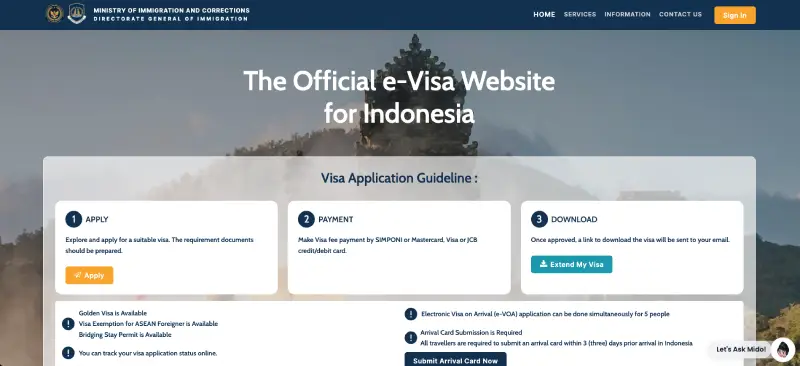
The B1 Visa on Arrival is available to passport holders from 97 countries and territories. It permits entry and an initial stay of up to 30 days, counted from the date of arrival.
An eVOA is the same B1 entry category purchased before travel. It is not a separate entitlement and does not expand the nationality list. Eligible travelers can apply through the official Indonesian eVisa portal or obtain a non-electronic VOA at a supported arrival checkpoint.
The current B1 fee is Rp500,000. An eVOA is valid for use within 90 days after issuance, but the permitted stay begins when the traveler enters Indonesia, not when the visa is approved.
Nationalities eligible for VOA and eVOA
| Group | Eligible passports |
|---|---|
| A–C | Albania, Andorra, Argentina, Armenia, Australia, Austria, Azerbaijan, Bahrain, Belarus, Belgium, Bosnia and Herzegovina, Brazil, Brunei Darussalam, Bulgaria, Cambodia, Canada, Chile, China, Colombia, Croatia, Cyprus, Czech Republic |
| D–K | Denmark, Ecuador, Egypt, Estonia, Finland, France, Germany, Greece, Guatemala, Hong Kong SAR, Hungary, Iceland, India, Ireland, Italy, Japan, Jordan, Kazakhstan, Kenya, Kuwait |
| L–R | Laos, Latvia, Liechtenstein, Lithuania, Luxembourg, Malaysia, Maldives, Malta, Mauritius, Mexico, Monaco, Mongolia, Morocco, Mozambique, Myanmar, Netherlands, New Zealand, Norway, Oman, Palestine, Papua New Guinea, Peru, Philippines, Poland, Portugal, Qatar, Romania, Russia, Rwanda |
| S–Z | Saudi Arabia, Serbia, Seychelles, Singapore, Slovakia, Slovenia, South Africa, South Korea, Spain, Suriname, Sweden, Switzerland, Taiwan, Tanzania, Thailand, Timor-Leste, Tunisia, Türkiye, Ukraine, United Arab Emirates, United Kingdom, United States, Uzbekistan, Vatican City, Venezuela, Vietnam |
Applicants need a passport valid for at least six months, a recent photograph and a return or ticket. The official B1 tourist VOA information also explains payment methods, eVOA validity and restrictions on paid activities.
Approval or issuance of an eVOA does not guarantee admission. Immigration officers retain authority to examine the passport, travel purpose and supporting documents at the border.
Who needs an advance tourist visa?
Ordinary-passport holders outside the published exemption and VOA groups generally need an appropriate visa before departure. The usual short-stay tourism route is the C1 single-entry tourist visa, although additional clearance procedures apply to certain calling-visa nationalities.
The C1 provides an initial stay of up to 60 days from arrival. It can be extended in Indonesia, subject to approval, until the total stay reaches a maximum of 180 days. The current initial government fee is Rp1,000,000.
The official C1 tourist visa page lists the principal application documents, including:
-
A national passport valid for at least six months
-
A recent color photograph
-
Bank statements covering the previous three months
-
Evidence of at least USD 2,000 in living expenses, held by the applicant or eligible sponsor
The C1 is an advance electronic visa, but “eVisa” describes how the application is submitted. It does not mean every application is automatically eligible or approved. Applicants should wait for the issued visa before traveling and ensure that the passport number, name and dates match the document they will present at the border.
Tourist status does not authorize employment or receiving payment from an Indonesian person or company. Longer-term remote-work arrangements belong under a separate immigration category; see Indonesia Remote Worker Visa: USD 60,000 Income for that topic.
All Indonesia arrival card
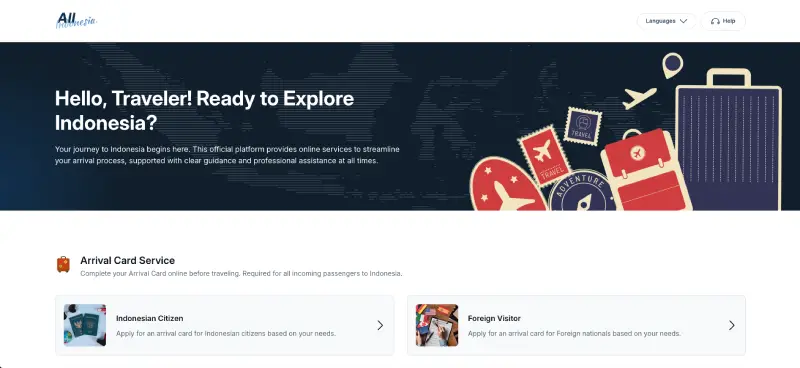
Since October 1, 2025, international passengers arriving through Indonesian airports and seaports have been required to submit their arrival declaration through All Indonesia.
The official All Indonesia portal accepts submissions during the three days before arrival. Travelers should save the resulting confirmation or QR code where it can be accessed offline.
All Indonesia combines information previously handled through separate immigration, customs, health and quarantine declarations. It remains an arrival form, not a visa, eVOA or permission to stay.
Customs questions concerning goods, alcohol, medicines, mobile-device registration and restricted items are covered separately in Indonesia Airport Customs Rules: Alcohol Limits, IMEI Tax & Drugs. Completing the declaration does not remove the duty to follow those rules.
The nationwide launch specifically covers international airports and seaports. Travelers planning to enter overland should check the procedures used by their intended border post rather than assuming every land crossing follows the same arrival-card process.
Passport and supporting-document requirements
For the principal A1, B1 and C1 tourist routes, a national passport generally needs at least six months’ remaining validity from arrival. Temporary passports, emergency passports and non-national travel documents can be treated differently; some may require 12 months’ validity or may be excluded from particular routes.
Keep these documents available during check-in and border inspection:
-
Passport used for the visa or eVOA application
-
Approved eVisa or eVOA, when applicable
-
All Indonesia submission confirmation
-
Return or ticket
-
Accommodation address and contact details
-
Evidence supporting the trip and available funds, where required by the visa category
Visa-free and B1 visitors are expressly required to have or return travel. C1 applicants must meet the financial-document requirements shown for that visa. Immigration may examine other evidence when assessing whether the proposed visit matches the entry category.
Do not assume a residence permit from another country changes the rule attached to your nationality. Residence can affect where or how an advance application is processed, but VOA and exemption eligibility are primarily determined by the passport presented.
Transit, airports and border type
Passengers who remain inside an airport’s international transit area, with baggage checked through and no need to pass immigration, normally do not make an Indonesian entry. The position changes when a connection requires baggage collection, immigration clearance, a landside terminal transfer, an overnight stay outside the transit area or check-in on a separate ticket.
VOA-eligible travelers who must cross immigration can use the B1 route for transit. Other passport holders may need an advance visa even when Indonesia is not their final destination.
Entry facilities are not automatically available at every airport, harbor or land post. The eVOA system publishes designated checkpoints, and operational arrangements can differ between air, sea and land entry. Confirm that the planned checkpoint supports your route before buying a ferry or overland ticket.
Domestic travel after the first Indonesian immigration checkpoint does not create a new international entry. For example, a traveler clearing immigration in Jakarta before a domestic flight to Bali uses the entry permission granted in Jakarta.
Extensions and overstay
Extension rights depend on the route used:
| Entry route | Extension position |
|---|---|
| A1 visa exemption | Not extendable |
| B1 VOA or eVOA | One extension, for a total stay of up to 60 days |
| C1 tourist visa | Multiple extensions may be possible, up to 180 days in total |
Submit an extension before the current permission expires. Since May 29, 2025, the process begins, but applicants are generally required to visit an immigration office for a photograph and interview, including travelers extending a VOA. The official extension-procedure announcement explains the in-person requirement.
Online submission alone should not be treated as an approved extension. Follow the instructions in the account, complete payment and attendance requirements, and retain proof that the application was lodged before expiry.
Short overstays can incur an immigration charge of Rp1,000,000 for each day. Overstays continuing beyond 60 days can lead to deportation and an entry ban rather than merely a daily charge. Anyone who has already missed the deadline should contact immigration promptly instead of relying on airport payment as a planned solution.
Common entry mistakes
Confusing visa-free entry with VOA: Both can provide 30 days, but B1 can normally be extended.
Applying through an unofficial website: Use Indonesia Immigration’s own eVisa domain. Third-party branding, search advertisements and lookalike pages can create extra fees or expose passport data.
Selecting eVOA without checking nationality: access does not make an ineligible passport eligible for B1.
Counting 30 days as a calendar month: The arrival date is part of the permitted stay. Check the stay-permit record rather than estimating by month names.
Submitting All Indonesia too early: The form is designed for the three-day period before arrival.
Assuming tourist permission covers work: Tourism status does not permit local employment, selling services or receiving Indonesian-source remuneration.
Treating Bali as a separate immigration system: Bali follows Indonesian visa and arrival rules. Local conduct and enforcement questions are discussed in Indonesia Tourist Bans & Laws: What Not To Do, while destination planning is covered in Is Bali Worth Visiting? Hype, Crowds and Reality.
Frequently asked questions
Do US citizens need a visa for Indonesia?
US ordinary-passport holders are not in the current tourist exemption group. They qualify for a B1 VOA or eVOA, providing an initial stay of up to 30 days with possible extension.
Do UK citizens need a visa for Indonesia?
UK ordinary-passport holders qualify for VOA and eVOA rather than visa-free tourist entry. The B1 fee is Rp500,000, and the initial 30-day stay may be extended.
Do Indian citizens qualify for Visa on Arrival?
Yes. Indian ordinary-passport holders appear on Indonesia’s B1 VOA and eVOA list. They should carry a passport with six months’ validity and a return or ticket.
Can Chinese passport holders use the eVOA?
Yes. Chinese ordinary-passport holders are in the B1 eligibility group and can obtain an eVOA before travel or a VOA at a supported checkpoint.
Do Turkish citizens need a visa?
Turkish ordinary-passport holders can enter visa-free for up to 30 days. That exemption cannot be extended. Türkiye also appears on the VOA list, so a traveler anticipating a longer visit may choose the paid B1 route and apply for extension.
Is the All Indonesia arrival card a visa?
No. It is a mandatory passenger declaration for airport and seaport arrivals. Travelers must still hold the exemption, VOA, eVOA or advance visa required by their passport.
Staying connected after arrival
Mobile data is useful for retrieving the All Indonesia confirmation, opening eVisa documents, contacting accommodation, using maps and managing transport bookings. How to Get Internet in Indonesia: SIM Cards, eSIM & Airport Prices compares the main connectivity options.
Roafly Indonesia eSIM can provide mobile data without changing the traveler’s visa, arrival-card obligations or eligibility for admission.