



The principal financial condition is verified annual income of at least USD 60,000. It does not authorize ordinary employment, local clients, or selling goods or services in Indonesia. Applications are available through Indonesia’s official electronic visa system.
Visa at a glance
| Status | Official Name | Remote Work Allowed | Financial Rule | Fee | Validity / Stay | Application Route |
|---|---|---|---|---|---|---|
| Operational dedicated remote-work residence visa | E33G Visa Rumah Kedua Pekerja Jarak Jauh | Yes, for duties performed for a company outside Indonesia | Annual income of at least USD 60,000 | IDR 7,000,000 government charge | One-year stay; multiple entry while the re-entry permit remains valid | Online through the official Indonesian eVisa system |
The Indonesian Directorate General of Immigration’s E33G page is the controlling program guide. The official visa-selection service also lists a remote-worker category, confirming that this is an application-ready route rather than an announced proposal.
Immigration describes the E33G as a limited-stay visa. Entry and re-entry are permitted while the associated re-entry permit remains valid. The visa should therefore not be confused with Indonesia’s tourist visas or visa-on-arrival arrangements.
Eligibility, work rights, and financial requirement

The E33G is designed for people who carry out assignments for a company established outside Indonesia. The applicant must provide an employment agreement with that overseas company.
The published financial threshold is annual income of at least USD 60,000. This is an income requirement, not a USD 60,000 savings or minimum-bank-balance rule. Applicants should be ready to show documentary evidence that the income is real, and connected to the qualifying overseas employment.
The permission is narrower than a general freelance or Indonesian work authorization. An E33G holder may perform the approved foreign-company duties while residing in Indonesia, but must not:
-
Take employment with an Indonesian employer.
-
receive pay from an Indonesian individual or company for local work;
-
sell goods or services in the Indonesian market;
-
perform activities outside the purpose of the residence permit; or
-
remain after the authorized stay expires.
This distinction is actively enforced. Indonesian immigration has described the E33G as being specifically for remote workers attached to companies outside the country.
The official wording is most clearly suited to employees. Independent freelancers serving several foreign clients should not assume that client contracts are equivalent to the required overseas-company employment agreement. They should obtain written confirmation from immigration before applying.
Required documents and how to apply
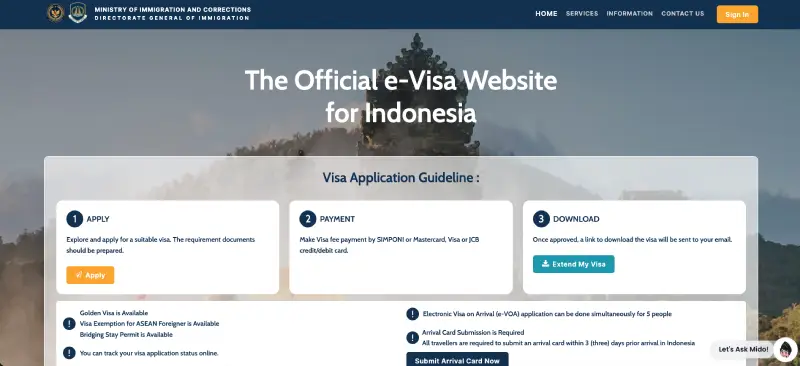
The official Indonesian eVisa portal is the application channel. The principal applicant can create an account and select the remote-worker residence category. A private visa agent is not the government application portal.
The official E33G checklist requires electronic copies of documents including:
-
A passport valid for at least six months.
-
A recent colour passport photograph.
-
Bank statements demonstrating living funds of at least USD 2,000 or the equivalent.
-
Proof of annual income of at least USD 60,000.
-
An employment agreement with a company established outside Indonesia.
-
Any additional declarations or supporting records requested through the application account.
The USD 2,000 living-funds evidence and USD 60,000 annual-income rule are separate requirements. The first concerns available funds; the second establishes eligibility as a qualifying remote worker.
The usual process is:
-
Create an account on the official eVisa website.
-
Choose the E33G remote-worker category and complete the application.
-
Upload the required passport, financial and employment documents.
-
Pay the government charge through the method shown in the portal.
-
Monitor the account for approval or requests for further evidence.
The visa must generally be used to enter Indonesia within 90 days of issuance. Official guidance does not publish a dependable universal processing time, so applicants should avoid making non-refundable arrangements until approval is issued.
Fees, validity, stay, extension, and renewal
The Directorate General of Immigration publishes a total government charge of IDR 7,000,000 for the-year E33G package. Its stated components are:
| Component | Official amount |
|---|---|
| Limited-stay visa | IDR 500,000 |
| Category II visa verification | IDR 2,000,000 |
| Limited stay permit for up to year | IDR 3,000,000 |
| Re-entry permit for up to year | IDR 1,500,000 |
| Total | IDR 7,000,000 |
These are government immigration charges. Payment-processing costs, professional assistance and document preparation are separate and should not be presented as official visa fees.
The permit authorizes a one-year stay. It also supports entry and exit while the re-entry authorization remains valid.
Current immigration guidance says the resulting limited stay permit can be extended through the eVisa system and may be converted to another qualifying residence status. That is an extension of the stay permit, not an extension of the original entry visa. Applicants should check the account-specific conditions and apply before the permit expires, because the official program page does not state a simple lifetime maximum or guarantee repeated approval.
Dependents, local work, and tax
Dependents
The public E33G page does not publish a complete dependent package covering eligible relationships, ages, additional financial thresholds and fees. Spouses or children should not be added informally to the principal applicant’s residence permission.
Family members may need an appropriate family limited-stay category based on the principal holder’s status. Confirm the correct category and supporting relationship documents directly through the eVisa system or immigration before filing.
Local work
The E33G does not replace an Indonesian work visa or employment authorization. Taking an Indonesian job, serving local clients or receiving local compensation can breach the permit conditions. A person planning to work for an Indonesian entity needs the immigration and employment permissions applicable to that activity.
Tax
Immigration permission and tax treatment are separate. Indonesia’s Directorate General of Taxes states that a foreign national may become an Indonesian domestic tax subject by residing in Indonesia, spending more than 183 days during a 12-month period, or demonstrating an intention to reside. A limited stay visa or permit lasting more than 183 days can help demonstrate that intention.
Residents may consequently face Indonesian reporting obligations involving Indonesian and foreign income, subject to detailed domestic rules and any applicable tax treaty. Obtain individual tax advice before relying on claims that foreign remote income is automatically exempt.
Practical remote-work conditions
Indonesia’s strongest remote-work infrastructure is concentrated in major cities and established tourism centres. Bali generally offers extensive coworking options and fixed broadband around Denpasar, Canggu, Ubud and the southern resort areas, although performance can vary by building and local provider. Jakarta usually offers the broadest business infrastructure, while Yogyakarta can suit people seeking a smaller urban base.
Power interruptions and weaker connections are more likely on smaller islands or outside major population centres. Before signing a longer lease, check the property’s actual fixed-line provider, mobile signal indoors and backup-power arrangements rather than relying solely on an advertised speed.
Prepaid Indonesia eSIM can be useful for maps, accommodation contact, verification messages and backup connectivity while arranging a local fixed or mobile service. See How to Get Internet in Indonesia: SIM Cards, eSIM & Airport Prices for connectivity options and airport pricing.
Need data in Indonesia? Get an eSIM!
Choose the perfect data plan for your trip

Manage your eSIM in the app
Install, top up and track data.
Living costs vary sharply by island, neighbourhood and season. Bali’s most popular areas can be considerably more expensive than regional cities, while Jakarta trades higher accommodation and transport costs for stronger corporate infrastructure. Is Bali Worth Visiting? Hype, Crowds and Reality gives additional context for deciding whether Bali fits a long stay.
Application checklist
-
Confirm that you work under an agreement with a company outside Indonesia.
-
Verify annual income of at least USD 60,000.
-
Prepare the passport, photograph, bank evidence and employment agreement.
-
Apply through the official eVisa system or a properly verified representative.
-
Budget for the IDR 7,000,000 government charge plus personal document costs.
-
Review Indonesian tax exposure before spending most of the year in the country.
FAQs
Is the E33G Indonesia’s digital nomad visa?
Yes. Immigration officially calls it the E33G Second Home Remote Worker Visa. It is a limited-stay route for carrying out duties for a company outside Indonesia, although “digital nomad visa” is not the precise official title.
Can freelancers apply?
The official requirement refers to an employment agreement with an overseas company. A freelancer relying on individual client contracts should obtain confirmation from Indonesian immigration rather than assuming that the category covers every form of self-employment.
Can I work for an Indonesian company on the E33G?
No. The E33G is for approved work connected to a company outside Indonesia. Indonesian employment or locally paid services require the appropriate work and immigration authorization.
Is USD 60,000 a savings requirement?
No. It is a minimum annual-income condition. Applicants must separately show at least USD 2,000 in living funds through the required financial evidence.
Can the-year permit be extended?
The current official E33G page says its limited stay permit can be extended. Approval is not automatic, and applicants should check the current extension requirements in their eVisa account before the permit expires.
Final assessment
Indonesia has a verified, operational remote-worker route rather than merely a proposed “Bali digital nomad visa.” The E33G is suitable for higher-earning foreign employees who can document at least USD 60,000 in annual income and continue working exclusively for an overseas company.
Its-year residence period, application and multiple-entry facility make it substantially more appropriate than using a tourist category for long-term remote work. The main limitations are equally important: the official rules centre on overseas-company employment, prohibit unauthorized local commercial activity and do not remove potential Indonesian tax obligations.
Rules checked on July 27, 2026. Immigration, tax and application requirements can change; confirm the linked official guidance and your responsible embassy before applying.