

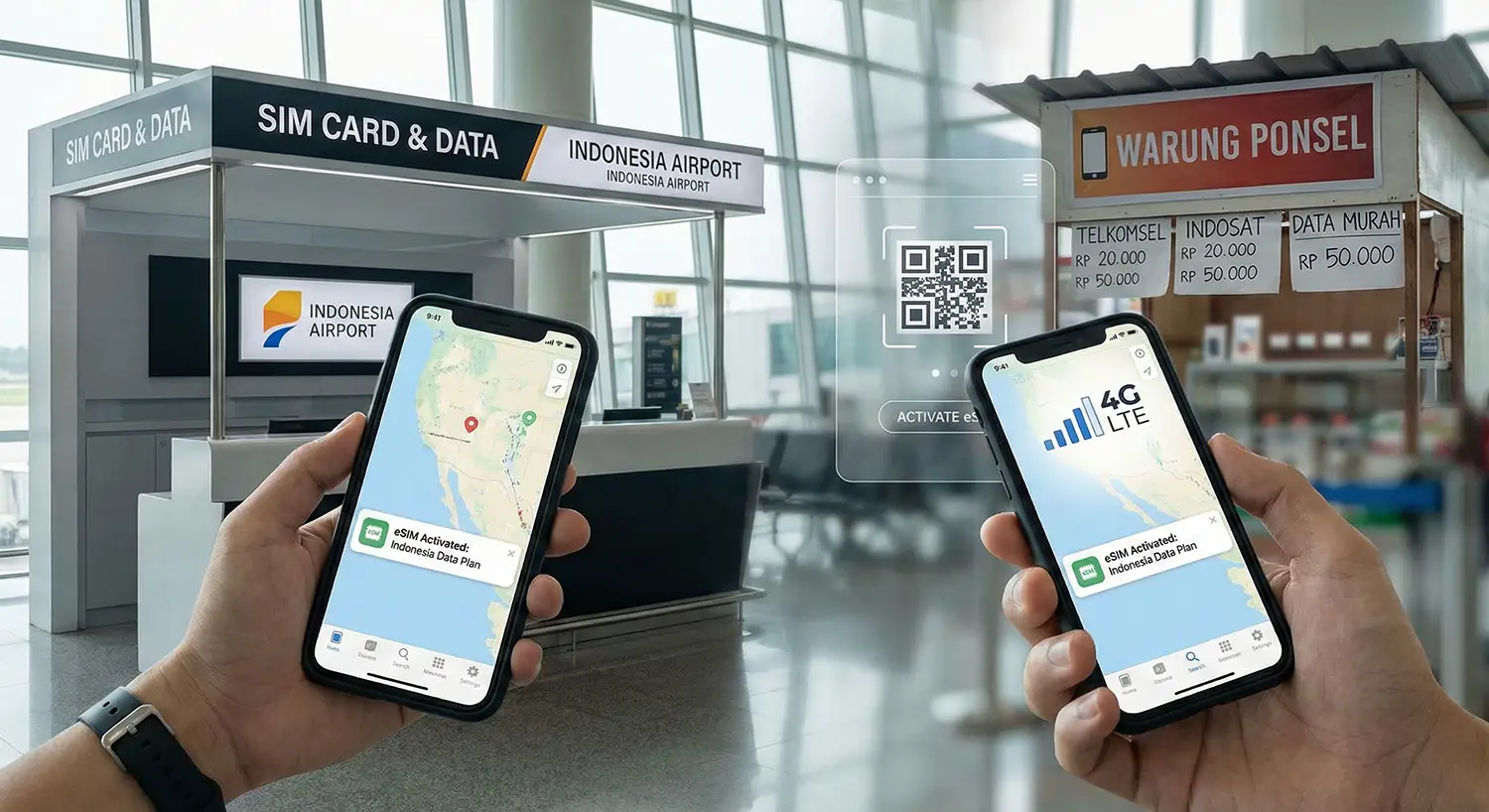

This guide breaks down the most practical ways to stay connected in Indonesia, from buying a SIM card after landing to using a digital eSIM before you arrive.
Internet Options for Travelers in Indonesia
Travelers in Indonesia generally rely on four main internet solutions. The right choice depends on how long you stay, where you travel, and whether you prefer convenience or lower costs. Below is a quick overview before exploring each option in detail.
-
Airport SIM Cards
Physical SIM cards sold at international airports. They offer instant connectivity after landing but come at a premium price compared to city purchases. -
Local Tourist SIM Cards
SIM cards bought from official operator stores or local mobile shops in cities. These provide the best value for money, with significantly more data at lower prices, but require in-person registration. -
eSIM (Digital SIM)
A fully digital SIM that installs directly on compatible phones. No physical SIM card, no store visits, and no airport queues. Ideal for travelers who want to be connected immediately upon arrival. -
Pocket WiFi Devices
Portable routers that create a personal WiFi hotspot. Commonly used by groups or travelers with multiple devices, though daily rental fees can add up quickly.
Each option has different trade-offs in terms of price, setup time, and flexibility. The sections below break down how each works in Indonesia, starting with airport SIM cards.
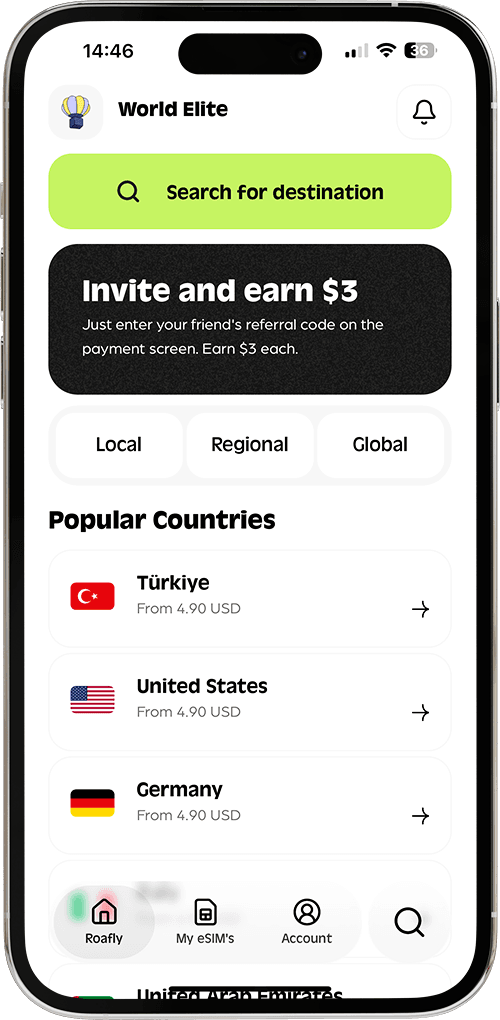
Need data in Indonesia? Get an eSIM!
Choose the perfect data plan for your trip

Manage your eSIM in the app
Install, top up and track data.
Buying a SIM Card at Indonesian Airports
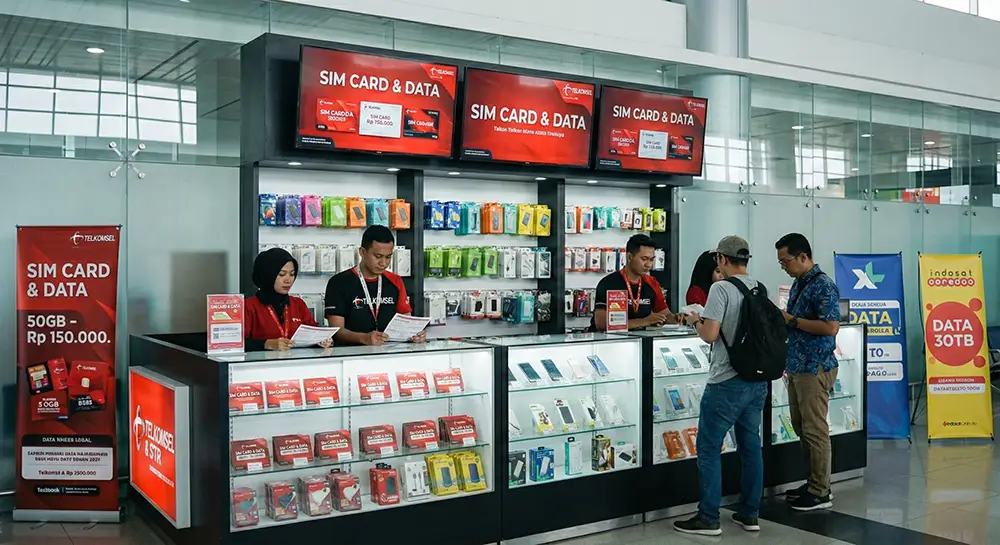
International airports such as Jakarta Soekarno-Hatta (CGK) and Bali Ngurah Rai (DPS) sell tourist SIM cards directly in the arrivals hall. These counters are easy to find and offer instant connectivity, but convenience comes at a cost.
Airport SIM cards are typically priced two to three times higher than city options. Registration is done on the spot using your passport, and queues can be long during peak arrival hours.
Airport SIM Prices in Indonesia
At major airports, current price ranges are:
-
8–14 GB data: 200,000–260,000 IDR (approximately $13–$17)
-
15–25 GB data: 300,000–400,000 IDR (approximately $19–$26)
-
Validity: usually up to 30 days
Some airport packages include limited local or international call minutes, but data is the main selling point. While these plans work well in cities and tourist areas, the high price makes them less attractive for longer stays.
Airport SIM cards make sense if you need immediate connectivity and plan to stay a short time.
Local Tourist SIM Cards: Best Value Option
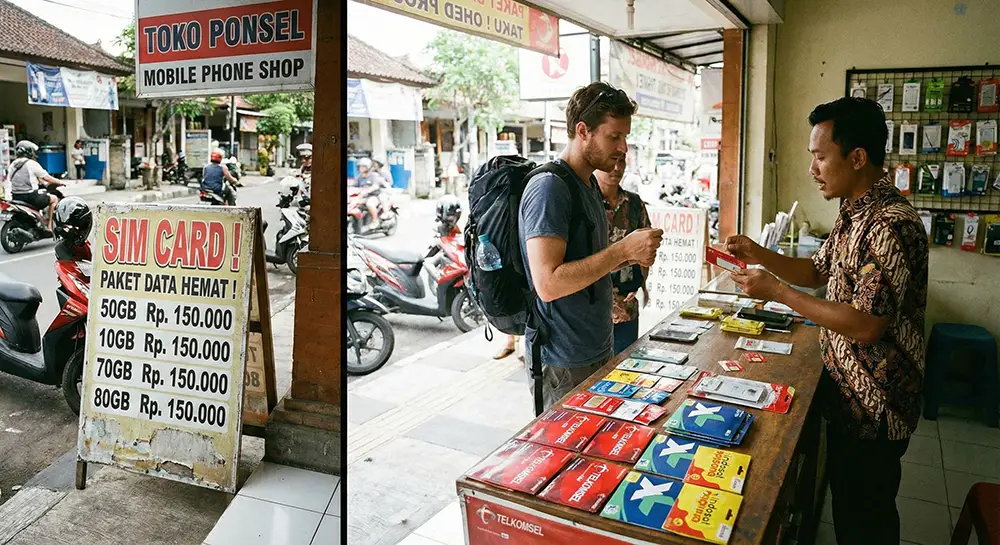
Buying a local SIM card in the city is the most cost-effective way to get internet in Indonesia. Official operator stores, convenience shops, and mobile kiosks are widely available in Jakarta, Bali, Yogyakarta, Lombok, and other destinations.
All local SIM cards require passport registration. Some stores may also register your device IMEI, especially for data-only plans. The process usually takes 5–10 minutes.
Local SIM Card Prices in Indonesia
Local prices are significantly cheaper than airport rates:
-
3–7 GB data: 30,000–50,000 IDR ($2–$3)
-
10–18 GB data: 50,000–70,000 IDR ($3–$5)
-
25–35 GB data: 80,000–100,000 IDR ($5–$7)
-
50–70 GB data: 115,000–140,000 IDR ($7–$9)
-
Validity: 30 days (some plans 15 days)
Starter SIM cards may cost as little as 10,000–25,000 IDR, with data added via top-ups. Data packages can be renewed easily through operator apps or USSD codes.
For travelers staying more than a few days, buying a local SIM card offers the best price-to-data ratio.
Using an eSIM in Indonesia
For travelers who prefer not to deal with physical SIM cards, eSIM is a modern and efficient alternative. eSIMs eliminate the need for store visits, passport registration queues, and SIM swapping.
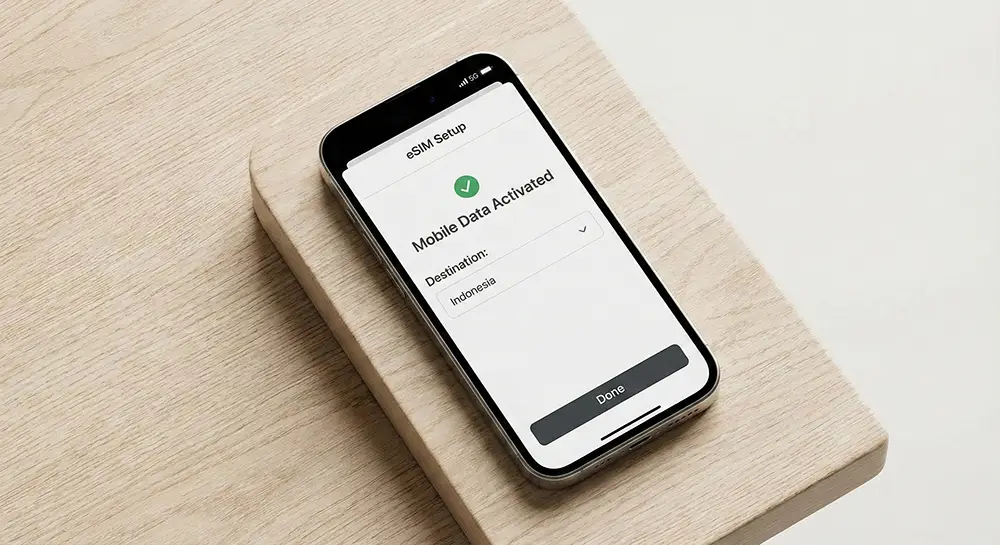
An eSIM works digitally and activates directly on your phone. This option is ideal for short trips, multi-country travel, or travelers who want internet access immediately after landing.
Roafly eSIM for Indonesia
Roafly offers Indonesia eSIM plans with flexible data options and simple activation. All prices are in USD, and plans are data-only.
Available Indonesia eSIM packages:
-
1 GB – 7 days: $3.90
-
3 GB – 30 days: $7.50
-
5 GB – 30 days: $9.90
-
10 GB – 30 days: $14.00
-
20 GB – 30 days: $20.00
-
50 GB – 30 days: $39.90
Need data in Indonesia? Get an eSIM!
Choose the perfect data plan for your trip
Manage your eSIM in the app
Install, top up and track data.
Roafly eSIMs connect to multiple major local networks in Indonesia, including Telkomsel and XL Axiata. Depending on your location, the eSIM automatically connects to the strongest available network, helping maintain stable coverage as you move between cities and islands. Installation is available via iOS direct install, QR code, or manual setup.
This option is especially useful if you are landing late at night, visiting multiple islands, or want to avoid local registration procedures. For a deeper comparison of data sizes and travel scenarios, you can also check the detailed best eSIM for Indonesia guide.
Pocket WiFi in Indonesia
Pocket WiFi devices provide internet access by creating a portable hotspot. These devices are commonly rented at airports or ordered before arrival.
Pocket WiFi Pros and Cons
Advantages
-
Can connect multiple devices
-
No phone compatibility issues
-
Useful for groups or families
Disadvantages
-
Daily rental fees
-
Requires charging and carrying an extra device
-
Loss or damage fees apply
-
Speed depends on network congestion
Typical rental prices range from $6–$12 per day, often with data caps or fair usage limits. Over a week-long trip, pocket WiFi can become more expensive than both local SIM cards and eSIM options.
Pocket WiFi is best suited for travelers carrying laptops or traveling as a group, but less practical for solo travelers.
Internet Coverage and Mobile Networks in Indonesia
Indonesia’s mobile network landscape is shaped by its geography. With over 17,000 islands, coverage quality can change quickly depending on where you travel. While major cities and tourist hubs are well covered, remote islands and rural areas rely heavily on the strength of the underlying operator.
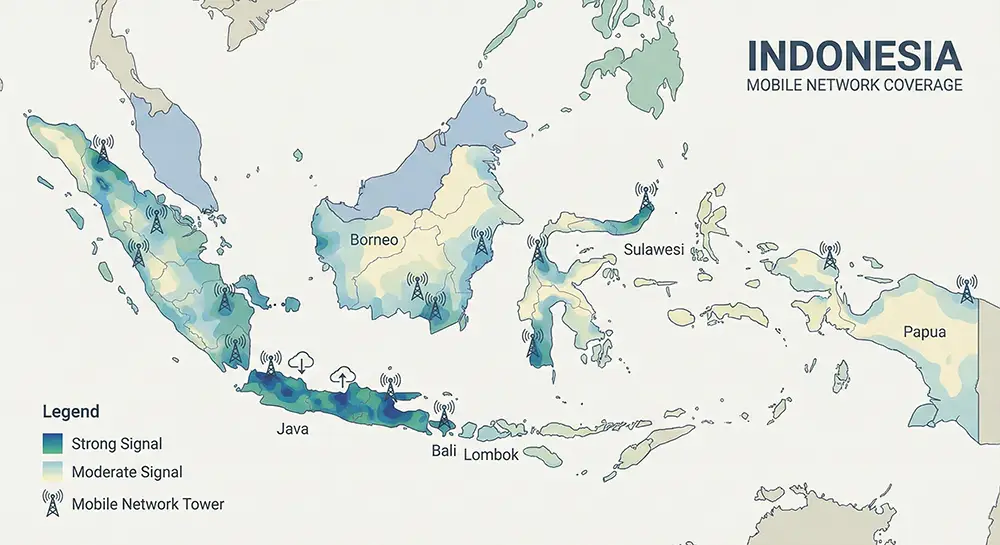
Understanding how each major network performs helps avoid slow speeds, signal drops, or complete loss of service during your trip.
Telkomsel Coverage
Telkomsel has the widest and most consistent coverage in Indonesia. It performs best outside major cities and is the most reliable option for travelers visiting multiple islands or less-developed regions.
You can expect strong and stable coverage in:
-
Jakarta, Bali, Surabaya, Yogyakarta
-
Lombok, Flores, Komodo area
-
Sumatra and Kalimantan main routes
-
Smaller islands and rural highways
Telkomsel is often the operator with usable signal in remote or sparsely populated areas. For island hopping, long road trips, or nature-focused travel, this network provides the highest reliability.
XL Axiata Coverage
XL Axiata performs very well in urban and tourist-heavy regions. It offers fast and stable 4G LTE speeds in cities and coastal destinations where most travelers spend their time.
XL Axiata coverage is strongest in:
-
Bali and surrounding islands
-
Jakarta metropolitan area
-
Java’s major cities
-
Popular beach and resort areas
In rural zones or during island crossings, coverage may drop faster compared to Telkomsel. However, for city-based travel and typical tourist routes, performance is generally smooth and consistent.
Indosat (IM3) Coverage
Indosat focuses primarily on urban affordability rather than nationwide reach. It works well in cities but is less reliable you move outside densely populated areas.
Indosat performs best in:
-
Central Jakarta
-
Major Java cities
-
Some urban parts of Bali
Coverage becomes limited in rural areas, smaller islands, and inland regions. It is suitable for travelers staying mostly in cities and not venturing far off main routes.
4G and 5G Availability
Across Indonesia, 4G LTE is the standard and widely available in cities, towns, and tourist destinations. Speeds are generally sufficient for navigation, messaging, video calls, and streaming.
5G coverage exists but remains limited to selected central areas of large cities. Travelers should not rely on 5G availability outside major urban zones.
Why Coverage Matters for Travelers
Indonesia is a destination where travel plans often change on the go. Ferry schedules, ride-hailing apps, maps, hotel communication, and payments all depend on a stable connection.
If your trip includes:
-
Island hopping
-
Long-distance road travel
-
Visiting less-touristy regions
then network consistency matters just as much as data speed. Choosing an internet option that can rely on strong local networks reduces connectivity issues and makes travel smoother from arrival to departure.
Which Internet Option Is Best for Indonesia?
The best choice depends on how long you stay, how much data you use, and how comfortable you are with local setup.
-
Short stays (1–7 days): eSIM offers instant connectivity and zero hassle
-
Longer trips (2+ weeks): Local SIM cards provide the best value
-
Group travel: Pocket WiFi may be convenient
-
Late-night arrivals: eSIM avoids airport queues
If you are planning activities that rely heavily on maps, ride apps, or social media, estimating your data usage beforehand can help avoid running out mid-trip.
Final Thoughts
Indonesia offers many ways to stay connected, from budget-friendly local SIM cards to flexible eSIM solutions and portable WiFi devices. Choosing the right option depends on your travel style, data needs, and convenience preferences.
Many travelers visiting Indonesia also continue to Thailand, and planning a Thailand eSIM in advance makes staying connected on the next leg of the trip much easier.