Download the App and manage your eSIMs easily
Create your order quickly
See your eSIM details
Track your remaining data
Download the App and manage your eSIMs easily
Create your order quickly
See your eSIM details
Track your remaining data
Plan your driving days around Türkiye’s regions, with practical advice on rental documents, HGS tolls, deposits and the costs behind the advertised rate.

Ethan Brooks
Updated Oct 2, 2026
10 min read
Save 15% on your Roafly eSIM
Stay connected on your next trip. Use the code below at checkout.
View All DestinationsJump to section
👇Save 15% on your Roafly eSIM
Stay connected on your next trip. Use the code below at checkout.
View All Destinations
Manage your eSIM in the app
Install, top up and track data.
Renting a car in Türkiye makes the most sense when your itinerary includes scattered beaches, archaeological sites, villages or rural accommodation. Istanbul sightseeing usually works better with public transport. If your holiday combines the city with Cappadocia or the coast, consider collecting a car when the regional part of your trip begins.
| Quick fact | What to know |
|---|---|
| Driving side | Drive on the right. |
| Rental timing | Compare a regional rental with keeping a car for the whole holiday. |
| Foreign licences | Foreign visitors can generally drive for up to six months; supporting-document requirements also matter. |
| Toll roads | HGS handles electronic tolls; your rental company’s billing terms determine additional charges. |
| Payment | Major suppliers commonly require a credit card in the main driver’s name. |
| Navigation | Download maps before travelling and use live road information for closures and traffic. |
Start with the places you want to reach each day. Moving between town centres presents a different transport problem from visiting several beaches or archaeological sites before returning to a rural hotel.
| Your trip | Our recommendation | Why |
|---|---|---|
| Istanbul’s historic centre and central neighbourhoods | Keep these days car-free | The T1 tram connects Sultanahmet, Eminönü and Karaköy, with connections to other public transport. |
| Cappadocia with independent sightseeing | Consider a short regional rental | You control the sequence and time spent at viewpoints, villages and underground cities. |
| Cappadocia with organised excursions | Compare tours before renting | Hotel-pickup tours can cover dispersed sights such as an underground city and Ihlara Valley. |
| A coastal trip with several bases and sightseeing stops | Renting becomes more useful | Your car carries the luggage and gives you flexibility between beaches, towns and historic sites. |
A holiday combining Istanbul and the Mediterranean does not necessarily need a continuous rental. Compare reaching the coastal region by flight or intercity transport, then collecting a car locally. Our guide to getting around Türkiye without a car covers those alternatives.
Your choice of base in Türkiye also changes the calculation. Central accommodation can make walking and occasional transfers practical; a countryside stay may make a car useful every day. Include parking arrangements when comparing hotels.
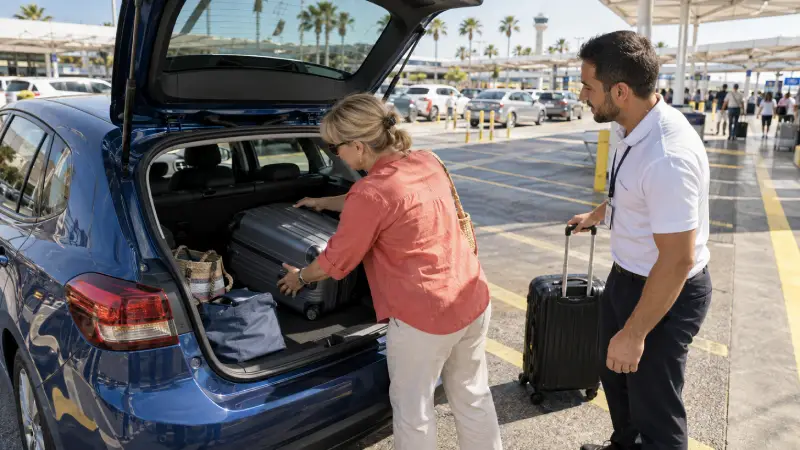
Match the collection point to the region you actually intend to explore:
Antalya: useful for an Antalya-based trip and journeys along the Mediterranean coast.
Dalaman: a practical starting point for the Fethiye area and nearby coastal touring.
İzmir: convenient for a western Aegean itinerary.
Bodrum: suited to a holiday focused on the peninsula and surrounding region.
Kayseri or Nevşehir: options for collecting a car for the Cappadocia portion of your trip.
In Istanbul, align collection and return with the correct airport. Choosing between IST and SAW affects the driving involved before your regional journey even begins.
Enterprise, Sixt and Hertz are among the suppliers to compare. Look at the actual rental company and collection branch, including whether collection is at a terminal desk, a nearby office or a shuttle-served location. A comparison platform may handle the reservation while a different company supplies the car.
Reserve an automatic explicitly if you need one. Select vehicle size around passengers, luggage and planned road surfaces; an SUV badge alone tells you little about permitted use on rough tracks.
Get the total for returning to another location before committing to a route. If your plans include a ferry or international border, obtain the supplier’s written permission for that itinerary.
Foreign visitors can generally use a valid foreign driving licence in Türkiye for up to six months after entry. The issuing country, licence format and supporting documents still matter.
British licence holders need a 1968 International Driving Permit or a UK licence notarised in Turkish. The UK-licence requirements for Türkiye specifically distinguish the 1968 permit from the older 1949 version. Carry the original driving licence alongside an IDP.
Other licence holders should establish the applicable IDP or translation requirement for their issuing country before booking. A rental desk’s willingness to release a car does not settle every legal document requirement.
Have these ready for collection:
Your original, valid driving licence.
Any required IDP or accepted translation.
Your passport and evidence of your entry date.
The booking confirmation.
An accepted payment card with sufficient available credit for the required hold.
Supplier eligibility is separate from legal driving permission. Enterprise’s specified economy groups start at age 21 with at least one year of licence history; Sixt’s economy groups require age 21 and at least two years. These examples were checked on 1 October 2026; other vehicle groups have different thresholds.
Arrange your mobile internet in Türkiye before travelling so you can retrieve booking details and contact the collection office. Keep an offline copy of the confirmation too.
Compare quotes for the same dates, collection location, transmission, mileage allowance and included protection. Then separate the amount you will spend from the credit you need available.
| Item | What it means |
|---|---|
| Rental charge | The price of using the vehicle under the booked terms. |
| Deposit or card hold | Funds or credit reserved against potential charges; release depends on the contract and banking process. |
| Damage excess | The amount you may remain responsible for under the applicable damage protection. |
The deposit and damage excess can be different amounts. Buying extra protection may reduce damage liability while leaving a card-hold requirement in place.
Before paying, get the rental total, deposit amount and excess separately in writing. Establish whether the supplier accepts your particular card, especially if you intend to use a debit or virtual card. Prepaying a reservation does not necessarily remove collection-day card requirements.
Build your budget from:
Rental charge and compulsory fees.
Fuel, parking, tolls and toll-service charges.
Any one-way return fee.
Selected extras, such as an additional driver or child seat.
Potential excess-mileage charges.
Leave enough usable credit for accommodation and other payments during your Türkiye trip, in addition to the vehicle hold.
Collision Damage Waiver, often shortened to CDW, can leave an excess and exclusions. Ask specifically about glass, tyres, parking damage and roadside assistance. If protection comes from a booking platform, establish whether it reduces the supplier’s liability charge directly or reimburses you after you have paid.
Every person who will drive should be included in the agreement. Unauthorised drivers and use outside the permitted conditions can affect protection.
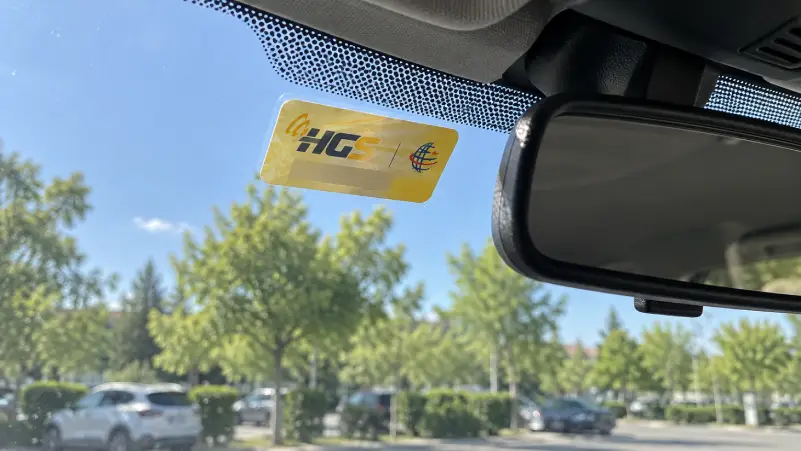
HGS is Türkiye’s electronic toll system. With a supplier-managed rental, the company handles the vehicle’s toll arrangements and bills you under its rental terms.
At collection, establish:
Whether the car’s HGS arrangement is active.
How toll charges will be collected.
Which service or administration fee applies.
Whether further charges can arrive after return.
The service fee matters. Enterprise’s agreement uses a percentage-based HGS service charge, while Sixt lists a separate charge per rental. Include your supplier’s current fee when comparing the total cost.
Follow the company’s payment instructions rather than setting up a second payment arrangement independently. Keep the final toll breakdown with your rental records.
Parking deserves its own budget, particularly if you keep a vehicle during city days. Ask the hotel whether parking is included, where the entrance is and whether vehicle access is restricted at particular times. Use signed parking areas and retain payment receipts.
Keep the agreement, return record and relevant receipts until outstanding tolls or other charges have been settled.
Türkiye drives on the right. Follow local signs and lane markings, and leave enough space to respond to turning vehicles, pedestrians and changing traffic conditions.
These are the standard limits for passenger cars where no different limit is posted:
| Road category | Standard limit |
|---|---|
| Built-up areas | 50 km/h |
| Two-way roads outside built-up areas | 90 km/h |
| Divided roads outside built-up areas | 110 km/h |
| KGM-operated motorways | 130 km/h |
| Build-operate-transfer motorways | 140 km/h |
The official speed-limit table distinguishes vehicle and road categories. Posted restrictions take priority, and conditions may require a much lower speed.
You cannot generally turn right on red. Stop unless a specific signal or instruction permits the movement. Where a separate arrow controls your turn, follow that arrow.
At unsigned junctions where the approaches have equal priority, give way to motor vehicles approaching from your right. Vehicles joining from a side road must yield to traffic on the main road.
At roundabouts, give way to vehicles already circulating unless signals or other controls direct traffic differently. Follow lane arrows, avoid unnecessary lane changes and signal right before leaving.
Everyone should use the appropriate restraint. Reserve a child seat suited to the child’s size before collection and allow time to fit it correctly.
The legal alcohol threshold is 0.50 per mille for private passenger cars, with a lower threshold for other vehicle categories. Keep driving days alcohol-free: alcohol-related breaches can also affect rental protection.
Set your navigation before moving. Let a passenger handle messages, or stop somewhere suitable before using the phone.
Plan coastal driving days around the visits you want to make. A sequence of beach stops, archaeological sites and town visits involves parking and walking as well as time behind the wheel.
Daylight arrival is useful for unfamiliar rural accommodation, particularly when the final approach differs from the main road. Ask the property for its recommended entrance or access route if the map offers an unexpected shortcut.
Season also changes the vehicle preparation. A winter visit to Cappadocia or mountain areas needs different planning from a summer coastal holiday; use our guide to Türkiye’s travel seasons when choosing dates and regions.
The national winter-tyre period for covered commercial intercity passenger and goods transport runs from 15 November to 15 April. Local decisions can affect requirements. For a private rental on cold or snowy routes, arrange suitable tyres and equipment with the supplier rather than relying only on the legal minimum.
Download the relevant Google Maps areas before departure, covering the entire route. Offline driving directions can work within the downloaded area, but live traffic information and alternative routes require connectivity.
Use KGM’s road-closure information for affected roads, and follow local closures even when an app continues to display a route.
Roafly’s Türkiye eSIM provides mobile data for live maps and online messages. It is data-only, so retain a suitable voice-call option for support numbers that require an ordinary phone call.
Longer regional trips make plan validity, data allowance and listed networks useful comparison points. Our best eSIMs for Türkiye guide covers those choices. The broader Türkiye travel-app guide also covers tools for the parts of your holiday spent outside the car.
Before leaving the collection point:
Photograph the bodywork, wheels, windscreen, interior, fuel level and mileage.
Have existing damage recorded on the handover document.
Locate the fuel type, assistance contact and required safety equipment.
Fit any child seat and set up navigation while parked.
Save the exact return address, office hours and after-hours procedure.
Before handing the car back:
Refuel according to the agreed policy and retain the receipt.
Photograph the vehicle, fuel gauge and mileage again.
Obtain a return record or follow the documented unattended-return procedure.
Remove belongings and clear paired-phone or navigation data.
Retain the paperwork while the deposit release and any final toll charges are processed.
