

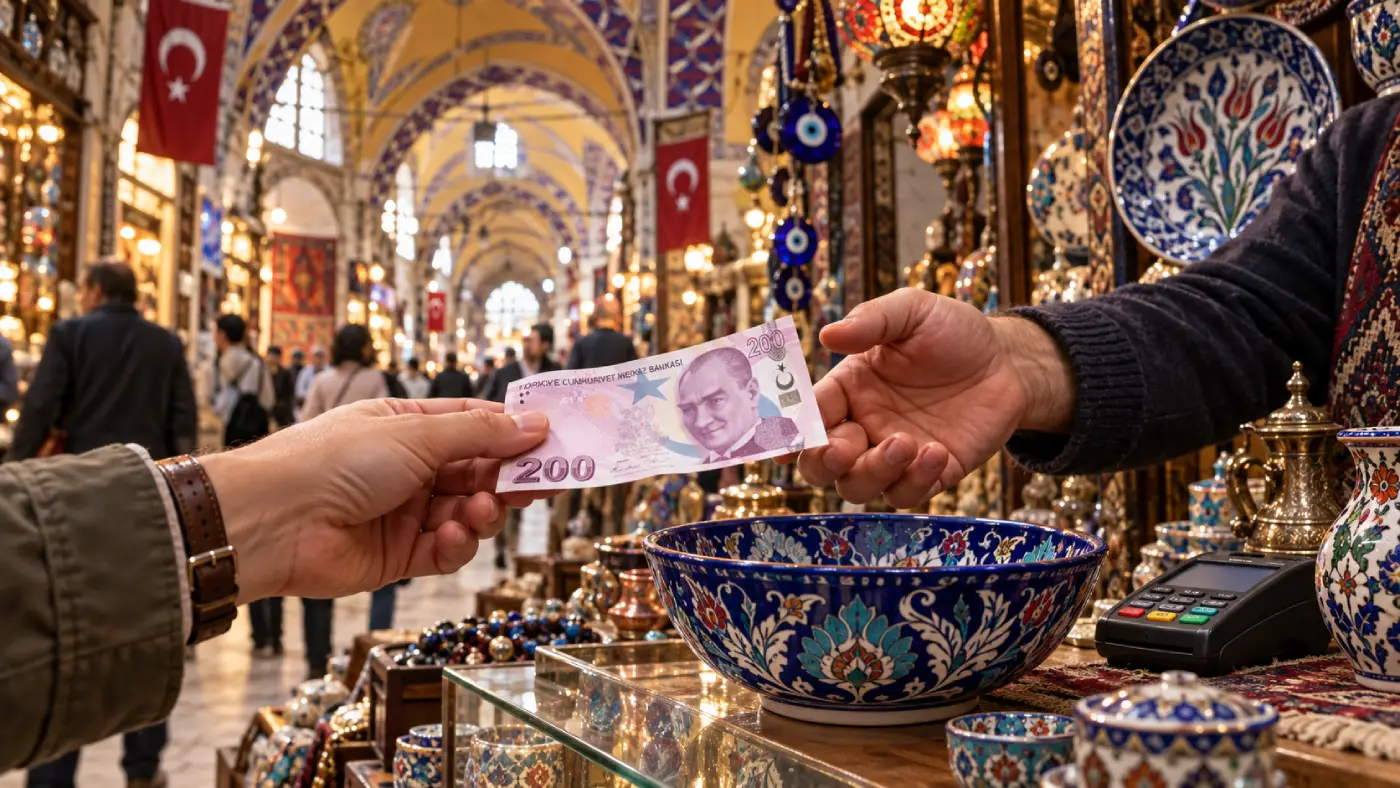

Türkiye’s cities and tourist areas are generally convenient for card payments, but small shops, market purchases and some local transport still make cash useful. Bring a physical card you can use abroad, keep another payment method separately and carry Turkish lira for the parts of your trip where card acceptance is less predictable.
The biggest avoidable cost can appear on a perfectly ordinary payment screen: an offer to charge you in your home currency. On a purchase priced in lira, paying in TRY lets your card’s normal conversion arrangements apply instead of accepting the merchant’s conversion offer.
Cash or Card in Türkiye?
Use a card for purchases where the business accepts your card network, and keep cash for smaller transactions and places with fewer payment options. Visa and Mastercard are practical cards to bring, although the individual merchant and your issuing bank still determine whether a transaction goes through.
| Where you are paying | Practical approach |
|---|---|
| Hotels, supermarkets and larger shops | Start with your card; read the amount and currency before approving. |
| Restaurants and cafés | Card payment is common, but ask before ordering in a small establishment. |
| Market stalls and small independent shops | Carry TL and establish the payment method before agreeing a purchase. |
| Taxis | Agree on cash or card before the journey starts. |
| Local transport | Use the ticket, transport card or payment method accepted by that operator. |
| Rural stops and smaller villages | Bring enough cash for planned purchases rather than relying on finding a working terminal. |
Keep some smaller notes available. They make modest purchases and an optional cash tip easier without using a large banknote for every transaction.
Turkish Lira, Euros or Dollars?
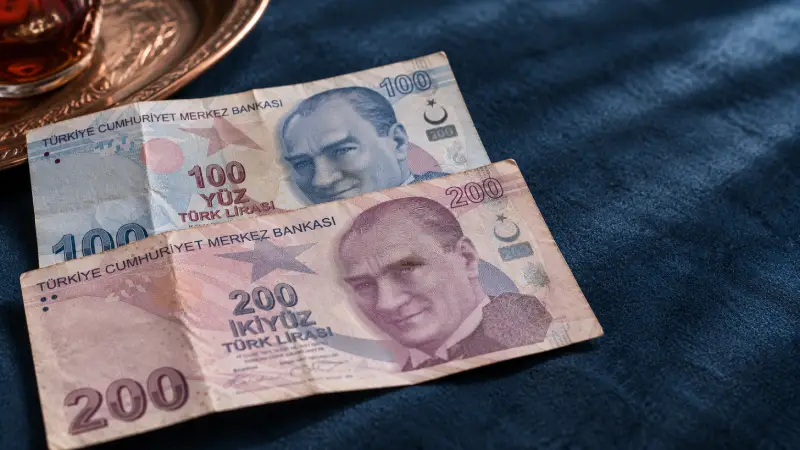
The local currency is the Turkish lira, shown as TRY, TL or ₺. Plan ordinary spending around lira rather than expecting euros, dollars or pounds to work as a general payment method.
If a hotel, tour or shop offers a price in euros, establish the actual payment currency before agreeing. Paying an agreed euro price is different from accepting a card terminal’s offer to convert a lira bill into euros. In the first case, the service was priced in euros; in the second, you are being offered a separate currency-conversion service.
Similarly, handing over foreign cash introduces an exchange calculation. Ask for the total in the currency you will give the business and how any change will be returned. Comparing that total with the TL price is more useful than assuming a familiar currency will be cheaper.
There is no universal best currency to bring for exchange. Compare what you would spend obtaining that currency at home with what you expect to receive in lira; buying an intermediate currency can add another conversion.
Using ATMs Without Confusing the Fees
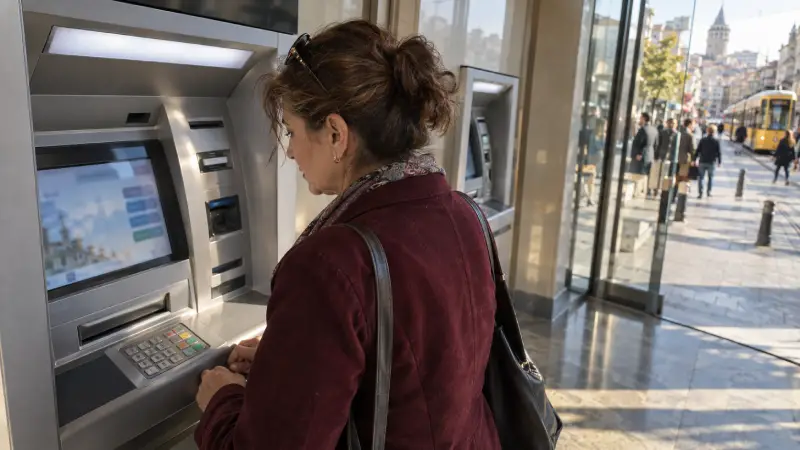
Bank ATMs provide a practical way to obtain lira with a compatible foreign card. İşbank, for example, accepts major international card networks and offers English-language menus. That establishes an available withdrawal option, not a promise that your withdrawal will be free.
Three separate costs matter:
-
The ATM operator’s charge. Read any fee shown before confirming. You can cancel if the offered cost is unacceptable.
-
Your card issuer’s charges. Your bank may charge for overseas withdrawals or currency conversion. Credit-card cash withdrawals can also have different terms from purchases.
-
The exchange arrangement. The ATM may offer to convert the withdrawal into your home currency, known as dynamic currency conversion, or DCC.
Declining DCC does not remove an ATM fee or your bank’s fees. It rejects the machine’s currency-conversion offer. Your card’s usual exchange-rate and fee arrangements then remain relevant.
What to select on the screen
Insert your physical card, select your language, enter your PIN and request a withdrawal in Turkish lira. Read the fee information and any conversion offer separately. If offered a choice between an ATM conversion and being charged in TRY, select TRY or the option to continue without the ATM’s conversion.
Screen wording varies, so follow the currencies and amounts rather than a memorised button colour. Under Visa’s currency-conversion rules, the conversion offer should disclose the rate and extra charges, and the decision belongs to you.
Withdrawal limits can depend on your card and the machine. Avoid planning around a supposedly universal daily limit or an old list of “free ATMs.” Comparing the actual offer for your card is more reliable.
Fewer withdrawals may reduce repeated fixed fees, but withdrawing more does not eliminate a percentage-based charge. Balance the fee saving against carrying more cash than you need.
Where to Exchange Money
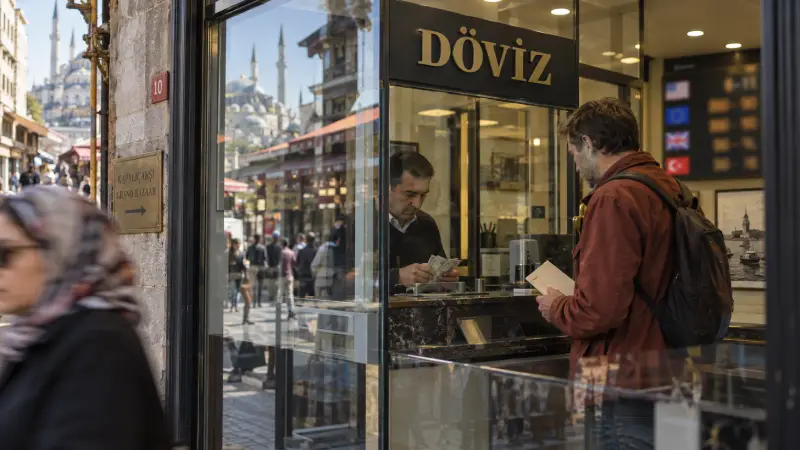
Currency-exchange offices, commonly called döviz bürosu, offer another way to obtain lira. Compare the net TL you will receive for the same amount of foreign cash, including any commission. “No commission” alone says little about the exchange rate.
If you are handing over euros or dollars, the exchange office is buying that currency from you. On a board displaying both buying and selling rates, the relevant side is the buying rate, often labelled alış. Ask for the final amount before handing over your money and retain the receipt.
Airport or hotel exchange can be convenient, but convenience does not establish a competitive rate. If you need cash immediately after landing, exchanging enough for your immediate needs gives you time to compare other options later.
The ATM-versus-exchange decision depends on your own costs. Someone paying a substantial overseas withdrawal fee may reach a different answer from someone whose card reimburses it. Compare the total cost of obtaining the same amount of lira, rather than choosing a method simply because another traveller found it cheaper.
Apple Pay, Google Wallet and Payment Apps
Already have a supported foreign card in Apple Pay or Google Wallet? Compatible contactless terminals can provide a way to use it in Türkiye. The key conditions are your card’s eligibility, the merchant’s acceptance of its network and a terminal enabled for the relevant contactless payment.
Türkiye’s absence from Apple’s list of locally supported markets should not be read as proof that every visitor’s foreign wallet will fail. Apple’s in-store acceptance requirements distinguish supported cards and payment networks from terminal compatibility. This is why local card enrolment and using an existing foreign card need to be considered separately.
Set up and verify your wallet before departure, while you can easily receive your bank’s security messages. Keep your physical card and PIN available if a phone payment fails. Your bank’s overseas charges still apply when the underlying card is used through a wallet.
Mobile data is useful for banking apps, payment approvals and contacting your card issuer; it is a separate consideration from whether an NFC terminal accepts your wallet. Compare eSIM options for Türkiye before departure if you want a travel data connection for those tasks.
Do you need a Turkish payment app?
Ordinary purchases can be organised around your existing cards and cash. Downloading a local app does not establish that a short-term visitor can complete its registration or fund an account with a foreign card.
İstanbul Senin illustrates the distinction: full registration for foreign users uses a Turkish foreigner identity number beginning with 99. That is a different requirement from simply holding a foreign passport. Physical transport tickets and cards remain useful alternatives to relying on a resident-oriented app account.
PayPal is also unsuitable as your main method for paying local businesses. Turkish merchants cannot receive PayPal payments into Türkiye-based accounts. A foreign PayPal account should not be treated as a substitute for carrying a usable bank card.
Paying for Transport
In Istanbul, a physical İstanbulkart is a practical way to pay on Metro Istanbul services. You can obtain and reload the card at station Biletmatik machines. Buying the physical card is a different task from opening an app account or registering for additional financial features.
Where a service offers direct bank-card payment, use the fare and conditions for that method. Do not assume it has the same price, transfer benefits or refund rules as a transport card. Airport shuttles, urban rail, ferries and local minibuses should be treated as separate payment decisions.
Before entering a taxi, tell the driver whether you intend to pay by card. Keep enough lira available if you agree to a cash journey, and read the terminal amount before approving a card payment. Our guide to getting around Türkiye explains the wider choice between taxis, public transport and intercity travel.
Restaurant Bills, Service Charges and Tips
Tipping is voluntary. Türkiye’s restaurant billing rules changed in January 2026, so older advice about automatically added service charges needs particular care.
The 30 January 2026 service-charge change prohibits restaurants, cafés, patisseries and similar food-and-drink businesses from demanding additional compulsory service, table or couvert charges. Listing such a charge on the menu does not make it permissible under that change.
The distinction also matters for food placed on the table before you order: the rule says businesses cannot charge for unsolicited pre-meal couvert items. Food you actually request remains part of your order.
Read the itemised bill, query an unexpected charge and decide separately whether you want to leave a tip. You do not need to apply a fixed percentage to every meal or drink.
If a bill or payment amount is disputed, keep the receipt and transaction record. Our guide to taxi and bill scams in Türkiye covers situations where the problem goes beyond an ordinary billing mistake.
How Much Cash Should You Carry—and What If Your Card Fails?
Work out your cash needs from your itinerary. An urban stay with accommodation already paid and mostly card-accepting businesses calls for a different reserve from a day visiting villages, taking local minibuses or shopping at market stalls.
Set aside cash for the purchases and journeys you expect to pay for in notes, plus a manageable backup for a declined card. Replenish it as needed. Fixed daily lira allowances ignore both your plans and changes in prices.
Before leaving home:
-
Review your card’s overseas purchase and withdrawal terms, know your PIN and enable the relevant transactions if your bank requires it.
-
Keep a second payment method separately from your main wallet.
-
Make sure you can sign into your banking app and reach the bank through its official support channel.
-
Arrange access to the number your bank uses for SMS verification. Installing a data eSIM does not transfer that number.
If you choose a Türkiye eSIM for mobile data, install it before travelling. Roafly’s plan is data-only and does not supply a local phone number or SMS service; any bank messages to your usual number still depend on that original line and your mobile provider’s arrangements.
If a payment fails, try the physical card when the wallet was the problem, then use your backup card or cash. Check the banking app for a decline or security request before making repeated attempts. For a lost card, freeze or block it through your bank and use the payment method you stored separately.