Download the App and manage your eSIMs easily
Create your order quickly
See your eSIM details
Track your remaining data
Download the App and manage your eSIMs easily
Create your order quickly
See your eSIM details
Track your remaining data
Rainforest walks, volcano views and Pacific beaches can fit into the same family trip. The planning challenge is matching them to your children’s energy, your transfer days and the room you actually need.

Ethan Brooks
Updated Oct 6, 2026
10 min read
Save 15% on your Roafly eSIM
Stay connected on your next trip. Use the code below at checkout.
View All DestinationsJump to section
👇Save 15% on your Roafly eSIM
Stay connected on your next trip. Use the code below at checkout.
View All Destinations
Manage your eSIM in the app
Install, top up and track data.
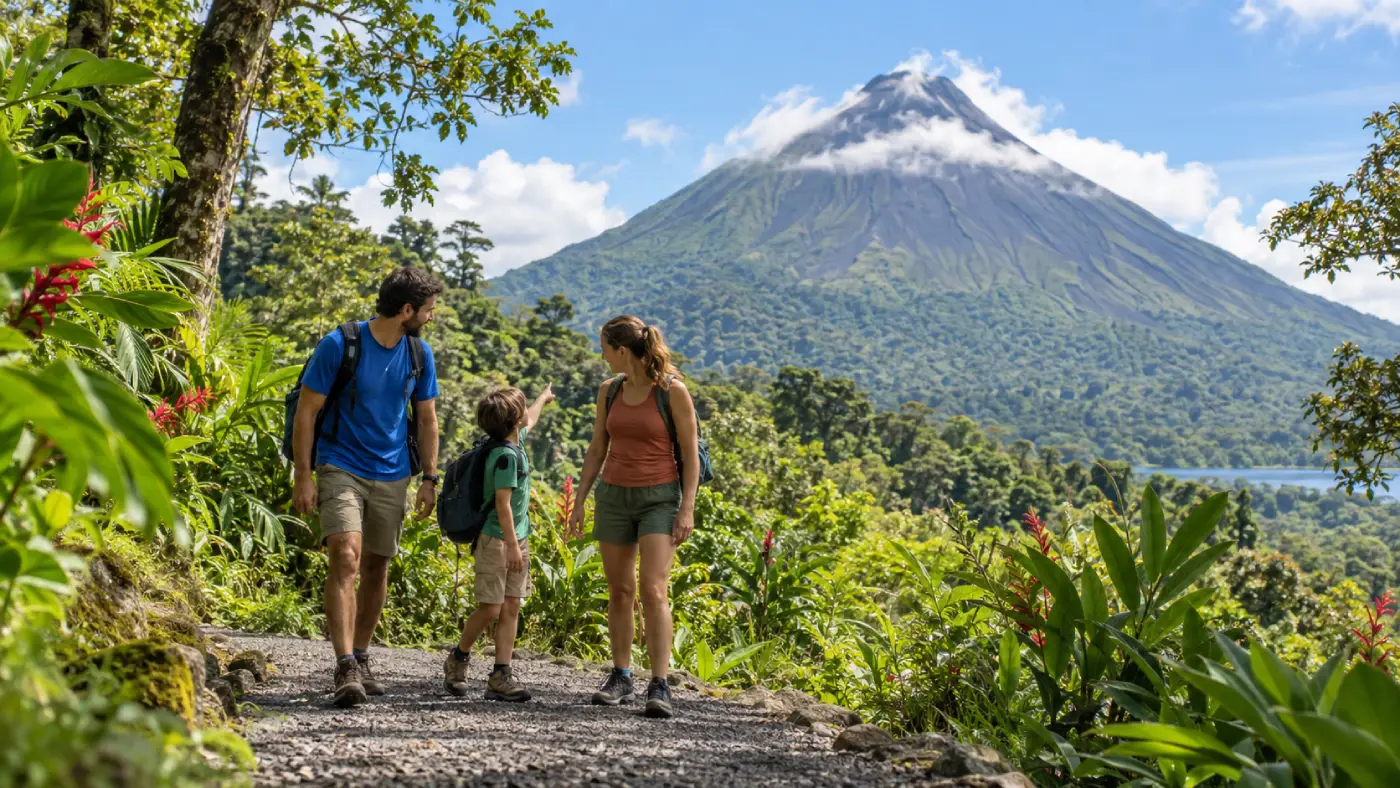
Costa Rica suits families who want wildlife, outdoor activities and time by the water. La Fortuna and Manuel Antonio make a workable forest-and-coast pairing, provided you give each place several nights and allow a transfer day between them.
We would start a first family trip with two main bases and one substantial outing per day. That leaves space for meals, naps, swimming and the slower pace of watching an animal through a guide’s telescope.
Your children’s ages help shape the trip, but walking tolerance, feeding routines and mobility needs matter just as much.
| Family stage | Planning priority | Useful adjustment |
|---|---|---|
| Babies and toddlers | Feeding, sleep and straightforward access | Keep hotel changes limited and select short outings with an easy return to your accommodation. |
| School-age children | Interesting activities with manageable walking | Combine a wildlife or forest outing with an unstructured afternoon. |
| Teenagers | Activities they actively want to do | Let them help choose excursions, then match each activity’s requirements to their abilities. |
| Families travelling across generations | Different energy levels and access needs | Build in shared experiences and opportunities to rest or split into smaller groups. |
These are planning suggestions, not attraction admission rules. Activities set their own age, equipment and participation requirements.
Decide which Costa Rica regions you want to stay in before searching for individual hotels. Otherwise, an appealing room can pull your family into a much longer route.
| Base | Main appeal for a family trip | What changes the decision |
|---|---|---|
| La Fortuna and Arenal | Forest walks, hanging bridges, wildlife and volcano views | Select accommodation around the outings you want to do; allow time for travel between them. |
| Manuel Antonio and Quepos | National park wildlife alongside a Pacific coast stay | Organise the park visit around its reservation slot and consider how you will reach the entrance from your hotel. |
| Guanacaste coast | A beach-focused holiday with Liberia airport as an arrival option | Pick a specific beach community first; Sámara and the coast around Liberia create different transfer plans. |
La Fortuna gives you several ways to experience the forest without moving hotels. You can choose a shorter walk, spend longer on a guided outing or leave part of the day free.
Manuel Antonio works when seeing wildlife and spending time near the coast are both priorities. Quepos and the Manuel Antonio area offer different accommodation locations, so look at the actual journey to the park and beach before booking.
Guanacaste deserves a more specific choice than “somewhere by the sea.” Sámara has a range of hotels and restaurants around a beach town, while other coastal communities suit different arrival routes. Select the location around the kind of stay you want and the transfers it requires.
Monteverde can earn an additional stop when cloud forest is a major interest. Give it enough time to justify another hotel change; it is an optional addition to a family route, not an essential stop on every short trip.
School holidays may fix your dates, but you can still choose the region around them.
The Pacific coast has its clearest dry-season pattern from December to March, with April a transition month. Rain is more frequent from May to October, and November is another transition. During wetter periods, scheduling outdoor activities early can leave more flexibility for afternoon rain.
The Caribbean coast follows a different pattern. February–March and September–October are relatively drier periods there, although rainfall continues throughout the year.
Match your dates to Costa Rica’s regional seasons before committing to a coast. Keep some flexibility in the daily plan so that a wet afternoon can become time to rest without disrupting the whole trip.
Choose between SJO and LIR once you know your main bases. SJO is in Alajuela, near San José; LIR is in Liberia and serves Guanacaste, with access to La Fortuna and Monteverde.
Compare the whole journey, including the drive after landing and the return to the airport. If an arrival leaves little room for a comfortable onward transfer, an airport-area night can be a sensible part of the itinerary.
Each option solves a different family problem:
Rental car: Useful when you want control over daily outings and stops. Include the appropriate child seats, luggage space, parking and the complete rental terms in your decision.
Private transfer: Useful when departure timing and planned stops matter more than having a vehicle throughout the stay. Agree those details when requesting the quote.
Shared shuttle: Useful for travelling between established tourist bases on a scheduled service. Compare the fare for everyone travelling and the pickup arrangements with the total private-transfer quote.
The wider transport options in Costa Rica help you decide whether to drive throughout the trip or combine transfers with local transport.
Treat longer journeys as travel days. Interbus gives an estimated journey time of 5.5 hours for its La Fortuna–Manuel Antonio shuttle. That is a service-specific estimate, but it shows why a prepaid afternoon excursion is an awkward addition to this transfer.
If La Fortuna is your first stop after SJO, plan getting from San José to La Fortuna alongside your flight arrival.
Costa Rica’s child-restraint regulation covers children who are both under 12 and shorter than 1.45 metres. It includes exemptions for specified taxi and public transport categories.
Give your rental or transfer company each child’s age, height and weight, and get confirmation of the restraint it will provide. Interbus offers child seats and boosters without an additional charge when requested during the reservation; other companies set their own arrangements.
Keep your driver’s contact details and accommodation location accessible. On a compatible, unlocked phone, a Costa Rica eSIM provides mobile data for maps and messaging apps. Roafly’s plan is data-only, with no local phone number.
Build the day around an outing your family can comfortably complete, then leave room to stop, eat and rest.
Wildlife watching can turn a short walk into a substantial outing. Allow time to pause, and choose a guided visit whose length fits your children’s attention and energy.
At Mistico, the full hanging-bridges walk covers approximately 3.2 km, with a shorter 1.5 km alternative available. Compare the full and shorter walking options before deciding how much forest time to book.
Taking a stroller requires a route-specific decision. Ask about steps, gradients and the exact path you will follow. Manuel Antonio has accessible boardwalk infrastructure and shorter walking options, but that does not make every trail suitable for a stroller.
Reaching the lower viewing area at La Fortuna Waterfall involves roughly 530 steps down, followed by the climb back.
Consider that return climb before heading down with a small child. The first viewpoint offers an alternative for visitors avoiding the descent, and the orchid garden provides another part of the visit without tackling the full staircase.
Ziplining, rafting and other adventure activities need a separate suitability decision. Get the operator’s requirements for the specific tour, including minimum age, equipment fit, height or weight limits, swimming ability where relevant, and how conditions can affect participation.
Use the broader selection of things to do in Costa Rica to find activities that match your family’s interests. Leave an unscheduled afternoon between more demanding outings.
Beach time can include sand play, a walk and a shaded break as well as swimming. That gives you more flexibility when the sea is unsuitable for your children.
Make swimming decisions from the conditions that day. Follow warning signs and local safety guidance, and keep children close and continuously supervised. Treat descriptions such as “family-friendly beach” as a starting point for choosing a location, not a swimming assessment.
At a pool, agree which adult is actively watching the children. Include the route from your room to the water in your accommodation decision, particularly where a terrace or door opens directly towards a pool.
Give wildlife space on trails and around accommodation. Keep food out of animals’ reach, and avoid touching or feeding them.
Build everyday safety precautions in Costa Rica into the day: keep valuables attended, stay together on trails and agree where to meet if your group separates.
Enter every guest and each child’s age when requesting a room. Ask for written confirmation of the maximum occupancy, sleeping arrangements and any cot or extra-bed provision.
Room names can be misleading. At Arenal Manoa, Junior, Superior and Chato suites accommodate up to four people, while some other room categories accommodate two. Its suites are not equipped for cooking.
Families of five or more should resolve room capacity before paying. If you need connecting rooms, a separate sleeping space, refrigeration or a kitchen, make each requirement part of the reservation.
Meal timing also affects the day. Establish how breakfast fits an early departure and whether you can prepare food at your accommodation. Having a simple meal plan makes it easier to keep outings within your children’s usual routine.
Book Manuel Antonio admission through the official SINAC reservation system. Have the visitor names, identification details and relevant resident or child categories ready, and choose a time slot that your family can realistically reach.
The reservation system’s published limit, checked in October 2026, is six Manuel Antonio tickets per transaction for a personal user, with one transaction allowed per day. If your party is larger, settle the booking arrangement with SINAC before paying.
Park admission and a guided tour are separate services unless your chosen tour explicitly includes the ticket. Use the available dates and entry conditions in the reservation system when planning the visit.
Manuel Antonio restricts food entry, with exceptions determined by the park administration. If you need to bring baby milk, food or a medically necessary item, arrange clarification with the park before your visit. Plan meal breaks around the permitted options.
Start with two main bases and adapt the number of nights to your flights. Seven days could mean three nights around La Fortuna and three at one coastal base, provided the arrival and departure arrangements work. With more time, add rest nights or an airport-area stay where it improves the journey.
Settle into La Fortuna. Spread a forest or bridge walk and another chosen outing across different days. Keep part of each day available for rest.
Move to the coast. Allow the transfer to be the main event that day. Have a meal, settle into the accommodation and leave organised sightseeing for later.
Stay at one coastal base. In Manuel Antonio, build one day around the park reservation. In Guanacaste, organise the stay around your chosen beach community and local outings.
Babies, toddlers or relatives with limited walking tolerance may benefit from spending the whole holiday in one base. Families keen on more activities can add depth through excursions while keeping hotel changes manageable.
Before departure:
Save tickets, accommodation details, driver contacts and useful maps for offline access.
Use the Costa Rica packing list to prepare for the actual mix of forest walks, beach time and transfers.
Decide who needs an independent data connection if adults or older children will split up. Hotspot sharing works while devices are nearby and uses the purchased allowance; compare Costa Rica eSIM options before deciding how to cover everyone’s needs.
