Download the App and manage your eSIMs easily
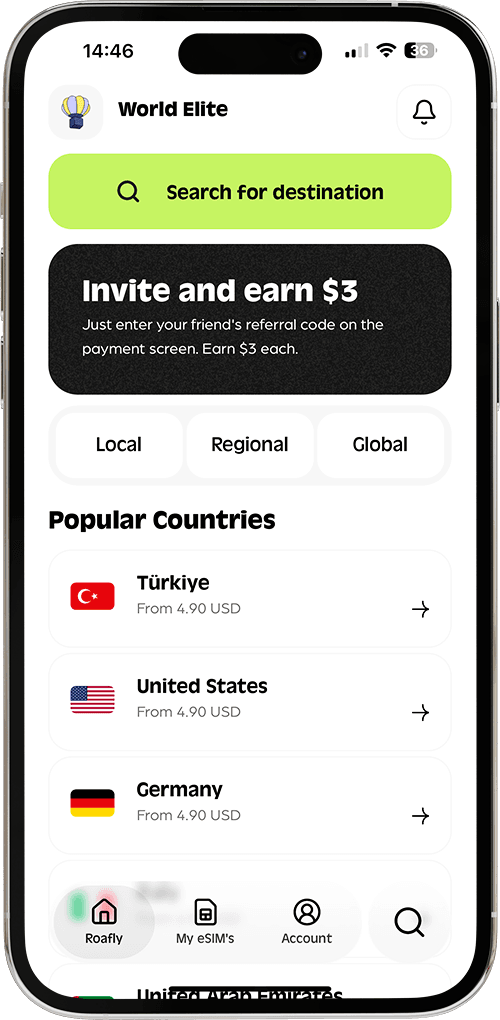
Create your order quickly
See your eSIM details
Track your remaining data
Download the App and manage your eSIMs easily
Create your order quickly
See your eSIM details
Track your remaining data
Costa Rica’s two main international gateways sit in very different parts of the country. Choosing between them can reshape the first and last travel days of your itinerary.

Ethan Brooks
Updated Aug 9, 2026
10 min read

Save 15% on your Roafly eSIM
Stay connected on your next trip. Use the code below at checkout.
View All DestinationsJump to section
👇Save 15% on your Roafly eSIM
Stay connected on your next trip. Use the code below at checkout.
View All Destinations
Manage your eSIM in the app
Install, top up and track data.
Choose LIR when Guanacaste and the northern Pacific are the core of your trip. Choose SJO for San José and the Central Valley, the Caribbean side, and most Central or South Pacific itineraries. La Fortuna and Monteverde sit in the middle of the decision, where flight timing, fare and your next stop can matter more than the airport itself.
Costa Rica’s tourism authority identifies Juan Santamaría International Airport (SJO), in Alajuela near San José, and Daniel Oduber Quirós International Airport (LIR), marketed as Guanacaste Airport, as the country’s two primary international gateways.
| Airport | Best for | Key destination access | Main tradeoff | Choose it when |
|---|---|---|---|---|
| SJO – Juan Santamaría | Central Valley, Caribbean, Central/South Pacific | San José, Manuel Antonio, Uvita/Dominical, Puerto Viejo; also La Fortuna/Monteverde | Poor geographic fit for most Guanacaste beach trips | Your route runs south, east or through the Central Valley |
| LIR – Guanacaste Airport | Guanacaste and northern Pacific | Papagayo, Playas del Coco, Tamarindo, Flamingo; also viable for La Fortuna/Monteverde | Less logical for Caribbean and most southern routes | Your first or final major stop is in Guanacaste |
| Either can work | Northern Plains/cloud forest combinations | La Fortuna, Monteverde | The better choice changes with the rest of the itinerary | Flight schedule, total cost and following stop break the tie |
The terminal itself is rarely the main issue. Costa Rica’s road geography makes the direction you travel after landing more important than whichever airport appears closest on a country map.
Juan Santamaría International Airport is Costa Rica’s principal international airport and sits in Alajuela, outside central San José. Its Central Valley location makes it the more natural gateway when your trip begins around the capital or continues toward the central, southern or Caribbean sides of the country.
SJO is usually the better geographic fit for:
San José and the Central Valley
Jacó, Manuel Antonio and Quepos
Dominical, Uvita and the broader South Pacific
Cahuita and Puerto Viejo de Talamanca
itineraries continuing toward the Caribbean side
Trips centered on San José or the Central Valley are clearer still. Arriving at SJO keeps the first travel day aligned with the area rather than adding a cross-country repositioning leg from Liberia.
Ground transport at SJO includes authorized airport taxis, rental-car services and public-bus connections toward Alajuela and San José. The official SJO transportation information is the right place to recheck current operators and arrangements before arrival.
Those city connections should not be confused with direct service to every major tourist destination. Reaching Manuel Antonio, the Caribbean coast or another regional stop may still require a separate bus, shuttle, rental car or private transfer.
Planning to spend the first night around San José? Area choice can matter almost as much as airport choice, so use Where to Stay in Costa Rica: Best Areas & Towns Guide when deciding whether to stay near the airport, in the city or farther along your route.
Daniel Oduber Quirós International Airport sits in Liberia and serves as the principal international gateway for Guanacaste. That position makes LIR the stronger choice for many trips focused on Costa Rica’s northwestern Pacific coast.
Destinations that usually point toward LIR include:
Papagayo
Playas del Coco
Playa Hermosa
Tamarindo
Flamingo
other Guanacaste beach bases
Using LIR for these areas can remove a long cross-country transfer from the beginning or end of the trip.
Guanacaste Airport currently lists public bus service between the terminal and Liberia, along with authorized transport providers and multiple rental-car companies. As checked on August 9, 2026, the airport publishes an approximately 30-minute bus frequency from 5:00 a.m. and an indicative fare of about US$1.
Recheck the official Guanacaste Airport transport information before relying on a specific departure.
That local connection reaches Liberia; it does not mean every beach town or resort has an equally simple public-transfer link from the airport. Depending on your accommodation, the onward trip may involve another bus, a prearranged shuttle, private transfer or rental car.
Road-trip plans deserve a separate check before choosing LIR purely from map position. Rental pickup, navigation and national driving considerations belong in Driving in Costa Rica: Waze vs. GPS & Navigation rather than turning this airport comparison into a full driving guide.
La Fortuna is where the usual “SJO for central Costa Rica, LIR for beaches” shortcut becomes less useful. Both international airports can work, so the better choice depends on what happens before and after the Arenal area.
For La Fortuna, compare three things:
Your next major destination: Guanacaste strengthens LIR; Manuel Antonio, Uvita or another southern stop strengthens SJO.
Your flight schedule: a significantly better arrival or departure time can outweigh a modest geographic disadvantage.
Your total ground cost: private transfers, rental cars and an extra hotel night can change which itinerary is actually cheaper.
Monteverde follows much the same logic. Combine it with Guanacaste and LIR gains appeal; combine it with the Central or South Pacific and SJO often fits the wider route better.
Instead of asking which airport is closest to La Fortuna or Monteverde in isolation, map the stop that comes immediately afterward. That usually gives the airport decision enough context to become useful.
Booking becomes easier once you stop asking which airport is “best for Costa Rica” and mark the first two and final two destinations on your itinerary.
Typical patterns look like this:
Guanacaste + La Fortuna: LIR often fits naturally.
La Fortuna + Manuel Antonio or Uvita: SJO usually becomes more attractive.
Caribbean + Central Valley: SJO is the logical international gateway.
A longer trip crossing several regions: using both airports may reduce backtracking.
Open-jaw routing can work particularly well when the trip moves progressively across the country. Arriving at one airport and departing from the other may save an otherwise unnecessary return drive.
Before committing, compare the airline’s multi-city pricing with a normal round trip. Time saved on the road is only useful when airfare, baggage terms and ground logistics still work together.
Neither SJO nor LIR is universally cheaper. Airfares change by origin, dates, connection pattern, baggage allowance and schedule, so one cheaper flight search cannot establish a permanent winner.
Compare the complete trip cost rather than the headline fare:
flight fare on the same dates and comparable ticket conditions
checked bags, seat fees or other required extras
airport transfer for everyone traveling
rental-car charges where relevant
fuel and tolls where they apply
an extra hotel night created by an awkward arrival
additional travel time created by choosing the less convenient airport
A family saving US$80 on airfare could lose that advantage after paying for a much longer private transfer. In the opposite direction, paying more for the geographically better airport may still be unnecessary when the ground-access difference is small.
Schedule deserves equal weight. An arrival that works with your confirmed onward transport can be more useful than a slightly cheaper evening flight that forces an unplanned airport-area night.
Route availability also varies by origin and season. Search both SJO and LIR for your exact dates instead of assuming every departure city offers equivalent service to each.
Airport choice deserves another look when your trip involves a rental car, a late landing or a different departure airport.
Check these points before booking:
whether airport pickup avoids an unnecessary transfer into San José or Liberia
the actual operating hours of your chosen rental-car or transfer provider
whether your first long drive is sensible at your scheduled arrival time
whether returning a rental car at the other airport is permitted
whether a one-way return fee changes the economics of an open-jaw itinerary
Both SJO and LIR serve travelers using rental cars, but individual company locations, procedures and opening hours differ. Late arrivals therefore require confirmation against the actual provider rather than an airport-wide assumption.
Open-jaw routing becomes especially useful when the itinerary moves steadily across Costa Rica. Landing at LIR for Guanacaste, traveling through La Fortuna or Monteverde, then finishing toward the Central or South Pacific before departing SJO can remove substantial backtracking.
The reverse can work for a trip that starts farther south and finishes in Guanacaste. Direction matters more than which airport you use first.
Whichever airport wins, mobile data becomes useful quickly for several arrival tasks:
navigating to your hotel or rental-car office
contacting a driver or accommodation
checking transport information
handling itinerary changes after a delayed arrival
Terminal SIM and Wi-Fi details belong in Costa Rica Airport SIM Cards: SJO vs LIR, while How to Get Internet in Costa Rica: SIM Cards, eSIM, Airport & WiFi Guide covers the broader choice between roaming, local SIMs, eSIMs and Wi-Fi.
Travelers who prefer to arrange data before landing can also review the Costa Rica eSIM. Connectivity does not make SJO or LIR the better airport; it simply helps with the onward journey once the airport decision has already been made.
LIR fits trips dominated by Guanacaste and the northern Pacific. SJO fits San José, the Central Valley, the Caribbean and most Central or South Pacific routes.
Neither airport automatically wins for La Fortuna or Monteverde. Let the surrounding itinerary, actual flight schedule and total ground cost decide.
Cross-country trips deserve one final comparison: a multi-city itinerary using both SJO and LIR may save more backtracking than forcing a round trip through either airport.
Both SJO and LIR are realistic options. Let your next destination, flight timing and total ground-transport cost decide rather than assuming one airport always wins.
SJO is normally the stronger international gateway for Manuel Antonio and Quepos because the Central Pacific is better aligned with the San José side of the country than with Liberia.
Generally, yes. LIR is the international gateway for Guanacaste and is the more logical choice for Tamarindo, Papagayo, Playas del Coco, Flamingo and many other northwestern beach destinations.
Yes, when suitable flights are available. Open-jaw routing can be especially useful when the itinerary moves from Guanacaste through inland destinations and finishes farther south or near the Central Valley instead of returning north.
No. Juan Santamaría International Airport is located in Alajuela, near San José rather than in the city center.
