Download the App and manage your eSIMs easily
Create your order quickly
See your eSIM details
Track your remaining data
Download the App and manage your eSIMs easily
Create your order quickly
See your eSIM details
Track your remaining data
Expect to budget roughly CHF 800–1,100 per person for a careful seven-day hostel trip, or CHF 1,500–2,000 per person when sharing a private hotel room, using second-class transport and eating a mixture of simple meals and restaurant food.
Sunrise, Salt
Instant delivery
From 3.90 USD

Ethan Brooks
Updated Oct 17, 2026
9 min read
Jump to section
👇Best for most trips
Sunrise, Salt

Switzerland
10 GB · 30 days
Enough for maps, bookings and everyday travel.
Hotspot supported
$14.00
From 3.90 USD
Those figures cover seven days and six nights around destinations such as Zurich, Lucerne and Interlaken. Major mountain excursions sit outside the base budget: adding Jungfraujoch can change the total much more than choosing a cheaper lunch.
Switzerland becomes easier to budget for once you separate three decisions: where you sleep, how often you move between destinations, and which mountain journeys you want to pay for.
These two models assume adults aged 25 or over, travel between May and October, and no skiing. The hotel scenario is per person sharing a double room with one other adult.
| Expense | Careful hostel trip, per person | Shared hotel room, per person |
|---|---|---|
| Accommodation: six nights | CHF 300–420 | CHF 600–900 |
| Food: seven days | CHF 210–280 | CHF 385–525 |
| Local and intercity transport | CHF 200–280 | CHF 439 |
| Other paid sightseeing | CHF 40 | CHF 40 |
| Reserve for tourist taxes, mobile data and small extras | CHF 60 | CHF 60 |
| Seven-day total | CHF 810–1,080 | CHF 1,524–1,964 |
| Approximate total in USD | $980–1,310 | $1,850–2,380 |
| Average per travel day | CHF 116–154 | CHF 218–281 |
Planning estimates using prices checked on 17 October 2026. USD equivalents use the Swiss National Bank’s 16 October reference rate of US$1 = CHF 0.8245, rounded for readability. Your payment provider’s exchange rate and fees may differ.
Accommodation, food and the hostel transport allowance are budget estimates. The hotel model uses the published CHF 439 price of an eight-day Swiss Travel Pass. The reserve is money set aside, not a fixed charge.
The hostel transport allowance assumes limited changes of base and advance purchases where suitable. It needs checking against your actual journeys. Major mountain excursions, international flights, visas, travel insurance and shopping are excluded from both models.
Two adults sharing a hotel room should therefore allow approximately CHF 3,048–3,928 combined, or around US$3,700–4,760, for the base week. Accommodation is already divided between them; there is no need to add another room bill.
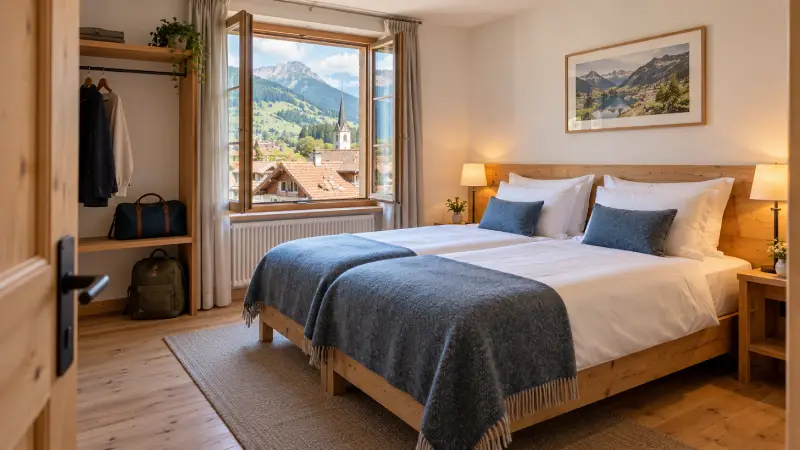
Allow CHF 50–70 per person per night for a hostel bed in the budget model. The shared-room model allows CHF 200–300 per double room, equivalent to CHF 100–150 each.
Current examples help put those allowances into context:
Lucerne: a bed in a four-bed room at Backpackers Lucerne costs CHF 49–54 per person per night.
Zurich: a Comfort Double Room at Hotel California starts at CHF 190 per room per night.
Interlaken: standard double rooms at Hotel Bernerhof cost CHF 180–240 in October and CHF 240–310 from May through September. Those tariffs include breakfast, service, taxes and VAT.
These examples have different inclusions and seasonal conditions. Treat an advertised starting rate as a possible entry point, rather than the amount every night will cost.
Room sharing makes a substantial difference. Splitting a CHF 250 double means paying CHF 125 each. Someone traveling alone who wants that same room must budget for its full price, unless a lower single-occupancy rate is available.
Breakfast and location also affect value. Compare the room’s total price with the meals and transport you will need around it. Saving CHF 50 per room per night would save a couple CHF 300 across six nights, before accounting for any extra travel.
Match your dates to the experiences you want using our guide to the best time to visit Switzerland. The cheapest room is only useful if its location and season suit the trip.

Budget CHF 30–40 per day for food when relying mainly on groceries, bakeries, takeaway meals and occasional simple hot lunches. CHF 55–75 per day gives more room for restaurant meals and drinks, particularly when breakfast is included with your accommodation.
Migros restaurants provide useful lower-cost hot-meal options. In the Zurich cooperative’s current menu, half a chicken with fries costs CHF 13.90, while a beef burger with fries starts at CHF 15.90. Its breakfast combination costs CHF 8.40.
Restaurant meals require a larger allowance. At Rathaus Brauerei in Lucerne, half a chicken with potatoes costs CHF 29, and Alpine macaroni costs CHF 29.50. Drinks, starters and desserts add to that meal price.
Mixing meal styles is an effective compromise: breakfast at your accommodation, a supermarket or counter-service lunch, and a restaurant dinner when it adds something to the day. There is little reason to make every meal a sit-down occasion.
Watch the unit on self-service menus. Migros Zurich’s buffet is priced at CHF 3.60 per 100 grams, so a 500-gram plate costs CHF 18. A buffet can be convenient without being a fixed-price bargain.
Transport is where a Switzerland budget needs more thought than a daily allowance. Frequent intercity journeys, a few long transfer days and a week mostly spent around one base can favour different tickets.
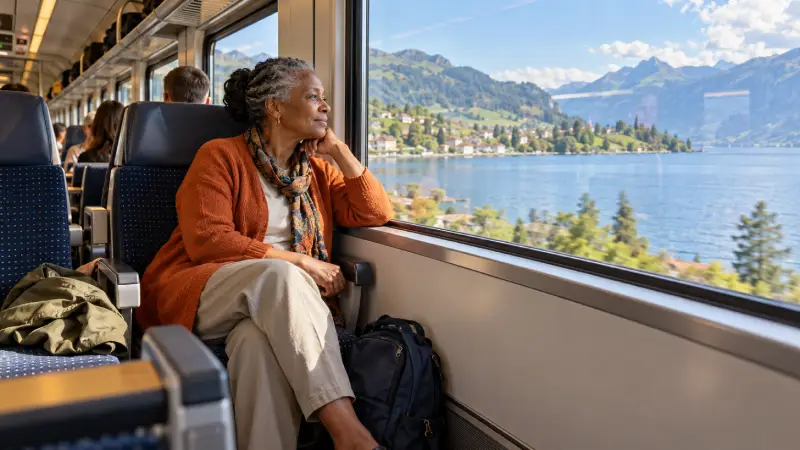
The adult eight-day Swiss Travel Pass costs CHF 439 in second class, with that tariff valid through 31 December 2026. There is no seven-day version, which is why the weekly hotel model uses eight days.
The pass covers travel across its network by train, bus and boat, plus local transport in numerous towns and cities. Rigi, Stanserhorn and Stoos are included mountain excursions. Panorama-train seat reservations or supplements can still cost extra.
Check the Swiss Travel Pass prices against the journeys you intend to take. Its flexibility can be valuable, but convenience and the lowest possible cost are separate considerations.
The Swiss Half Fare Card costs CHF 150 for one month. You then buy eligible tickets at half price or another reduced fare.
If every journey in your comparison receives exactly 50% off, the card reaches its break-even point at CHF 300 of full-price tickets:
CHF 150 for the card + CHF 150 for discounted travel = CHF 300.
That calculation is a starting point. Saver fares, routes with different reductions and competing passes can change the result. Compare the final basket of tickets rather than applying 50% to every transport expense.
Staying in fewer places can make individual tickets or selected Saver Day Passes more attractive. Second-class Saver Day Passes start at CHF 52 without a Half Fare Card or CHF 29 with one, subject to availability.
Those are starting prices, not a promise for every travel date. Saver Day Passes must be bought in advance, and their validity does not include every mountain railway.
Before paying for local buses separately, look at your accommodation’s guest-card benefits. The Interlaken guest card, for example, includes local public transport within its defined area.
Considering a car instead? Compare the complete rental, parking and road-cost picture through our guide to renting and driving a car in Switzerland, especially when several people would share the vehicle.
Jungfraujoch shows why mountain trips need their own budget line.
For travel from 1 May to 31 October 2026, an adult second-class return from Interlaken Ost costs CHF 261.20 at full fare. The compulsory seat reservation adds CHF 10, bringing the total to CHF 271.20 per person, approximately US$329.
With a Swiss Half Fare Card already purchased, the same fare calculation is CHF 130.60 for the ticket plus CHF 10 for the reservation: CHF 140.60.
Buying the Half Fare Card solely for this excursion would cost CHF 290.60 altogether: CHF 150 for the card plus CHF 140.60 for the journey and reservation. You would need savings on other journeys to make that purchase worthwhile.
Swiss Travel Pass holders also receive a reduction, but the upper mountain journey remains chargeable. Use the Jungfrau ticket calculator with your departure station, travel date and pass.
Choose the mountain experiences that matter most before selecting a transport card. Lakefront walks, old-town sightseeing and suitable walks from your base can fill other days without another major railway ticket.
Tourist taxes vary by destination and accommodation. Some room prices include them; others add them separately. The budget models contain a reserve for these charges, mobile data and small incidental expenses. Keep any unused amount rather than counting an included tax twice.
Guest cards can return some value through local transport and attraction discounts. In Interlaken, declining the guest card does not remove the visitor’s tax.
Payment costs also deserve attention. Your bank’s foreign-transaction and withdrawal charges sit outside the advertised hotel or meal price. Our guide to paying by card and withdrawing cash in Switzerland covers those practical choices.
Mobile data is another expense you can settle before departure. Check your home provider’s Switzerland charges, then compare them with a prepaid allowance.
Roafly’s Switzerland eSIM provides prepaid mobile data with hotspot support and top-ups. You need a carrier-unlocked, eSIM-compatible device. Choose the allowance that fits your trip and account for its current price within your communications budget.
If you want to compare providers, allowances and networks before choosing, compare Switzerland eSIM plans.
The weekly models cover spending during the trip. Add these personal costs separately:
International travel: include your flight or cross-border train, baggage and any relevant booking extras.
Visa and entry preparation: costs depend on your circumstances. Review Switzerland’s entry requirements before pricing this part of the trip.
Travel insurance: match the cover to your planned activities. Consider mountain safety in Switzerland when deciding what protection you need.
Shopping: keep souvenirs and larger purchases separate from daily living costs. Check Switzerland’s VAT refund rules before assuming a purchase will qualify for a refund.
Best for most trips
Sunrise, Salt
Switzerland
10 GB · 30 days
Enough for maps, bookings and everyday travel.
Hotspot supported
$14.00
From 3.90 USD
Choose the perfect data plan for your trip

Manage your eSIM in the app
Install, top up and track data.
