

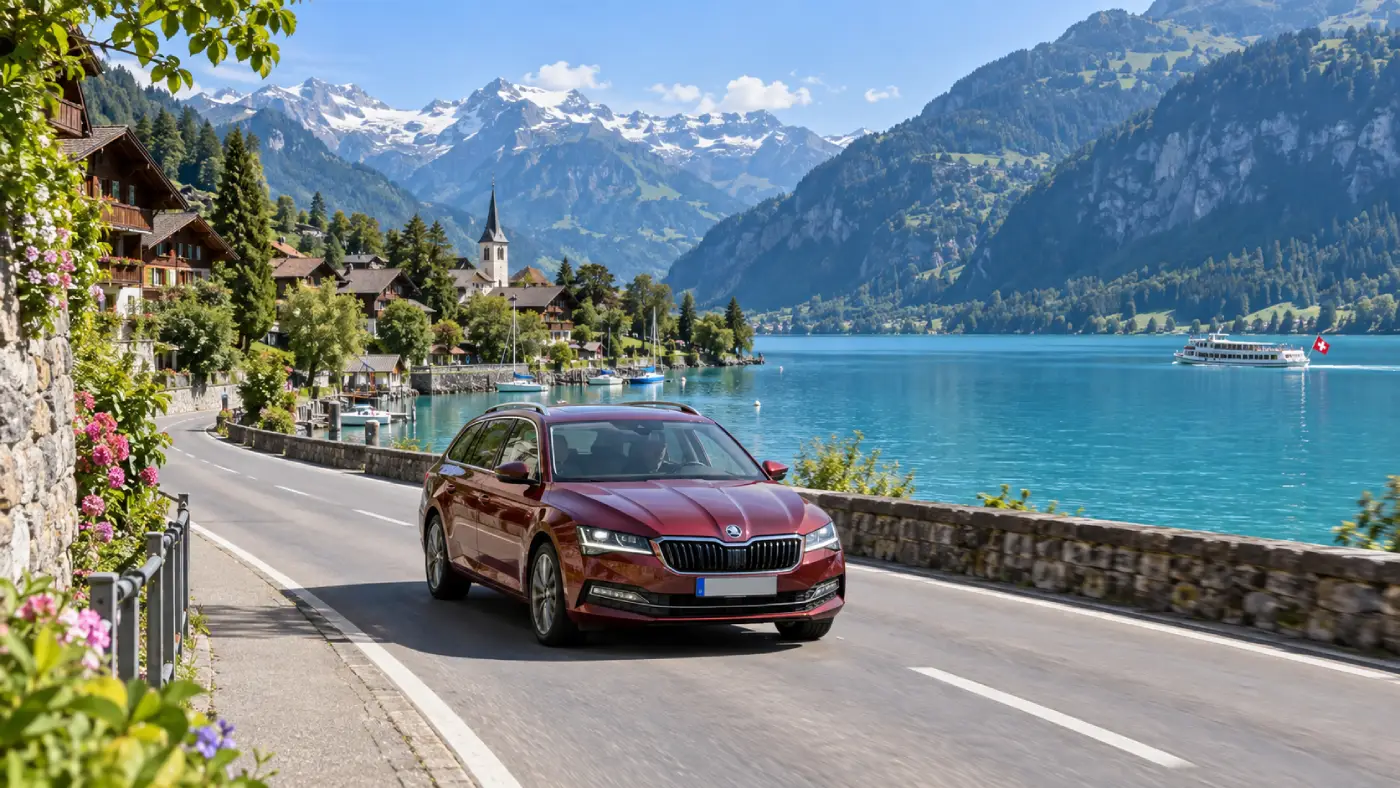

You can explore Swiss cities and many mountain destinations without renting a car. Driving becomes more useful when your accommodation sits away from convenient transport, your days include scattered stops, or the mountain road itself is part of the holiday. Renting after your city stay can give you that flexibility for the days you need it.
Before booking, look beyond the distance between towns. Wengen and Zermatt involve leaving your car behind, while other destinations let you drive to your accommodation or a mountain railway station.
| Quick fact | What to know |
|---|---|
| Driving side | Keep right. |
| Turning on red | Cars have no general permission to turn right at a red light. |
| Standard car speed limits | 50 km/h in built-up areas, 80 outside, 100 on expressways and 120 on motorways; signs take precedence. |
| Motorway vignette | CHF 40; establish whether your rental already has. |
| Car-free destinations | Park in Lauterbrunnen for Wengen and in Täsch for Zermatt. |
| Mountain roads | Seasonal closures and weather can change the route. Download maps and consult current pass information. |
Do You Need a Car in Switzerland?
Start with your accommodation and the places you want to reach each day. Staying near a station in Zurich or Lucerne creates a different transport decision from renting a rural apartment with several separate excursions planned.
Our recommendation for a trip combining cities and mountain resorts is to compare a train-based itinerary first, then identify the specific days when driving would improve it.
| Your trip | Where a car helps | What to weigh against it |
|---|---|---|
| City stays with occasional excursions | Trips to accommodation or stops away from convenient connections | Daily rental and parking while you explore on foot or use local transport |
| Several nights in Wengen or Zermatt | Reaching the valley transfer point as part of a wider road trip | The car remains parked while you use local transport |
| A base around Grindelwald or Lauterbrunnen | Moving luggage and combining dispersed stops | Parking and mountain transport may still be needed |
| Scenic passes and frequent roadside stops | Flexible timing and access to permitted stopping places | Weather, closures and the driver's comfort on mountain roads |
| Rural accommodation away from a station | Direct access and easier luggage handling | Any hotel shuttle, bus connection and the final walk from the stop |
The final part of the journey can change the result. Reaching a valley car park still leaves you with unloading, boarding the mountain transport and getting from its arrival station to your hotel. Include those steps when comparing journey times.
Grindelwald and Lauterbrunnen offer a different choice: you can drive into these valleys, but excursions higher into the mountains may continue by train or cable car. Include those tickets in either transport budget.
Group size also matters. Sharing a car can spread its costs, although five passengers with large suitcases may need a different vehicle from the cheapest rental advertised. Compare the vehicle you would actually book with suitable rail tickets or passes for your party.
Where to Rent a Car and Which Vehicle to Choose
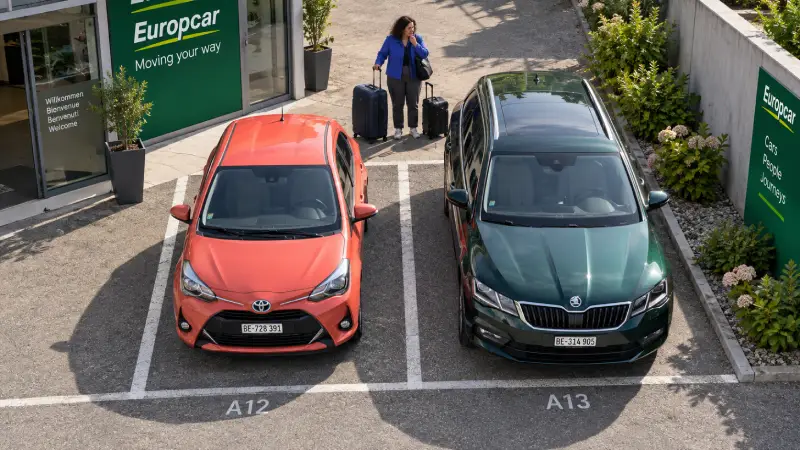
Zurich and Geneva airports are useful collection points if your road trip starts immediately. If you are spending the first few nights in a city, collecting from a city branch when you leave can avoid paying for unused rental days and overnight parking.
SIXT has both airport and city locations in Switzerland, including Zurich, Geneva, Bern, Lucerne and Basel. Compare the actual branch arrangements: opening hours, the collection address, return location and whether your route requires crossing a border.
Geneva needs particular attention because rental locations exist in both the Swiss and French airport sectors. Match the booking to the sector where you intend to collect and return the vehicle; border permissions and Swiss motorway coverage belong in that comparison.
Book for passengers, luggage and the roads you intend to use. Automatic transmission can simplify driving if you are unfamiliar with manual gears. More luggage may justify an estate car, while winter conditions call for suitable tyres and equipment. Mountain scenery alone is not a reason to book a large SUV.
Before choosing an electric rental, establish how you will charge at your accommodation or along the route and what charge level is required on return. Make that part of the booking decision, especially if this would be your first trip using unfamiliar charging networks.
Driving Licences, Rental Costs and Insurance
Bring your original, valid driving licence for the vehicle category, plus the identification required by the rental company. Depending on the licence and its format, you may also need an international driving permit or an official translation under the Swiss foreign-licence requirements. Carry an IDP together with the original licence.
Legal permission to drive and the rental company's acceptance conditions are separate. Minimum age, how long you have held your licence, payment-card acceptance and restrictions on particular vehicle categories belong to the booking you select.
Get three figures clear before paying:
-
The rental total: the vehicle, mandatory charges and selected extras.
-
The deposit or card hold: money or credit temporarily unavailable during the rental.
-
Your potential liability: the excess and any damage or circumstances excluded from the protection you buy.
Refundable deposits affect your available funds and become an expense if an amount is retained. Protection described as “full coverage” needs closer reading: establish whether it reduces the supplier's excess directly or reimburses you after a claim.
Your transport budget should include fuel or charging, parking, any needed vignette, additional drivers, child seats, winter equipment and-way or cross-border fees. Add the trains and cable cars you will still use after parking.
Swiss Driving Rules: Turns, Roundabouts and Speed Limits
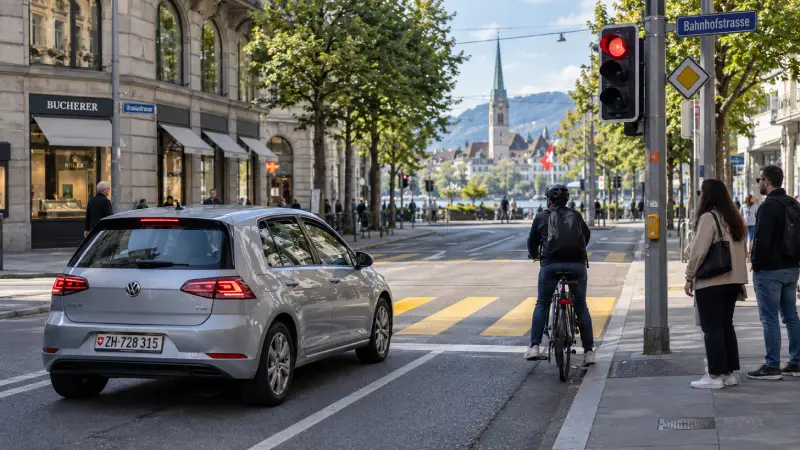
Swiss traffic drives on the right. Give yourself time to read lane arrows and junction signs, particularly around trams and unfamiliar city streets.
Red lights and turns. Stop at red; cars have no general right-turn-on-red permission. The yellow bicycle-and-arrow sign allowing certain cyclists and moped riders to turn at red does not give that permission to cars. At an ordinary green light, turning left generally means yielding to opposing traffic; follow any dedicated directional signals.
Junction priority. Where no signal or priority arrangement overrides it, give way to traffic approaching from the right. Pay attention in residential 30 km/h zones. Tram priority also matters at junctions governed by this rule, so read the signals before crossing tracks.
Roundabouts. Slow down and give way to traffic approaching from your left. Signal right before leaving, ideally after passing the previous exit. On a roundabout with several lanes, follow the marked directions and yield when changing lanes. Watch for cyclists alongside you and pedestrians at exit crossings.
The standard car limits are 50/80/100/120 km/h for built-up areas, roads outside them, expressways and motorways respectively. Lower posted limits and temporary restrictions take precedence.
Several other rules deserve attention before your first drive:
-
Use daytime running lights or dipped headlights during the day, with appropriate headlights for darkness and poor visibility.
-
Wear seat belts. Children under 12 who are also shorter than 150 cm need an appropriate restraint.
-
When motorway traffic slows to walking pace, form an emergency corridor between the two lanes, or between the leftmost lane and the lane beside it on wider roads.
-
At a lane closure, merge in turn where the lanes come together.
Keep the phone secured and set up your route before moving. Stop in a suitable parking place if you need to change settings or examine the map.
Vignettes, Parking and Car-Free Villages
The Swiss motorway vignette costs CHF 40. Both electronic and adhesive versions are valid from 1 December of the preceding year until 31 January of the following year.
The e-vignette is linked to the registration plate; the adhesive version is attached to the vehicle. Establish whether the rental already has a valid vignette before buying another. If you need, use the official vignette information and purchase route.
Parking deserves its own line in your budget. Ask accommodation providers about overnight parking and where you can unload. At public spaces, follow the posted time limits, payment instructions and any parking-disc requirement.
Two destinations show why parking location matters:
Wengen: leave the car in Lauterbrunnen and continue by train. Parking near the station keeps the transfer shorter. Other spaces can involve an additional walk or bus ride before you board.
Zermatt: private vehicles may travel as far as Täsch. The shuttle train from there takes around 12 minutes, with frequent daytime departures. Include parking, the shuttle and the journey from Zermatt station to your accommodation.
Hiring an electric car does not grant visitor access to a car-free village. Plan around the permitted arrival route for private vehicles.
Alpine Passes, Winter Roads and Cross-Border Trips
Furka and Susten can be highlights of a driving holiday when they are open and conditions suit your trip. Their seasonal availability makes a pass-based itinerary different from a journey along the main transport corridors.
Consult the current Swiss pass status before setting out. A scenic pass road, a road tunnel and a vehicle-carrying train are separate ways through the mountains, with different routes and costs.
Leave time for the driving itself. Hairpin bends, narrow sections and weather can demand more concentration than the distance suggests. Use designated stopping places for photographs and keep an alternative route available.
The season you choose affects both driving and activities you park. Our guide to when to visit Switzerland for hiking or skiing helps align those plans.
Winter equipment
Switzerland has no blanket nationwide requirement to fit winter tyres during a fixed calendar period. Drivers still need a vehicle suited to the conditions, and inadequate equipment that obstructs traffic can lead to penalties.
Winter mountain trips call for suitable tyres and any necessary chains arranged with the rental company. Chain requirements on signed roads are separate from the tyres fitted; follow the sign and any stated exemption for your vehicle. Learn how to fit the supplied chains before you need them.
Keep the driving assessment separate from the activity beyond the car park. Snow, ice and changing conditions may also affect your walk or mountain excursion; consider mountain safety in Switzerland when planning that part of the day.
Crossing a border
If you collect a car in Italy or France and drive into Switzerland, arrange permission for the specific vehicle and countries involved before booking. Establish the cross-border fee, protection coverage, assistance arrangements and whether a Swiss vignette is already included.
Returning a vehicle in another country is a separate booking condition from permission to drive there. Compare that complete arrangement with travelling by train into Switzerland and renting locally for the days you need.
Visitors bringing their own cars should carry the relevant vehicle documents and establish that their insurance covers Switzerland.
Navigation and the Checks to Make Before You Drive
Download maps covering the whole route, including a sensible alternative. Google Maps can provide driving directions offline within downloaded areas, but live traffic information and alternative-route suggestions require a connection.
Use navigation for directions and current road information for whether the route is usable. Set your destination to the correct hotel entrance, public car park or transfer station. In a car-free destination, save the parking location and the journey separately.
Decide how you will connect before collection day. Comparing internet options in Switzerland can help you choose between your existing service and a separate travel connection.
On an unlocked, compatible phone, a Switzerland eSIM can provide mobile data for live road information and messages to your accommodation. Keep the downloaded maps available for places where reception drops.
At collection, photograph existing damage, record the fuel or charge level, and locate the warning triangle and any winter equipment. Save the rental company's assistance number and return instructions.
On return, keep photographs showing the car's condition, fuel or charge level and where you left it. If returning outside staffed hours, follow the branch's key-drop procedure and retain its return confirmation.