Download the App and manage your eSIMs easily
Create your order quickly
See your eSIM details
Track your remaining data
Download the App and manage your eSIMs easily
Create your order quickly
See your eSIM details
Track your remaining data
Paying in Switzerland is usually straightforward, but euros, TWINT and mountain stops need a little preparation. Here’s how to organise your cards and Swiss francs before you travel.

Lena Hartley
Updated Oct 13, 2026
11 min read
Save 15% on your Roafly eSIM
Stay connected on your next trip. Use the code below at checkout.
View All DestinationsJump to section
👇Save 15% on your Roafly eSIM
Stay connected on your next trip. Use the code below at checkout.
View All Destinations
Manage your eSIM in the app
Install, top up and track data.
Switzerland is easy to explore with a payment card, particularly when your itinerary centres on cities, hotels and rail travel. Keep some Swiss francs as a backup, and plan additional cash around specific stops such as mountain huts.
The most useful distinction is between how much your trip costs and how much of it you must pay in cash. Expensive train tickets or accommodation do not automatically require a large cash withdrawal. Your route, booked services and available payment methods matter more.
Use an internationally accepted card for most purchases, with CHF cash and a second payment method available. Visa and Mastercard are practical primary cards, while Apple Pay and Google Pay provide another way to use a supported card at participating merchants.
Keep a physical card with you even if you normally pay by phone. Your phone and its wallet should not be your only way to access money.
| Situation | Practical payment approach | What to prepare |
|---|---|---|
| Hotels, supermarkets and larger restaurants | Card is usually convenient | A physical card and your PIN |
| SBB train tickets | Card, supported wallet or ticket-machine payment | Access to any required bank verification |
| Small shops, market stalls and self-service sellers | Follow the seller’s accepted methods | CHF cash if their digital option is unavailable to you |
| Mountain huts | Plan around the individual hut’s payment arrangements | Enough cash for unpaid accommodation, meals and extras |
| Car rental | Follow the rental company’s card and deposit conditions | The required card and sufficient available balance or credit |
| Card or phone failure | Switch to a separately stored backup | A second card and some CHF |
TWINT acceptance is not the same as card acceptance. Seeing its logo does not establish that you can pay with your foreign card or your existing mobile wallet.
Switzerland’s currency is the Swiss franc, abbreviated CHF. Prices may also use “Fr.” or “SFr.”
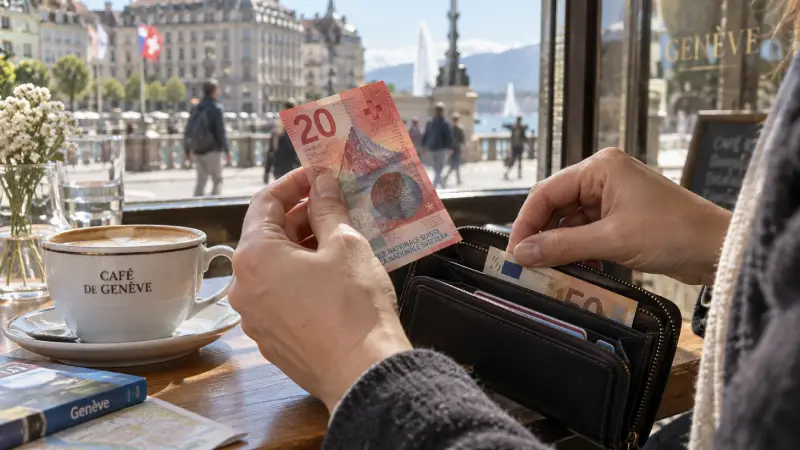
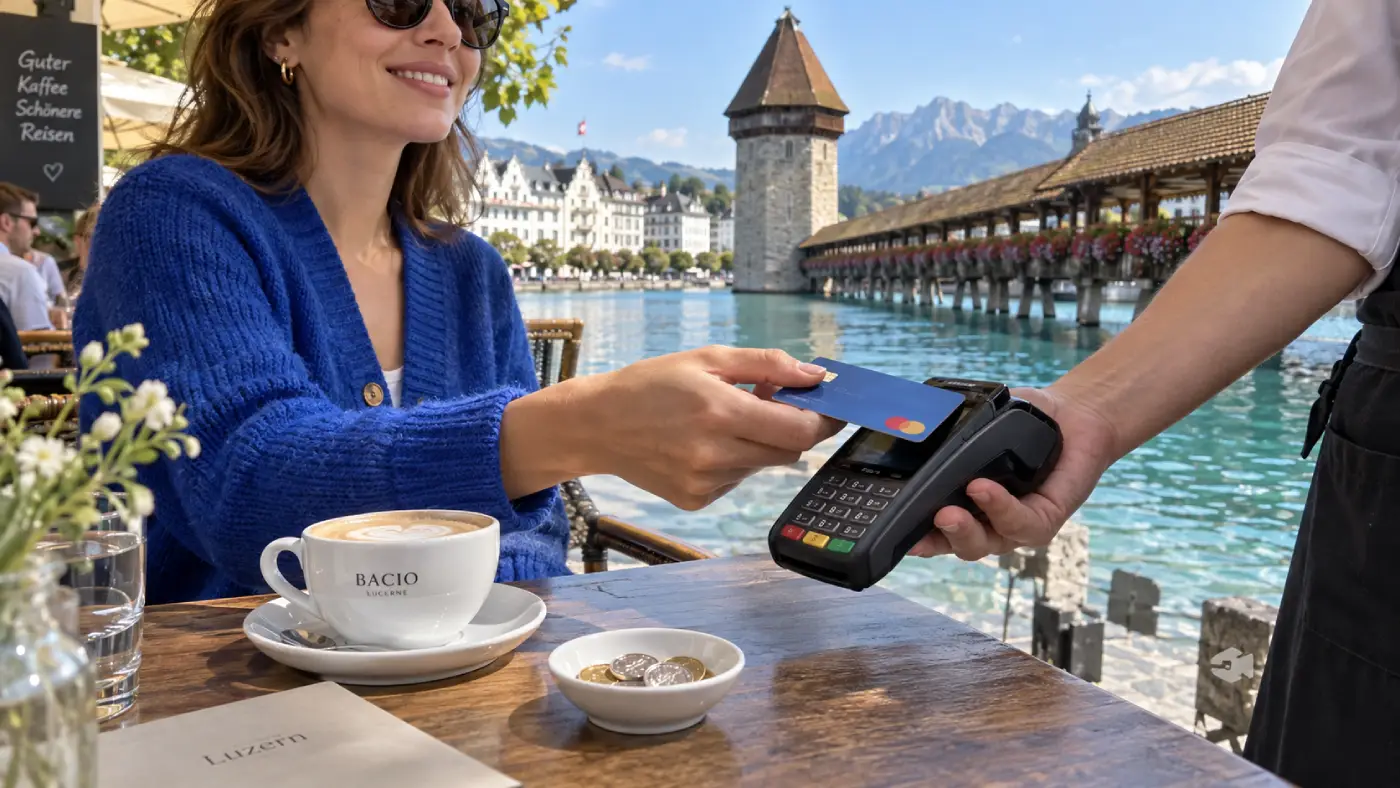
Some businesses accept euro cash, particularly where visitors regularly spend money. Change is generally given in Swiss francs. The business applies its own exchange arrangement, so using leftover euros is a convenience rather than a reliable way to obtain the best value.
Ask how many francs your euros will buy before handing over the money. Avoid exchanging money into euros specifically for a Swiss trip when your intended spending currency is CHF.
If a terminal offers to charge you in your home currency, select CHF and decline the merchant’s currency conversion.
That offer is dynamic currency conversion, or DCC. It lets the merchant or ATM provider set the conversion rather than leaving it to your card’s normal arrangements. The familiar-looking total can include an exchange markup.
Choosing CHF avoids that particular conversion offer. Your card issuer may still apply foreign transaction or currency conversion fees under your account terms.
ATMs provide a straightforward way to obtain CHF after arrival. At Geneva Airport, for example, UBS and Postomat machines are available in the arrivals area and offer Swiss-franc withdrawals.
Look for a machine displaying your card network, request CHF, and read the transaction screen before accepting.
The total cost of withdrawing money can include several different charges:
ATM operator fee: any charge imposed by the machine’s operator.
Card issuer fee: your own bank’s overseas withdrawal charge.
Currency conversion cost: the exchange rate and any associated markup or fee.
An ATM showing no operator fee does not establish that the whole withdrawal is free. Likewise, a card advertised as offering free withdrawals may have limits or conditions and may not cover an independent ATM surcharge.
Before departure, find your card’s international withdrawal terms, including any cash-advance treatment for credit-card withdrawals. At the machine, review the displayed operator charge and decline DCC separately.
Currency exchange is available through banks, exchange offices and participating SBB station counters. Compare the final CHF amount after fees, rather than choosing solely on a “zero commission” sign.
SBB Change lists a standard CHF 5 exchange fee, with a counter-service exemption for GA Travelcard holders. A fixed charge has a greater effect on a small exchange, so include it when comparing quotes.
There is no universal winner between bringing francs, withdrawing them and exchanging cash locally. Your existing card’s fees and the quoted exchange rate determine the result. For a short trip, avoiding unnecessary conversion and leftover currency may matter more than chasing a small rate difference.
Build your cash allowance around payments that cannot conveniently go on a card.
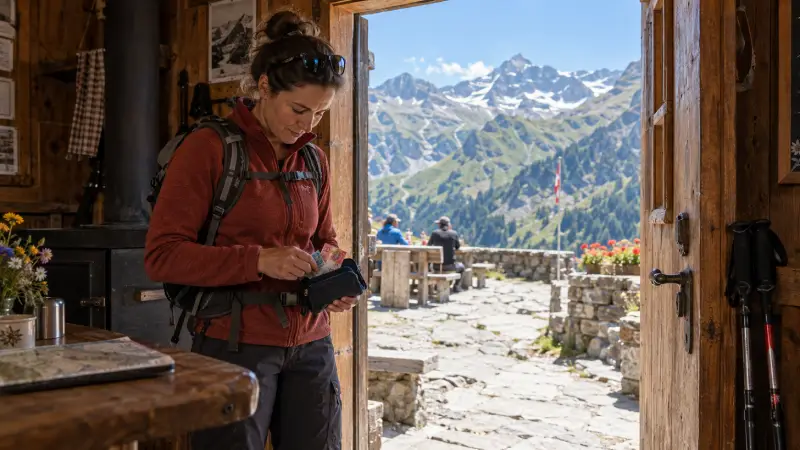
During a city stay in Zurich, Geneva or Lucerne, cash can mainly serve as a backup and cover small purchases. A hiking itinerary with hut accommodation needs a different calculation: you may need to carry enough for an entire stay before leaving the valley.
Use this approach:
Identify any unpaid bookings or purchases that require cash.
Add meals and extras you expect to buy at those stops.
Include a reserve for a temporary card problem.
Subtract cash you already have.
This gives you a useful withdrawal target without treating your whole holiday budget as cash spending.
Many Swiss mountain huts accept cashless payments, but acceptance varies and connectivity can be limited. Ask your booked hut which methods it accepts and whether accommodation, meals and extras are settled together.
Carry the necessary CHF before starting the walk. Small notes are easier to use for modest purchases than large denominations.
Payment preparation belongs alongside route and equipment planning. If you are heading beyond resort centres, review the practical advice on staying safe in the Swiss Alps.
TWINT is not a universal payment app for visitors. Eligibility depends on the version you use, your phone number, residence and funding arrangements.
The bank-issued TWINT apps and TWINT Prepaid have different conditions. Do not assume that downloading one will let you attach any foreign card and start paying.
As checked on 13 October 2026, the official TWINT Prepaid phone and residence requirements list:
Switzerland: +41
Germany: +49
Liechtenstein: +423
Austria: +43
Registration also requires residence in one of those countries. The registered number is verified by SMS, and TWINT may request additional information.
TWINT Prepaid cannot connect to a non-Swiss bank account, and credit cards cannot be saved as its payment method. Funding options include supported bank arrangements and credit vouchers, subject to the app’s limits.
The remaining-balance rule is particularly relevant to visitors: releasing Prepaid credit to a bank account requires an account in your own name in Switzerland. Loading a large holiday balance can therefore leave you with money that is inconvenient to recover.
If you are eligible and want to use TWINT, complete registration and understand funding and withdrawal conditions before relying on it. Otherwise, organise your trip around cards and CHF cash.
A Swiss mobile connection alone does not establish eligibility. Buying an eSIM does not change your residence or banking arrangements.
SBB accepts Visa and Mastercard credit, debit and prepaid cards through its online channels. SBB Mobile also supports Apple Pay and Google Pay. Ticket machines offer further options, including CHF cash and euro notes, with change returned in CHF.
Online payments may require 3D Secure verification through your bank’s app, an SMS or another approval method.
If a purchase fails:
Complete any bank verification request.
Look for the actual ticket in your orders or confirmation email.
Try another supported payment method if no ticket was issued.
Use a station sales channel if the online problem remains unresolved.
A pending bank authorisation can appear even after an unsuccessful attempt. It is not proof that you have a valid ticket. The SBB payment help page covers supported methods and failed transactions.
Make sure you can sign in to your bank app and receive whichever verification method your bank uses. If approval arrives by SMS, retain access to the number registered with the bank.
Roafly’s Switzerland eSIM provides mobile data for accessing banking apps and online bookings on a compatible phone. It is data-only and does not supply a local phone number or receive your bank’s SMS codes.
If you are deciding between mobile data, a local SIM and Wi-Fi, compare the available internet options in Switzerland before departure.
Tipping is voluntary in Switzerland. Rounding up the bill or adding a tip for good service is common, but you do not need to treat a fixed percentage as a mandatory charge.
Tell the server your intended total before completing the card payment, or leave a cash tip if you prefer. Read any amount already entered on the terminal before approving it.
Paying in CHF and claiming a tourist VAT refund are separate decisions. Choosing your payment currency does not start a refund application.
If you intend to make eligible purchases, arrange the necessary paperwork with the retailer and retain the receipts. Our guide to VAT refunds in Switzerland explains the shopping and departure steps.
Before booking a rental car or accommodation requiring a deposit, establish the total price and any separate card hold. Leave enough available credit or balance for the hold alongside your normal spending.
Bring the card required by the booking conditions. Do not assume that a digital wallet or a different person’s card will satisfy a rental company’s requirements.
Parking also deserves a quick payment check when you arrive. Follow the methods displayed at the location, particularly if you cannot use TWINT. The guide to renting and driving in Switzerland covers the wider road-trip preparation.
Complete the few tasks that would be inconvenient to solve at a station, checkout or hotel desk:
Know your physical card’s PIN and overseas transaction terms.
Bring a second payment card and store it separately.
Test access to your banking app and its verification method.
Identify cash-dependent stops before deciding how many francs to obtain.
Save your card issuer’s official contact details somewhere accessible without your wallet.
If you plan to use mobile data for bookings and bank approvals, compare eSIM plans for Switzerland before travelling.
If a card disappears, freeze or block it through your bank’s official channel and switch to your backup. Review transactions and report unfamiliar charges to the issuer.
Treat unexpected payment requests separately from ordinary transaction failures. Contact a hotel or operator through your original booking details before entering card information into a new link. Our guide to common tourist scams in Switzerland covers related booking and payment traps.
A city-focused trip may involve very little cash spending, but taking some CHF gives you another option if a payment fails or a seller cannot accept your card. A mountain itinerary requires closer attention to each stop’s payment arrangements.
The eighth banknote series was withdrawn as legal tender on 30 April 2021. These notes can still be exchanged at the Swiss National Bank at their full nominal value without a time limit. If you have francs left from an older trip, identify the series before relying on them for purchases.
Switzerland permits unrestricted amounts of cash to enter, leave or pass through the country, without a routine declaration requirement. You must answer customs questions truthfully.
If you carry, or are suspected of carrying, CHF 10,000 or more, officers can require information about your identity, the source and intended use of the money, and its beneficial owner. The Swiss cash border rules explain these checks.
Other countries on your route have separate requirements. Entering or leaving the EU with €10,000 or more, or its equivalent, triggers an EU declaration obligation. For accompanying purchases and other belongings, review the broader Swiss customs rules.
