


The useful distinction is between an unfamiliar charge and deliberate deception. Understand what you are buying, keep control of where you go, and verify unexpected payment requests independently. For broader questions about the trip, our guide to travel safety in Japan covers the wider picture.
Nightlife Invitations That Lead to an Inflated Bill
Tokyo’s nightlife warnings deserve particular attention around Kabukicho in Shinjuku, Roppongi, Shibuya and Ikebukuro. The warning sign is the approach and the payment arrangement, rather than the district name alone.
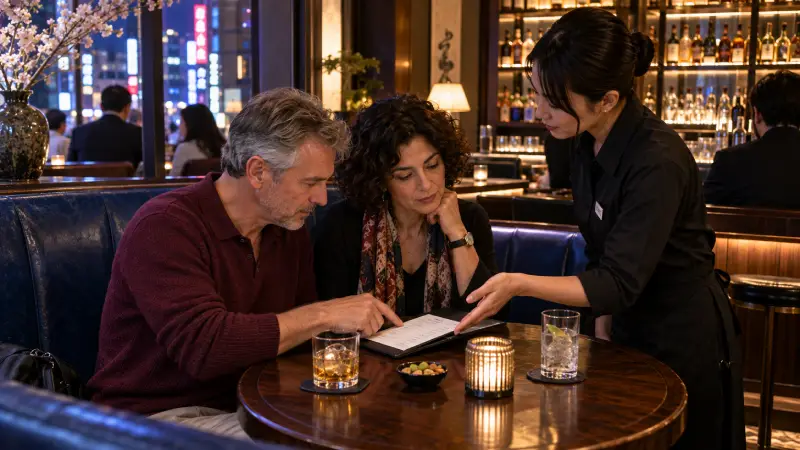
Street promoters may promise cheap drinks, free entry or an attractive package, then take you to a venue where the bill bears little resemblance to the offer. Hidden conditions, charges for services you did not knowingly order, and pressure to pay can follow.
Do not follow street touts into bars. Seeing a menu after you have followed someone inside is a weaker safeguard than selecting the venue yourself.
Before entering somewhere you chose independently, establish the admission charge, minimum order and any time limit. Our guide to planning a night out in Japan explains the different nightlife areas and venue types.
“Your Restaurant Is Full—Come to Our Other Branch”
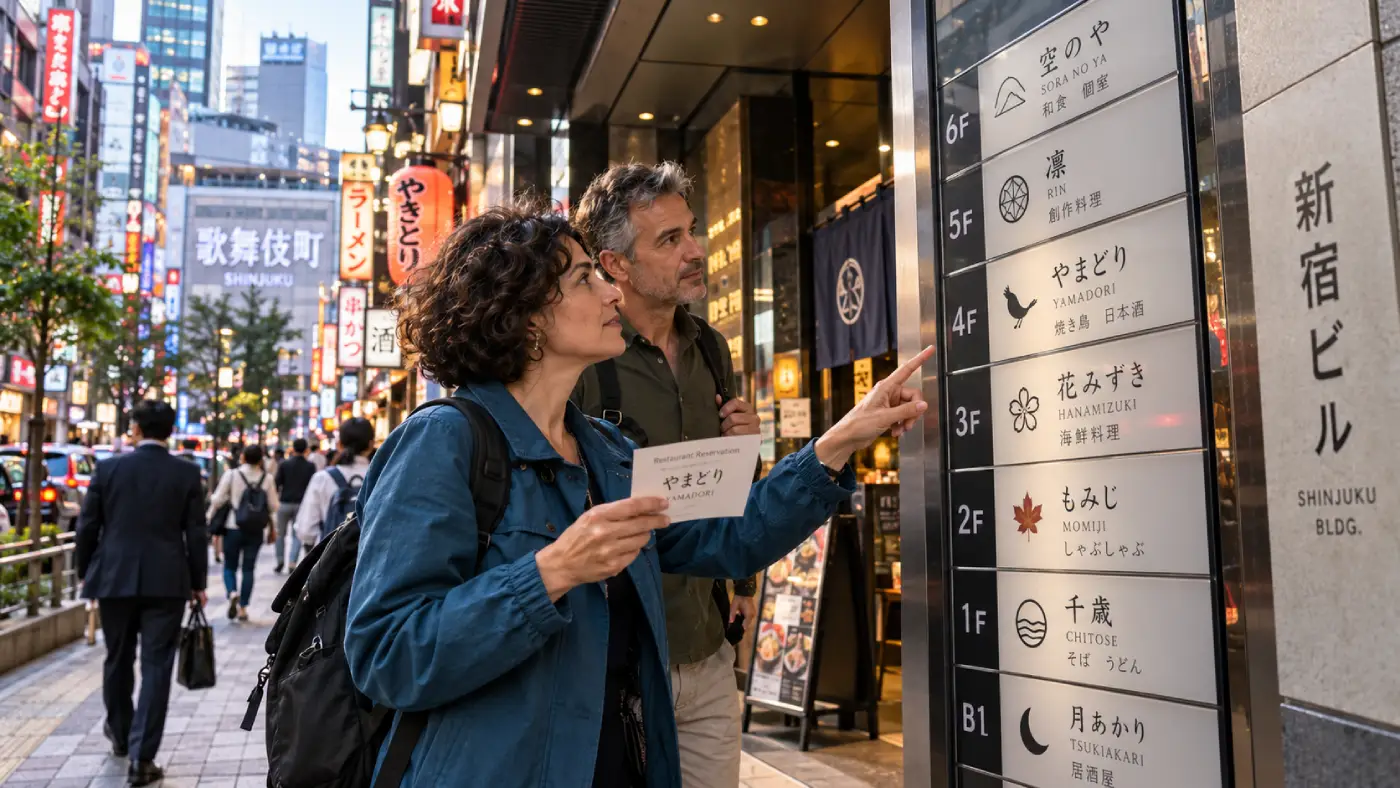
Someone standing outside a restaurant may look like an employee without having any connection to it. Tokyo police have documented people impersonating staff, telling customers the restaurant is full and redirecting them to an unrelated establishment.
Having a reservation does not make this approach impossible. The deception relies on your willingness to accept a helpful explanation and follow directions.
Speak to staff inside the restaurant or use the contact details in your booking confirmation. If a change of venue is genuine, the original business should be able to explain it directly. An unfamiliar person outside should not control that decision.
The Dating-App Match With a Particular Bar in Mind
Another route into an inflated bill begins. Someone you meet through a dating app or social media suggests a specific venue while concealing their connection to it. They may disappear before staff present the bill.
The practical difference from a street approach is the time spent building trust. Pleasant messages and an apparently ordinary first meeting can make the venue recommendation feel personal.
Suggest a public meeting place you select together. Treat insistence on unfamiliar bar, especially a sudden change after meeting, as a reason to decline. Keep the conversation and account details if you later need to report what happened.
Deposits for Services That Never Arrive
Tokyo police also describe touts collecting advance payments or deposits for promised adult services that are never provided. Further demands can follow under the guise of cancellation fees or threats to expose the encounter.
Do not hand over money for a service arranged by someone approaching you on the street. If threats begin, prioritize getting help and moving to safety over negotiating a replacement service or trying to recover the deposit yourself.
Drink Spiking and Unauthorized Card Transactions
Drink spiking and fraudulent card charges can occur alongside nightlife scams, but they require additional precautions beyond understanding the menu.
Japan’s current nightlife warning describes victims waking with gaps in their memory and discovering substantial charges on their cards. The warning specifically identifies Kabukicho, Roppongi, Shibuya and Ikebukuro among Tokyo’s areas of concern.
Keep your drink with you and decline drinks from strangers. Go out with companions who will notice if someone suddenly becomes unusually confused or unwell. Keep your card in sight when paying and read the amount before approving a transaction.
If a payment is said to have failed, establish what happened before authorizing another attempt. A pending bank entry can require clarification; it is not, by itself, proof that a transaction has settled or that fraud occurred.
Unexpected illness or a memory gap after drinking needs medical attention. Ask a trusted companion or staff at a safe location to help you obtain care. You do not need to determine exactly what happened before seeking assistance.
Fake Visit Japan Web Sites and Payment Requests
Visit Japan Web is a free government service for arrival procedures. It does not require your credit card details.
Fake websites and apps can imitate the service and ask for payment or personal information under the pretext of processing an arrival declaration. Other businesses sell assistance with a process you can complete yourself. A clearly disclosed private service is different from a website pretending that its fee is a mandatory government charge.
Use the official service reached through the links in Japan Customs’ warning about fake declaration websites. Avoid relying on a familiar-looking logo or the position of a search advertisement.
Two distinctions matter before you submit anything:
-
Visit Japan Web is not a visa. Your passport and trip circumstances determine the applicable visa and entry requirements for Japan.
-
Free electronic declarations do not mean every imported item is tax-free. Goods can still be subject to the normal Japanese customs declaration rules.
If you have already entered card details into a suspicious site, contact your card issuer through its official app or the number on your card. Explain what you submitted and retain the website address and any payment confirmation.
Hotel Messages Asking You to Verify or Pay Again
An unexpected payment message can appear convincing when it includes your hotel name and stay dates. Japanese hotels, including NOHGA Hotel Ueno Tokyo, have warned guests about messages impersonating the property or booking platform.
Typical pressure points include a demand to re-verify your card, a short deadline, or a claim that your reservation will be canceled unless you follow a link.
Open your booking account independently and review the original payment terms. Contact the hotel using details you obtained separately from the suspicious message. Ask whether the request, amount and payment channel are genuine.
Some hotels use legitimate external payment systems, so the presence of a link alone does not settle the question. The stronger warning is an unexpected demand that you cannot reconcile with your booking and verify directly.
Save the message before reporting it. If you entered a password, change it through the real service; if you submitted card information, notify your card issuer promptly.
The “Gift” That Becomes a Demand for Money
Reports from Ueno in Tokyo have documented people dressed as religious figures approaching visitors with amulets, then demanding payment after the visitor accepts what appeared to be a gift.
Reporting in 2023 described this around Ueno Toshogu Shrine. That establishes a documented example, not a claim that the same individuals remain there or that every temple area has this problem.
The deception involves an implied religious affiliation and an item whose price becomes apparent after it is in your hands. Clothing alone cannot establish someone’s connection to a shrine or temple.
Decline unsolicited objects when the terms are unclear. Buy charms from the site’s own sales counter and use its designated donation facilities if you want to contribute. If someone starts pressuring you, seek help from the attraction’s staff instead of arguing about the person’s identity.
Otoshi and Other Charges That Are Not Automatically Scams
Japanese izakaya and bars may serve a small appetizer called otoshi, also known as tsukidashi in parts of western Japan. It commonly functions as a cover charge, even though you did not order the dish separately.
A seating charge, service fee or expensive drink is not enough on its own to establish fraud. The relevant questions are what terms applied, whether they were misrepresented, and whether the bill includes items or services you did not authorize.
Before sitting down, ask about:
-
The charge per person, including otoshi or seating.
-
Any minimum order or minimum spend.
-
Time limits on drink packages.
-
Additional service charges and whether tax is included.
Our guide to ordering food in Japan explains the dining customs behind an ordinary restaurant visit.
If the bill is unclear, request an itemized explanation calmly. Avoid turning a pricing dispute into a physical confrontation.
Requests to Use Your Passport for Someone Else’s Shopping
Someone asking you to purchase goods using your tourist tax-free status may describe it as a harmless favor or offer a small reward. The transaction can leave you responsible for goods you no longer possess.
Japan’s tax-free shopping rules require the purchaser to take the goods out of the country. Purchases made on behalf of a third party at their request are not eligible simply because the person presenting the passport is a visitor.
Decline requests to use your passport or purchase allowance for someone else. Your name on the transaction matters more than their promise that everything is allowed.
This is a purchasing and tax-responsibility warning, rather than evidence that every such approach follows the same scam. Review the tax-free shopping rules in Japan before making substantial purchases for yourself.
Verify Airport Transfers and Taxi Bookings
Japan’s tourism authorities warn about unlicensed taxi operators, including around major airports. An unfamiliar transport offer should be assessed through the operator and booking channel rather than the driver’s assurances.
Arrange a pickup through an established company, an official booking service or your hotel. Match the arriving driver and vehicle to your reservation before leaving with them. A stranger offering an immediate alternative should not replace a booking you can verify.
Neither a high fare nor a street-hailed licensed taxi is automatically a scam. Check the applicable fare arrangement and keep the receipt. Our Japan transport guide compares taxis with train and other transport options.
Keep your accommodation address and transfer confirmation available offline. If you need live maps or translation, a Japan eSIM can provide mobile data on a compatible, unlocked phone; it does not include a local phone number.
What to Do if You Think You Have Been Scammed
Your next step depends on whether you are facing immediate danger, a suspicious transaction or a disagreement with a business.
-
Get to safety first. If you are threatened, prevented from leaving or otherwise in immediate danger, call police on 110 when you can safely do so. For an ambulance or fire emergency, call 119. Avoid confrontation and do not put yourself at risk to photograph evidence.
-
Secure your payment accounts. Use your bank’s official app or card contact number to report suspected unauthorized transactions. Ask about blocking the card and the appropriate dispute process. Reimbursement depends on the circumstances and the provider’s assessment.
-
Preserve useful records. Keep receipts, booking confirmations, messages, transaction details and the location. Write down the sequence of events while you remember it.
-
Use the appropriate reporting or advice channel. Report suspected crime to police. For consumer disputes involving shops, restaurants, bars, hotels or transport, contact the Consumer Hotline for Tourists.
The consumer hotline number is 03-5449-0906. It operates Monday to Friday, 10 a.m.–noon and 1–4 p.m., Japan time, excluding national holidays and December 29–January 3. English support is available, and standard call charges apply. The service offers advice to help you deal with the business; it does not have enforcement powers or guarantee a refund.
Japan’s Visitor Hotline, 050-3816-2787, provides visitor assistance around the clock in English, Chinese and Korean. It serves a different purpose from police, ambulance services and consumer dispute advice.
Set up a way to access bookings and contact details before you need them. Our guide to internet options in Japan covers the available connection methods. Keep a separate way to make ordinary phone calls, or ask hotel or station staff to help: a data-only plan does not provide standard voice service.