

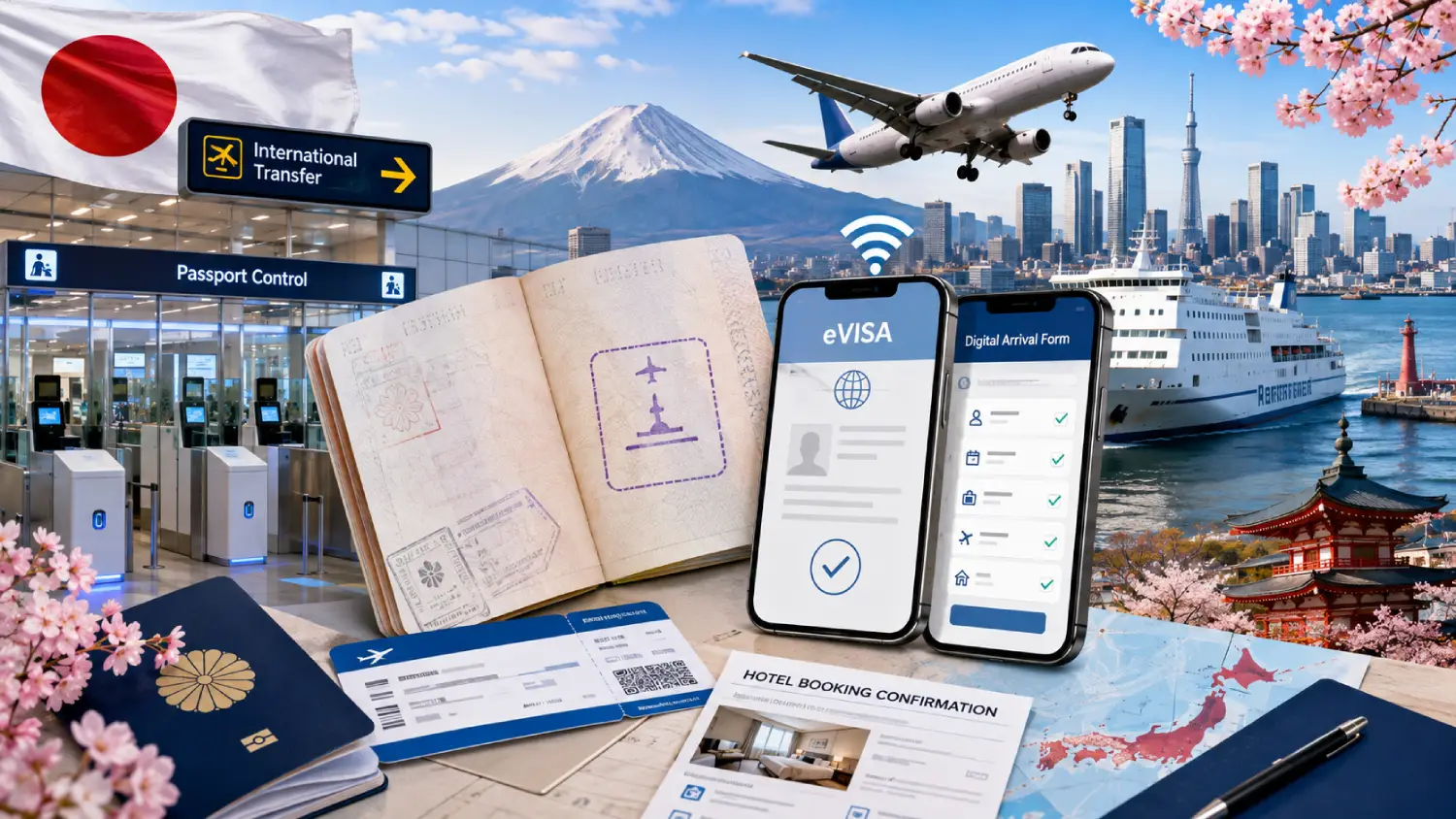

Visit Japan Web is a separate digital service for immigration, customs and tax-free shopping procedures. It is not a visa, eVisa or electronic travel authorization.
Rules depend on nationality, document type, travel purpose, country of residence and intended stay length.
Japan entry requirements at a glance
| Passport situation | Entry route | Typical stay | Main requirement |
|---|---|---|---|
| Ordinary passport covered by Japan’s visa-exemption arrangements | Visa-free Temporary Visitor admission | 15, 30 or 90 days | The passport must meet any nationality-specific ePassport, machine-readable or registration condition |
| Austrian, German, Irish, Liechtenstein, Mexican, Swiss or British citizen using the bilateral arrangement | Visa-free admission followed by an extension application when staying beyond 90 days | Up to six months if the extension is approved | Apply at a regional immigration office before the initial 90-day permission expires |
| Visa-required traveler residing in a direct eVisa jurisdiction | JAPAN eVISA | Usually up to 90 days | Tourism, an ordinary passport and residence in an eligible jurisdiction |
| Traveler covered by an agency-assisted eVisa arrangement | JAPAN eVISA through an accredited agency | 15, 30 or up to 90 days, depending on the route | Nationality, residence and tour conditions may apply |
| Visa-required traveler outside the eVisa arrangements | Visa issued before departure | Period stated in the landing permission | Apply through the Japanese diplomatic mission or authorized application channel responsible for the residence area |
| Passenger remaining airside without passing immigration | Airside transit | Connection period | Confirm that baggage collection, airport changes or passport control are not required |
| Transit passenger who must pass immigration | Visa exemption or advance visa | Based on the approved entry route | The traveler must qualify to enter Japan even when the visit is a connection |
A visa or visa exemption allows a traveler to request entry. Final admission and the permitted period of stay are determined during landing inspection.
Visa-free travel to Japan
Japan maintains visa-exemption arrangements for short visits by eligible ordinary passport holders. Travelers should verify their nationality and passport conditions on the official visa-exemption list before departure.
The permitted stay is divided into three main groups.
| Visa-free stay | Eligible passport group |
|---|---|
| 15 days | Indonesia and Thailand, subject to passport-specific conditions |
| 30 days | Brunei and Qatar, subject to the conditions stated below |
| 90 days | Other eligible countries and regions on the official exemption list |
Indonesia’s exemption applies to travelers whose ICAO-compliant ePassport has been registered with a Japanese diplomatic mission in Indonesia. The registration remains valid for three years or until the passport expires, whichever occurs first.
Thai passport holders must use an ICAO-compliant ePassport to qualify for the 15-day exemption.
Qatari nationals need an ICAO-compliant ePassport registered with a Japanese diplomatic mission. This registration is also valid for three years or until passport expiry, whichever comes first.
Several nationalities in the 90-day group have additional passport conditions:
-
Brazil, Montenegro, Panama, Paraguay, Peru, Serbia and the United Arab Emirates require an ICAO-compliant ePassport.
-
Malaysia’s exemption applies to holders of an ICAO-compliant ePassport.
-
Barbados, Lesotho and Türkiye require an ICAO-compliant machine-readable passport.
-
Taiwan’s exemption is limited to passports containing a personal identification number.
-
Hong Kong eligibility is limited to qualifying Hong Kong SAR passports and British National (Overseas) passports whose holders have the right of residence in Hong Kong.
-
Macao eligibility applies to Macao SAR passports.
-
Japan does not recognize the newer Uruguayan ordinary passport version that omits the place of birth from its personal-data page. The exemption applies to qualifying holders of the older passport version.
Ordinary passport holders outside the published exemption group generally need an appropriate visa before traveling to Japan. Residence in a visa-exempt country does not transfer that country’s exemption to a different nationality.
Travelers choosing dates for a short visit can use Best Time to Visit Japan to compare weather, crowds and seasonal travel conditions. Seasonal planning does not alter the immigration permission granted at the border.
Bilateral stays of up to six months
Austria, Germany, Ireland, Liechtenstein, Mexico, Switzerland and the United Kingdom have bilateral arrangements that can permit stays of up to six months.
Immigration normally grants 90 days on arrival. A traveler intending to remain beyond the initial period must apply for an extension at a regional immigration office before the existing permission expires.
The six-month arrangement does not mean that six months are automatically stamped into the passport on arrival. Extension approval must be obtained while the initial stay remains valid.
Visa on Arrival and advance visas
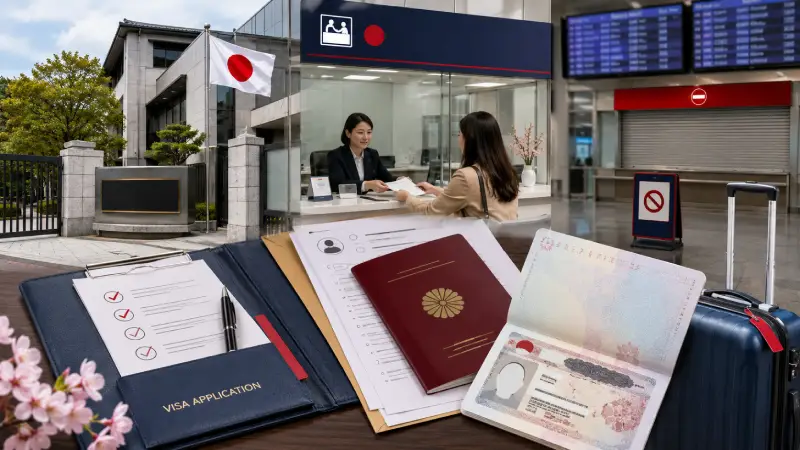
Japan does not issue a general tourist visa after a traveler reaches an airport or seaport. Visa-required visitors must complete the correct application process before departure.
Japan’s official visa guidance explains that applications may be accepted by a Japanese embassy or consulate, an accredited agency, a visa application center or the system, depending on the applicant’s residence and the instructions of the responsible diplomatic mission.
Application rules are residence-based as well as nationality-based. A traveler normally applies through the Japanese mission responsible for the country or region where they lawfully reside, rather than choosing any embassy for convenience.
Required documents, submission methods, visa fees and processing arrangements can differ between missions. Some locations accept direct applications, while others require an accredited agency or application center.
Short-term tourism status does not permit paid work or profit-making activities in Japan. Employment, long-term study, residence and other non-tourist purposes require the appropriate immigration route.
Who can use the JAPAN eVISA system?
JAPAN eVISA is an electronic application and issuance method for an eligible single-entry tourism visa. It is not a universal entry authorization, and availability can depend on both nationality and country of residence.
Visa-required foreign nationals residing in the following jurisdictions can use the direct application route:
-
Australia
-
Brazil
-
Cambodia
-
Canada
-
Saudi Arabia
-
South Africa
-
Taiwan
-
United Kingdom
-
United States
Travelers who are already visa-exempt do not need an eVisa merely because they live in of these places.
The official JAPAN eVISA eligibility page also identifies agency-assisted arrangements.
| Application jurisdiction | Who may use the arrangement |
|---|---|
| China | Chinese nationals residing in China |
| Philippines | Philippine nationals residing in the Philippines who join a packaged tour organized by a designated travel agency |
| Viet Nam | Vietnamese nationals residing in Viet Nam who join a packaged tour organized by a designated travel agency |
| Hong Kong, India, Indonesia, Macao, Mongolia, Republic of Korea, Singapore and United Arab Emirates | Visa-required foreign nationals residing in the relevant jurisdiction, subject to local mission rules |
Only ordinary passport holders qualify through the central eVisa system. Travelers using diplomatic, official, temporary, emergency or other special documents must follow the instructions applicable to that document.
The eVisa generally covers a single-entry short-term tourism visit of up to 90 days. Different limits apply to some agency routes:
-
Chinese nationals residing in China may receive a 15- or 30-day eVisa.
-
Eligible Philippine and Vietnamese packaged-tour applicants receive a 15-day eVisa.
JAPAN eVISA can be used for arrival by international flight. Sea arrival is limited to scheduled international passenger ferries operating between Japan and Busan or Shanghai.
At departure, the traveler must display the live Visa Issuance Notice in an internet-connected browser. A screenshot, printed copy or saved PDF is not accepted as a replacement.
Visit Japan Web and arrival procedures
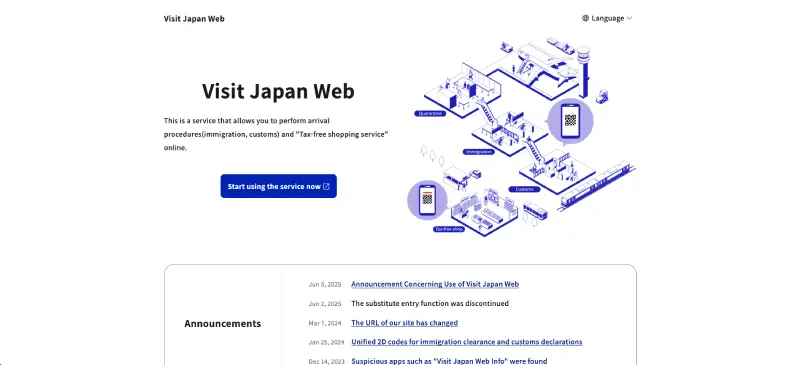
Visit Japan Web allows travelers to pre-register information for immigration, customs and the tax-free shopping service.
Using the platform is optional under the currently published procedures. It does not replace a required visa, does not extend a permitted stay and does not guarantee entry.
Travelers should keep the different processes separate:
-
Visa or eVisa: Permission required before travel for passports that are not exempt
-
Landing inspection: The border examination that determines whether the traveler may enter
-
Visit Japan Web: A digital tool for submitting arrival-related information
-
Customs declaration: Information about goods, currency and restricted items
-
Tax-free shopping registration: A retail procedure for eligible visitors
Customs questions about alcohol, medication, food, currency and prohibited goods are covered separately in Japan Airport Customs Rules: Alcohol, Meds & Prohibited Items.
Travelers planning to make tax-free purchases can review Japan Tax-Free Rules: How to Claim VAT Refunds for the shopping procedure. Neither customs clearance nor tax-free registration changes a traveler’s visa status.
Passport validity and supporting documents
Japan does not impose a general six-month passport-validity rule on every short-term visitor. Official Japanese embassy guidance states that a passport should remain valid throughout the intended stay, including departure from Japan.
Travelers using emergency passports, temporary passports, refugee travel documents or other non-standard documents should obtain confirmation from the Japanese mission responsible for their residence before booking.
The official Japanese embassy guidance on passports and visas also notes that visa applicants submitting a physical passport need sufficient blank space for the visa and immigration endorsements.
Documents that may help support a short tourist visit include:
-
A confirmed return or booking within the permitted stay
-
Accommodation reservations or the address of a host
-
A credible tourism itinerary
-
Evidence of sufficient funds for the planned trip
-
The live eVisa issuance notice or physical visa, when required
-
Documents explaining an unusual itinerary or extended visit
These documents are not necessarily requested from every passenger. Immigration officers may examine whether the stated purpose, available funds and intended length of stay are consistent with Temporary Visitor status. Airlines may also check entry eligibility before allowing a passenger to board.
Transit and arrival by sea
Passengers who remain in the international transit area and do not pass through immigration generally do not need a Japanese visa solely for the connection.
The official transit guidance distinguishes airside transit from itineraries that require entry into Japan.
A traveler may need to pass immigration when the itinerary involves:
-
Collecting and rechecking baggage
-
Separately ticketed flights requiring a new check-in
-
Changing between Narita and Haneda or another airport
-
Leaving the secure transit area
-
An overnight connection where the airport transit area closes
-
Changing terminals through a landside route
-
Passing passport control for any other reason
Visa-exempt passport holders may enter under the applicable exemption when their connection requires immigration clearance. Visa-required travelers must obtain the appropriate short-term visa before departure.
Japan has no international land borders. Cruise and ferry passengers still need to meet the immigration rules applicable to their passport and travel document. eVisa use for sea entry is limited to the scheduled ferry routes specifically listed by the Ministry of Foreign Affairs.
Extensions and overstaying
Most Temporary Visitors should plan to leave Japan within the period written in their landing permission.
The clearest routine extension arrangement applies to nationals of Austria, Germany, Ireland, Liechtenstein, Mexico, Switzerland and the United Kingdom who are using the bilateral six-month provision. They must apply before the initial 90-day permission expires.
Other Temporary Visitors should not assume that additional tourist time will be granted. An extension application is not an automatic renewal, and approval depends on the traveler’s circumstances and immigration’s decision.
Remaining after the authorized period is an immigration violation. It may lead to detention, departure or deportation procedures and restrictions on future entry. Travelers dealing with a serious emergency should contact the Immigration Services Agency before their existing permission expires.
Repeated border crossings should not be treated as a guaranteed way to reset a stay. Each arrival is examined independently, and tourist status must not be used for employment or other activities outside its permitted purpose.
Common entry mistakes
Common problems include:
-
Checking eligibility according to residence rather than passport nationality
-
Assuming Japan offers tourist visas on arrival
-
Treating eVisa as available to every nationality and every resident
-
Calling Visit Japan Web a visa or ETA
-
Presenting a screenshot instead of the live eVisa issuance notice
-
Assuming every passport needs six months of remaining validity
-
Overlooking ePassport, machine-readable passport or registration conditions
-
Booking a connection without checking baggage collection or airport changes
-
Expecting a six-month stay to be granted automatically on arrival
-
Confusing immigration requirements with customs or tax-free shopping procedures
Japan entry requirements FAQs
Do US citizens need a visa for Japan?
Ordinary United States passport holders can enter visa-free for up to 90 days for tourism and other qualifying short-term activities that do not involve paid work.
The passport must remain valid throughout the stay. Entry is still subject to landing inspection, and travelers should be prepared to show a return or booking when requested.
Do UK citizens need a visa for Japan?
British citizens can enter Japan without a visa for an eligible short-term visit.
Immigration normally grants 90 days on arrival. A British citizen intending to remain for longer under the bilateral arrangement must apply for an extension before the initial permission expires.
Other British passport categories do not necessarily receive the same treatment as a British Citizen passport.
Do Indian citizens qualify for Visa on Arrival?
No. Indian ordinary passport holders are not included in Japan’s tourist visa-exemption group, and Japan does not provide a general tourist Visa on Arrival route.
Visa-required foreign nationals residing in India may be eligible for the agency-assisted eVisa process. Residence in India alone does not determine eligibility; nationality, passport type and travel purpose must also satisfy the current rules.
Can Chinese passport holders use the eVisa?
Chinese nationals residing in China may use the accredited-agency eVisa route. The available tourism eVisa may permit a stay of 15 or 30 days.
A Chinese passport holder lawfully residing in of the direct eVisa jurisdictions may instead qualify through the residence-based channel. The correct route therefore depends on both nationality and residence.
Do Turkish citizens need a visa for Japan?
Eligible Turkish ordinary passport holders can enter visa-free for up to 90 days when using an ICAO-compliant machine-readable passport.
A traveler whose document does not meet the machine-readable requirement should obtain passport-specific advice and may need a visa before departure.
Is Visit Japan Web a visa?
No. Visit Japan Web is an optional service for pre-registering immigration, customs and tax-free shopping information.
Travelers who require a visa must obtain it through the appropriate visa or eVisa process. Completing Visit Japan Web does not create entry eligibility.
Staying connected after arrival
Mobile data can help travelers open maps, contact accommodation providers, check train routes, retrieve bookings and access digital travel documents.
How to Get Mobile Internet in Japan explains the broader connectivity choices, including airport options, local prepaid SIM cards, pocket WiFi, roaming and eSIMs.
Travelers who specifically want to compare eSIM companies can use Best eSIM for Japan: Plans, Speed & Coverage Compared. It focuses on providers, plan features, connection speeds and coverage in Japan.
Roafly Japan eSIM can provide mobile data during the trip, but it does not affect visa eligibility, landing permission or the authorized length of stay.
Need data in Japan? Get an eSIM!
Choose the perfect data plan for your trip

Manage your eSIM in the app
Install, top up and track data.