Download the App and manage your eSIMs easily
Create your order quickly
See your eSIM details
Track your remaining data
Download the App and manage your eSIMs easily
Create your order quickly
See your eSIM details
Track your remaining data
Oaxaca’s neighbourhood celebrations and Mexico City’s monumental parade offer different ways to experience Día de Muertos. Here’s how to choose your base, time your visit and take part respectfully.

Ethan Brooks
Updated Oct 27, 2026
10 min read
Save 15% on your Roafly eSIM
Stay connected on your next trip. Use the code below at checkout.
View All DestinationsJump to section
👇Save 15% on your Roafly eSIM
Stay connected on your next trip. Use the code below at checkout.
View All Destinations
Manage your eSIM in the app
Install, top up and track data.
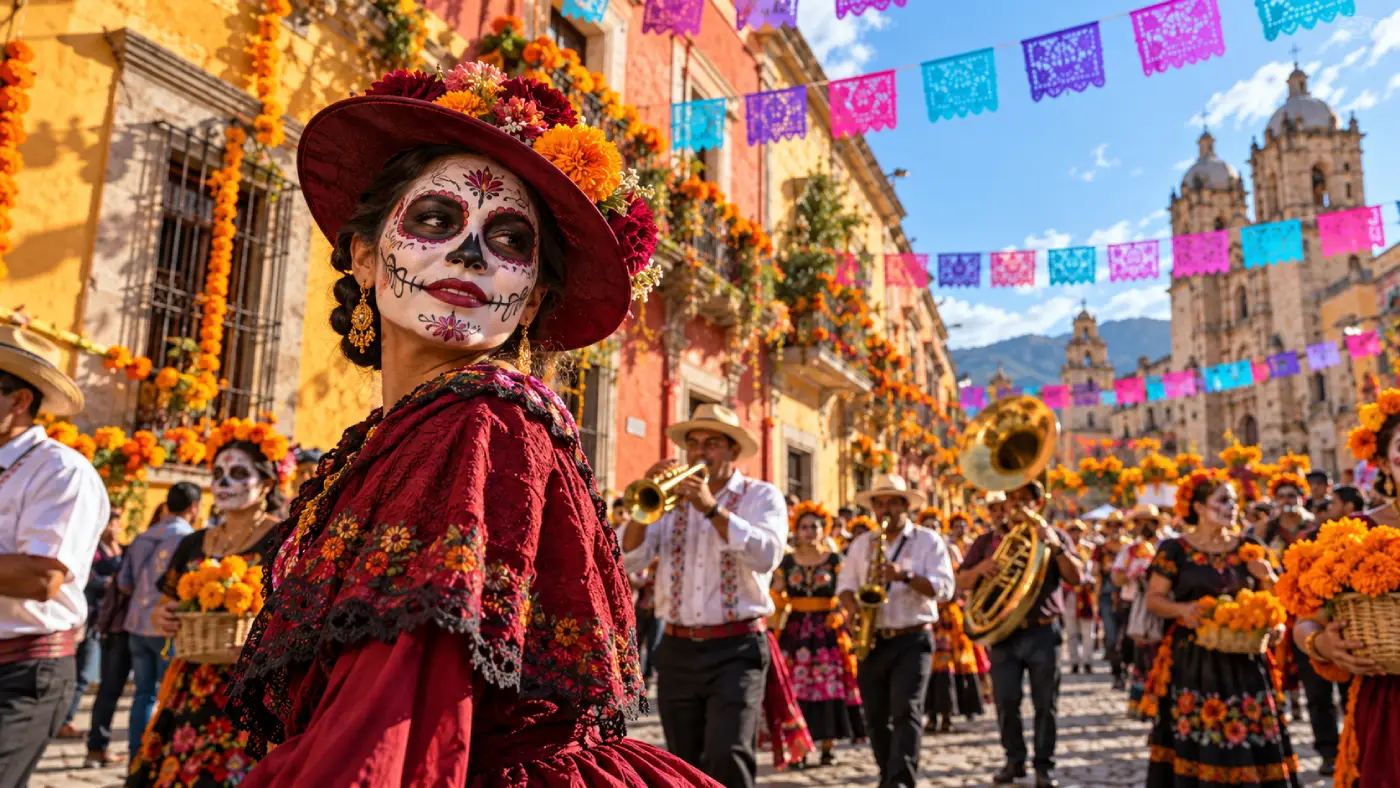
Oaxaca is our choice for a trip centred on neighbourhood celebrations, decorated streets and the traditions of surrounding communities. Mexico City suits a visit built around the large parade, monumental altars and sightseeing across the capital.
The most useful decision is where you want to spend the main festival evenings. In 2026, both cities hold their major processions on October 31, while important cemetery gatherings happen on different nights. Pick your priority before booking transport: moving between cities can cost you the very event you travelled to see.
Día de Muertos centres on November 1 and 2, with preparations and public events extending into late October. Families honour deceased loved ones through offerings, food, flowers and time spent together. Many traditions associate November 1 with children who have died and November 2 with adults, although practices vary between communities.
The ofrenda, or offering altar, helps explain what you are seeing. Photographs, candles, cempasúchil flowers and favourite foods remember particular people and welcome their return in the family’s tradition. Public installations bring these ideas into streets and squares; household altars and cemetery gatherings remain personal.
Festival dates and parade dates are separate planning questions. Arriving on November 1 can mean missing a city’s largest procession.
| Event | Date and local time | Location |
|---|---|---|
| Oaxaca’s main festival programme | October 26–November 3 | Oaxaca City and participating communities |
| Jalatlaco sand tapestry | October 26–November 3 | Atrium of the San Matías Jalatlaco church |
| Verbena Xandú | October 30, 7:30 p.m. | Oaxaca’s Zócalo |
| Oaxaca Gran Comparsa | October 31, 6 p.m. | Starts at Fuente de las Ocho Regiones |
| Mexico City’s monumental ofrenda | October 29–November 2 | Zócalo |
| Mexico City’s Grand Day of the Dead Parade | October 31, 2 p.m. | Paseo de la Reforma towards the Zócalo |
| Mixquic celebrations and La Alumbrada | October 31–November 2; Alumbrada on November 2 in the evening | San Andrés Mixquic, Tláhuac |
The Oaxaca programme and Mexico City programme provide the event details above. Dates and times were checked on October 27, 2026.
These are edition-specific schedules. Keep November 1–2 as the cultural reference when planning a future trip, then build your itinerary around that year’s announced events.
Oaxaca makes it easier to build several days around the celebration itself: decorated façades, neighbourhood displays, street processions and visits to nearby communities. Mexico City offers a larger urban spectacle, with the Reforma parade and Zócalo installations forming the centre of a broader city break.
| Your priority | Better starting point | What to plan carefully |
|---|---|---|
| Neighbourhood celebrations and regional traditions | Oaxaca City | Which evening to spend in the centre and which to reserve for a nearby community |
| The large parade and monumental public displays | Mexico City | Accommodation location and movement around the parade route |
| A cemetery gathering near Oaxaca | Oaxaca, with a visit to Xoxocotlán | The October 31 evening visit and your return transport |
| Mixquic’s candlelit Alumbrada | Mexico City | A separate November 2 excursion with an arranged return |
Four nights, arriving on October 30 and leaving on November 3, would be our starting point for either base. That gives you time for the main procession, another evening experience and some unhurried daytime exploring. Arriving earlier opens up more of the published programme.
Both cities can fit into a longer Mexico trip. Keep the main festival nights in one place, then travel before or afterwards. If you are adding a beach stay or another region, use our guide to the best time to visit Mexico to plan that part separately.
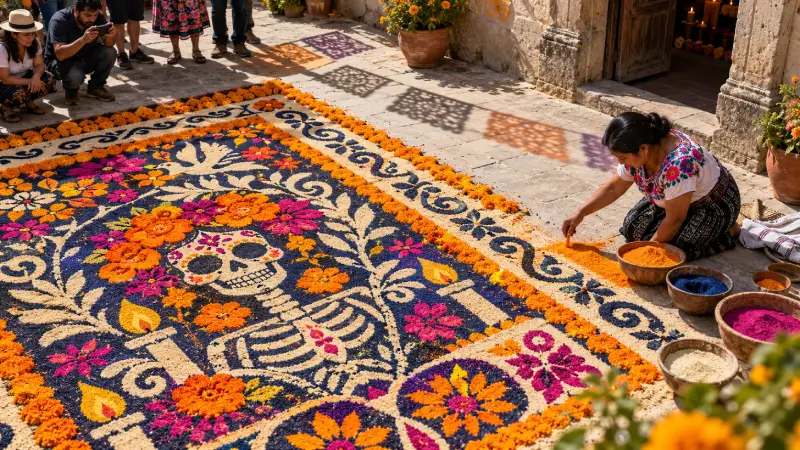
Oaxaca’s appeal extends beyond one procession. The Centro Histórico’s decorated façades, Jalatlaco’s sand tapestry and public celebrations give you reasons to explore on foot during the day, then return to a different setting in the evening.
Jalatlaco’s 2026 tapestry occupies the church atrium from October 26 to November 3. Treat it as artwork to view from the edges, leaving space for other visitors and people using the church.
On October 30, the Verbena Xandú begins at 7:30 p.m. in the Zócalo. Participating stalls share bread, tamales, chocolate and coffee free of charge. It offers a food-centred evening alongside the more visually elaborate processions and displays.
The following evening, the Gran Comparsa starts at 6 p.m. from Fuente de las Ocho Regiones. Music, costumes and moving groups make this a different experience from browsing altars: give the procession room and choose a viewing position that lets you step away comfortably.
Santa Cruz Xoxocotlán’s principal cemetery vigil takes place on the night of October 31. The announced 2026 programme includes gatherings at San Sebastián Mártir, Mictlancíhuatl and Monte Albán cemeteries.
That creates a real choice within an Oaxaca itinerary: the city’s Gran Comparsa and Xoxocotlán’s vigil share the same evening. We would give one priority rather than build the night around a rushed transfer.
If the cemetery visit matters most, arrange transport around that visit. Agree on a return time, pickup point and driver contact before leaving Oaxaca. When comparing organised excursions, look at how much time is spent at the cemetery, the group size and the return arrangements—not simply the number of stops advertised.
Families gather beside the graves of people they knew. Let their use of the space guide yours.
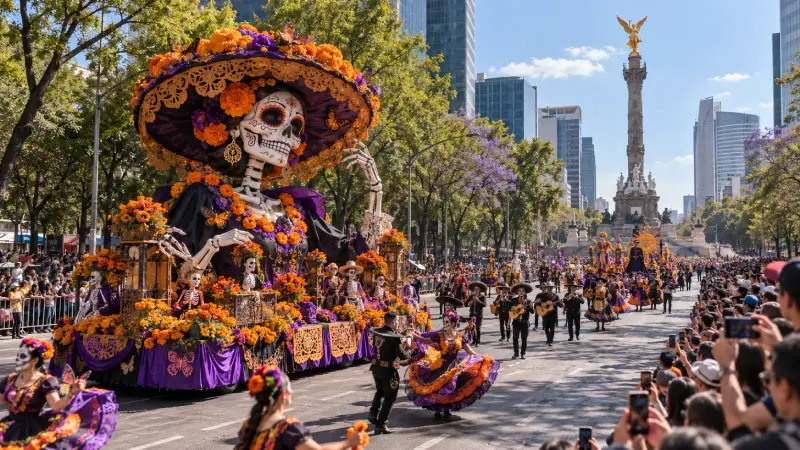
Mexico City’s Grand Day of the Dead Parade takes place on October 31 at 2 p.m., following Paseo de la Reforma towards the Zócalo. Floats, dancers, musicians and large sculptural figures make it the clearest choice for visitors who want the capital’s major public spectacle.
Keep that afternoon flexible. Choose a stretch of the route, arrive ahead of the procession and avoid a tightly timed restaurant booking or departure immediately afterwards. With children or anyone who finds prolonged standing difficult, prioritise a position you can leave easily.
The Zócalo’s monumental ofrenda runs from October 29 to November 2. Visit it on another day if you would rather spend the parade afternoon watching from Reforma. Community ofrendas and celebrations in places such as Coyoacán and Tlalpan also offer ways to explore beyond the main square.
San Andrés Mixquic, in the Tláhuac borough, holds celebrations from October 31 to November 2. La Alumbrada takes place on the evening of November 2, when candles illuminate the cemetery during the remembrance of the dead.
Set aside the excursion properly. Arrive before the evening gathering and arrange the journey back before you go, especially if you intend to stay late. The November 2 timing makes Mixquic a separate experience from the October 31 city parade.
Keep voices low during the Alumbrada, ask before photographing families and leave graves and offerings untouched. You can appreciate the candlelight without moving into someone’s family space.
Many public altars, street decorations and community processions are free to enjoy. Oaxaca’s Verbena Xandú includes free food and drinks, while Mexico City’s Zócalo programme includes free concerts.
Paid experiences have their own terms. Guided excursions, performances, boat trips and special exhibitions may require a reservation or ticket. Identify the actual venue or operator and what the purchase includes before paying.
A guided excursion is most useful when it solves a specific problem: understanding a community’s traditions, reaching a place outside your base or getting back after an evening visit. A tour is less compelling if it mainly takes you between central displays you are comfortable visiting independently.
Before booking, establish:
The exact stops and time spent at each.
Whether entry charges are included.
Where pickup and drop-off happen.
Whether transport back to your accommodation is included.
The cancellation terms and any age or mobility restrictions.
Keep some pesos available for food, markets and small purchases. Our guide to cash and card payments in Mexico covers how to organise that part of your spending.
In Oaxaca, start with accommodation in the Centro Histórico if walking to central displays and evening events is your priority. Jalatlaco is worth considering if its neighbourhood setting appeals to you. Ask about the room’s position and evening noise before choosing accommodation directly beside a celebration area.
In Mexico City, compare hotels around Reforma and the Centro Histórico against the events you intend to attend. Being close to your chosen parade viewing point can simplify the day; proximity to the Zócalo suits repeated visits to the central installations. Ask your hotel about arrival access if you will be checking in on parade day.
The 2026 Mexico City Grand Prix weekend also falls on October 30–November 1. Price your actual accommodation dates before committing to flights or a festival itinerary. Our Mexico travel budget guide provides a broader starting point, but your festival-week hotel quote should drive the lodging calculation.
ADO operates services between Mexico City and Oaxaca, including departures from TAPO. Typical journey times are around six to eight hours, depending on the service and traffic. Compare your actual departure terminal, arrival time and fare through ADO’s festival travel page.
That journey is substantial enough to shape the itinerary. With Mexico City’s parade at 2 p.m. and Oaxaca’s procession at 6 p.m. on the same day, plan around attending one of them.
Place the intercity journey outside your priority festival evening. Our guide to getting around Mexico covers the wider choice between buses, flights and local transport.
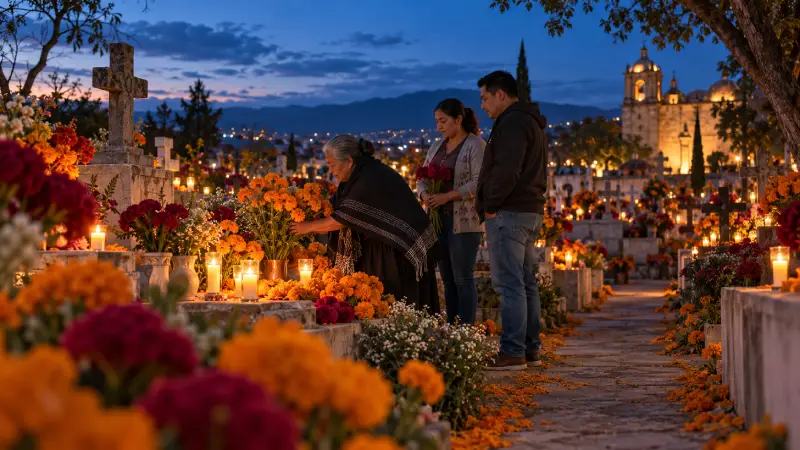
Public processions invite participation and celebration. Cemetery visits call for closer attention to the people around you. Watch how families use the space, keep paths clear and ask permission before photographing individuals or private altars.
Stay off graves and do not move candles, flowers or offerings to improve a photograph. Keep flash away from people taking part in a vigil. If a family or organiser asks you to move back, do so promptly.
Comfortable shoes, a light layer for the evening and a charged phone are useful preparations. Carry a power bank if you expect to be out from daytime sightseeing through a late return. Anyone who needs step-free access or seating should discuss the exact venue and route with the organiser before booking an excursion.
Keep your phone and valuables secure, agree on a meeting point with companions and save your accommodation address. Wider route decisions belong in your overall travel planning; our guide to safety when travelling in Mexico covers that broader context.
Complete your Mexico entry requirements checks before paying for non-refundable travel. Save transport tickets, accommodation details and excursion pickup instructions somewhere you can access offline.
Install the useful apps for Mexico you intend to use before your first evening out. Keep the return address and driver contact available even if you usually rely on an app.
If you are comparing mobile data options, our guide to the best eSIM for Mexico explains plans and networks. On a compatible, unlocked phone, Roafly’s Mexico eSIM provides prepaid data for maps, bookings and messaging while you travel.
Before leaving for a procession or cemetery visit, settle one final detail: how you will get back. Save the pickup point, share it with your companions and give the evening room to unfold.
