



The biggest planning mistake is comparing the main ticket. In the Yucatán Peninsula, reaching a Tren Maya station can change the calculation. In Cancún, an airport bus may reach a useful stop in the Hotel Zone, but you still need to check the distance to your hotel.
Match the transport to the journey
Compare the complete trip between your accommodation at both ends, including luggage charges, waiting time and connections.
| Transport | Most useful for | Check before booking |
|---|---|---|
| Reserved intercity bus | City-to-city trips within a region | Exact terminals, service class, arrival time and baggage allowance |
| Domestic flight | Long distances or a limited travel schedule | Airport location, baggage charges and the final payable total |
| Tren Maya | Journeys served by its southeastern network | Station access, departure times and transport |
| Rental car | Several dispersed stops with limited convenient public transport | Insurance, deposit, parking and return-location charges |
| Passenger ferry | Island connections such as Cozumel and Isla Mujeres | Departure pier, operator and current sailing information |
The cheapest ticket can lose its advantage several people need a taxi at the other end. Conversely, a bus arriving near your accommodation may be more convenient than a shorter flight with two lengthy airport transfers.
Booking intercity buses and domestic flights
Find the right bus and terminal
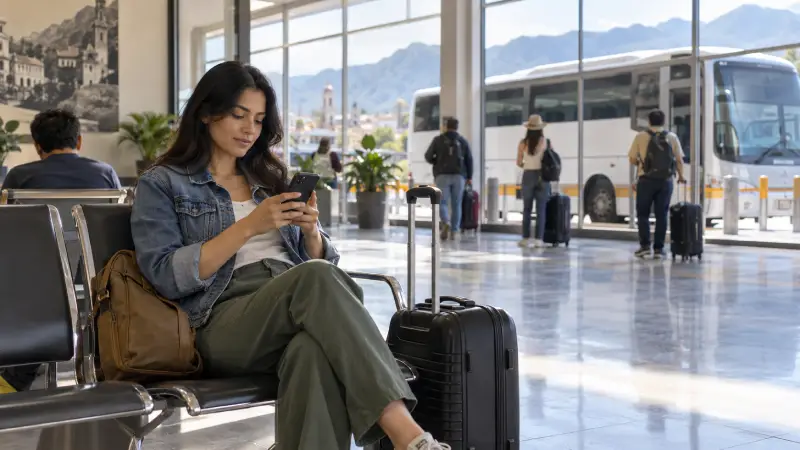
ADO is a useful starting point for routes involving Mexico City, Puebla, Oaxaca and the southeast. ETN Turistar serves destinations including Guadalajara, Querétaro, Morelia and San Miguel de Allende. Search your actual journey: neither company should be treated as the operator for every route in Mexico.
Pay attention to the complete departure and arrival names. A city name alone may cover several terminals or boarding points. Check the map location before paying, then save the address with your ticket.
Service class also matters. Compare the seat layout, scheduled stops, luggage allowance and change conditions shown for that departure. Brand names and descriptions such as “luxury” are less useful than the actual service details.
ETN's ticket conditions, for example, include 25 kg of baggage and recommend arriving around 30 minutes before departure to check luggage and board. Those conditions belong to ETN; check the allowance separately when booking another company.
Use your name as it appears on your passport, keep the ticket available offline, and have your original identification ready. Confirm any additional boarding requirements in your booking.
Paying and choosing an arrival time
Online payment options vary by operator and sales channel. ADO ticket offices accept cash and bank cards, providing an alternative to checkout. A listed card brand does not guarantee that every foreign-issued card will be accepted.
If payment fails, check whether a booking or charge was created before trying again. Use another payment method offered by the operator or buy at its ticket office, allowing for seat availability.
Prefer a daytime journey where practical and plan the transfer from the arrival terminal before departure. UK travel advice recommends first-class buses using toll roads; this reduces some risks without making every route equally suitable. Check the regional safety advice for Mexico before committing to a longer road journey.
Compare the full flight price
Flying deserves a comparison when the road journey would consume much of a travel day. Include the journey to the airport, check-in time, baggage collection and transport at the destination.
Read the fare bundle before judging the price. Volaris separates baggage allowances by fare, so a personal item, cabin suitcase and checked bag should not be treated as interchangeable inclusions.
Leave a generous buffer when a flight connects with a separately booked bus or train. Separate bookings may leave you responsible for rearranging the trip if the first service is delayed.
City transport: use the local payment system
Mexico City's transport card is not a countrywide pass. Guadalajara and Monterrey have their own systems, while smaller local services need to be checked individually.
| City | Useful public transport | Practical payment starting point |
|---|---|---|
| Mexico City | Metro and Metrobús | Movilidad Integrada card; both systems also accept contactless payment with supported international bank cards |
| Guadalajara | Mi Tren and Mi Macro | Full-fare Mi Movilidad card |
| Monterrey | Metro and Transmetro | Me Muevo card; Metrorrey also lists app-based QR payment |
Mexico City
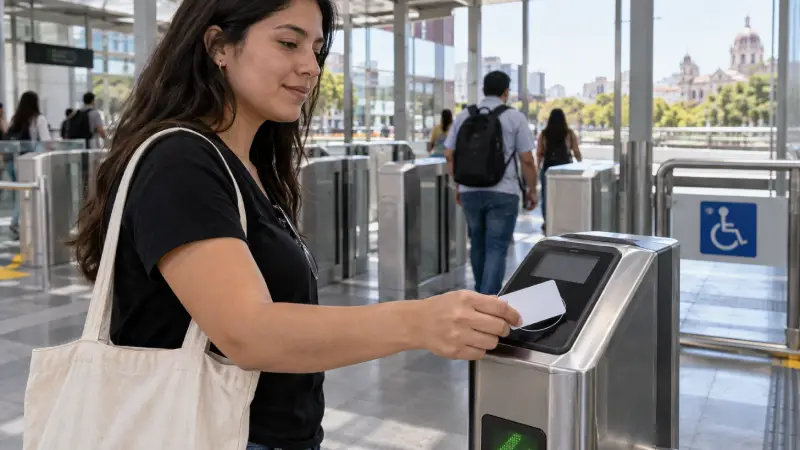
The Metro fare is MXN 5 per journey, including internal transfers. Both Metro and Metrobús accept contactless payments with supported international bank cards, as well as compatible digital wallets and Movilidad Integrada cards.
Keep a backup payment method and some peso cash for card purchases or top-ups. Do not assume that the same bank card or phone wallet works on every other transport service.
Metrobús is a separate bus rapid transit system. The Movilidad Integrada card is useful across both, but check fares separately when switching systems. Confirm the fare and payment options for the service you will actually use, especially for airport travel.
With a large suitcase, compare the number of station changes and the walk to your accommodation. Avoiding a difficult interchange can be worth more than saving a small amount on the fare.
Guadalajara and Monterrey
In Guadalajara, the regular Mi Movilidad card costs MXN 30 and is sold through designated station vending and recharge machines. This is the card purchase price; you still need travel credit. The full-fare card is distinct from concessionary programmes that require eligibility documentation.
Monterrey uses Me Muevo. Cards are available at Metro stations and participating retailers, while Metrorrey lists its payment options and recharge locations. Visitors who prefer a physical card can avoid depending on an unfamiliar app for their first journey.
Local buses and shared vans require more route-specific preparation. Ask your accommodation where to board, confirm the destination and fare before travelling, and carry small peso notes or coins. Check luggage space before relying on a shared van for an airport-sized suitcase.
Taxis and app-booked rides
Use a licensed taxi or an app-booked ride where available when luggage or several transfers make public transport impractical. With a taxi, establish whether the trip uses a meter or an agreed fare before setting off. With an app, check the quoted journey, pickup point, registration plate and driver details against the vehicle that arrives.
Keep the booking in the app and avoid accepting an unsolicited replacement ride. Airport pickups need their own checks, even if the same app works for ordinary city journeys.
Airport arrivals: confirm where the service leaves you
Mexico City airport
At Benito Juárez International Airport, use the airport's authorised taxi providers to identify the official services. Confirm the destination, vehicle size and total fare before paying.
Keep airport pickups separate from ordinary city ride-hailing. Access arrangements for app-based vehicles have been disputed, and an app displaying a car does not establish that it can collect you at your terminal door. Verify current airport instructions before relying on that option.
The Metrobús Line 4 airport service connects Terminals 1 and 2 with central Mexico City and has a fare of MXN 30; the standard Metrobús fare is MXN 6. Movilidad Integrada cards can be purchased and recharged at machines in both terminals' boarding areas.
Book an authorised airport taxi or confirmed transfer when substantial luggage makes public transport impractical. Check the flight's airport and terminal before booking any ground transport.
Cancún and the Riviera Maya
ADO lists a direct airport service to Punta Cancún in the Hotel Zone, with departures from Terminals 2, 3 and 4. Its destination is a fixed bus stop near kilometre 9 of Boulevard Kukulcan.
The bus does not deliver passengers to individual resorts. Check your hotel's entrance and the journey before selecting this stop. Accommodation near Punta Cancún may suit that service; a hotel farther along the coast may make a direct transfer more practical.
Select the correct airport terminal and check live departures for your arrival date. Allow time for immigration and baggage collection rather than matching a bus departure to the aircraft's scheduled landing.
Before buying flights, choosing between Cancún and Tulum airports can change the cost and length of the ground journey.
Tren Maya and ferries need an-connection plan
Tren Maya is worth comparing for journeys served by its southeastern network. Start with the station location, then check the train departure and how you will reach your accommodation afterwards.
The operator's connection and ticket guidance explains that intermodal transport links some stations with city centres or nearby airports. Availability and schedules vary by station, so do not assume that every train comes with a convenient connecting shuttle.
Buy through a sales channel linked from the official Tren Maya site and select the correct passenger category. Check any eligibility conditions before choosing a discounted fare.
Tickets cover the journey purchased. If you get off before the booked destination, the same ticket does not let you resume the trip on a later train. Plan sightseeing stops as separate legs.
Island travel requires a similar check at the pier. For Cozumel and Isla Mujeres, consult the operator's ferry routes and departures, then confirm the departure location and return service before paying.
Compare-way and return ticket conditions if your plans are flexible. Leave room for disruption when a sailing connects with a flight, and check operating updates during unsettled weather.
Rent a car when it improves the itinerary
Car rental can be useful for several scattered stops, particularly when public transport would require repeated backtracking. It is less compelling for a city stay where you would mainly pay to park.
Request the complete quote before comparing companies. Check:
-
What third-party liability cover is included and what other protection is offered.
-
The damage excess or deductible and exclusions.
-
The deposit or card hold.
-
Additional-driver and young-driver charges.
-
One-way return fees, fuel terms and mileage conditions.
Hertz Mexico's rental guidance, for example, requires a valid licence, identification and an appropriate payment card, with the deposit affected by the vehicle and protection selected. Other suppliers and branches may apply different conditions.
Bring your original licence and passport. Ask the rental company whether your licence's issuing country or language requires an International Driving Permit or translation; an IDP accompanies your national licence rather than replacing it.
Confirm that any credit-card rental protection satisfies the supplier's requirements. Do not assume that cover for damage to the rental vehicle also settles third-party liability.
Use current regional advice to choose the route, favour daylight driving and consider toll roads where appropriate. In Mexico City, ask the rental company whether the vehicle is affected by Hoy No Circula or other driving restrictions.
Check luggage and accessibility before paying
Large luggage can change which option is practical even when it is technically permitted. Check storage, boarding steps and the distance between stops, especially when combining a train, local bus and taxi.
Keep valuables, medication and travel documents with you when a suitcase goes into a coach's luggage compartment.
If you need step-free access or wheelchair space, confirm the whole journey: station entrance, platform, vehicle and transfer. Tren Maya documents dedicated wheelchair areas, but contact the operator about the booking process and assistance required. Accessible space on a train does not establish that every station connection will meet your needs.
Prepare tickets, payments and the last connection
Save these essentials before leaving your accommodation:
-
Tickets or boarding passes in a form you can access offline.
-
The exact terminal, station or pier address.
-
Your accommodation's entrance and a workable connection.
-
A backup payment method and a modest amount of peso cash.
-
The operator's contact details and current service notices.
Set up navigation and booking apps while you have a reliable connection. Compare the internet options in Mexico if you still need to decide how to get.
If you use an unlocked, compatible phone, Mexico eSIM plans are option for checking live departures and arranging transport. Keep tickets and maps downloaded too, since reception can vary along the journey.