


An important change is pending. Thailand’s Cabinet has approved a replacement for the current 60-day exemption scheme, but the new framework is not yet in force. Until its effective date is officially announced, eligible ordinary passport holders continue to use the existing rules described below.
Thailand entry rules at a glance
| Passport situation | Entry route | Current stay | Main requirement |
|---|---|---|---|
| Ordinary passport covered by a 90-day bilateral agreement | Visa exemption | Up to 90 days | Passport, TDAC and evidence supporting the visit |
| Ordinary passport in the current 93-country exemption group | Visa exemption | Up to 60 days | Passport, TDAC and supporting documents if requested |
| Myanmar ordinary passport arriving at an international airport | Bilateral visa exemption | Up to 14 days | Entry must be through an eligible international airport |
| Passport in the practical VOA-only group | Visa on Arrival | Up to 15 days | VOA documents, fee, funds and ticket |
| Passport outside the exemption and VOA groups | Visa before travel | According to the visa issued | Apply through the responsible Thai mission, usually using eVisa |
| Airside passenger who does not pass immigration | International transit | Depends on itinerary | Confirm that baggage, tickets and terminal arrangements permit airside transit |
This table is an overview. Thailand’s Department of Consular Affairs maintains the current official exemption, Visa on Arrival and bilateral eligibility information, which should be checked again shortly before departure.
Pending replacement of the 60-day exemption scheme

On 19 May 2026, Thailand’s Cabinet approved a substantial revision of the visa-exemption and Visa on Arrival system. The planned framework would:
-
End the 60-day exemption scheme covering 93 countries and territories.
-
Introduce a 30-day exemption for 54 countries and territories.
-
Introduce a 15-day exemption for three countries and territories.
-
Reduce the published Visa on Arrival group from 31 to four.
-
Continue relevant bilateral visa-exemption agreements.
These changes do not begin on the Cabinet approval date. They take effect 15 days after the relevant Ministry of Interior announcements are published in the Royal Gazette.
The official update issued on 16 July 2026 still described the measures as pending Royal Gazette publication. As checked on 23 July 2026, no later official notice establishing the effective date had been published.
Travelers admitted before the new rules take effect may remain until the expiry date already granted in their passports. Anyone traveling around the implementation period should check which scheme is active on the actual arrival date rather than relying on an announcement headline.
Visa-free entry under the current rules
Ninety-day bilateral exemptions
Ordinary passport holders from the following countries benefit from bilateral arrangements allowing tourist stays of up to 90 days:
-
Argentina
-
Brazil
-
Chile
-
Korea, Republic of
-
Peru
Some of these passports also appear in the broader 60-day group. Where the bilateral agreement provides a longer stay, the bilateral period applies, subject to the immigration officer’s admission decision.
Current 60-day exemption group
The active exemption scheme permits ordinary passport holders from the following countries and territories to visit for tourism or qualifying short-term business engagements for up to 60 days:
| Albania | Andorra | Australia | Austria | Bahrain |
| Belgium | Bhutan | Brazil | Brunei | Bulgaria |
| Cambodia | Canada | China | Colombia | Croatia |
| Cuba | Cyprus | Czechia | Denmark | Dominica |
| Dominican Republic | Ecuador | Estonia | Fiji | Finland |
| France | Georgia | Germany | Greece | Guatemala |
| Hong Kong | Hungary | Iceland | India | Indonesia |
| Ireland | Israel | Italy | Jamaica | Japan |
| Jordan | Kazakhstan | Korea, Republic of | Kosovo | Kuwait |
| Laos | Latvia | Liechtenstein | Lithuania | Luxembourg |
| Macao | Malaysia | Maldives | Malta | Mauritius |
| Mexico | Monaco | Mongolia | Morocco | Netherlands |
| New Zealand | Norway | Oman | Panama | Papua New Guinea |
| Peru | Philippines | Poland | Portugal | Qatar |
| Romania | Russia | San Marino | Saudi Arabia | Singapore |
| Slovakia | Slovenia | South Africa | Spain | Sri Lanka |
| Sweden | Switzerland | Taiwan | Tonga | Trinidad and Tobago |
| Türkiye | Ukraine | United Arab Emirates | United Kingdom | United States |
| Uruguay | Uzbekistan | Vietnam |
The permitted period is determined by the immigration stamp issued at entry. Travelers should check that stamp before leaving the checkpoint rather than calculating the stay from the general exemption policy.
Eligible visitors may usually apply for extension of up to 30 additional days, but approval is discretionary and the application must be made before the existing permission expires.
Myanmar passport holders
Myanmar ordinary passport holders may use a bilateral exemption for stays of up to 14 days when entering through an international airport. This air-entry arrangement should not be assumed to apply at land or sea checkpoints.
Visa on Arrival
Thailand’s official VOA list currently contains 31 countries and territories. Sixteen also appear in the active 60-day exemption group, meaning their ordinary passport holders will normally enter under the more favorable exemption while that scheme remains active.
The practical VOA-only group under the present combination of rules is:
| Armenia | Belarus | Bolivia |
| Costa Rica | El Salvador | Ethiopia |
| Kyrgyzstan | Namibia | Nauru |
| Paraguay | Serbia | Seychelles |
| Tunisia | Vanuatu | Venezuela |
Visa on Arrival is for tourism and normally permits a stay of no more than 15 days. It is issued at designated immigration checkpoints, so travelers using a smaller land or sea crossing should verify that VOA processing is available there.
Applicants should be prepared with:
-
Completed VOA application and a recent 4 × 6 cm photograph.
-
Passport valid for the required period, preferably with at least six months remaining and two blank pages.
-
Confirmed or return ticket showing departure within 15 days.
-
Evidence of at least THB 10,000 per person or THB 20,000 per family.
-
The THB 2,000 fee, normally payable in Thai baht cash.
-
Accommodation information and a completed TDAC.
Official Thai mission pages are not completely consistent about the minimum passport validity stated for VOA. Following the stricter six-month standard reduces the risk of a carrier or checkpoint applying more demanding guidance.
VOA is generally not extendable for an ordinary holiday. Immigration may consider limited extensions in exceptional situations such as documented illness, but travelers should not plan a longer trip around that possibility.
Who needs a visa before traveling
Ordinary passport holders outside Thailand’s published exemption, bilateral and VOA groups generally need an appropriate visa before departure.
Tourists can start through the official Thai eVisa portal. Thailand has expanded electronic visa processing across its embassy and consular network, but eVisa remains an application method, not a universal entitlement or guaranteed approval.
The system asks for the applicant’s:
-
Passport country or travel-document type.
-
Current physical location.
-
Thai embassy or consulate responsible for that location.
-
Intended visa category and purpose.
-
Travel dates, accommodation and supporting evidence.
Applicants must normally be outside Thailand and apply through the mission responsible for their current location. Nationality alone does not establish which embassy can process the application; proof of lawful residence or presence may be required.
Typical tourist-visa files include the passport biodata page, a recent photograph, proof of current location, travel plans, accommodation and financial evidence. The responsible mission may request additional documents, and fees and processing periods differ.
Approved applicants receive an electronic confirmation by email. Keep the approval accessible and carry a printed copy for airline and immigration checks.
Tourist status does not authorize employment. Longer stays connected with remote work or other qualifying activities belong to a separate immigration route covered in Thailand Digital Nomad Visa: DTV Guide & Income.
Thailand Digital Arrival Card
Every non-Thai national entering Thailand by air, land or sea must complete the TDAC, including visa-exempt visitors, visa holders, VOA applicants, children and infants.
Submit it through the official Thailand Digital Arrival Card portal during the three-day window before arrival, including the arrival date. For example, a traveler arriving on Friday may submit from Tuesday.
The form requests:
-
Passport and personal information.
-
Arrival date and flight, vehicle or vessel details.
-
Purpose of travel.
-
Address in Thailand.
-
Countries visited before arrival when relevant.
-
Health-declaration information.
-
An email address for the confirmation.
Each TDAC is valid for one entry. A new submission is required for a later trip, even when the traveler holds a multiple-entry visa.
The TDAC is an arrival card, not a visa, ETA, health certificate or customs declaration. Completing it does not create visa eligibility and does not guarantee admission.
Travelers may present the confirmation electronically. Keeping an offline copy or screenshot is sensible in case mobile service is unavailable at the checkpoint.
Passengers remaining in international airside transit without passing Thai immigration do not normally submit a TDAC. the itinerary requires immigration clearance—for example, to collect and recheck baggage—the passenger is entering Thailand and must meet the relevant visa and TDAC rules.
Passport and supporting documents
Passport condition and validity
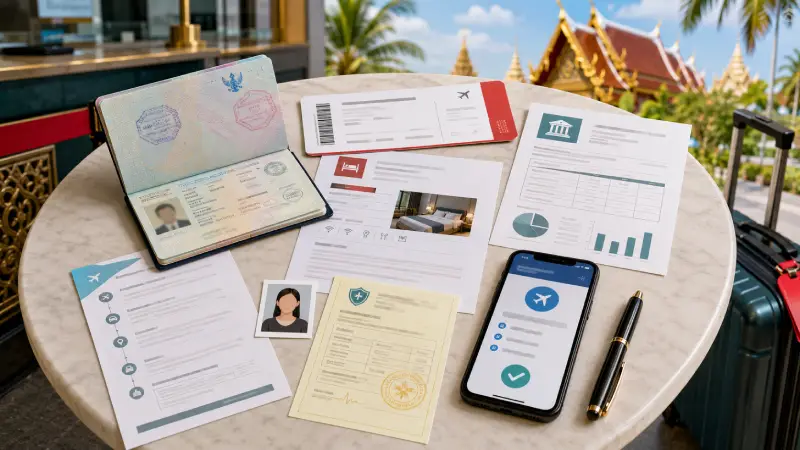
Use a passport in good condition with enough blank space for immigration stamps. Thai official pages commonly publish a six-month passport-validity standard, although route-specific wording can differ. Following the six-month standard is the safer approach for airline and border checks.
The name, passport number and nationality on the TDAC, visa and booking documents should match the passport presented at the checkpoint.
Onward travel and accommodation
Keep confirmed or return travel within the permitted stay. Airlines may check this before boarding, and immigration can request evidence that the visit is temporary.
The TDAC requires an address in Thailand. Hotel, rental or host details should therefore be available before submission.
Evidence of funds
Thailand has reminded foreign visitors to keep evidence of sufficient funds ready for possible screening. The published amount depends on the entry category rather than universal figure for every traveler.
For VOA, the stated minimum is THB 10,000 per person or THB 20,000 per family. Different figures may apply to tourist-visa or visa-exempt cases. Funds, payment access or other credible evidence should be available without assuming that every traveler will always be asked.
Health documents
Most visitors do not complete a separate general health form beyond the relevant TDAC questions. Travelers arriving from or after visiting a country designated for yellow-fever controls may need a valid International Certificate of Vaccination.
Where the yellow-fever rule applies, submit the certificate through the official Thailand Health Pass system and carry the original document. Vaccination normally must have been completed at least ten days before travel.
Customs declarations concern goods rather than immigration status. Alcohol, vaping products, food, medication and restricted-item rules are covered separately in Thailand Airport Customs Rules: Alcohol Limits & Vape Ban.
Air, land, sea and transit differences
TDAC registration applies to immigration entry through all three modes, but the available visa route and frequency limits can differ.
Under the active exemption scheme, visa-exempt entries by land or sea are generally limited to two per calendar year. Nationals of Brunei, Indonesia, Malaysia and Singapore are exempt from that stated two-entry limit. This rule should not be treated as permission to use repeated border crossings to extend a holiday.
VOA is available at designated checkpoints. Confirm availability before using a remote border crossing.
Myanmar’s 14-day bilateral exemption is limited to international-airport arrival. Travelers should not assume it is available at a land border.
International transit depends on the real itinerary, not merely the word “transit” on a booking. Baggage collection, separate tickets, terminal access, an airport change or an overnight stay outside the sterile area may require the passenger to pass immigration.
Transport and airport risks beyond immigration are discussed in Is Thailand Safe? Scams, Taxis & Transport Guide.
Extensions and overstay
Visitors admitted under the current 60-day exemption may normally request an extension of up to 30 days. Tourist-visa holders may also have an extension route, depending on the visa and admission stamp.
Applications are made through Thai Immigration and should be filed before the existing permission expires. Approval is discretionary, and an application does not create a right to remain after the current stamp has expired.
VOA holders should plan to leave within 15 days because ordinary tourist extensions are generally unavailable.
Overstay is an immigration violation. The standard fine is THB 500 per day, capped at THB 20,000, but payment of a fine does not make overstay lawful. Longer overstays or cases discovered before voluntary departure can result in detention, deportation and a re-entry ban.
Check the immigration stamp immediately after entry and treat its expiry date—not the flight-booking date or a general summary—as the controlling deadline.
Common entry mistakes
-
Treating the approved 30-day reform as active. The current 60-day scheme remains in force until the Gazette-based effective date.
-
Confusing TDAC with a visa. The arrival card is required in addition to the correct visa or exemption route.
-
Applying for VOA despite qualifying for the current exemption. Several passports appear in both published groups.
-
Choosing the wrong eVisa mission. The application location must match the responsible embassy or consulate’s jurisdiction.
-
Assuming airport and land-border rules are identical. VOA availability, bilateral exemptions and land-entry limits can differ.
-
Ignoring the admission stamp. The officer may grant a period that needs to be checked before leaving the counter.
-
Mixing immigration and local-law questions. Vaping, cannabis and visitor conduct are covered in Thailand Tourist Bans & Laws: Vaping, Weed & Fines.
Staying connected after arrival
Mobile data can help with maps, hotel messages, transport bookings, translations, tickets and access to stored travel documents. Connectivity has no effect on visa eligibility or the immigration officer’s decision.
Using a Roafly Thailand eSIM can keep essential services accessible without relying on airport Wi-Fi. Broader comparisons are available in How to Get Internet in Thailand: Airport, Local SIM, eSIM & WiFi and Best eSIM for Thailand.
Need data in Thailand? Get an eSIM!
Choose the perfect data plan for your trip

Manage your eSIM in the app
Install, top up and track data.
Frequently asked questions
Do US citizens need a visa for Thailand?
Ordinary United States passport holders currently qualify for the 60-day visa exemption for tourism. They must complete the TDAC and may be asked for travel, accommodation and financial evidence.
The approved future framework is expected to shorten the exemption, but it does not apply until the official effective date.
Do UK citizens need a visa for Thailand?
Ordinary British citizen passport holders currently qualify for visa-exempt tourist entry for up to 60 days. The TDAC is still mandatory, and the final stay is shown on the immigration stamp.
Travelers arriving after the pending reform takes effect must follow the replacement period then in force.
Do Indian citizens qualify for Visa on Arrival?
India appears on Thailand’s published VOA list, but ordinary Indian passport holders also qualify for the current 60-day visa exemption. The exemption is therefore the more favorable route while the present scheme remains active.
The Cabinet-approved replacement may move Indian travelers to a different category, but that change should not be applied before its Gazette-based effective date.
Can Chinese passport holders enter visa-free?
Ordinary Chinese passport holders currently qualify for the 60-day exemption. China also has bilateral arrangements with Thailand, but the active exemption scheme presently provides the longer tourist stay.
Chinese travelers needing a visa for another purpose or category may use eVisa when eligible through the responsible Thai mission.
Do Turkish citizens need a visa?
Ordinary Türkiye passport holders currently qualify for the 60-day visa exemption for tourism. They must also submit the TDAC and satisfy the ordinary passport,-travel and entry-document requirements.
This position should be rechecked when the pending replacement scheme receives an effective date.
Is the TDAC a visa?
No. The TDAC is a mandatory digital arrival card used to provide traveler, journey, accommodation and health-declaration information.
It does not replace a visa, Visa on Arrival or visa exemption and cannot make an otherwise ineligible passport eligible for entry.