Roafly esim logo
Shop eSIMsFAQDownload app
global

Where to go next?

Languages

Login
Roafly logo
App Store Google Play
symantec
apple pay
amex
visa
mastercard
diners club

Popular Countries

Learn more

About usContactFAQCompatible DeviceseSIM SetupBlogTrip Data EstimatorDownload app

Copyright © 2024 Roafly. All rights reserved.

Privacy PolicyTerms and ConditionsRefund Policy
All articles

How to Get Internet in Thailand (2026): Airport SIM, Local Tourist SIM, Roafly eSIM, and Pocket WiFi

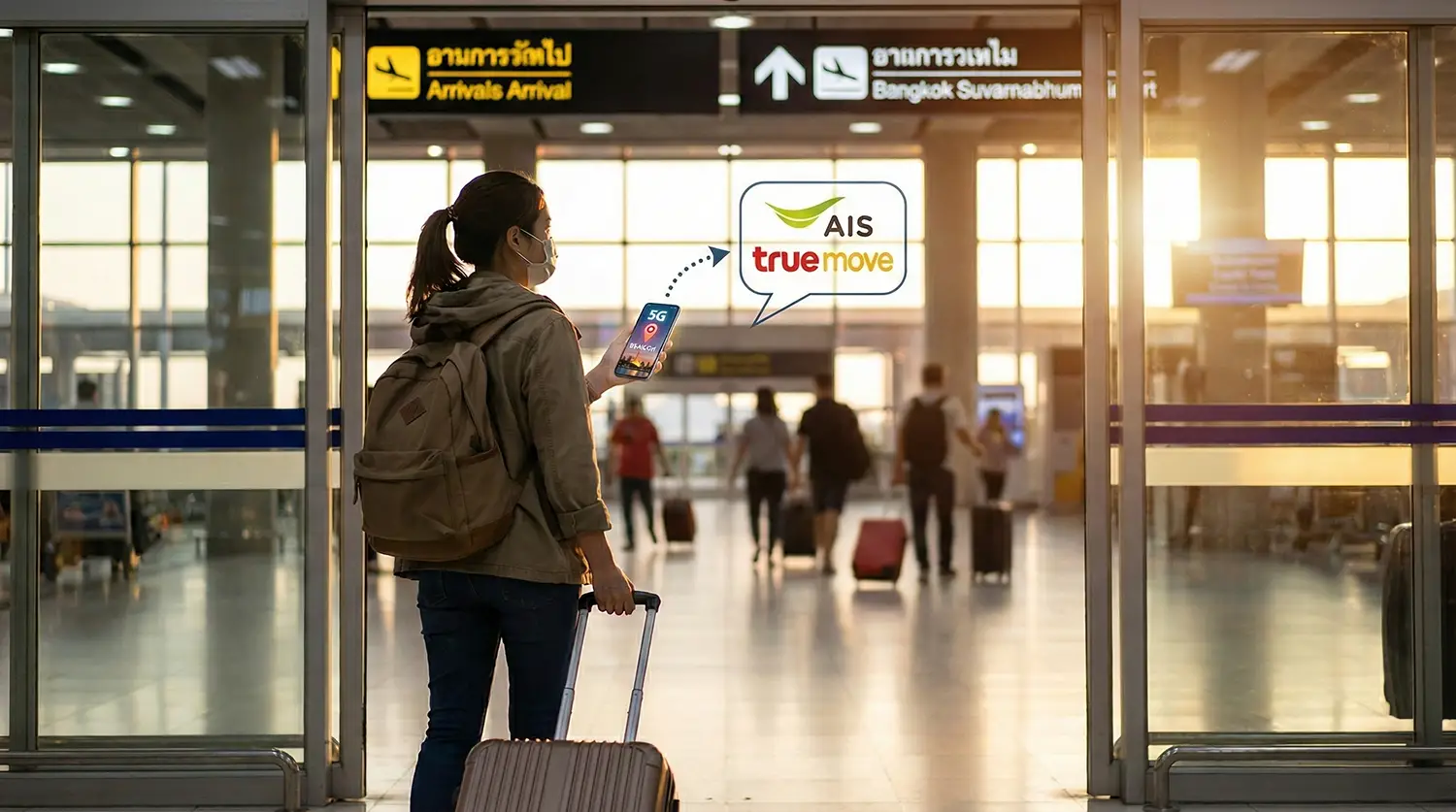
Landing in Thailand without internet is a fast way to lose time—whether you need Grab, Google Maps, hotel check-in messages, or a quick bank OTP. The good news is that Thailand is one of the easiest countries in Asia to get connected quickly, with solid 4G/5G in most tourist areas.

Ethan Brooks

Jan 2, 2026

How to Get Internet in Thailand (2026): Airport SIM, Local Tourist SIM, Roafly eSIM, and Pocket WiFi
Jump to section 👇

In this article

  • Your options for getting internet in Thailand
  • Quick overview: your main connectivity options
  • Buying a SIM at the airport: prices and what to expect
  • Getting a local SIM in the city: cheaper tourist deals at 7-Eleven and operator stores
  • Roafly Thailand eSIM: set up before you land (no physical SIM swap)
  • Pocket WiFi in Thailand: when it makes sense (and when it doesn’t)
  • Coverage and speed in Thailand: what travelers should expect
  • Which option should you choose?

Below is a practical guide to airport SIM kiosks, local tourist SIM deals in the city, a Roafly Thailand eSIM you can set up before you land, and pocket WiFi for groups.

Your options for getting internet in Thailand

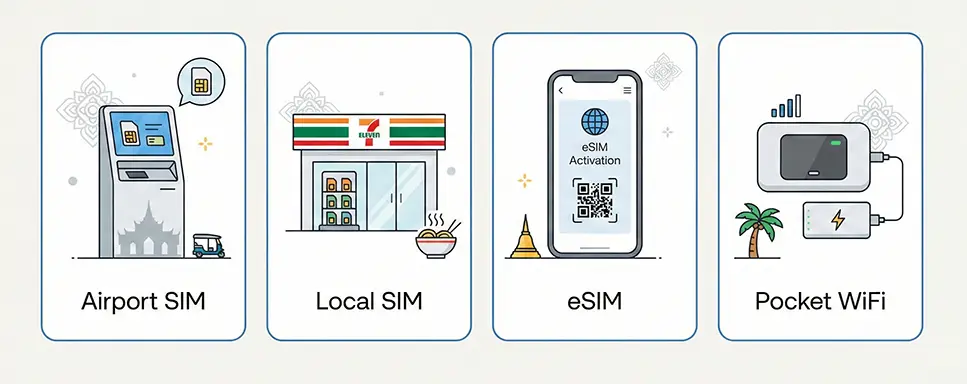
Before you compare prices, it helps to choose the setup that fits your trip style. Thailand gives you four realistic ways to get online, and each one solves a slightly different problem:

Your options for getting internet in Thailand

  • Airport tourist SIM (BKK/DMK/HKT/CNX): Fastest “walk off the plane and connect” option. Great if you want staff to activate everything for you, but it usually costs more than buying in the city and can involve queues.

  • Local tourist SIM in the city (7-Eleven / operator shops): Often the best value. Ideal if you can wait until you reach town (using airport or hotel Wi-Fi in the meantime).

  • Roafly Thailand eSIM: The cleanest setup if you want to avoid SIM swaps and kiosk lines. You can install before you fly and connect as soon as you land (as long as your phone supports eSIM).

  • Pocket WiFi rental: Best for groups or travelers who need to connect multiple devices (phones + laptop). The trade-off is carrying and charging an extra device.

Need data in Thailand? Get an eSIM!
1GB 7 Days
$3.90
2GB 15 Days
$5.50
3GB 30 Days
$6.50
See all data plans

Quick overview: your main connectivity options

Here’s the decision in one glance—then we’ll break down prices and setup step by step.

Option Best for What you need Typical setup time Typical cost Main downside
Airport tourist SIM (BKK/DMK/HKT/CNX) Convenience right after landing Passport + unlocked phone 5–15 min (longer in queues) Mid-range Often pricier than city deals
Local SIM in the city (7-Eleven / operator shops) Cheapest physical SIM deals Passport + unlocked phone 10–20 min Low You must wait until you reach the city
Roafly Thailand eSIM Set up before arrival, no physical SIM swap eSIM-compatible phone 2–5 min Low–mid Data-only (no Thai phone number)
Pocket WiFi rental Groups, laptops, multiple devices Pickup + deposit (varies) 10–20 min Mid Extra device to carry/charge
International roaming Short trips, “I need it now” Enabled roaming 1–2 min High Expensive for heavy data

Buying a SIM at the airport: prices and what to expect

Buying a SIM at the thailand airport:

At Thailand’s major airports—Suvarnabhumi (BKK), Don Mueang (DMK), Phuket (HKT), and Chiang Mai (CNX)—you’ll see tourist SIM counters right in the arrivals area. Staff typically help with registration and activation on the spot.

What you’ll need (important)

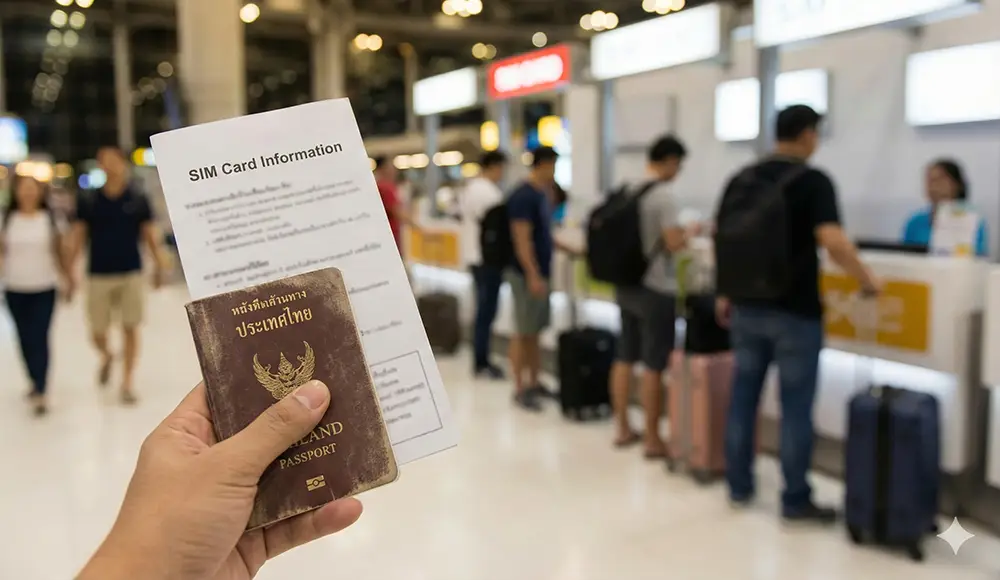
Thailand requires SIM registration, and tourists should expect to show a passport during purchase/activation. 

Typical airport tourist SIM pricing (THB + USD estimate)

To keep the math consistent, the USD estimates below use 1 USD ≈ 31.4 THB (Jan 2, 2026).

Common tourist SIM package Validity Price (THB) Approx. price (USD)
AIS tourist plan (entry-level) varies by package 399 12.71
AIS tourist plan (mid) varies by package 499 15.89
AIS tourist plan (higher) varies by package 699 22.26
dtac “Happy Tourist” 8 days 299 9.52
dtac “Happy Tourist” 15 days 599 19.08
True tourist SIM (Infinite) 8 days 449 14.30
True tourist SIM (Infinite) 15 days 699 22.26
True tourist SIM (Infinite) 30 days 1,199 38.18

Prices above reflect the currently published tourist SIM packages from major Thai operators (as of Jan 2, 2026)

Note: Airport kiosks are convenient, but they can be more expensive than city purchases, and queues can be long at peak arrival times. 

Airport SIM checklist (so you don’t get over/under-sold)

  • Ask the staff to confirm validity days and whether the plan is high-speed capped (many “unlimited” plans slow down after a quota).

  • Confirm whether you want a Thai number (useful for local calls/OTP in some cases) or data-only is enough.

  • Save the SIM packaging (it often contains APN info and top-up instructions).

Getting a local SIM in the city: cheaper tourist deals at 7-Eleven and operator stores

If you can survive on airport Wi-Fi (or your hotel’s Wi-Fi) for the first hour or two, buying a SIM in the city is often the best value. In Thailand, 7-Eleven is a common stop for prepaid SIMs, and operator stores in malls can also be straightforward.

7-Eleven Thailand SIM deal

Example of a widely available 7-Eleven SIM deal (official)

dtac publishes 7-Eleven SIM options with clear pricing and inclusions:

  • 199 THB (30 days): includes 30GB at 15 Mbps, then throttled (plus some calling benefits). 

  • 49 THB (7 days): includes 3GB at max speed. 

Using the same exchange rate (1 USD ≈ 31.4 THB), that’s roughly $6.34 for the 30-day pack and $1.56 for the 7-day mini pack. 

Local store price snapshot (THB + USD estimate)

Where you buy Example plan Validity Price (THB) Approx. price (USD)
7-Eleven Prepaid SIM (30GB @ 15 Mbps, then throttled) 30 days 199 6.34
7-Eleven Prepaid SIM (3GB) 7 days 49 1.56

The prices and inclusions above are based on dtac’s published 7-Eleven SIM offers.

City SIM buying tips (to avoid activation issues)

  • Bring your passport. SIM registration rules apply nationwide.

  • Make sure your phone is unlocked.

  • If you need help, a mall operator shop may be easier than a busy convenience store cashier.

Roafly Thailand eSIM: set up before you land (no physical SIM swap)

If you’d rather skip kiosks and paperwork at arrivals, a travel eSIM is the simplest path—especially if your phone supports eSIM and you’re comfortable with a data-only line.

Need data in Thailand? Get an eSIM!
1GB 7 Days
$3.90
2GB 15 Days
$5.50
3GB 30 Days
$6.50
See all data plans

Roafly’s Thailand eSIM connects on major local networks (shown in plan details as AIS and TrueMove H), and it’s designed for travelers who want quick setup and reliable coverage.

Roafly Thailand eSIM packages (USD)

  • 1GB / 7 Days — $3.90

  • 2GB / 15 Days — $5.50

  • 3GB / 30 Days — $6.50

  • 5GB / 30 Days — $7.50

  • 10GB / 30 Days — $10.00

  • 20GB / 30 Days — $16.00

  • 50GB / 180 Days — $49.00

Plan notes: Data-only, mobile hotspot available, eKYC not required, and validity starts when the eSIM first connects to a supported network.

Roafly prices listed above are in USD (as of Jan 2, 2026)

Installation methods (Roafly)

Roafly supports the common install flows travelers expect:

  • iOS Direct Install

  • QR Code

  • Manual installation

For a deeper breakdown of which package size fits different trip styles, see the Best eSIM for Thailand guide.

How much data do you actually need in Thailand?

A quick planning rule:

  • Light (1–3GB/week): maps, chat, occasional browsing

  • Medium (5–10GB/week): social media, short videos, frequent ride-hailing

  • Heavy (10GB+/week): lots of video, hotspots, remote work

A data usage calculator helps travelers estimate how much data they’ll need and avoid overpaying.

Quick troubleshooting (so you don’t lose a day to “No Service”)

If you land and your eSIM shows bars but no data, try these quick fixes: toggle the eSIM line off/on, enable data roaming for the eSIM line, switch Airplane Mode on for 10 seconds and off again, and manually re-select the network. If it still doesn’t work, confirm the eSIM is set as the active mobile data line and restart the phone.

Pocket WiFi in Thailand: when it makes sense (and when it doesn’t)

Pocket WiFi is a small portable router you rent, and it can connect multiple devices at once. This is most useful if:

  • You’re traveling as a group/family and want to share one connection

  • You need to connect a laptop all day

  • Your phone is not unlocked and you don’t want to rely on roaming

Typical pocket WiFi costs

Many rentals land around $3–$5 per day, depending on provider, pickup location, and rental length. 
Some services offer airport pickup and returns, which is convenient if you prefer a physical device over SIM changes. 

Pocket WiFi trade-offs

  • You must carry and charge another device.

  • If the battery dies, everyone loses connection.

  • Rentals may involve damage/loss fees—so check terms before you walk away from the counter. 

Coverage and speed in Thailand: what travelers should expect

In practice, connectivity quality depends on where you are:

  • Bangkok, Chiang Mai, Phuket, Pattaya, Samui: strong 4G/5G in most populated areas. Independent coverage maps show broad availability across Thailand for major networks. 

  • Road trips, mountains, smaller islands: coverage can drop outside towns; expect occasional slowdowns and dead spots depending on terrain. Coverage maps can help you sanity-check your route in advance. 

  • For a performance-oriented view (speed/experience metrics), Opensignal’s Thailand reports provide third-party benchmarking based on real user measurements. 

If your plan connects to AIS and TrueMove H networks, you’re generally well-covered across common tourist corridors.

Which option should you choose?

A simple way to decide:

  • Choose an airport SIM if you want help immediately after landing and don’t mind paying a bit more for convenience.

  • Choose a city SIM (7-Eleven/operator shop) if your priority is the lowest local price and you can wait until you’re in town. 

  • Choose a Roafly eSIM if you want to be connected the moment you arrive, without swapping SIMs or queuing at kiosks.

  • Choose pocket WiFi if you’re sharing internet across multiple devices all day and don’t mind carrying a router.

Check the latest Roafly Thailand eSIM packages before your trip so you can land with data ready to go.

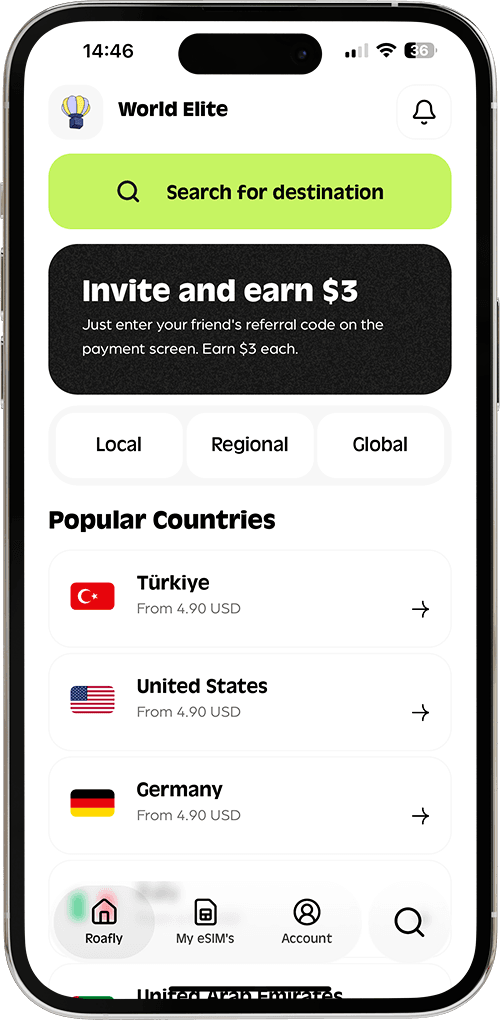
Download the App and manage your eSIMs easily

Download on the

App Store

GET IN ON

Google Play

Roafly esim
  • Create your order quickly
  • See your eSIM details
  • Track your remaining data