

'%3e%3cg id='b'%3e%3cpath id='a' stroke='%23000' stroke-width='2' d='M-6-25H6m-12 3H6m-12 3H6'/%3e%3cuse xlink:href='%23a' y='44'/%3e%3c/g%3e%3cpath stroke='%23fff' d='M0 17v10'/%3e%3ccircle r='12' fill='%23cd2e3a'/%3e%3cpath fill='%230047a0' d='M0-12A6 6 0 0 0 0 0a6 6 0 0 1 0 12 12 12 0 0 1 0-24z'/%3e%3c/g%3e%3cg transform='rotate(-123.69)'%3e%3cuse xlink:href='%23b'/%3e%3cpath stroke='%23fff' d='M0-23.5v3M0 17v3.5m0 3v3'/%3e%3c/g%3e%3c/svg%3e)
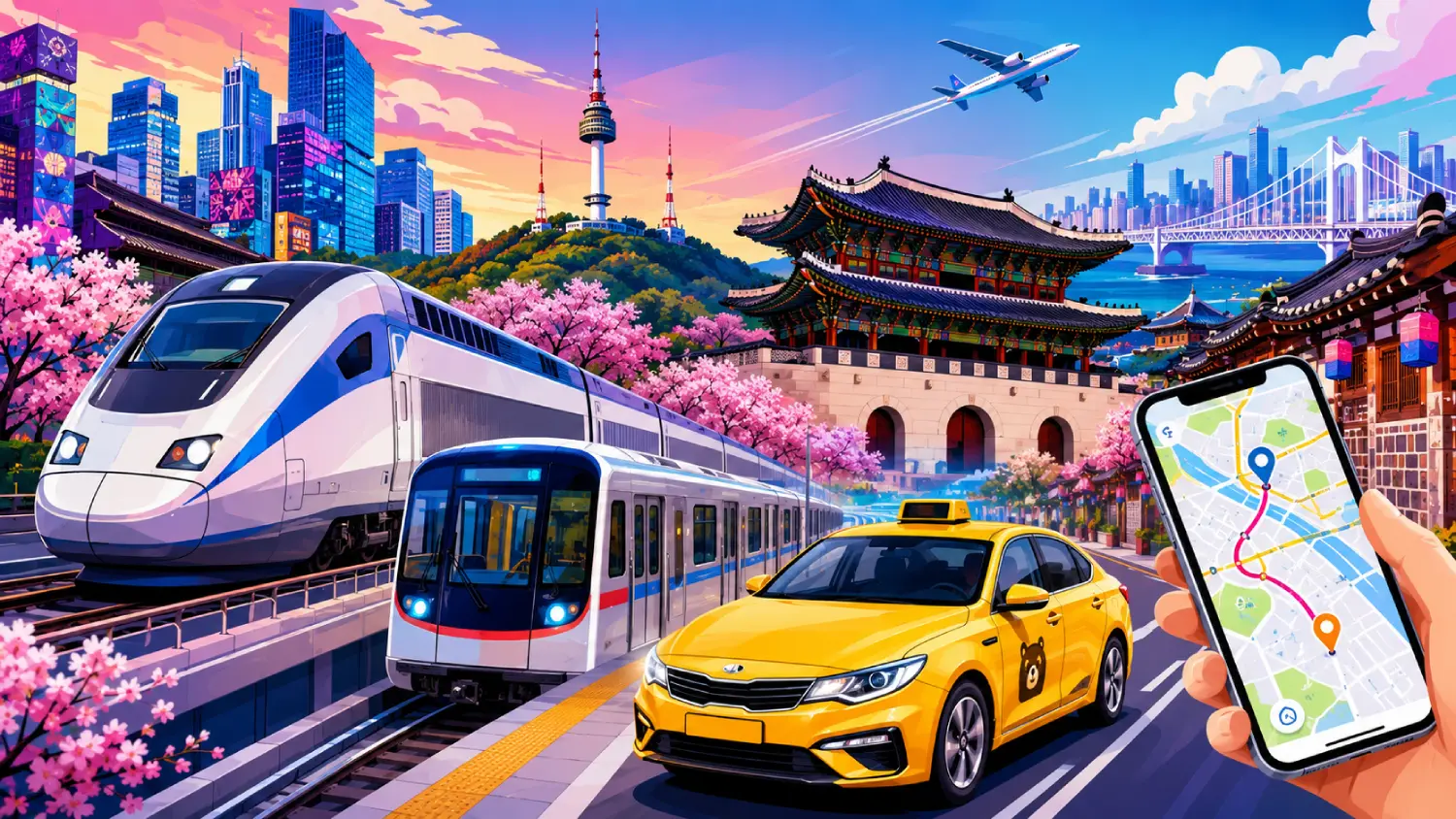
South Korea in 2026 boasts of the most advanced, pristine, and punctual public transit networks on the planet. Whether you are navigating the deep subway lines of Seoul or catching a 300 km/h bullet train down to Busan, the system is designed for speed. However, this high-tech paradise is fiercely localized. Foreigners cannot simply land, open Google Maps, and expect to navigate effortlessly.
The reality is that South Korea uses its own digital mapping and ride-hailing platforms, which often present steep learning curves for first-time visitors. The good news is that the physical infrastructure is incredibly tourist-friendly, with English signage widely available across all major transport hubs. If you prepare by downloading the correct apps and securing the right transit cards, getting around becomes the easiest part of your trip.
If you are currently deciding when to brave these transit hubs, reviewing the Best Time to Visit South Korea: Weather & Seasons will help you avoid the suffocating monsoon rains. For those specifically planning a spring trip, comparing Japan vs. South Korea: Which Should You Visit? is essential before booking any high-speed train tickets.
The Basics: Understanding the Network
South Korea's public transit is dominated by massive, interlocking subway systems in major cities like Seoul, Busan, Daegu, and Incheon. The Seoul Metropolitan Subway alone has over 20 lines, integrating perfectly with an extensive local bus network. You will rarely need a taxi if your destination is within city limits.
Buses are categorized by color to indicate their route types. Blue buses run on major trunk routes across the city, Green buses connect residential areas to subway stations, and Red buses serve as express commuter lines to the suburbs. Memorizing these colors will save you from boarding an hour-long express ride out of the city center by mistake.
Transit systems across the country are highly unified, meaning the same transit card you buy in Seoul will seamlessly work on a bus in Jeju Island. Be aware that the transit network shuts down entirely between roughly midnight and 5:30 AM. If you are out late, you must rely on night buses (Owl Buses) or ride-sharing apps to get back to your hotel.
Payment & Tickets: Mobile Apps vs. Physical Cards
The golden rule for South Korean transit in 2026 is to abandon cash and single-trip tickets immediately. You need a unified transit card to swipe in and out of stations, which automatically calculates distance-based fares and free transfers between buses and subways. Failing to tap out when exiting will result in penalty fares on your next ride.
Your primary options for paying transit fares are:
-
T-money Card: The undisputed standard physical card available at any convenience store for about ₩3,000. You must top it up with cash at station kiosks or convenience stores.
-
WOWPASS: A powerful all-in-one card for tourists that combines transit functionality with a prepaid debit card you can top up using foreign currency.
-
Seoul Climate Card (2026 Edition): A game-changer for heavy riders, offering unlimited rides on Seoul subways and buses. Short-term tourist passes range from a 1-day pass at ₩5,000 to a 5-day pass at ₩15,000.
-
NAMANE Card: A customizable dual-wallet card that allows you to print a custom photo on the front while managing transit and retail balances via a mobile app.
CRITICAL WARNING: Apple Pay and Google Wallet do not support South Korean transit systems for foreign credit cards. You cannot simply tap your iPhone at the turnstile. Always carry enough Korean Won in cash to reload your physical T-money or Climate Card, as station kiosks strictly do not accept foreign credit cards for transit top-ups.
Airport Transfers: Getting to the City Safely
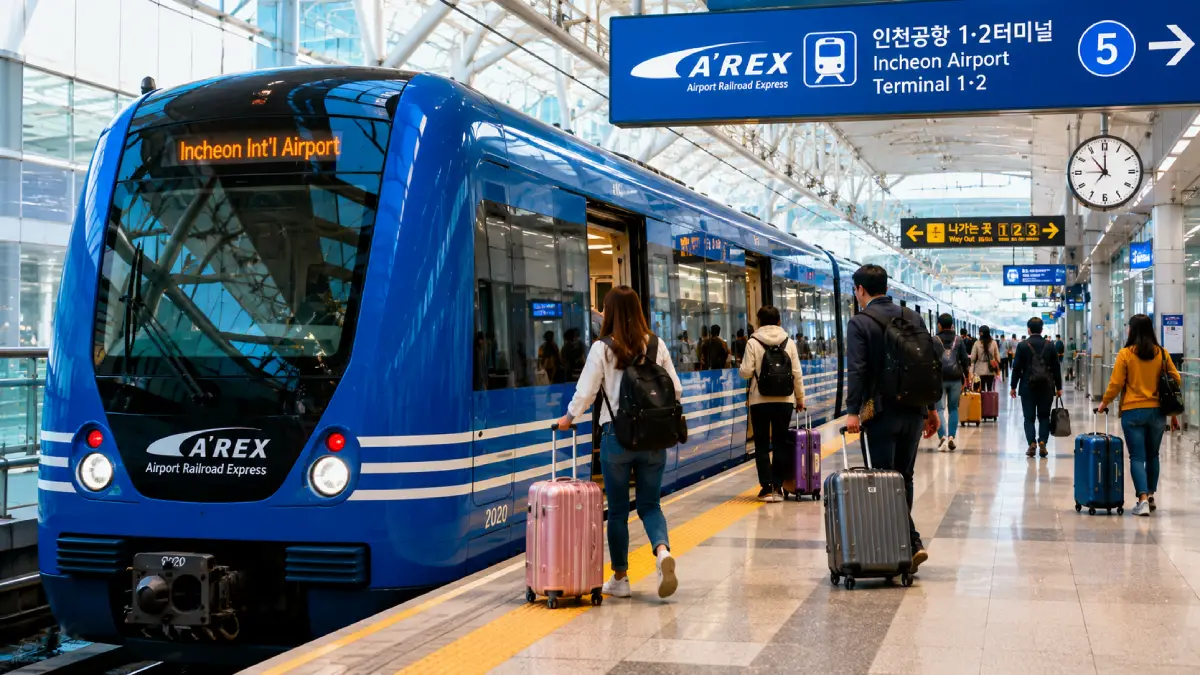
Navigating from Incheon International Airport (ICN) into central Seoul is painless if you understand your options. Before you even exit the terminal, ensure you are compliant with the South Korea Airport Customs Rules to avoid hefty fines that could ruin your travel budget. cleared, you have three primary paths into the city.
The AREX (Airport Railroad Express) is the undisputed champion for speed and budget.
-
AREX Express Train: Runs directly to Seoul Station with zero stops in exactly 43 minutes. Tickets cost ₩13,000 and feature guaranteed seating with free Wi-Fi and luggage storage.
-
AREX All-Stop Train: Takes about 60 minutes and stops 14 times along the way. It costs around ₩5,000 and can be paid for with a standard T-money card, making it ideal if your accommodation is near Hongdae or Gongdeok.
If you have heavy luggage, the Airport Limousine Buses are a fantastic alternative. They cost between ₩9,000 and ₩16,000 and drop you directly in front of major hotels across Seoul. Taxis are the most expensive option, generally costing between ₩65,000 and ₩90,000, plus a mandatory ₩7,900 highway toll fee that the driver will add to the final meter. Beware of illegal touts inside the arrivals hall offering rides; always use the official taxi stands outside.
Shifting Cities: Inter-City Trains, Shuttles & Domestic Flights
When traveling between major hubs like Seoul and Busan, the high-speed rail network is your best friend. The KTX (Korea Train eXpress) and the SRT (Super Rapid Train) hurtle across the country at 300 km/h. A trip from Seoul to Busan takes just over two hours on the KTX and costs roughly ₩60,000 for a standard economy seat.
Booking inter-city transport requires advanced planning:
-
Korail App/Website: Use the official Korail platform to book KTX tickets up to a month in advance. Weekend trains to popular destinations sell out incredibly fast.
-
SRT App: The SRT is slightly cheaper and departs from Suseo Station in southern Seoul, making it highly convenient if you are staying in the Gangnam district.
-
Express Buses: For mid-tier cities without high-speed rail access, the Express Bus Terminal network offers luxurious "Premium Gold" buses with fully reclining seats and private curtains for a fraction of the cost of a train.
-
Domestic Flights: Flying from Gimpo Airport to Jeju Island is the most popular domestic flight route in the world, with flights leaving every few minutes.
Luggage space on high-speed trains is strictly limited to racks at the ends of the cars on a first-come, first-served basis. If you are traveling with massive suitcases, consider arriving at the platform 15 minutes early to secure rack space. Alternatively, use domestic luggage delivery services to ship your bags directly from your Seoul hotel to your Busan accommodation.
Taxis, Ride-Sharing & Local Driving Laws
The ride-sharing landscape in South Korea is vastly different from the West. While Uber (operating locally as UT) exists, its footprint is heavily marginalized. The absolute monopoly holder is Kakao T, a super-app that every tourist must download before arrival.
Kakao T allows you to hail standard metered taxis, luxury vans (Kakao Venti), and premium black cars directly to your GPS location. To use Kakao T without a Korean phone number or local credit card, simply bypass the payment screen and select the "Pay to the Driver" option. This allows you to pay at the end of the ride using cash, your physical credit card, or even your T-money card.
If you plan to rent a car—highly recommended for exploring Jeju Island or the remote eastern coast—you must carry a physical International Driving Permit (IDP).
-
Strict Speed Limits: South Korea enforces speed limits via an aggressive network of traffic cameras. GPS systems will constantly beep to warn you of upcoming speed traps.
-
Zero Tolerance: Drink driving laws are incredibly strict. Do not consume even a drop of alcohol if you plan to drive.
-
Before hitting the road, it is highly recommended to read the South Korea Tourist Bans & Laws to ensure you don't accidentally violate local photography or driving ordinances.
As for local taxi culture, drivers are generally honest and meters are strictly enforced, but very few drivers speak fluent English. While you might wonder Is South Korea Safe, taxi scams are incredibly rare compared to other global capitals. However, always have your destination written in Hangul (Korean script) on your phone to show the driver and prevent routing errors.
Transit Etiquette & Unwritten Rules
South Korean public transit operates on a strict social code of silence and spatial awareness. The most heavily enforced unwritten rule is regarding noise: talking loudly on your phone, playing music without headphones, or having boisterous conversations with your group is considered highly offensive. You will endure stern glares if you break the silence of the morning commute.
Eating and drinking are strictly forbidden on local buses. Bus drivers will aggressively deny you entry if you are holding a to-go coffee cup or any unsealed food item. Subways are slightly more lenient, but consuming anything messier than a quick sip of water is heavily frowned upon.
Priority Seating is a sacred institution in South Korea. The seats at the far ends of every subway car are strictly reserved for the elderly, pregnant women, and the disabled. Even if the train is packed shoulder-to-shoulder, able-bodied young people will leave these seats completely empty. Do not sit there under any circumstances, or you risk being publicly scolded.
Navigation Apps & The Best Route Tools
Do not rely on Google Maps in South Korea. Due to legacy national security laws involving geographic data, Google is legally restricted from providing turn-by-turn walking or driving directions. It can show basic transit routes, but the data is often outdated and highly inaccurate for complex subway transfers.
Your primary survival tools are local mapping apps:
-
Naver Map: The most comprehensive and foreigner-friendly option, offering excellent English language support, precise bus tracking, and detailed subway exit numbers.
-
KakaoMap: Equally powerful and integrates flawlessly with Kakao T, though its English interface can sometimes be slightly clunkier than Naver.
-
Subway Korea: A dedicated, lightweight app specifically for calculating the fastest routes through the sprawling subway networks of Seoul and Busan.
When using these apps, the most critical piece of information is the Subway Exit Number. Seoul subway stations are massive underground labyrinths with sometimes over a dozen exits. Exiting from Exit 2 instead of Exit 9 might put you a 20-minute walk away from your destination. Always follow the app's specific exit recommendations.
Staying Connected: Your Ultimate Navigation Tool
To survive South Korea's transport ecosystem, you need absolute, uninterrupted internet access. You cannot load Naver Map to find your bus stop, hail a Kakao T taxi in the rain, or use Papago to translate a train announcement if you are relying on spotty public Wi-Fi. The transit network demands that you are digitally connected at all times.
Need data in South Korea? Get an eSIM!
Choose the perfect data plan for your trip

Manage your eSIM in the app
Install, top up and track data.
While there are several ways to get, physical SIM cards require wasting time at airport counters. A South Korea eSIM gives you instant 5G data the second your plane touches the tarmac at Incheon. You can read a full breakdown of your options in our How to Get Internet in South Korea guide to see why digital SIMs are dominating the market.
For a deeper dive into which network providers offer the fastest speeds inside underground subway tunnels, check out the Best eSIM for South Korea. The peace of mind that comes with having immediate, high-speed data to navigate a foreign transit system is invaluable.
Summary Checklist: 2026 Transport Tips
-
Ditch Google Maps: Download Naver Map and Kakao T before you board your flight to Korea.
-
Get a Card Immediately: Purchase a T-money Card, WOWPASS, or Climate Card at the airport and top it up with local cash.
-
Take the AREX: Use the Airport Railroad Express to get from Incheon to Seoul—it is significantly faster and cheaper than an airport taxi.
-
Book Trains Early: Reserve your KTX or SRT tickets weeks in advance via the official apps, especially for weekend trips to Busan.
-
Respect the Silence: Keep your voice down on public transit, never eat on local buses, and leave the priority seats empty.
-
Pay Drivers Directly: Use the Kakao T app to hail cabs and select the "Pay to the Driver" option to bypass local credit card requirements.