

'%3e%3cpath fill='%23001489' d='M0 0v6h9V0z'/%3e%3cpath fill='%23e03c31' d='M0 0v3h9V0z'/%3e%3cg stroke='%23fff' stroke-width='2'%3e%3cpath id='d' d='m0 0 4.5 3L0 6m4.5-3H9'/%3e%3cuse xlink:href='%23b' stroke='%23ffb81c' clip-path='url(%23c)'/%3e%3c/g%3e%3cuse xlink:href='%23d' fill='none' stroke='%23007749' stroke-width='1.2'/%3e%3c/g%3e%3c/svg%3e)
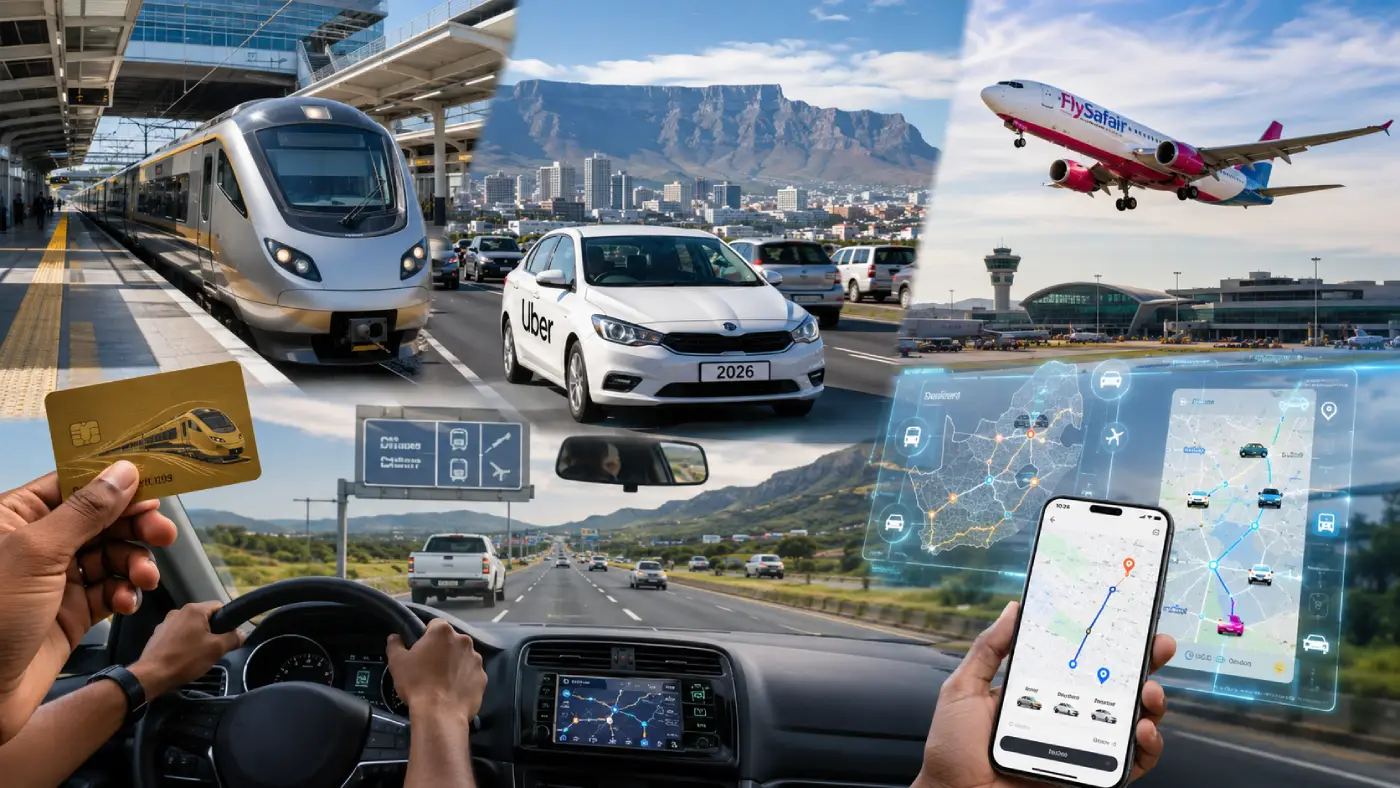
Navigating South Africa requires a strategic approach to personal safety and logistics. Unlike Europe or Japan, there is no comprehensive national rail network connecting every city seamlessly. Instead, you will rely heavily on domestic flights, private rideshare applications, and specific regional transit systems.
The transportation landscape is constantly shifting, with recent 2026 regulations dramatically reshaping the e-hailing and taxi industries. Understanding these updates is critical to avoiding scams, staying safe, and keeping your itinerary on track. Before you plan your daily routes, it is essential to understand the broader security landscape by reading our Is South Africa Safe? Crime Reality, Safaris & Load Shedding guide.
The Basics: Understanding the Network
South Africa does not have a unified public transportation system. Each major city operates its own isolated network, with varying levels of reliability and safety. Johannesburg and Pretoria are serviced by the Gautrain, a rapid transit railway system that is world-class, secure, and incredibly efficient.
In Cape Town, the MyCiTi bus rapid transit network provides clean, safe, and heavily monitored routes across the city center and Atlantic Seaboard. Outside of these specific, state-of-the-art systems, traditional municipal buses are generally unreliable and rarely used by international tourists.
You will inevitably see thousands of white minibus taxis crowding the streets and highways. While these represent the backbone of local commuter transport, they are completely unregulated, operate without fixed schedules, and are notoriously unsafe due to reckless driving. Tourists are strictly advised to avoid minibus taxis entirely and stick to official apps and private networks.
Payment & Tickets: Mobile Apps vs. Physical Cards
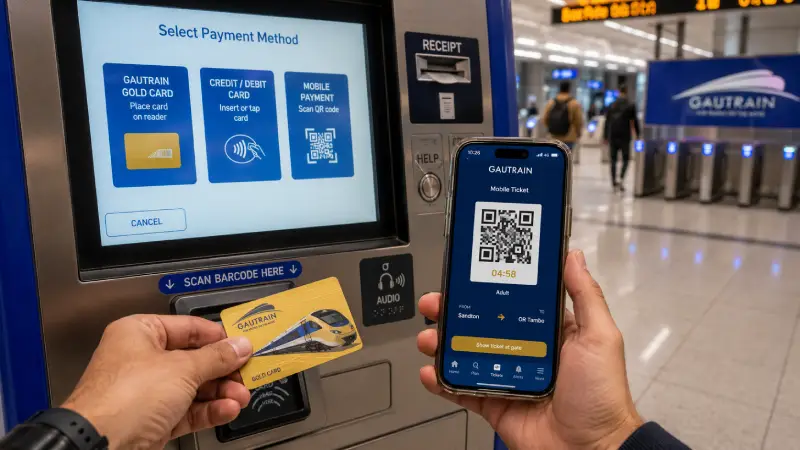
The days of paying cash for public transit in South Africa are entirely over. If you are riding the Gautrain in Gauteng, you must purchase a Gautrain Gold Card at the station for a R10 issuance fee. You load this card with funds using a credit card or debit card at the automated ticketing machines.
In Cape Town, the MyCiTi bus network requires a MyConnect card, which you can purchase for R35 at major station kiosks or participating retail stores. You must tap in when boarding and tap out when exiting, similar to the Oyster card system in London. Neither the Gautrain nor the MyCiTi networks currently support tapping in with digital Apple Pay or Google Wallet, so you must keep the physical transit cards on you.
For everything else, including rideshares and long-distance buses, digital payments are king. Uber and Bolt securely link to your international credit cards, ensuring you never have to flash cash on the street. Carrying small amounts of cash (R20 or R50 notes) is necessary for tipping petrol attendants or authorized parking guards.
Airport Transfers: Getting to the City Safely
Arriving at OR Tambo International Airport (JNB) in Johannesburg can be overwhelming, but the transfer is incredibly straightforward if you use the Gautrain. The station connects directly to the arrivals terminal; just follow the prominent yellow signage. A ride to Sandton Station takes about 15 minutes, costs approximately R190, and bypasses Johannesburg’s notorious highway traffic entirely.
If you have excessive luggage or arrive after the trains stop running, utilize the designated e-hailing pickup zones or official metered taxi ranks. Never accept a ride from individuals verbally soliciting passengers inside the terminal, as this is a classic scam. Before you even exit the baggage claim, make sure you are compliant with local entry laws by checking our South Africa Airport Customs Rules: Alcohol, Cigarettes, Vaping guide.
At Cape Town International Airport (CPT), the MyCiTi Route 100 bus is the most economical transfer option. It runs directly from the airport to the Civic Centre in the City Bowl for roughly R120, taking around 40 minutes. However, if you are traveling to neighborhoods like Camps Bay, or if you simply prefer door-to-door service, ordering an Uber or Bolt from the dedicated airport rideshare zone is safe, affordable, and takes about 25 minutes.
Shifting Cities: Inter-City Trains, Shuttles & Domestic Flights
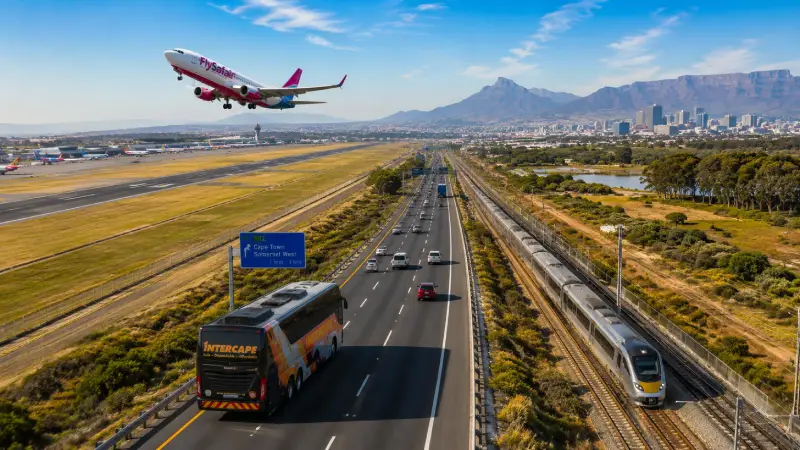
South Africa is roughly the size of France and Spain combined, meaning driving between major hubs can take days. The most efficient way to travel between Johannesburg, Cape Town, and Durban is by booking domestic flights. Carriers like FlySafair, Airlink, and CemAir offer highly reliable, frequent, and relatively inexpensive daily routes.
If you prefer to see the landscape and have time to spare, luxury train travel is an iconic South African experience. The Rovos Rail and The Blue Train offer five-star, multi-day rail journeys across the country. Conversely, standard passenger trains operated by Shosholoza Meyl have suffered from severe infrastructure issues and are not recommended for tourists seeking reliable transit.
For budget-conscious travelers, luxury long-distance coaches like Intercape and Greyhound provide safe, air-conditioned overnight routes between major cities. When planning a cross-country road trip or long bus journey, you should align your travel dates with optimal road conditions detailed in our Best Time to Visit South Africa: Weather, Regions & Seasons guide.
Taxis, Ride-Sharing & Local Driving Laws
Uber and Bolt dominate the urban transport landscape in South Africa, providing the safest and most transparent way to move around cities. In a massive shift for 2026, new national regulations require all e-hailing drivers to be formally licensed and equipped with in-app panic buttons. Furthermore, the Gautrain is launching its own integrated e-hailing platform called Gau Express in October 2026, offering discounted last-mile rides directly from their stations.
When taking traditional metered taxis, ensure the driver turns the meter on before departing, or agree on a fixed price upfront. If you plan to drive yourself, you must possess an International Driving Permit (IDP) alongside your home country's driver's license. South Africans drive on the left side of the road, and road conditions outside of major urban centers can be treacherous due to large potholes.
Driving in South Africa requires heightened situational awareness, particularly at intersections and highway off-ramps. Always keep your doors locked, windows rolled up, and all valuables stowed entirely out of sight in the trunk to prevent smash-and-grab thefts. Familiarize yourself with local traffic enforcement expectations by reviewing our South Africa Tourist Laws: Illegal Items & Strict Bans guide.
Transit Etiquette & Unwritten Rules
Social harmony on public transit in South Africa relies on a few unwritten, yet strictly observed, rules of etiquette. On the Gautrain, eating, drinking, and chewing gum are aggressively forbidden. Security guards actively patrol the carriages, and you will be fined if caught consuming even a sip of bottled water.
In e-hailing vehicles, tipping your driver is customary and deeply appreciated, usually around 10% to 15% of the fare. It is also customary to sit in the back seat of an Uber, though engaging in polite small talk with the driver is considered basic good manners. Always check the license plate and ask the driver "Who are you picking up?" before stepping inside the vehicle.
If you are renting a car, you will encounter informal car guards wearing high-visibility vests in public parking lots. These individuals watch your car while you shop or dine. It is standard practice to tip them between R5 and R10 upon your return, provided your vehicle is safe.
Navigation Apps & The Best Route Tools
Google Maps is highly reliable in South African cities, accurately mapping business hours, restaurant locations, and main highways. However, Waze is incredibly popular among locals and is often the superior choice for active driving. Waze provides real-time, community-driven alerts about unexpected traffic jams, speed cameras, and severe potholes on rural routes.
If you are navigating Johannesburg, the official Gautrain App is indispensable. It provides live train tracking, exact fare calculators, and will soon house the Gau Express ride-hailing interface. For bus commuters in the Mother City, the MyCiTi App allows you to plan routes, check bus schedules, and view your card balance seamlessly.
Never rely solely on offline maps if you are venturing outside of major metropolitan zones. Route calculations can sometimes lead you through informal settlements or high-crime areas just to save a few minutes. Always stick to major highways (labeled as N or M routes) and ask your hotel concierge to verify your driving route before departing.
Staying Connected: Your Ultimate Navigation Tool
Navigating South Africa's diverse transport networks safely requires an unbroken, high-speed internet connection. Whether you need to order an emergency Uber at night, reload a digital transit card, or bypass a sudden road closure on Waze, losing signal is simply not an option. Rolling blackouts, known locally as load shedding, can occasionally knock out local WiFi networks, making cellular data your lifeline.
Need data in South Africa? Get an eSIM!
Choose the perfect data plan for your trip

Manage your eSIM in the app
Install, top up and track data.
Before you land, you need to understand the cellular landscape by reading How to Get Internet in South Africa: SIM Card, Travel eSIM, and Pocket WiFi. Physical SIM cards require tedious passport registrations under strict local laws, which can delay your exit from the airport. Bypassing this bureaucratic headache entirely is the smartest logistical move you can make.
Installing a South Africa eSIM gives you instant, secure data the second your plane touches the tarmac at OR Tambo or Cape Town International. You can hail your ride, map your route, and contact your hotel without hunting for an airport kiosk. To find the perfect data package for your itinerary, check our comprehensive breakdown in the Best eSIM for South Africa: Compare Prices and Plans review.
Summary Checklist: 2026 Transport Tips
-
Download Uber and Bolt: These are the safest, most reliable ways to navigate cities after dark.
-
Ride the Gautrain: Use it exclusively for safe, rapid transfers from OR Tambo Airport to Sandton and Pretoria.
-
Avoid Minibus Taxis: They are unregulated, lack fixed schedules, and are notoriously unsafe for foreign tourists.
-
Fly Between Cities: Distances are vast; book domestic flights with FlySafair or Airlink instead of driving across provinces.
-
Lock Your Doors: If renting a car, keep doors locked, windows up, and all bags hidden in the trunk to prevent smash-and-grabs.
-
Pre-Load Transit Cards: Buy and top up your Gautrain Gold Card or Cape Town MyConnect card at designated stations before boarding.