Download the App and manage your eSIMs easily
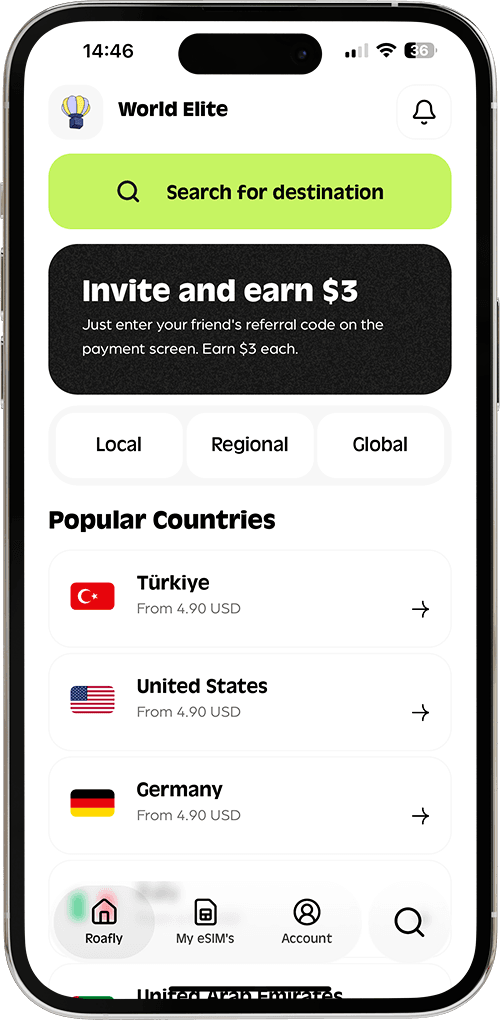
Create your order quickly
See your eSIM details
Track your remaining data
Download the App and manage your eSIMs easily
Create your order quickly
See your eSIM details
Track your remaining data
South Africa is one of those trips where mobile data matters from the moment you land. You may need Uber at the airport, Google Maps in Cape Town, WhatsApp for your safari lodge, or mobile banking verification while on the road. A good eSIM saves time and usually avoids the paperwork that comes with buying a local physical SIM.
Vodacom
Instant delivery
From 4.50 USD

Ethan Brooks
Updated Mar 25, 2026
9 min read

Jump to section
👇Best for most trips
Vodacom

South Africa
10 GB · 30 days
Enough for maps, bookings and everyday travel.
Hotspot supported
$21.00
From 4.50 USD
For most travelers, the best eSIM for South Africa is the one that gives reliable network access on a strong local carrier, fair pricing at 5GB, 10GB, and 20GB, simple setup, and predictable validity. In this comparison, Roafly stands out for value, easy installation, and access to Vodacom’s network, which remains one of the country’s strongest options. At the same time, MTN is also extremely competitive in overall network performance, so network partner matters just as much as headline price.
A travel eSIM is usually the easiest way to get connected in South Africa because you can install it before departure and activate it once you arrive. That means no searching for a kiosk, no swapping your home SIM, and no waiting for in-store registration. This matters even more in South Africa because local physical SIMs are tied to RICA registration rules, so travelers generally need ID documents such as a passport, and sometimes proof of where they are staying.
That convenience has a real travel benefit. South Africa’s two strongest large-scale mobile brands for travelers are usually Vodacom and MTN. Opensignal’s August 2025 South Africa Mobile Network Experience report says MTN won 11 of 15 awards, while Vodacom remained one of the top performers in the market. Roafly’s South Africa plans run on Vodacom, which is why they make sense for travelers who want broad mainstream coverage and straightforward setup.
Choose the perfect data plan for your trip
The table below uses the exact prices you provided for 30-day plans in USD. For Holafly, the offer provided is a 7-day unlimited plan rather than a direct 5GB, 10GB, or 20GB equivalent.
| Provider | Local Network | 5GB | 10GB | 20GB | Notes |
|---|---|---|---|---|---|
| Roafly | Vodacom | $12.00 | $21.00 | $34.90 | Best balance of price and strong network access |
| Airalo | RSA CellC | $12.50 | $22.00 | $37.00 | Very close pricing, but on Cell C |
| Roamless | Vodacom | $13.95 | $24.45 | $39.95 | Good network partner, higher price |
| BNESIM | Vodacom | $17.95 | $32.98 | $62.24 | Expensive at mid and high tiers |
| Jetpac | MTN | $14.00 | $22.50 | $40.00 | Strong MTN network, competitive mid-tier |
| GigSky | Not listed | $20.39 | $36.54 | — | High pricing, no 20GB figure provided |
| aloSIM | Cell C, Telkom | $14.00 | $24.50 | $42.50 | Mid-range pricing |
| Nomad | Vodacom | $18.00 | $25.00 | $39.00 | Reliable option, but pricier than Roafly |
| Holafly | Not specified here | — | — | — | Unlimited for 7 days at $39.90; fair-use policy may apply |
Prices in this table are the USD prices provided for this article on March 25, 2026.
On pure value, Roafly leads the comparison at every fixed-data tier you shared. At 5GB, it undercuts most alternatives while still using Vodacom. At 10GB, it stays below Airalo, Roamless, Jetpac, aloSIM, Nomad, BNESIM, and GigSky. At 20GB, the gap becomes clearer, especially against BNESIM, aloSIM, Jetpac, and Roamless. For travelers who already know they need a fixed amount of data for 2 to 4 weeks, that price-to-network ratio is hard to beat.
Holafly is the outlier because it is positioned as unlimited for 7 days rather than as a normal 30-day fixed-data plan. That can work for short trips, but it is not the best apples-to-apples choice for someone planning a 10-day, 2-week, or month-long stay.
Roafly is the strongest overall choice here for four reasons: pricing, network partner, setup simplicity, and traveler fit.
First, it wins on value in the fixed-data tiers you shared. That matters because South Africa is a trip where many travelers can estimate their usage fairly accurately. A city-break traveler using maps, messaging, rideshare, and some social media will usually be fine with 5GB. A remote worker or longer-stay traveler may want 10GB or 20GB. Roafly is priced well across all three brackets.
Second, it runs on Vodacom. While MTN currently scores extremely well in independent network testing, Vodacom remains one of the country’s major top-tier networks, with broad consumer presence and wide traveler familiarity. Opensignal’s 2025 report places Vodacom among the leading operators, even though MTN won most categories. In practice, that means Roafly users are still getting access to a proven nationwide network rather than a low-tier option.
Third, Roafly’s installation flow is traveler-friendly. Roafly supports iOS Direct Install, QR Code, and Manual installation across its eSIM products, and its site highlights support in 200+ destinations. That is useful if South Africa is only one stop on a longer Africa or multi-country trip.
Fourth, Roafly avoids a lot of the friction attached to physical SIM shopping in South Africa. Local SIMs can still make sense for some travelers, but they require in-country purchase, RICA-related identity checks, and store time. An eSIM is simply easier for most international visitors. For current South Africa plan details, you can browse the latest options on Roafly’s South Africa eSIM page
South Africa’s main mobile operators for travelers are Vodacom, MTN, Cell C, and Telkom. In independent testing, MTN currently leads overall experience in several categories, while Vodacom remains a major high-quality national network. Cell C and Telkom can still be usable depending on area and reseller arrangement, but for many international visitors, the safest default is still MTN or Vodacom access.
That is why the network line in the comparison table matters:
This does not automatically make every MTN-backed option better than every Vodacom-backed option, because price and plan fit still matter. But if you are doing long road trips, spending time outside city cores, or prioritizing connection quality over everything else, the local network partner should influence your decision.
You can buy SIM cards at major arrival points such as O.R. Tambo International Airport in Johannesburg and Cape Town International Airport. Vodacom travel bundles are specifically sold at airport stores and participating retailers, according to Vodacom’s own travel SIM terms. Independent airport SIM guides also show MTN, Vodacom, and other options being available on arrival.
The problem is not availability. The problem is value and convenience.
Airport SIM pricing in South Africa is often less attractive than what you can arrange in advance with an eSIM or find later in city stores. Independent 2026 and 2025 guides note that airport SIMs are convenient but often pricier, while city stores or malls can offer better value. Example figures cited in current guides include MTN airport options around 99 ZAR for 2GB and tourist-focused bundles from Vodacom at notably higher price points depending on the package.
So the real question is simple: do you want to spend your first hour in South Africa buying and registering a SIM, or do you want data working as soon as your plane lands?
For most travelers, eSIM wins that trade-off.
Sometimes, yes. But you need to read South African prepaid pricing carefully.
For example, Vodacom’s prepaid LTE data page currently advertises 30-day bundles such as 5GB Anytime + 5GB Night Owl for R99, 10GB + 10GB Night Owl for R149, and 20GB + 20GB Night Owl for R229. Those offers look extremely cheap on paper, but they are not clean one-to-one comparisons with travel eSIMs because they include night data conditions, require local SIM purchase, and still involve RICA registration and in-country setup.
That is the trade-off travelers need to understand. A local SIM can be cheaper per gigabyte, but it costs time, paperwork, and convenience. Travel eSIMs cost more than local prepaid data, but they are dramatically easier to start using. For a short trip, many travelers are happy to pay a small premium for that convenience. For longer stays, very heavy users, or people needing a local South African number, a physical SIM may still be worth it.
Here is the most practical way to choose.
The 10GB tier is usually the sweet spot for a 10- to 20-day trip. It is enough for navigation, WhatsApp, email, normal browsing, booking apps, and moderate social media use. Based on the prices you provided, Roafly’s 10GB plan at $21.00 is the best-value option in that range.
If your hotel, lodge, or apartment has decent Wi-Fi and you mainly want data for rideshare, maps, messaging, and occasional browsing, 5GB is usually enough. Roafly’s $12.00 price is especially strong here.
If you tether, upload photos regularly, use Instagram or TikTok heavily, or work online while traveling, 20GB is the safer choice. At $34.90, Roafly stays below most alternatives in your list.
Jetpac is one of the few options here using MTN, and MTN is currently performing very strongly in South Africa. If network preference is more important to you than lowest price, Jetpac deserves consideration. Still, the pricing gap is enough that Roafly remains the better all-around pick for most travelers.
Holafly’s unlimited 7-day plan works best for short, intensive trips where you know you will use a lot of data in a week. But because it does not match the 30-day fixed-data structure of the other plans, it is more of a niche option than the best overall choice.
First, confirm your phone is eSIM-compatible and unlocked. Without that, no travel eSIM will work properly.
Second, install before departure whenever possible. That way, you are not dependent on airport Wi-Fi after landing.
If you are not sure how much data you need, using a simple travel data usage calculator before you buy can also help prevent overpaying.
The best eSIM for South Africa in 2026 is Roafly.
It offers the best value at 5GB, 10GB, and 20GB in the pricing set you provided, uses Vodacom’s strong network, avoids airport SIM hassle, and fits the real needs of travelers who want fast setup and stable data from arrival. Jetpac is the main alternative if you specifically want MTN access, while Airalo is close on price but less compelling here because of the network line and smaller pricing advantage.
For most people heading to Cape Town, Johannesburg, the Garden Route, Kruger, or a longer multi-stop South Africa trip, Roafly is the smartest balance of price, convenience, and network quality.
Check the latest eSIM packages for South Africa before your trip so you can land with data already ready to go.
Best for most trips
Vodacom
South Africa
10 GB · 30 days
Enough for maps, bookings and everyday travel.
Hotspot supported
$21.00
From 4.50 USD

Manage your eSIM in the app
Install, top up and track data.
Choose the perfect data plan for your trip
Manage your eSIM in the app
Install, top up and track data.
