Download the App and manage your eSIMs easily
Create your order quickly
See your eSIM details
Track your remaining data
Download the App and manage your eSIMs easily
Create your order quickly
See your eSIM details
Track your remaining data
Paying in Canada involves more than choosing cash or card. Understand Canadian dollars, foreign-card acceptance, ATM charges, provincial sales taxes and the tip options that appear before you tap.

Sophie Callahan
Updated Oct 21, 2026
10 min read

Save 15% on your Roafly eSIM
Stay connected on your next trip. Use the code below at checkout.
View All DestinationsJump to section
👇Save 15% on your Roafly eSIM
Stay connected on your next trip. Use the code below at checkout.
View All Destinations
Manage your eSIM in the app
Install, top up and track data.
Canada is straightforward to visit with a credit card and a small reserve of Canadian dollars. Visa and Mastercard are widely accepted, and contactless payments are available across many everyday purchases. Keep a physical card with you even if you usually pay by phone.
The bigger surprises often appear in the total: sales taxes can be added to the displayed price, restaurant terminals prompt for a tip, and an ATM may offer to convert your withdrawal into your home currency. Understanding those separate charges makes it easier to spot what you are actually paying.
Use a card for most purchases and carry enough Canadian cash to cover a few small expenses or a temporary card problem. The right reserve depends on your route: a city break with prepaid accommodation needs a different backup from a trip involving remote stops.
| Situation | Practical payment approach |
|---|---|
| Shops, restaurants and everyday city spending | Use an accepted card; keep another payment method available. |
| Markets, small businesses and remote stops | Ask about payment methods before relying on a particular card. Carry some CAD cash. |
| Small cash tips | Keep smaller notes and coins so you can leave the amount you intend. |
| Hotels and car rentals | Establish the card and deposit requirements before booking. |
| A declined card or unavailable terminal | Try your backup card or cash, subject to what the business accepts. |
Cash is useful, but it is not accepted everywhere. Canadian businesses can choose their payment methods, including operating without cash.
Canada uses the Canadian dollar, written as CAD, C$ or simply $. In local shops and restaurants, an unqualified dollar price normally refers to Canadian dollars. Online travel sellers may display another currency, so read the currency label before paying.
Some businesses accept US dollars, particularly in tourist areas, but acceptance and the exchange rate are the merchant’s choice. Canadian and US dollars are not interchangeable at equal value. Pay in CAD rather than building your trip around spending US cash.
Cash totals may be rounded to the nearest five cents because pennies are no longer distributed. Rounding applies to the final cash amount, after tax; card payments remain payable to the exact cent.
If you cross the Canadian border carrying currency and monetary instruments worth CAD10,000 or more in total, including the equivalent in foreign currencies, declaration requirements apply. See Canada’s customs and declaration rules before carrying a large amount.
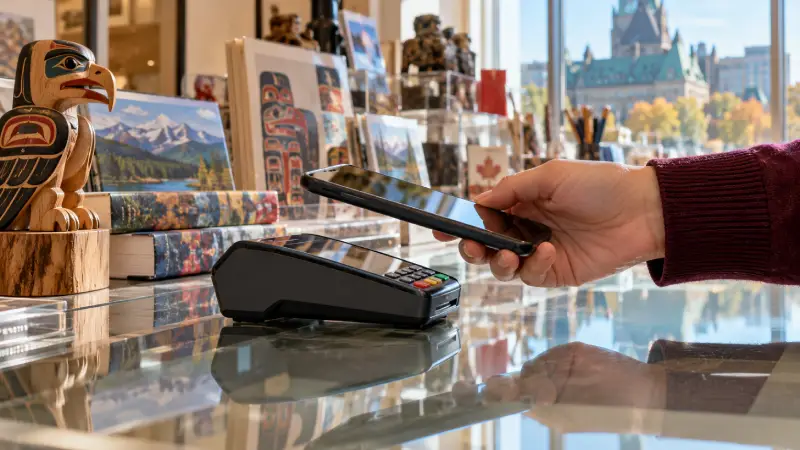
Bring a card enabled for international purchases and know its PIN. Visa and Mastercard are practical primary choices because of their broad acceptance. American Express is also accepted by many businesses, but the logos displayed at the merchant remain the useful guide.
Before departure, establish your issuer’s foreign-transaction charges and whether overseas purchases or cash withdrawals need enabling. Keep those settings separate from any travel notification your bank may request.
Apple Pay and Google Pay are convenient where the terminal and your underlying card are supported. Add and verify your cards before travelling, and carry the physical card for situations where mobile payment is unavailable or a merchant needs to see it.
Canada’s domestic debit system is closely associated with Interac. A business accepting Interac does not, by itself, establish that every foreign debit card will work.
Look for the payment network on your own card and the networks accepted by the merchant. An internationally issued Visa Debit or Debit Mastercard is different from a bank card that only works through its home country’s domestic system.
The same distinction matters with Interac e-Transfer. This service works through participating Canadian financial institutions and their banking services. It is not a general tourist wallet that you can activate simply by downloading an app and adding a foreign card.
If a small business or accommodation host requests an e-Transfer, arrange an accepted alternative before committing to the purchase.
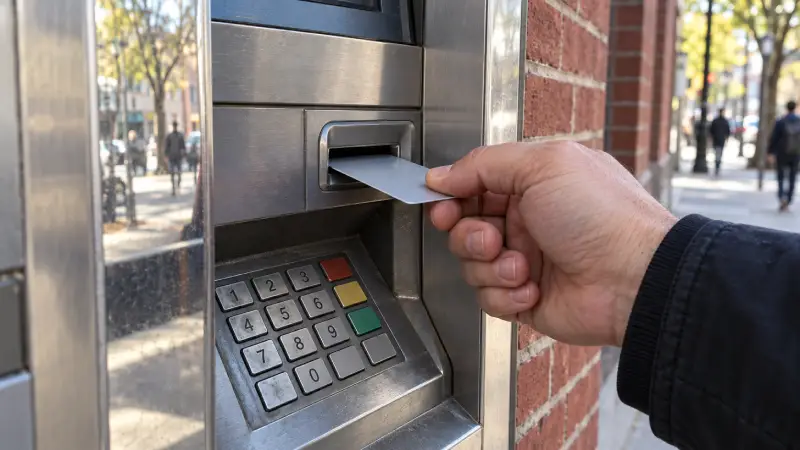
Canadian cash machines may be labelled ATM or ABM, meaning automated banking machine. Use a machine that supports your card’s network, preferably somewhere you can comfortably read the screen and protect your PIN.
The cost of a withdrawal can have three separate parts:
ATM operator charge: the fee for using that particular machine.
Your bank’s withdrawal charges: fees for overseas withdrawals or using another institution’s network.
Currency conversion cost: the exchange rate and any markup applied when CAD is converted into your account currency.
A bank-branded ATM is not automatically free for a foreign card. Your own bank may have partner arrangements, but those depend on the account and network involved.
Read the operator charge before approving the withdrawal. Repeated small withdrawals can multiply fixed fees, while taking out too much leaves you carrying cash you may not use. Withdraw for your expected cash expenses rather than treating the machine’s maximum as a target.
An ATM or payment terminal may ask whether you want to be charged in Canadian dollars or your home currency. The home-currency option is usually dynamic currency conversion, or DCC: the machine or merchant offers its own conversion rate and charges.
CAD is the sensible default, leaving conversion to your card’s usual arrangements. Compare the disclosed costs if you are considering the alternative. Your issuer’s fees can still apply when you pay in CAD.
Declining the offered conversion is different from cancelling the withdrawal. Visa’s currency-conversion guidance explains that accepting or declining DCC does not remove your ability to make the purchase or withdraw cash.
Credit-card withdrawals can also be treated as cash advances, with additional fees and interest. Use a suitable debit card for planned withdrawals after reviewing its terms.
At a currency-exchange counter, ask how many Canadian dollars you will receive after all charges. “No commission” is not enough information: the exchange rate still determines the value of the transaction.
Compare offers using the same amount of your starting currency. If you already have a working card and some cash, you can take time to compare exchange options instead of converting your entire budget at the first available counter.
Many Canadian shelf and menu prices are shown before sales tax. The amount added depends on the province and what you buy.
Canada uses federal GST, combined federal-provincial HST in some provinces, and separate provincial taxes in others. Québec’s provincial tax is called QST.
| Province | General sales-tax structure | Combined standard rate |
|---|---|---|
| Alberta | 5% GST | 5% |
| British Columbia | 5% GST + 7% PST | 12% |
| Ontario | 13% HST | 13% |
| Québec | 5% GST + 9.975% QST | 14.975% |
| Nova Scotia | 14% HST | 14% |
Rates checked on 21 October 2026 against the CRA’s sales-tax rates and calculator. These are general rates for purchases subject to the listed taxes, not a universal rate for every expense.
The distinction matters in British Columbia: restaurant meals are exempt from PST, so applying the table’s 12% to every restaurant bill would be wrong. Drinks and accommodation can also have different tax treatment.
Use the itemised total when comparing bookings. For accommodation, ask for the amount including applicable taxes and property charges.
If you are budgeting on the assumption that shopping taxes can be reclaimed before departure, read Canada’s tourist tax-refund rules before making the purchase.
Tipping is customary for restaurant table service, but there is no single compulsory percentage for every purchase. Around 15% of the bill before tax is a useful starting point for table service; you can adjust the amount for the service received.
Terminal suggestions are choices. You can select a custom amount, and a tip prompt at a counter does not create the same expectation as a full restaurant meal.
Before entering anything, look for a gratuity or service charge already included in the bill. If its purpose is unclear, ask the server whether it covers the tip.
Suppose an Ontario restaurant bill contains CAD100 of food and drink subject to 13% HST, with no gratuity already included:
| Item | Amount |
|---|---|
| Bill before tax | CAD100.00 |
| HST at 13% | CAD13.00 |
| Your chosen 15% tip on the subtotal | CAD15.00 |
| Total | CAD128.00 |
This is an illustrative calculation, not an estimate of meal prices. Applying the same 15% tip to the after-tax CAD113 would produce a CAD16.95 tip instead.
Québec has a specific rule: percentage-based tip suggestions must be calculated before GST and QST. Its rules for suggested tips also require an option to enter your own amount and neutral presentation of the choices.
Elsewhere, look at the amount the terminal calculates rather than assuming every machine uses the same basis.
Contactless transit payments can save you a separate ticket purchase, but acceptance depends on the transport system.
Toronto’s TTC accepts international credit cards and internationally issued Visa Debit and Debit Mastercard cards for contactless payment. Ordinary foreign debit cards without the supported functionality are not covered by that acceptance.
Use the same physical card or the same card on the same device when transferring. Switching from a plastic card to its mobile-wallet version can be treated as a different payment method, even though both connect to the same account.
Vancouver’s TransLink supports contactless Visa, Mastercard and American Express credit cards, Interac Debit and supported mobile wallets. These contactless bank-card payments charge adult fares; concession eligibility needs a different payment arrangement.
A card that works for shopping may not meet a rental company’s deposit requirements. Before booking, establish:
Which card types the pickup location accepts.
Whether the physical card must be in the renter’s name.
How much available credit or account balance is needed.
Whether the deposit is an authorisation hold or an actual debit.
Enterprise’s Canadian deposit guidance illustrates the difference: with a credit card, the rental cost and deposit are authorised against available credit; with an accepted debit card, those funds are taken from the account and the deposit is refunded later. Debit acceptance and other conditions depend on the rental arrangement.
Ask your hotel separately about payment at check-in and any incidental deposit. Include those temporary holds in your available spending balance, even when you have already budgeted for the room and car.
Set up the parts you control before departure:
Carry a second card separately. Ideally, it should give you another way to pay if your primary card or issuer has a problem.
Test your banking app. Make sure you can log in, approve transactions and find the card-freezing function.
Save your bank’s contact details. Keep a copy accessible without the phone or wallet that could be lost.
Prepare for verification messages. Establish whether your bank uses app approvals, SMS codes or another method.
If your bank sends codes to your usual phone number, keep that line capable of receiving them and understand its roaming terms. The guide to phone compatibility and roaming in Canada can help you prepare the device and line settings.
Mobile data is useful for banking apps, transaction notifications and contacting a booking provider. Roafly’s Canada eSIM provides a data connection on a compatible, unlocked device; it does not include a phone number or receive your bank’s SMS codes. You can compare eSIM plans for Canada when choosing the allowance and provider for your trip.
If a payment is declined, ask whether it failed outright or remains pending before repeating it. Read any bank notification, try another accepted method, and contact the issuer through its app or the number on your card when necessary.
Unexpected payment requests deserve a separate check. Open the relevant banking or booking service directly, keep receipts, and review payment and booking scams in Canada if a request feels inconsistent with what you agreed to pay.
