

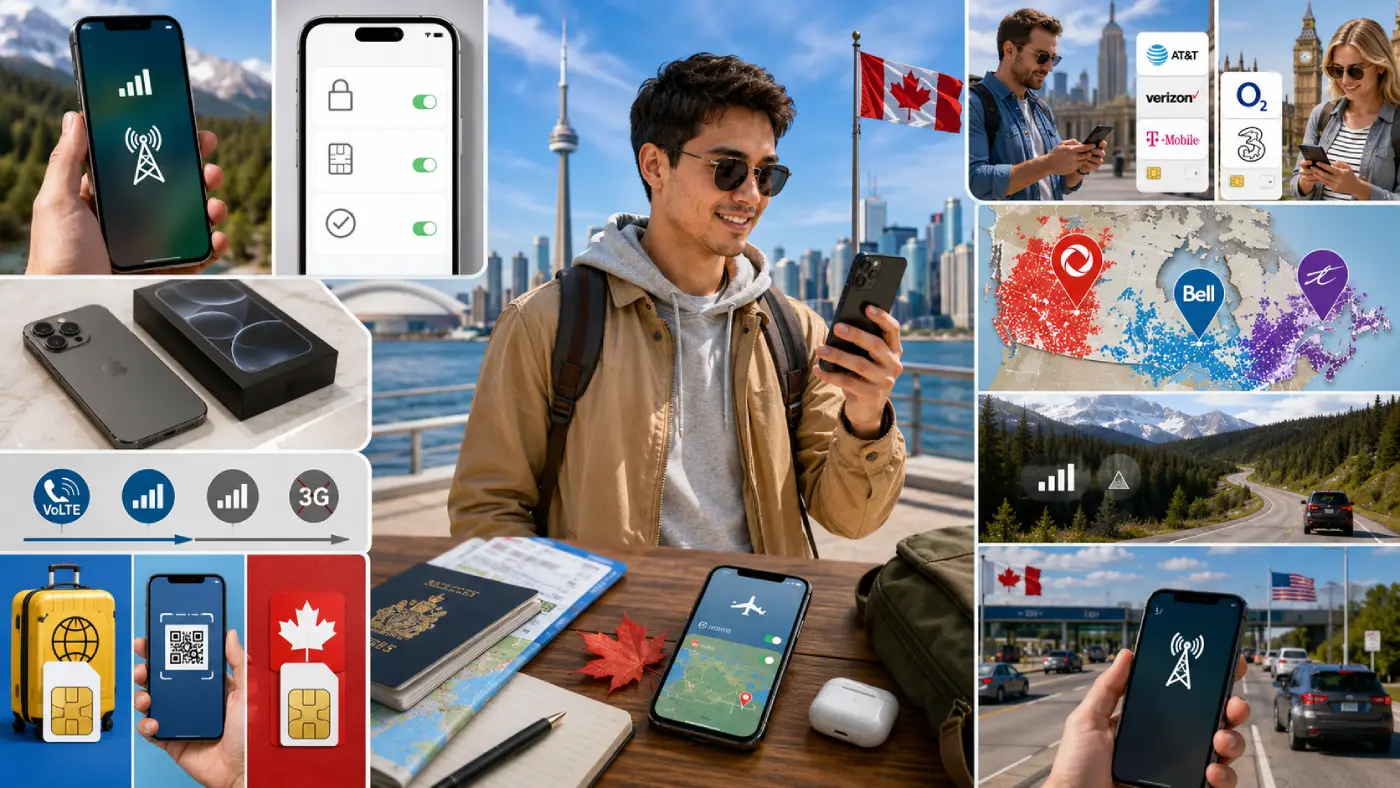
Most recent unlocked smartphones can connect in Canada, but there is no universal guarantee. Your exact model and regional variant, LTE/5G support, VoLTE compatibility, carrier lock and chosen roaming or SIM arrangement all affect what will actually work.
Voice deserves extra attention in 2026. Canada is in the middle of a staggered 3G phase-out, and an imported phone can sometimes get LTE data while still failing to make normal cellular calls because VoLTE support or carrier certification is missing.
Will your phone work in Canada? Quick answer
| Your phone situation | Likely result in Canada | Best next step |
|---|---|---|
| Recent, unlocked, eSIM-compatible phone | Usually a strong candidate | Check model, then choose roaming, travel eSIM or local SIM |
| Recent but carrier-locked phone | Home roaming may work; another SIM/eSIM may be blocked | Check roaming or request an unlock |
| Unlocked phone without eSIM | Cellular service may still work normally | Use roaming or a physical local SIM |
| Older LTE phone | Data may work while voice remains uncertain | Verify VoLTE support before travel |
| International or unusual regional variant | Compatibility varies by exact model | Check manufacturer specs and Canadian network support |
Being able to install an eSIM is separate from being compatible with a Canadian network. Likewise, seeing a 4G or 5G icon does not prove that ordinary voice calls will work.
Check the carrier lock before anything else
Carrier locking matters when you want to use a different SIM or eSIM. A locked phone can still roam through its home carrier when that carrier supports Canada, yet reject a Canadian SIM or travel eSIM.
On an iPhone, Settings → General → About → Carrier Lock can show the current lock status on recent iOS versions. Android menus vary by manufacturer, so checking with the carrier that sold the phone is often more reliable.
Roafly maintains a compatible-device list for eSIM checks. For additional model guidance, see Which devices support Roafly eSIMs?.
Model number and VoLTE matter more than the phone name
Two phones sold under the same family name can have different radios or software depending on where they were purchased. Checking “Galaxy S-series” or “iPhone” by name alone is therefore less reliable than checking the exact model number.
Canadian operators also warn that imported devices may support their LTE frequencies without supporting every network feature. Rogers, for example, notes that some devices not sold by the carrier can use mobile data while VoLTE or Wi-Fi Calling remains unavailable; Bell similarly cautions that some VoLTE-capable devices may not be fully supported on its network.
Frequency matching still matters, particularly with older or region-specific Android models. Rather than comparing a long generic band list, look up the exact regional model on the manufacturer’s specification page and compare it with the Canadian operator you expect to use.
Canada’s 3G shutdown changes the compatibility test
Canada does not have nationwide 3G shutdown date. The Canadian Radio-television and Telecommunications Commission says providers are retiring legacy networks on different schedules and warns that international visitors with older devices may be affected as Canadian networks transition toward LTE and 5G.
Bell currently lists March 1, 2027 for its national 3G/HSPA discontinuation, following an earlier shutdown in Manitoba. TELUS also lists March 1, 2027 nationally, with its Manitoba retirement completed on April 14, 2026.
Rogers is likewise moving users toward LTE and VoLTE compatibility. Its remaining 2G network is currently scheduled for retirement on November 30, 2027, and the carrier warns that a phone displaying 4G or 5G can still depend on a legacy network for voice when VoLTE is unavailable.
An old phone that technically connects today is therefore not a good basis for assuming full service. For a 2026 trip, LTE plus working VoLTE is a much safer compatibility target than simply asking whether the phone “supports 3G.”
Roaming, travel eSIM or local SIM: which should you use?
Home-carrier roaming
Roaming requires the least change. Your existing number stays active, there is no SIM replacement, and a carrier-locked phone can often use this route.
Cost and data limits are the trade-off. Canada is included in several major US plans, while some UK customers need an inclusive plan, roaming pass or daily charge.
Travel eSIM
An unlocked, eSIM-compatible phone lets you add travel data without removing the physical SIM already in the device.
Roafly’s Canada eSIM is a data-only option, so it should not be treated as a replacement for a Canadian voice number. Keeping your home SIM enabled alongside the eSIM may preserve access to your normal line, but whether incoming SMS, calls or OTP messages work without extra charges depends on your home carrier and phone settings.
Once you know eSIM is suitable, Best eSIM for Canada: Compare Prices, Networks and Hotspot covers the deeper provider and plan-selection decision.
Installation is better handled before departure over reliable Wi-Fi; Roafly’s step-by-step eSIM guide covers the setup process.
Local Canadian SIM
Physical local SIM service can make sense for a longer stay or when a local phone number and conventional calling matter more than pre-arrival convenience.
Plan prices and purchase options change frequently, so this page does not duplicate a local prepaid comparison. See Canada SIM Card for Tourists when that is the route you prefer.
Still deciding between roaming, local SIM and eSIM? Internet in Canada: SIM Cards, eSIM & Airport Options owns the broader connection-method comparison.
Current US and UK roaming options for Canada
Carrier terms below were checked September 2, 2026. Legacy plans, business accounts, prepaid service and promotional packages can differ, so verify the exact plan shown in your account before departure.