

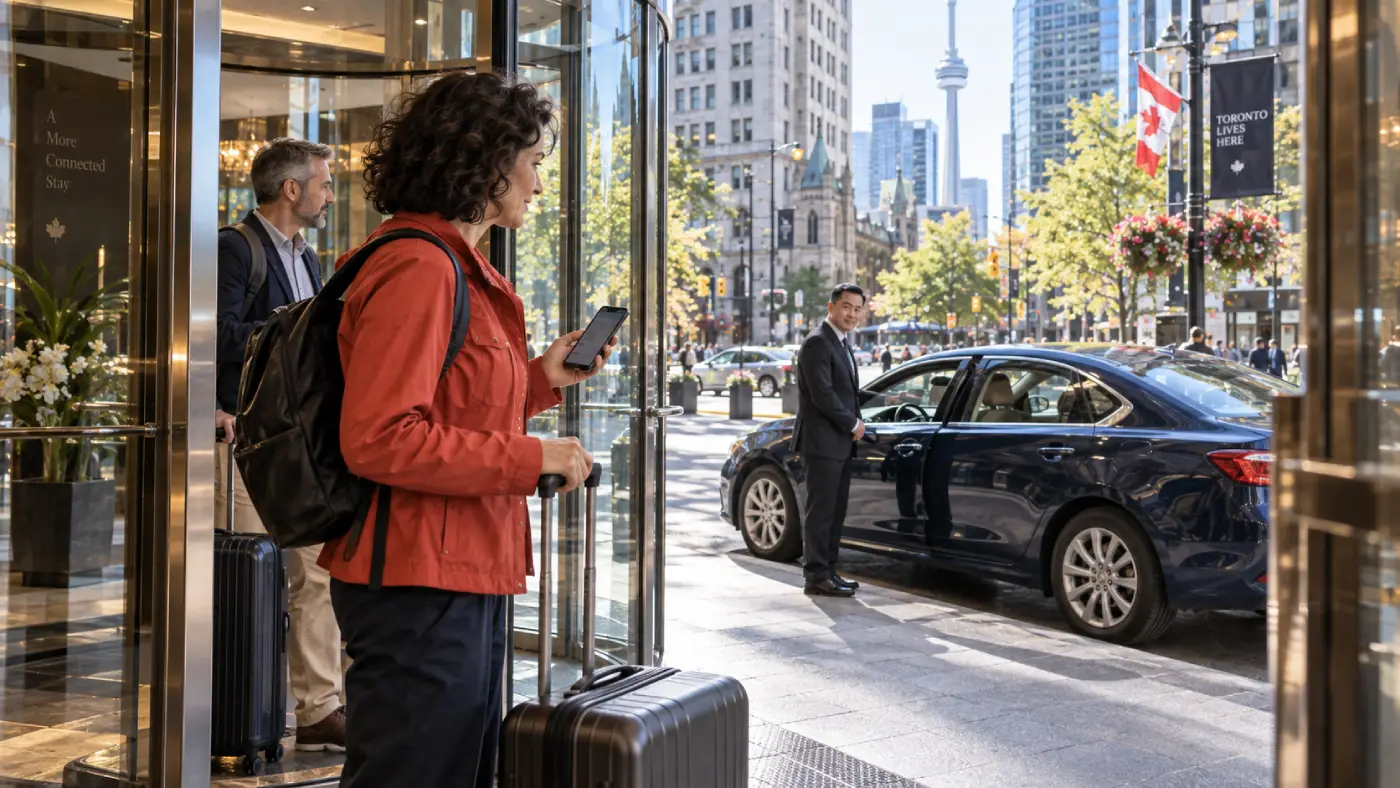

The useful precautions differ by situation. Keep control of your payment card, start bookings and applications through independently verified channels, and pause when a stranger creates urgency. The examples below distinguish documented local schemes from problems that can affect bookings anywhere in Canada.
Taxi Card Swaps and the “Help Me Pay” Trick
Toronto police have documented two situations that can end with the same loss: someone captures your PIN and returns a different card while keeping yours.
Your card is switched after a ride
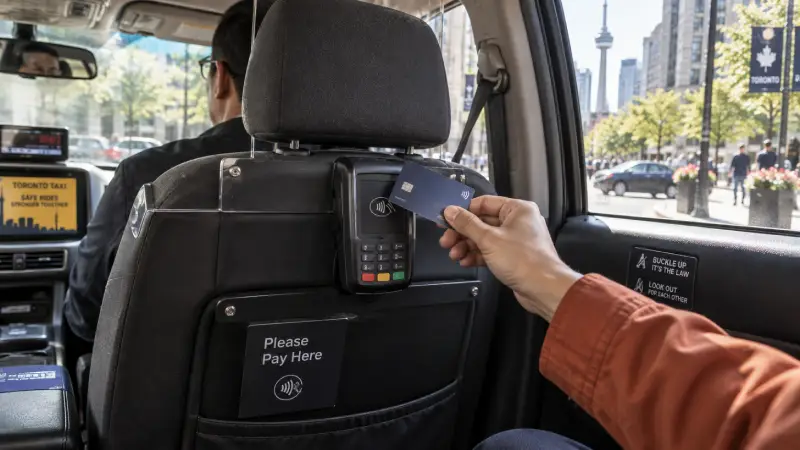
The transaction begins as payment for your own journey. During processing, the person handling the terminal swaps your debit or credit card for a similar-looking. You may leave believing payment is complete while the stolen card and PIN are used elsewhere.
Keep the card in your own hands and insert or tap it yourself. Shield your PIN, read the amount before approving it and examine any card handed back to you. If it is not yours, contact your card issuer immediately rather than waiting to see whether a withdrawal appears.
Someone offers cash if you pay their fare
Here, you do not need to be taking a taxi. Someone beside a vehicle says the driver refuses cash and asks you to pay by card, promising to reimburse you with banknotes. The apparent passenger and driver are working together.
The Toronto Police explanation of the taxi scam describes a modified terminal that records the PIN, followed by a card swap. Decline the payment request. If someone genuinely needs assistance, you can direct them to nearby staff without putting your card into their transaction.
Arriving at Toronto Pearson
Use the designated taxi or limousine queue on the arrivals curb. Licensed airport taxis and limousines do not collect walk-up passengers inside the terminals or parking garages.
Look for the GTAA plate on the bumper and the window decal. Licensed services offer flat rates to Toronto destinations and accept major credit cards; ask for the fare before departure. Someone approaching you inside the building is a reason to continue to the official queue.
Before arrival, arrange access to your reservation, destination address and transport information. Our guide to internet options in Canada explains the available connection methods.
Fake eTA Websites and Paid “Customs Declarations”
If your journey requires an electronic travel authorization, the government eTA application costs CAD 7. Start through the Government of Canada’s application channel, rather than assuming that an official-looking logo or prominent search advertisement identifies it.
Some private companies legitimately charge for application assistance. Paying more than CAD 7 therefore does not, by itself, prove fraud. The more serious concerns are a site concealing who operates it, promising guaranteed approval or taking payment without submitting an application.
If you have already used a third party, establish whether you have a valid eTA through IRCC’s official status-checking service. Keep the application reference and payment record. The Canadian government does not refund a private company’s additional service fees.
ArriveCAN is a separate service. Its Advance Declaration feature is free and optional; a payment demand for an official ArriveCAN submission should prompt you to stop. The CBSA’s guidance on fraudulent travel websites and messages covers both ArriveCAN and eTA impersonation.
Optional advance submission does not remove your obligation to make the required border declaration. Our guide to Canada’s customs declaration rules explains the legitimate arrival process and restricted goods.
Calls and Messages Impersonating Border Officials

Someone claiming to represent the Canada Border Services Agency may demand money or sensitive information, using a convincing caller ID, employee name or logo.
End an unexpected payment conversation and contact the agency independently. Do not use the caller’s callback number or payment link. The CBSA does not initiate requests for your Social Insurance Number or credit card number by phone, text or email.
Pressure to resolve an alleged problem immediately is a reason to pause. Establish what the request concerns through a genuine contact channel before providing information or money.
Holiday Rentals That Disappear After the Deposit
Fake rental listings can use photographs copied from real properties. The address may exist, yet the person collecting the deposit has no right to rent it to you. Other listings advertise accommodation that is unavailable for the dates being sold.
Warning signs become stronger when combined: an unusually attractive rate, pressure to reserve immediately and a request to move the conversation or payment outside the booking platform.
Keep messages and payments within the platform when you book through. If the supposed host offers a discount for a separate transfer, you would be changing both the recipient and the protections attached to the original booking.
Before paying, review the property’s history, location, cancellation terms and total charge. Photographs establish what a place looks like; they do not establish that the advertiser controls it.
If a reservation becomes suspicious, contact the booking platform through your account. Preserve the listing and messages before they disappear.
Fake or Duplicated Event Tickets
Concerts, sports matches and other events create another opportunity for fraudulent sales. The ticket may be invented, invalid or duplicated, leaving you to discover the problem at the entrance.
Start with the event or venue’s own ticketing information and follow its authorized purchase or resale route. Treat a screenshot or confirmation email as something a seller can copy, not proof that admission will transfer to you.
Be cautious when someone insists on immediate payment through a private message or asks you to leave an established resale platform. Verify the transfer process before sending money, especially when the event uses tickets held within an account.
High resale prices alone do not establish a scam. The key question is whether the seller can legitimately deliver a valid ticket under that event’s rules.
Parking QR Codes and Fines That Lead to Fake Payment Pages
Calgary illustrates two distinct traps: a false payment route when you park, and an invented fine afterwards.
A QR sticker redirects your parking payment
QR stickers added near a machine or sign may lead to fraudulent websites, exposing your card details without paying for parking.
Use the operator’s official app, website or machine. Calgary Parking warns about suspicious stickers and codes placed over signs. Legitimate codes also exist; inspect the payment route rather than treating every QR code as fraudulent.
A fake ticket creates a second demand
Fraudsters may leave a convincing paper ticket on your windshield or send an overdue-fine message. City logos and ticket numbers do not authenticate the demand.
Verify it through the operator’s independently accessed system. Calgary Parking does not send unsolicited texts demanding fine payments. Its customer-initiated text-to-park service is different: you start it to pay for parking.
Photograph suspicious notices and report them to the operator. Verify genuine penalties promptly rather than ignoring unfamiliar tickets.
What to Do If You Have Already Paid
Act on the part of the transaction that is at risk.
-
Contact your bank or card issuer. Use its official app or the contact details you already trust. Explain whether your card was swapped, your details were entered on a suspicious page or an unauthorized transaction has appeared. Ask about blocking the card and the appropriate dispute process.
-
Preserve evidence. Keep receipts, booking references, messages, website addresses and transaction details. Record vehicle information if you can do so safely.
-
Notify the relevant service. Contact the booking platform, ticket provider or parking operator through its genuine support channel.
-
Report the incident. Contact local police and use the Canadian Anti-Fraud Centre’s reporting channels. Its telephone line is 1-888-495-8501, open Monday to Friday, 10:00 a.m.–4:45 p.m. Eastern Time, excluding holidays.
If you are threatened or in immediate danger, move to a safe public place and call 911. Do not confront someone to recover a card or force a refund. Reporting a loss does not guarantee reimbursement; your payment provider will explain the options for your transaction.
Mobile data can help you open your bank’s app, retrieve a booking and find official contact details. A Canada eSIM can support those tasks on a compatible, unlocked phone, but Roafly’s plans are data-only and do not include ordinary phone calls.
Our guide to broader travel safety in Canada covers vehicle theft, wildfires and outdoor risks beyond the deceptive transactions discussed here.