Download the App and manage your eSIMs easily
Create your order quickly
See your eSIM details
Track your remaining data
Download the App and manage your eSIMs easily
Create your order quickly
See your eSIM details
Track your remaining data
Malaysia allows many tourists to visit without a visa, but the permitted stay varies by passport. Most foreign visitors must also complete the Malaysia Digital Arrival Card, or MDAC, before arrival—even when their trip is visa-free.

Ethan Brooks
Updated Nov 12, 2026
9 min read
Save 15% on your Roafly eSIM
Stay connected on your next trip. Use the code below at checkout.
View All DestinationsJump to section
👇Save 15% on your Roafly eSIM
Stay connected on your next trip. Use the code below at checkout.
View All Destinations
Manage your eSIM in the app
Install, top up and track data.
Your passport determines the visa route, the MDAC records your arrival details, and immigration grants your permission to stay. These rules were checked on 12 November 2026; India’s temporary exemption has a specific end date, while China’s exemption includes a cumulative stay limit.
Use your passport nationality to find your starting point. Living in Singapore, holding a European residence permit or flying from a visa-exempt country does not by itself give you that country’s passport privileges.
| Ordinary passport examples | Tourist entry route | Stay and main condition |
|---|---|---|
| United States, United Kingdom, Australia, Germany, Türkiye | Visa-free | Up to 90 days |
| Singapore, Indonesia, Thailand | Visa-free | Up to 30 days |
| India | Temporary visa exemption | Up to 30 days; the exemption currently runs through 31 December 2026 |
| China | Visa-free under the bilateral agreement | Up to 30 days per visit, with no more than 90 days in any 180-day period |
| Myanmar | Visa-free for short social visits | Up to 14 days; a visa is needed for the longer, up-to-30-day visit option |
| Bangladesh, Pakistan, Sri Lanka | Visa required; eligible for the eVisa application route | Up to 30 days for these examples, subject to the permission granted |
| Afghanistan | Advance immigration approval, followed by a visa application | Obtain the required approval before applying for the visa |
These are representative examples for ordinary tourist passports, not a complete nationality list. Use the official visa requirements by country to check passports and travel documents outside these examples. Myanmar’s 14-day exemption took effect on 1 October 2025.
China’s agreement took effect on 17 July 2025. Its 90-day cumulative allowance does not permit a single 90-day visit. Indian passport holders planning an arrival after 31 December 2026 need the rules applicable to that later date; the current exemption should not be assumed to continue.
At the border, check the departure deadline on your entry permission. Your actual authorised stay controls when you must leave.
The Malaysia Digital Arrival Card is free on the official MDAC portal. It is an arrival-information form, not a visa application or a payment for entry.
Submit it within the three days before you arrive in Malaysia. “Within three days” is the submission window, rather than a requirement to apply several weeks ahead. Prepare your passport, travel dates and Malaysian accommodation details, then keep the completed registration accessible with your travel documents.
Most foreign tourists need the form. The exemptions cover:
Singapore citizens.
Holders of diplomatic or official passports.
Malaysian permanent residents and Malaysian long-term pass holders.
Holders of Brunei’s General Certificate of Identity or the Brunei–Malaysia Frequent Traveller Facility.
Thai border-pass holders and Indonesian cross-border travel-document holders, known as PLB holders.
Those last exemptions attach to the specified documents or facilities. They do not exempt every Bruneian, Thai or Indonesian tourist. Similarly, residence in Singapore does not make a foreign passport holder a Singapore citizen.
Use the government portal directly to avoid paying a third party for the free form. Keep a saved copy of the registration so you can retrieve it without relying on airport internet.
Bangladeshi, Pakistani and Sri Lankan ordinary passport holders are among those eligible to apply through the official Malaysia eVisa service. Afghan passport holders must obtain the required advance immigration approval first.
Start at least two weeks before travel. Normal processing takes two to seven working days, excluding holidays and additional document or interview requests. Wait for approval before travelling; a submitted application is not an issued visa.
Prepare clear copies of the documents requested for your application, including your passport, photograph, itinerary and accommodation evidence. Keep the approved eVisa available digitally or as a printout for the journey.
Read the validity dates and stay conditions separately. The period in which you may use a visa to enter Malaysia is different from the number of days you may remain after arrival.
Malaysia’s limited Visa on Arrival facility applies to eligible Chinese and Indian nationals arriving through specified checkpoints from Singapore, Thailand, Indonesia or Brunei. It carries separate supporting-document conditions and allows a 15-day stay.
Eligible short-stay tourists from China and India should start with the current visa-exemption rules above. The limited VOA facility is not a general service for every passport that requires a visa, or a substitute for obtaining the correct permission before a longer visit.
Prepare a small immigration document folder, with copies available offline:
Passport: at least six months’ validity remaining on arrival, in good condition. Renew early if you are close to the validity threshold.
Visa or approval documents: the issued permission required for your nationality and purpose.
MDAC registration: unless you fall within an exempt category.
Return or onward travel: a confirmed ticket showing your departure from Malaysia.
Accommodation: hotel reservations or details of your arranged lodging.
Financial evidence: documents showing that you can support the stay if requested.
Immigration officers can ask about your visit and request supporting evidence. Your bookings, intended activities and length of stay should form a clear, consistent itinerary.
Once you have saved the essentials offline, a Malaysia eSIM provides mobile data for accessing updated bookings and arranging transport after arrival. Set aside the entry documents themselves before travelling, so getting through immigration does not depend on establishing a connection.
Yellow fever documentation depends on your journey. Malaysia requires a vaccination certificate for arrivals from countries with a risk of yellow fever transmission, including travellers who have transited for more than 12 hours through an airport in a risk country.
The certificate becomes valid 10 days after vaccination and remains valid for life. Review this requirement early if your itinerary includes affected parts of Africa or South America; it is not a blanket vaccination requirement for every visitor to Malaysia.
Packing also involves separate decisions about goods and declarations. Check Malaysia’s customs rules before bringing alcohol, tobacco, vaping products or other items that may be restricted or taxable.
The key question is whether you will cross immigration, rather than how many hours you spend at the airport.
Remaining airside: an international connection that stays inside the transit area does not involve admission to Malaysia. Confirm that your airline can handle the connection and baggage without sending you through arrivals. Passengers who do not pass through immigration do not need to complete the MDAC for entry.
Collecting baggage or leaving the airport: reclaiming checked bags, checking in again landside, visiting Kuala Lumpur or using an accommodation option outside the transit area can require entry. Your passport’s normal visa requirements and the applicable MDAC requirement then matter.
Changing between KLIA Terminal 1 and Terminal 2: plan this as a transfer involving entry into Malaysia. Do not confuse it with moving between gates or buildings within an airside terminal connection.
Connecting to a domestic flight also requires you to enter Malaysia. If your onward flight is to Langkawi, for example, you must clear immigration before continuing your journey.
Separate tickets deserve particular attention because baggage collection and onward check-in may change the immigration process. Resolve the transfer arrangement with your airlines before buying a connection that depends on staying airside.
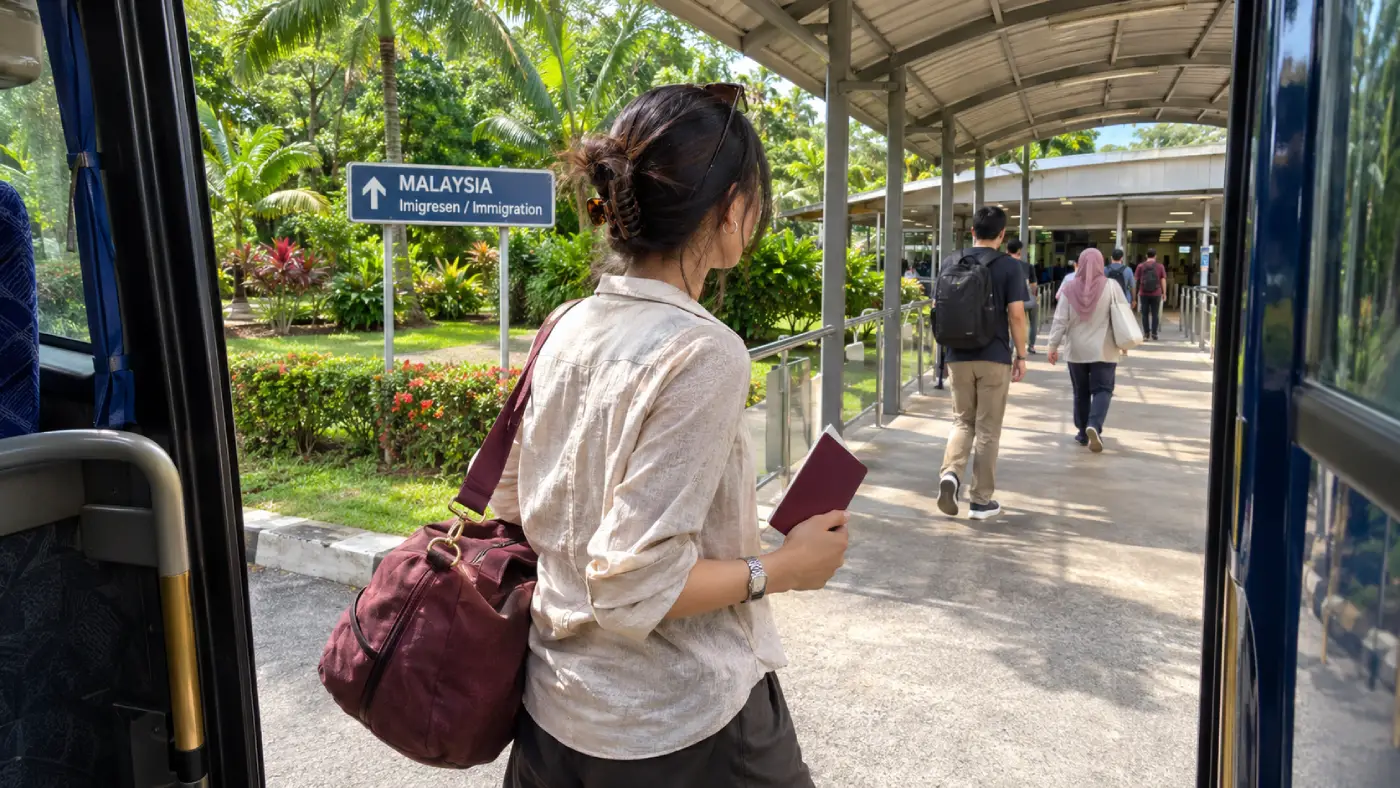
Arriving by bus, train or ferry does not remove the need for the correct passport, visa status and arrival documents. Unless exempt, complete the MDAC for your arrival even when you are not flying into Kuala Lumpur.
Some visa-required nationalities have an additional restriction: entry by air only. The Immigration Department marks these countries in its list; Nigeria, Ghana and Angola are examples. Do not assume that a Malaysian visa necessarily permits arrival across a land border.
If you are travelling from Singapore to Kuala Lumpur, choose the transport method after checking your passport’s entry route. The border crossing forms part of the journey, whether the rest of the trip is booked as one coach service or several train legs.
Cruise passengers who require a Malaysian visa must have it before sailing if they intend to disembark at a Malaysian port. Remaining aboard is a different case from going ashore.
Carry your passport when travelling between Peninsular Malaysia and Sabah or Sarawak. Domestic flights to Malaysian Borneo can still involve immigration control and entry or exit stamps.
Keep your passport and existing entry documents in your hand luggage, then check the permission recorded at the checkpoint. Do not treat the flight’s domestic label as a reason to leave your passport in a hotel safe.
Beyond the entry formalities, review the safety considerations for your Malaysia itinerary when choosing your Borneo stops, particularly if your route includes eastern Sabah.
Extensions of a short-term social visit pass are considered in exceptional circumstances, such as illness, an accident or war in the traveller’s home country. They are not a routine way to turn a short holiday into a longer stay.
Prepare supporting evidence, your passport, the relevant form and a confirmed departure ticket for an extension application. Apply through Malaysian immigration before your permission expires; an embassy abroad cannot grant the extension for you.
Do not plan an immediate border exit and re-entry as a guaranteed reset. Malaysia’s entry screening rules specifically address short-term visitors attempting a “u-turn” as their previous permission approaches expiry.
Save your accommodation address, onward ticket and immigration documents somewhere you can reach offline. Plan how you will access bookings and contact your accommodation once you leave the airport or border checkpoint; our guide to internet access in Malaysia compares the available options.
Daily conduct needs a separate check too. Read the local laws for visitors before planning activities involving alcohol, smoking or vaping.
