

'/%3e%3cuse xlink:href='%23a' transform='translate(0 -400)'/%3e%3cuse xlink:href='%23a' transform='translate(0 -600)'/%3e%3cuse xlink:href='%23a' transform='translate(0 -800)'/%3e%3cuse xlink:href='%23a' transform='translate(0 -1000)'/%3e%3cuse xlink:href='%23a' transform='translate(0 -1200)'/%3e%3cpath d='M0 0h1400v800H0z' style='fill:%23010066'/%3e%3cpath d='M576 100c-166.146 0-301 134.406-301 300s134.854 300 301 300c60.027 0 115.955-17.564 162.927-47.783-27.353 9.44-56.71 14.602-87.271 14.602-147.327 0-266.897-119.172-266.897-266.01 0-146.837 119.57-266.01 266.897-266.01 32.558 0 63.746 5.815 92.602 16.468C696.217 118.91 638.305 100 576 100z' style='fill:%23fc0'/%3e%3cpath d='m914.286 471.429-99.538-53.25 29.43 108.982-66.575-91.165-20.77 110.96-20.428-111.024-66.857 90.96L699.314 418l-99.701 52.943 74.065-85.192-112.8 4.441 103.694-44.62-103.555-44.94L673.8 305.42 600 220l99.538 53.25-29.43-108.982 66.575 91.165 20.77-110.96 20.428 111.023 66.857-90.959L814.97 273.43l99.702-52.944-74.065 85.193 112.8-4.441-103.694 44.62 103.555 44.94-112.785-4.79z' style='fill:%23fc0' transform='matrix(1.2738 0 0 1.2423 -89.443 -29.478)'/%3e%3c/svg%3e)
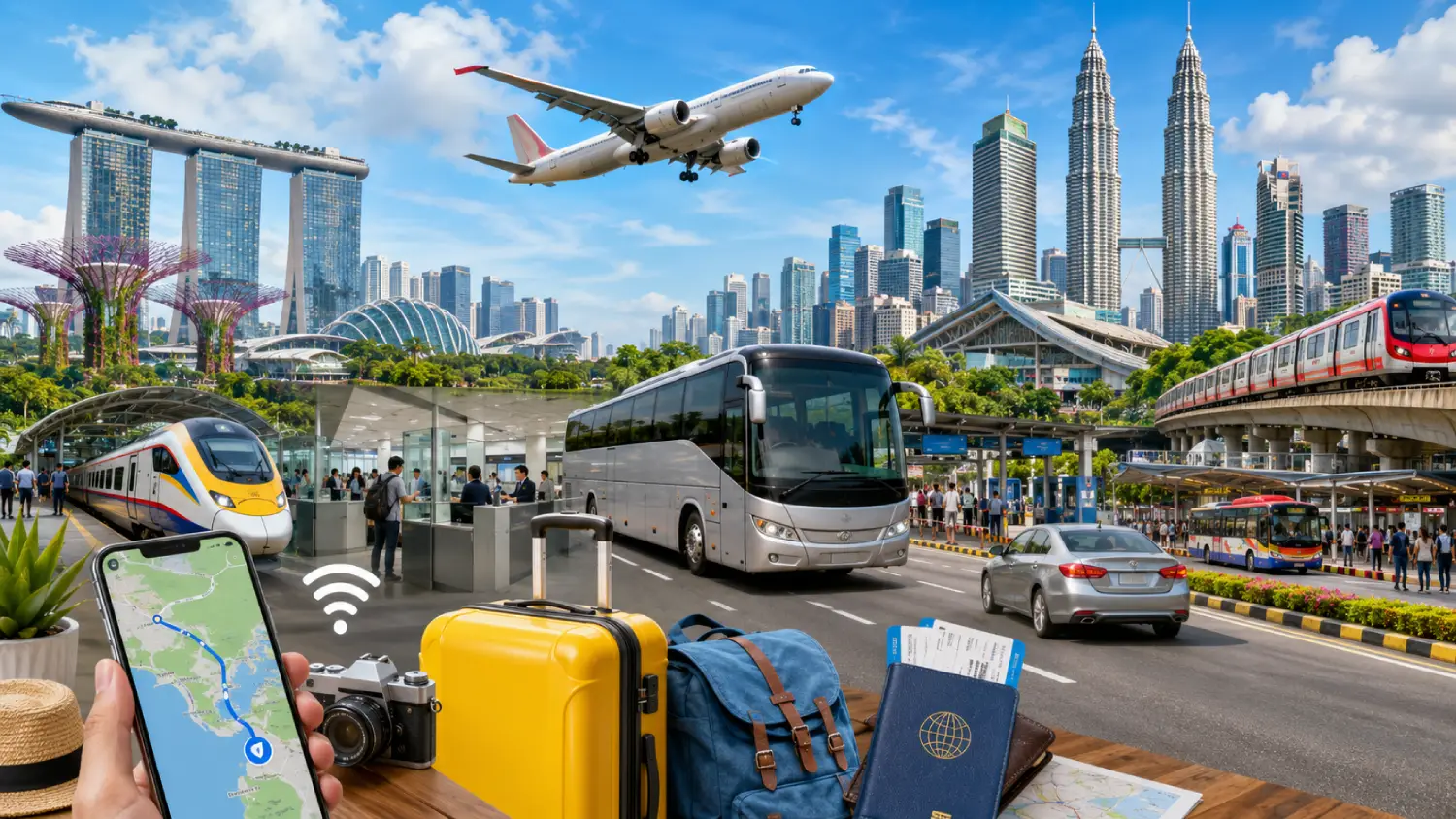
Rail travel has become much more practical now that direct KTM ETS services connect Johor Bahru with Kuala Lumpur. However, passengers still need a separate Shuttle Tebrau ticket from Woodlands Train Checkpoint to JB Sentral.
For most visitors staying in central Singapore and central Kuala Lumpur, a direct coach is the best overall balance of price and simplicity. Flying makes more sense for travelers near Changi Airport, those with a useful flight time, or anyone connecting to another flight from Kuala Lumpur.
Singapore to Kuala Lumpur Transport Comparison
| Method | Typical Total Time | Typical Cost | Best For | Main Drawback |
|---|---|---|---|---|
| Direct coach | 5.5–7.5 hours | S$25–55 | Simple city-to-city travel | Road and immigration delays |
| Shuttle Tebrau and ETS train | 6–8 hours | S$5 plus roughly RM73–109 in standard class | Predictable rail journey and more legroom | Separate tickets and a change at JB Sentral |
| Direct flight | 4–5.5 hours door to door | Commonly S$60–200 before optional extras | Travelers prioritizing speed | Airport transfers can erase the time saved |
| Private car or self-drive | 4.5–7 hours | Fuel, tolls, border fees and parking | Families or groups carrying luggage | Vehicle paperwork and checkpoint congestion |
Times can increase substantially before long weekends, school holidays and major festivals. Land travelers should treat advertised coach arrival times as estimates rather than guaranteed connections.
Which Route Should You Choose?
Choose the direct coach when you want booking, no airport journey and a drop-off point within Kuala Lumpur or the Klang Valley. Premium operators cost more but generally use roomier seating and more central terminals.
Choose the train when road congestion is your main concern. The cross-border shuttle uses dedicated railway immigration facilities, and the ETS journey from JB Sentral to KL Sentral takes approximately 4 hours 20 minutes to 4 hours 40 minutes. Reaching Woodlands and waiting between trains bring the full journey closer to a coach trip.
Choose the flight when a low fare aligns with your schedule or when you are starting near Changi Airport. Flight time is about one hour to hour 15 minutes, but Kuala Lumpur International Airport is well outside the city center.
Driving works best for groups continuing beyond central Kuala Lumpur. It is rarely the simplest choice for a visitor making a-way city break.
Direct Coach from Singapore to Kuala Lumpur
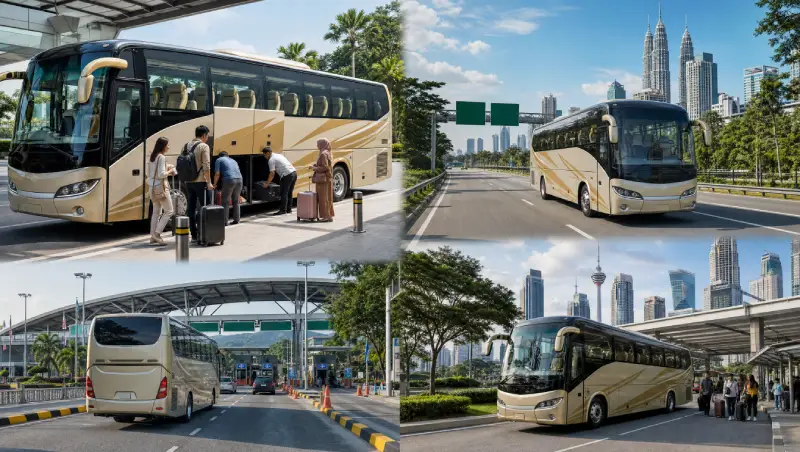
Direct coaches are the least complicated land option. Passengers board in Singapore, complete immigration at the land border and remain with the same service to Kuala Lumpur.
Journey time is usually around six hours, although queues at Woodlands or Tuas can push it beyond seven hours. Friday evenings, Sunday returns, long weekends and holiday periods carry the greatest delay risk.
Departure and arrival points differ significantly by operator. Aeroline, for example, uses the coach bay at HarbourFront Centre in Singapore and stops opposite the Corus Hotel near KLCC. Other operators may use locations around Lavender, Boon Lay, MacPherson, Novena or other commercial pickup points, then arrive at Terminal Bersepadu Selatan, Berjaya Times Square, KL Sentral, Jalan Imbi, 1 Utama or another Klang Valley terminal.
Read the ticket voucher carefully. “Singapore” and “Kuala Lumpur” describe broad service areas rather than universal bus station.
Coach fares, booking and check-in
Standard services often cost approximately S$25–40, while premium coaches can reach S$50–55 or more. Prices rise around public holidays and for departures with wider seats, fewer passengers or meals.
Book through the operator or an established coach-ticket platform, then confirm:
-
Exact boarding address and check-in counter
-
Required arrival time
-
Kuala Lumpur drop-off point
-
Luggage allowance
-
Whether the ticket can be changed
-
Whether the service uses Woodlands or Tuas
Premium operators commonly request arrival about 30 minutes before departure. Late passengers may lose their seats because the coach must follow its border slot and schedule.
Comfort and luggage
Coach standards range from conventional buses with closely spaced seats to low-capacity premium vehicles. Air-conditioning can feel cold, so keeping a light layer in your hand luggage is useful.
Expect to leave the coach at immigration. Operators handle checked bags differently at each stage, but passengers entering Malaysia may be required to take all luggage through customs. Listen to the driver’s instructions and verify the coach number before walking away from it.
Keep passports, phones, medication, money and booking confirmations in a small bag that stays with you. Do not leave essential items in the luggage compartment.
Flying from Singapore to Kuala Lumpur
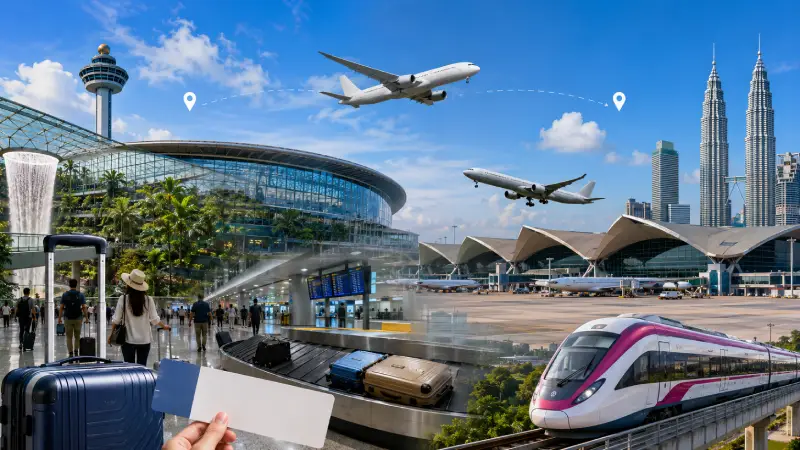
Nonstop flights operate between Singapore Changi Airport and Kuala Lumpur International Airport, commonly shown as SIN–KUL. AirAsia, Malaysia Airlines, Scoot and Singapore Airlines are among the carriers serving the route, although frequencies and operating terminals can change.
Flying time is approximately one hour to hour 15 minutes. A realistic city-to-city plan should also include:
-
Travel to Changi Airport
-
Airline check-in and baggage drop
-
Singapore departure procedures
-
Malaysian immigration and baggage collection
-
Transfer from KLIA to Kuala Lumpur
That produces a typical total of four to five and a half hours. A flight can still be fastest, but the difference from a coach may be small when your Singapore hotel is far from Changi or your Kuala Lumpur accommodation is far from KL Sentral.
Fares and baggage
Sale fares may begin below S$60 way, while departures booked close to travel or during busy periods can exceed S$200. Low-cost tickets frequently exclude checked luggage, seat selection and meals.
Compare the final checkout price rather than the headline fare. Travelers carrying a large suitcase may find that a coach or train costs less after airline baggage charges are included.
Check the terminal shown in the airline app shortly before departure. Scoot normally operates from Changi Terminal 1, but terminal assignments and operational arrangements can change.
Getting from KLIA to Kuala Lumpur
KLIA Terminal 1 and Terminal 2 are separate facilities. Confirm where you have landed before arranging transport.
KLIA Ekspres runs to KL Sentral in about 28 minutes from Terminal 1 and approximately 33 minutes from Terminal 2. The standard adult fare is RM55 way. It is usually the quickest predictable transfer during busy road periods.
Airport coaches cost less but take longer. Grab and licensed taxis are practical for groups or hotels away from a rail station, although traffic into Kuala Lumpur can be heavy.
Train from Singapore to Kuala Lumpur via Johor Bahru
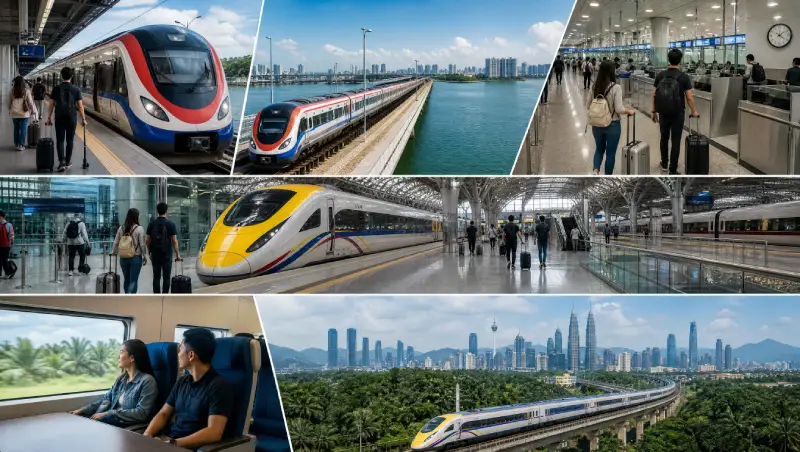
No single train runs from central Singapore to Kuala Lumpur. The practical railway journey consists of two separately ticketed services:
-
Travel to Woodlands Train Checkpoint in northern Singapore.
-
Take KTM’s Shuttle Tebrau to JB Sentral.
-
Change at JB Sentral to a direct KTM ETS service for KL Sentral.
Direct ETS trains now operate between JB Sentral and KL Sentral, so passengers booking of these services do not need the former change at Gemas.
Woodlands to JB Sentral on Shuttle Tebrau
The cross-border train ride itself takes about five minutes. Passengers departing from Woodlands complete Singapore exit formalities and Malaysian entry formalities at the co-located railway checkpoint before boarding. On arrival at JB Sentral, they can proceed into the station without repeating immigration.
For non-Malaysian travelers purchasing the Singapore departure, the fare is normally S$5. KTMB applies separate citizen pricing in some cases.
Woodlands boarding gates operate on strict cutoffs. Check-in opens before departure and normally closes 20 minutes before the train leaves, so reaching the building at least 40 minutes early is sensible. Arriving at Woodlands MRT station is not the same as arriving at the train checkpoint; additional bus or taxi travel is required.
Shuttle tickets often sell out before popular weekends. Book this segment as soon as your travel date is confirmed.
JB Sentral to KL Sentral by ETS
Direct ETS services take roughly 4 hours 20 minutes to 4 hours 40 minutes. Standard-class fares commonly fall around RM73–109, depending on the service category, departure and KTMB’s flexible pricing. Business-class seats cost more.
ETS trains use assigned seating and provide air-conditioning, toilets and space for luggage. Compared with most coaches, passengers can walk around more easily and avoid prolonged road congestion.
Purchase the Shuttle Tebrau and ETS tickets separately. Neither booking automatically protects the other if a service is missed. Leave at least 60 minutes at JB Sentral, particularly when traveling with children or several bags.
JB Sentral is a large integrated complex connected to the immigration building and shopping areas. Follow KTMB signs rather than exiting toward the local bus concourse.
Driving from Singapore to Kuala Lumpur
The road journey covers roughly 350 kilometers and generally follows Malaysia’s North–South Expressway after crossing at Woodlands or Tuas. Driving time can be around four and a half to five hours in light traffic, excluding meals and border queues.
Woodlands is more direct for central and northern Singapore. Tuas may suit travelers starting in western Singapore, but the Second Link can still become congested.
Foreign vehicles entering Malaysia must meet Malaysian requirements, including valid insurance and Vehicle Entry Permit registration. Prepare toll-payment arrangements before departure and check that the vehicle’s registration details match the permit.
Rental vehicles require particular care. Many Singapore rental agreements prohibit taking the car into Malaysia or require prior written approval and additional insurance. Do not assume that a standard rental booking covers cross-border use.
Driving becomes more attractive for three or four people splitting costs, especially when staying in suburban Kuala Lumpur. Central parking fees, expressway tolls and peak traffic reduce its advantage for a short city-center visit.
Crossing the Singapore–Malaysia Land Border
Coach and car travelers usually use either the Woodlands Causeway or the Tuas Second Link. Procedures vary slightly by vehicle and operator, but the journey normally follows this order:
-
Singapore departure clearance: Coach passengers leave the bus and follow signs through the departure hall. Car occupants complete clearance in the vehicle unless directed elsewhere.
-
Crossing the causeway or Second Link: Return to the same coach or continue by car toward Malaysia.
-
Malaysian entry immigration: Present your passport and any required entry documentation. Passport nationality determines whether a visa is required.
-
Customs and baggage screening: Coach passengers may need to carry all bags through the arrival building.
-
Reboarding: Locate the same coach using its plate number, operator name or bay. Do not board a vehicle solely because it has similar branding.
-
Onward journey: Coaches continue toward Kuala Lumpur, sometimes with a motorway rest stop.
Eligible bus and car travelers can use a QR code generated in the MyICA app for Singapore land-checkpoint clearance, but everyone should still carry their physical passport.
Many foreign visitors must submit the Malaysia Digital Arrival Card within the permitted three-day window before arrival. Exemptions apply, including for Singapore citizens and certain pass holders. Visa eligibility and permitted stay depend on nationality, passport type and purpose of travel, so check the requirements for your own documents.
Review Malaysia Customs Rules: Alcohol & Vaping Limits before packing restricted goods. Broader rules on prohibited items and local penalties are covered in Malaysia Tourist Bans & Laws: Fines & Illegal Items. Travelers finishing a Singapore stay may also find Singapore Tourist Bans & Laws: 10 Rules to Avoid Jail useful before departure.
Arriving in Kuala Lumpur
Your final transfer depends more on the terminal than on the word “Kuala Lumpur” printed on the ticket.
KL Sentral is the easiest arrival point for public transport. KTM, LRT, MRT connections, the Monorail area and airport rail services can all be reached from the wider transport complex, although some transfers involve indoor walkways and separate paid areas.
Terminal Bersepadu Selatan, often abbreviated to TBS, sits south of the city center. It connects with Bandar Tasik Selatan rail station, where passengers can transfer to KTM Komuter, LRT or KLIA Transit services.
Coach stops near KLCC, Jalan Imbi or Bukit Bintang may be closer to hotels but lack the organized taxi areas found at major terminals. Grab is widely used, and the app’s pickup pin helps avoid confusion where several building entrances share address.
Keep your bags close in busy stations and verify the vehicle registration before entering a ride. Is Malaysia Safe for Tourists?: Crime, Scams & Areas to Avoid explains common precautions without treating Kuala Lumpur as uniformly risky.
Staying Connected During the Journey
Mobile data helps with coach departure changes, digital tickets, immigration forms, maps and last-minute hotel messages. It is also useful after arrival for Grab pickup instructions and Kuala Lumpur rail navigation.
Roaming depends on your home provider and plan; crossing the border does not automatically disable an existing SIM. Check Malaysia coverage, speed limits and roaming charges before leaving Singapore.
Travelers comparing local SIM cards, pocket WiFi and eSIMs can read How to Get Internet in Malaysia. Pricing and network differences are examined in Best eSIM for Malaysia: Prices, Coverage, and Honest Comparison.
Preparing Roafly’s Malaysia eSIM before departure can simplify activation after arrival on compatible devices and supported Malaysian networks. Keep offline copies of tickets and hotel details because connection is not guaranteed immediately at the checkpoint.
Need data in Malaysia? Get an eSIM!
Choose the perfect data plan for your trip

Manage your eSIM in the app
Install, top up and track data.
Practical Tips for the Singapore–Kuala Lumpur Route
-
Avoid Friday evening and holiday departures when possible. Border and motorway queues can add several hours.
-
Book Shuttle Tebrau early and treat the ETS connection as a separate journey. Leave enough time at JB Sentral to absorb a delayed arrival.
-
Screenshot tickets, terminal maps and accommodation details before reaching the border.
-
Keep Malaysian ringgit available for small purchases, although cards and mobile payments are common in Kuala Lumpur.
-
Carry your passport and valuables whenever you leave a coach, including at immigration and rest stops.
-
Check the arrival terminal before booking a hotel transfer. TBS, KL Sentral, KLCC and suburban coach stops require different plans.
Frequently Asked Questions
What is the best way to travel from Singapore to Kuala Lumpur?
A direct coach is usually the best overall choice for city-center travel because it avoids airport transfers and requires transport booking. Flying is faster when the schedule and airport locations work in your favor, while the train suits travelers who value predictable rail travel and more space.
Is there a direct train from Singapore to Kuala Lumpur?
Not from central Singapore. Take Shuttle Tebrau from Woodlands Train Checkpoint to JB Sentral, then change to a direct KTM ETS train for KL Sentral. Both segments require separate tickets.
How long does the bus take from Singapore to Kuala Lumpur?
Most operators estimate about six hours. Allow 5.5–7.5 hours under ordinary conditions and considerably longer during peak border periods, public holidays or motorway congestion.
Do coach passengers carry luggage through immigration?
Expect to remove personal belongings and, at Malaysian arrival clearance, potentially all luggage from the coach. Procedures can differ by operator and checkpoint, so follow the driver’s instructions rather than assuming bags remain.
Do I need a visa or Malaysia Digital Arrival Card?
Visa rules depend on nationality and passport type. Many foreign visitors must complete the Malaysia Digital Arrival Card shortly before arrival, while Singapore citizens and certain other categories are exempt. Verify both requirements before boarding.
Is flying much faster than taking the bus?
Flight time is about hour, but the full journey commonly takes four to five and a half hours after airport travel, check-in and the transfer from KLIA. Compared with a six-hour coach, the actual saving may be modest.