Download the App and manage your eSIMs easily
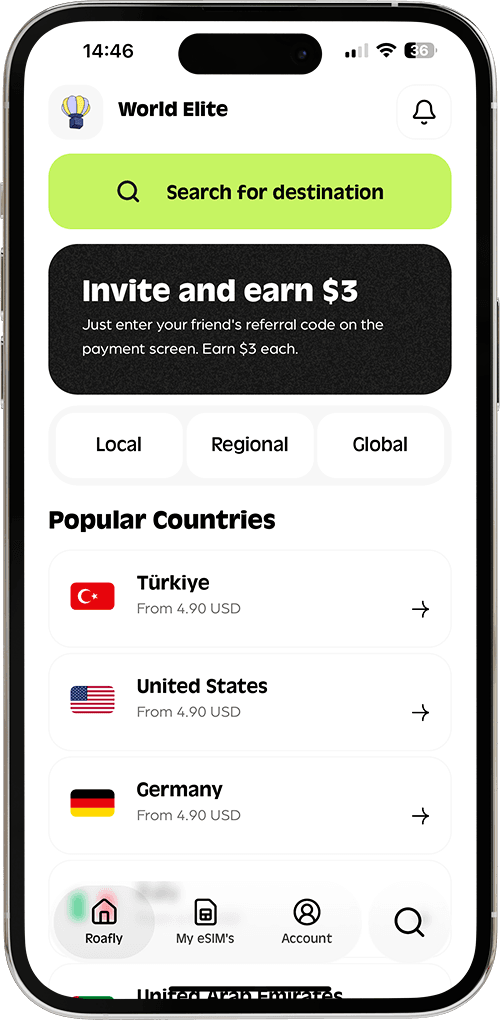
Create your order quickly
See your eSIM details
Track your remaining data
Download the App and manage your eSIMs easily
Create your order quickly
See your eSIM details
Track your remaining data
Let's be brutally honest about Costa Rica in 2026: it is the most expensive country in Central America. Treating this destination like a dirt-cheap backpacker haven will drain your bank account immediately. However, with ruthless budgeting and a strategic approach, you can still experience "Pura Vida" without going broke.
Kölbi (ICE), Liberty
Instant delivery
From 4.90 USD

Sophie Callahan
Updated Jul 19, 2026
10 min read

Jump to section
👇Best for most trips
Kölbi (ICE), Liberty

Costa Rica
10 GB · 30 days
Enough for maps, bookings and everyday travel.
Hotspot supported
$24.90
From 4.90 USD
Welcome to the raw financial framework of Costa Rican travel. A vacation here can range drastically depending on the style of travel you choose. It all comes down to whether you are eating local plates, taking public transit, or indulging in private shuttles and high-end coastal resorts.
If you are unsure which coastal town matches your vibe and wallet, consult Where to Stay in Costa Rica: Best Areas & Towns Guide before pulling the trigger.
Costa Rica demands that you define your travel style before you even book a flight. If you attempt to wing it, you will default to standard tourist prices and spend hundreds of dollars a day without realizing it. We have broken down the realistic USD and CRC (Colones) daily targets for three distinct traveler profiles.
The Backpacker strictly relies on public transit, sleeps in fan-cooled dorms, and eats mostly at local "sodas" or cooks their own meals. The Flashpacker upgrades to private Airbnbs, rents a car for specific days, and balances local street food with trendy western cafes. The Luxury Seeker demands boutique eco-resorts, air-conditioned private shuttles, and premium guided wildlife tours with no expense spared.
| Traveler Style | Estimated Daily Cost (USD) | Accommodation Style | Main Transit Mode |
| The Backpacker (Budget) | $60 - $85 | Hostel Dorms & Surf Camps | Public Buses & Walking |
| The Flashpacker (Mid-Range) | $150 - $220 | Private Guesthouses & Airbnbs | Shared Shuttles & Rental Car |
| The Luxury Seeker | $450 - $800+ | 5-Star Eco-Resorts & Villas | Private Drivers & Domestic Flights |
Keep in mind that these numbers can fluctuate aggressively based on the specific month you choose to travel. The dry season brings premium pricing, while the rainy season offers deep discounts. To optimize your spending by season, review our Best Time to Visit Costa Rica: Weather, Wildlife & Secrets guide.

Lodging will always consume the absolute largest portion of your daily budget in Central America. In popular surf hubs like Tamarindo or Santa Teresa, prices inflate wildly during peak seasons and major international holidays. However, traveling in July brings the "green season," offering a slight reprieve for travelers willing to dodge afternoon rain showers.
Hostel dorms remain the safest bet for budget travelers aiming to stretch their dollars in 2026. A standard bed in a 6-to-8 person dorm costs between $20 and $35 USD (10,000 - 18,000 CRC) per night depending on location. If you want a basic private room in a budget-friendly surf camp, expect to pay $50 to $75 USD (26,000 - 39,000 CRC).
Solo travelers trying to navigate lodging safely should check our Solo Travel in Costa Rica for the best communal options. Mid-range boutique hotels and standard Airbnbs offer incredible value if you book several months in advance. A comfortable, air-conditioned room with jungle views or pool access ranges from $100 to $180 USD (52,000 - 93,000 CRC) per night.
Luxury eco-lodges in Costa Rica are world-class, but the nightly pricing vividly reflects that prestige. Expect to spend a minimum of $350 to $500 USD (182,000 - 260,000 CRC) per night for standard high-end resorts in Arenal or Manuel Antonio. Premium secluded jungle villas in regions like the Papagayo Peninsula easily exceed $1,000 USD (520,000 CRC) nightly.
If you are staying long-term to work remotely from these luxury villas, you should absolutely read the Costa Rica Digital Nomad Visa: Requirements, Income, Rules & Process to understand the financial prerequisites.
Eating in Costa Rica can either be incredibly affordable or shockingly expensive depending entirely on where you sit down. The secret to saving money is to avoid any restaurant that hands you a purely English menu. Local "Sodas" are family-run joints that serve massive portions of traditional food at unbeatable prices.
A "Casado"—the traditional heaping plate of rice, beans, plantains, salad, and protein—at a local Soda costs around $6 to $10 USD (3,100 - 5,200 CRC). If you go to a modern western-style cafe for avocado toast and a cappuccino, that exact same meal jumps to $18 to $25 USD (9,300 - 13,000 CRC). A fresh fruit smoothie, locally known as a batido, costs roughly $3 to $5 USD (1,500 - 2,600 CRC) depending on whether it is made with milk or water.
High-end tourist dinners easily hit $40 to $75 USD (20,000 - 39,000 CRC) per person once you factor in imported ingredients and atmosphere. A local beer like Imperial or Pilsen will cost $2.50 to $4.00 USD (1,300 - 2,000 CRC) at a local dive bar. For those looking to explore the late-night party towns, review the Costa Rica Nightlife Guide: Clubs, Scams & Party Zones to see where drink prices get artificially inflated.
A quick grocery run for a large bottled water and a snack will run you about $3 to $5 USD (1,500 - 2,600 CRC).
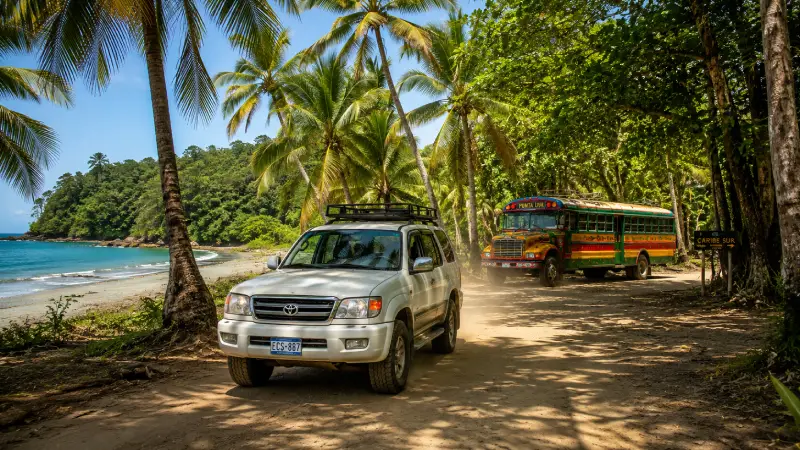
Getting from the Caribbean coast to the Pacific coast requires serious logistical planning and a highly realistic budget. Public buses are the absolute cheapest method available, but they are incredibly slow and often require transfers in downtown San José. A cross-country public bus ticket costs between $8 and $15 USD (4,100 - 7,800 CRC) and provides an authentic, albeit sweaty, local experience.
Shared tourist shuttles operated by companies like Interbus or EasyRide are the mid-range sweet spot. They provide reliable, air-conditioned, door-to-door service between major tourist hubs for $50 to $70 USD (26,000 - 36,000 CRC) per route. Domestic flights via Sansa Airlines are the fastest option, with 45-minute hops costing $100 to $160 USD (52,000 - 83,000 CRC) one way.
If you want total freedom, renting a 4x4 SUV is essential for rougher roads, costing $60 to $120 USD (31,000 - 62,000 CRC) per day. Car rentals come with a massive catch: mandatory Costa Rican liability insurance that is frequently hidden from third-party booking sites. This inescapable insurance adds a staggering $15 to $25 USD (7,800 - 13,000 CRC) daily onto your base rate.
Before getting behind the wheel, study our Driving in Costa Rica: Waze vs. GPS & Navigation Guide to avoid costly local traffic fines and navigation blunders.
You did not fly all the way to Costa Rica just to sit inside your hotel room. However, nearly every waterfall, volcano trail, and protected beach requires a paid entry ticket in 2026. The government rigorously enforces these fees through the official SINAC online booking system to prevent overcrowding.
National Park entry fees generally range from $15 to $18 USD (7,800 - 9,300 CRC) for international adult visitors. For example, Manuel Antonio and Corcovado both charge around $18 USD (9,300 CRC) just to walk through the gates. If you want a certified naturalist guide—which is highly recommended for spotting elusive sloths and monkeys—add another $25 to $40 USD (13,000 - 20,000 CRC) per person.
Adrenaline tours and specialty excursions are where daily budgets go to die. A comprehensive zip-lining canopy tour in Monteverde costs between $50 and $90 USD (26,000 - 46,000 CRC). Half-day scuba diving trips or luxury catamaran sunset cruises will easily set you back $100 to $150 USD (52,000 - 78,000 CRC) per person.
A pass to the famous Arenal hot springs ranges from a budget $40 USD (20,000 CRC) to a luxurious $120 USD (62,000 CRC) depending on the resort.
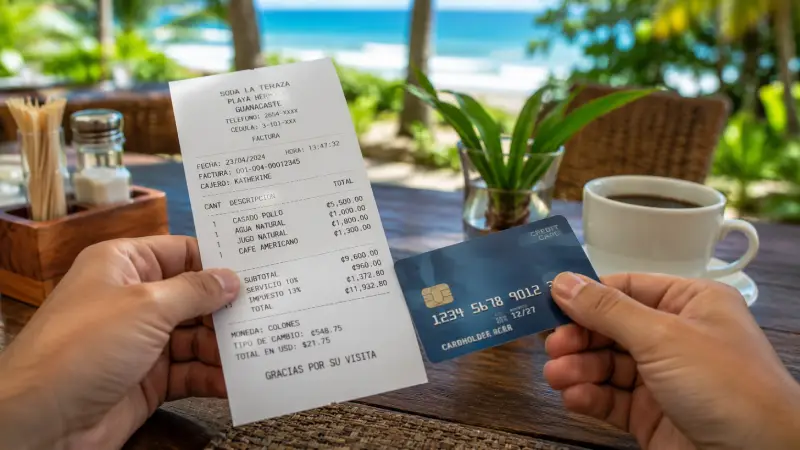
Costa Rica has a few notorious financial landmines that regularly catch first-time visitors entirely off guard. The most common shock comes at the end of a restaurant meal when the bill arrives. Menu prices rarely include the mandatory 13% Value Added Tax and the obligatory 10% restaurant service charge, adding an immediate 23% hike to your food budget.
Another massive trap is exchanging currency at the San José (SJO) or Liberia (LIR) airport kiosks. These booths offer predatory exchange rates that will rob you of 15% to 20% of your money instantly. Always use official bank ATMs (like Banco Nacional) and explicitly decline the ATM's dynamic currency conversion prompt.
Furthermore, renting a car requires a massive credit card deposit hold, often ranging from $500 to $1,500 USD, which can max out a traveler's available credit. Finally, do not buy illegal recreational items or ignore local customs, as police fines are steep and strictly enforced. Read our Costa Rica Tourist Bans & Laws: Illegal Items & Rules to keep yourself out of costly legal trouble.
If you plan on buying luxury goods before you leave, familiarizing yourself with the Costa Rica VAT Refund: Tax-Free Rules & Steps can actually claw back some of that lost tax money. Knowing how to protect your cash physically is just as important as budgeting it. Ensure you review Is Costa Rica Safe? Crime, Scams & Travel Reality Check to prevent pickpockets from ruining your trip.
To give you a crystal clear picture, we have calculated the total ground costs for trips in 2026. These figures strictly exclude international airfare and pre-trip travel insurance policies. They encompass lodging, three meals a day, local transport, and a moderate amount of paid excursions.
The 7-Day Trip Estimate:
The Backpacker: $420 - $595 USD (218,000 - 309,000 CRC)
The Flashpacker: $1,050 - $1,540 USD (546,000 - 800,000 CRC)
The Luxury Seeker: $3,150 - $5,600+ USD (1,638,000 - 2,912,000 CRC+)
The 14-Day Trip Estimate:
The Backpacker: $840 - $1,190 USD (436,000 - 618,000 CRC)
The Flashpacker: $2,100 - $3,080 USD (1,092,000 - 1,601,000 CRC)
The Luxury Seeker: $6,300 - $11,200+ USD (3,276,000 - 5,824,000 CRC+)
Always keep an emergency buffer of at least $150 to $300 USD (78,000 - 156,000 CRC) in your checking account. Last-minute transport changes or unexpected medical clinic visits can happen to anyone.
One of the most devastating budget leaks happens silently in the background of your smartphone. Relying on your home network provider's international roaming plan can result in bills exceeding $100 USD within a matter of days. You need continuous, reliable data to track your daily spending, use Waze for navigating dirt roads, and order safe local ride-shares.
For a comprehensive breakdown on all local connectivity options, review How to Get Internet in Costa Rica: SIM Cards, eSIM, Airport & WiFi Guide. However, know that physical SIM cards at the SJO airport are notoriously overpriced and require waiting in massive lines. An eSIM is the absolute smartest financial play for modern travelers who want to land and leave the airport immediately.
A Costa Rica eSIM is the most cost-effective way to secure 5G/4G data instantly before your plane even touches the tarmac. You get transparent, prepaid pricing with absolutely zero roaming shocks or hidden fees. Dive into the Best eSIM for Costa Rica: Guide to Plans, Prices, and Coverage to lock in your digital connection safely.
Eat at the Sodas: Skip the westernized tourist traps and eat at local "sodas" where a massive Casado plate costs under $8 USD (4,100 CRC).
Use State ATMs: Withdraw local Colones from official state-bank ATMs to avoid the absurd $5 to $10 USD flat fees charged by private tourist machines.
Book Parks on SINAC Directly: Never buy national park tickets from third-party street vendors; always book directly through the government SINAC portal for exactly $15 to $18 USD.
Filter Tap Water: Tap water is entirely safe to drink in most of the central valley and mountainous regions, saving you $3 USD per plastic bottle daily.
Travel in the Green Season: Booking in July or August slashes accommodation and tour costs by up to 30% compared to the peak December-to-April rush.
Best for most trips
Kölbi (ICE), Liberty
Costa Rica
10 GB · 30 days
Enough for maps, bookings and everyday travel.
Hotspot supported
$24.90
From 4.90 USD
Choose the perfect data plan for your trip

Manage your eSIM in the app
Install, top up and track data.
