Download the App and manage your eSIMs easily
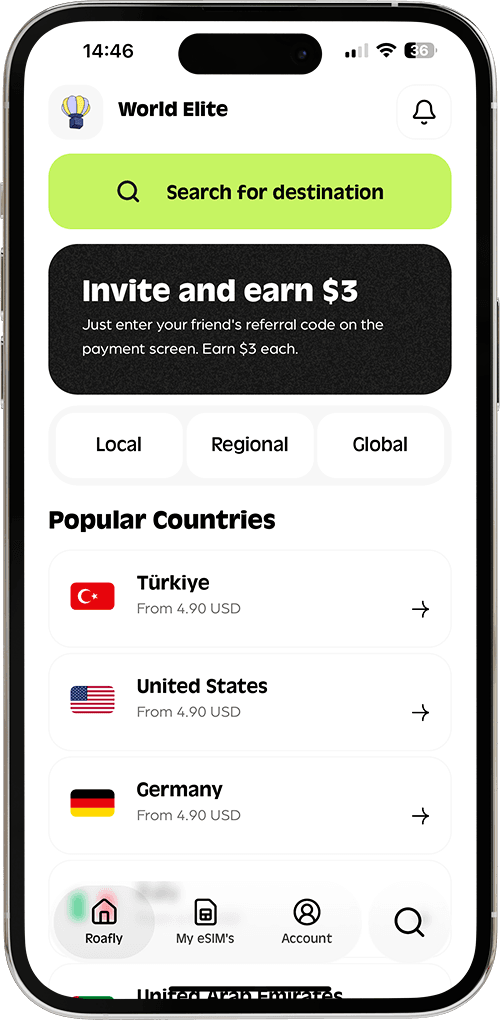
Create your order quickly
See your eSIM details
Track your remaining data
Download the App and manage your eSIMs easily
Create your order quickly
See your eSIM details
Track your remaining data
Türkiye allows visa-free tourist visits for Russian, German, Iranian and Bulgarian passport holders, as well as travelers with a British citizen passport. Russian visitors can stay up to 60 days per visit; the other passports in this group allow up to 90 days. All remain subject to a total of 90 days in any 180-day period.

Lena Hartley
Updated Sep 10, 2026
8 min read

Save 15% on your Roafly eSIM
Stay connected on your next trip. Use the code below at checkout.
View All DestinationsJump to section
👇Save 15% on your Roafly eSIM
Stay connected on your next trip. Use the code below at checkout.
View All Destinations
Manage your eSIM in the app
Install, top up and track data.
This guide covers short tourist visits on ordinary passports, with rules checked in September 2026. Work, study and longer stays require their own immigration arrangements.
Use the nationality on your travel document when checking the official visa eligibility list. Your departure airport or country of residence does not determine your tourist visa exemption.
| Passport nationality | Tourist visa needed? | Maximum visa-free stay |
|---|---|---|
| Russia | No | 60 days per visit; 90 days total in 180 days |
| Germany | No | 90 days in 180 days |
| United Kingdom — British citizen | No | 90 days in 180 days |
| Iran | No | 90 days in 180 days |
| Bulgaria | No | 90 days in 180 days |
| Poland | No | 90 days in 180 days |
| United States | No | 90 days in 180 days |
| Netherlands | No | 90 days in 180 days |
| France | No | 90 days in 180 days |
| Ukraine | No | 90 days in 180 days |
Check any conditions attached to your passport type as well as the general visa rules, which set the rolling stay limit.
The UK row applies to British citizens. Other British nationality categories can have different requirements; do not assume that every passport displaying “British” receives the same exemption.
The allowance runs across a moving 180-day period. Previous visits still count while their dates remain inside that window. Leaving Türkiye briefly does not start a fresh 90-day allowance.
Suppose you have already spent 35 days and then another 40 days in Türkiye within the relevant window. That uses 75 days, leaving 15 before accounting for older days moving out of the calculation.
Russian visitors must meet both limits: no more than 60 days on an individual visa-free visit and no more than 90 days across the rolling 180 days. Having unused days in the overall allowance does not extend that 60-day visit.
If your visa permits a shorter stay, that shorter allowance controls your trip. Check previous visits before booking a long stay, and resolve any uncertainty with a Turkish mission before departure.
Türkiye’s standard legal rule requires a passport or travel document to remain valid for at least 60 days beyond the stay allowed by your visa or visa exemption.
That means:
Permission to stay 90 days requires 150 days of passport validity from arrival.
Permission to stay 30 days requires 90 days of passport validity from arrival.
The official passport validity requirements use the permitted stay, so a one-week holiday does not reduce the requirement to one week plus 60 days.
The same guidance recommends six months of validity as a buffer. That recommendation is different from the legal calculation, and nationality-specific exceptions also apply.
British-citizen visitors should check for at least 150 days remaining on arrival and one blank passport page, according to the UK government’s entry advice.
Some can. Germany, Bulgaria, Poland, the Netherlands and France appear on Türkiye’s official list of countries whose citizens may enter with national ID cards.
This is a nationality-specific arrangement, not a general rule for everyone living in Europe. Do not substitute a residence permit for a national identity card.
Check the conditions for your own nationality and route before leaving your passport at home. Any transit country must also accept the document you carry. Treaty exceptions can affect passport validity too, so travelers covered by these arrangements should check their specific rules before applying the standard calculation above.
Ordinary passport holders from India, Pakistan and the Philippines generally need a visa. Eligible Indian and Pakistani applicants can obtain single-entry eVisas allowing stays of up to one month; eligible Philippine passport holders can obtain single-entry eVisas allowing stays of up to 30 days. Check the supporting-document requirements and other conditions in the ministry’s nationality guidance.
Indian applicants, for example, must hold a qualifying Schengen, US, UK or Irish visa or residence permit and satisfy the remaining conditions. The Turkish embassy’s eVisa guidance explains that supporting visas must be valid when entering Türkiye and that another country’s eVisa is not accepted as a supporting visa.
Holding one of those documents does not automatically give you visa-free entry to Türkiye. It can help you qualify for a Turkish eVisa where your nationality’s rules allow it.
Open the official Türkiye eVisa portal and select your nationality and travel document.
Read every eligibility condition before paying. Check the fee shown for your application.
Enter your passport details accurately, then check the issued visa’s dates, permitted stay and number of entries.
Save an offline copy and print a backup. Carry the original supporting documents required for your eligibility.
Airlines and border officials can check your supporting documents. Receiving an eVisa does not excuse a missing or invalid supporting visa.
If you do not qualify for an eVisa, follow the application process of the relevant Turkish embassy or consulate. The ministry recommends applying at least a month before travel; that is planning advice, not a guaranteed processing time. Visa applicants must also check the medical insurance requirement and their mission’s document checklist in the general visa guidance.
Do not build your trip around buying a visa at the airport. Visa-on-arrival arrangements depend on nationality; establish your route before departure.
Keep your original passport or accepted national ID accessible, together with your visa if required. Conditional eVisa holders should also carry the original documents that establish their eligibility.
It is practical to have your accommodation address, booking details and return or onward itinerary easy to retrieve. Your application conditions determine which supporting evidence you must provide; these are not identical for every traveler.
While arranging connectivity, compare the best eSIM options for Türkiye for your phone, trip length and expected use.
Save your travel documents and accommodation address offline before leaving home. If your phone supports eSIM and is unlocked, you can also install a Türkiye eSIM before departure, while you have a reliable connection.
Staying within the international transit area generally does not require an entry visa, according to the ministry’s transit guidance. Passing immigration to collect baggage, change airports, visit the city or use a hotel outside the transit area brings normal entry requirements into play.
Confirm the actual connection with your airline. Changing between Istanbul Airport and Sabiha Gökçen requires entering Türkiye; an overnight connection only requires entry if your arrangements take you through passport control.
There are also passport- and route-specific transit rules. The official electronic airport transit visa notice sets out requirements for affected Indian and Nepalese travelers connecting through Istanbul Airport toward Mexico, Panama, Colombia or Venezuela. Check that notice if it matches your journey, even when you intend to remain airside.
Visa eligibility does not establish whether a particular border crossing is open for your journey. Check the named crossing, current operating conditions and the requirements of countries you pass through.
When entering by land with a passport, check that it receives a dated entry stamp before leaving border control.
Driving also brings separate vehicle entry requirements. Review those before departure, and consider travel safety in Türkiye when choosing an overland route.
Some cruise passengers may receive local entry permission for sightseeing around the port for up to 72 hours.
Confirm eligibility with your cruise operator before disembarking. Do not assume it covers an ordinary ferry journey, a longer stay or an airport arrival to join a cruise.
Passport control and customs deal with different requirements. Before packing, check the customs rules in Türkiye, particularly if you are carrying alcohol, tobacco or vaping products.
Plan the journey from your arrival point to your accommodation before you travel. Comparing transport options in Türkiye helps you decide how to make that first journey and any later intercity trips.
Your preparation should also include the local laws tourists should know, especially rules affecting what you carry or do during the visit.
No. Border authorities make the admission decision. Visa-free travelers can also be refused entry; the German Foreign Office’s guidance expressly notes that exemption is not an unconditional right to enter.
Arrange the appropriate immigration permission before your current allowance expires. The ministry’s general guidance directs visitors seeking a longer stay to the provincial migration authorities. A residence permit requires a separate application and is not automatically granted because you entered as a tourist.
