Download the App and manage your eSIMs easily
Create your order quickly
See your eSIM details
Track your remaining data
Download the App and manage your eSIMs easily
Create your order quickly
See your eSIM details
Track your remaining data
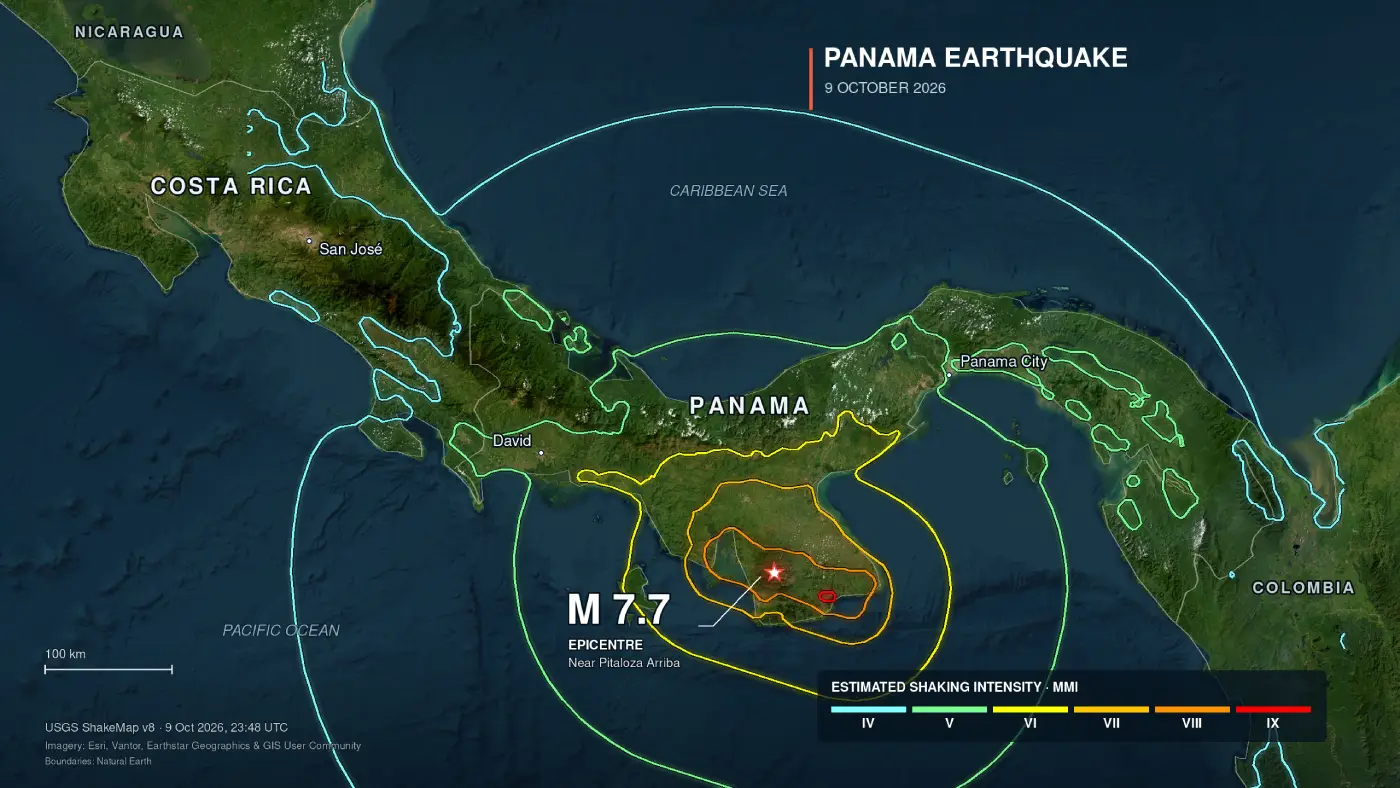
Panama’s October 9 earthquake, widely reported at magnitude 7.7, caused building damage and temporarily interrupted flights at Tocumen International Airport. Shaking was also reported in Costa Rica and Colombia.

Ethan Brooks
Updated Oct 10, 2026
6 min read
Save 15% on your Roafly eSIM
Stay connected on your next trip. Use the code below at checkout.
View All DestinationsJump to section
👇Save 15% on your Roafly eSIM
Stay connected on your next trip. Use the code below at checkout.
View All Destinations
Manage your eSIM in the app
Install, top up and track data.
As of 10:50 UTC on October 10, 2026, Tocumen had reopened and the initial tsunami warnings had been lifted. Aftershocks and damage assessments remained the main concerns. Anyone travelling to Panama should establish whether their flight, accommodation and onward route are operating before continuing with their original itinerary.
The main earthquake struck at approximately 12:56 p.m. in Panama on October 9 — 11:56 a.m. in Costa Rica. Its epicentre was near Pitaloza Arriba on Panama’s Azuero Peninsula. Early magnitude estimates changed as agencies reviewed their measurements.
Associated Press reported a later magnitude 6.6 earthquake and numerous aftershocks. Damage reports included buildings in Penonomé and communities in Herrera, Veraguas and Los Santos. Conditions varied considerably between locations.
That variation matters when planning a trip. Panama City, a rural road in Azuero and a coastal hotel can have very different access and inspection needs. Ask your accommodation about the specific property and the route used to reach it.
Yes. Shaking reached Costa Rica, including the Southern Zone, Central Valley and parts of the Caribbean region.
The Tico Times reported shaking across Costa Rica, with reports from San José, Cartago, Turrialba, Pérez Zeledón and Limón, among other places. Its early-afternoon October 9 report said authorities had not reported injuries or structural damage in Costa Rica at that point.
Colombia also experienced shaking, according to Associated Press. Regional tsunami assessments extended farther along the Pacific coast, but inclusion in those assessments is separate from reports of damaging ground shaking.
Costa Rica visitors should therefore make decisions around their actual destination and transport arrangements. Someone staying in San José faces a different question from someone connecting through Panama or travelling onward to an affected Panamanian community.
Tocumen International Airport (PTY) reopened after its temporary suspension, and Copa Airlines announced that it had restarted flights. The reopening allows operations to resume, while individual schedules can still require changes.
In its October 9 statement on restarting operations, Copa said it would prioritise returning diverted aircraft to Panama and warned of delays and itinerary adjustments.
The statement also announced flexibility for affected passengers:
| Copa condition | Announced arrangement |
|---|---|
| Ticket issue date | Tickets issued on or before October 9, 2026 |
| Original travel dates | October 9 or 10, 2026, on Copa-operated routes |
| Change fees and fare differences | Waived under the announced policy |
| Rescheduled travel | Through October 31, 2026 |
| How to request a change | Through My Trips on Copa’s website |
Copa also offered cancellation in exchange for a ticket credit, handled through its call centre. Confirm how the policy applies to your booking before purchasing a replacement flight.
Connecting through PTY? Review both flight segments together. If a delay creates an overnight stay requiring you to leave the international transit area, check your eligibility under Panama’s entry and transit requirements before arranging accommodation outside the airport.
Costa Rica flights can be affected through the same network. AERIS, the operator of San José’s Juan Santamaría Airport, told The Tico Times that it expected diverted flights from Panama. A Costa Rica itinerary involving PTY therefore needs an airline status check even when the destination itself has no reported earthquake damage.
The initial tsunami warnings were lifted. The current Panama earthquake advisory confirms that change while advising people in coastal areas to remain alert and follow local instructions.
Costa Rica’s National Tsunami Monitoring System, SINAMOT, separately assessed that this earthquake posed no tsunami danger to Costa Rica, as reported by The Tico Times and Infobae.
Be careful with screenshots of the first alerts: they can keep circulating after the assessment changes. Use the latest dated notice for your coastline. Any new evacuation instruction or strong natural warning signs require an immediate response, regardless of an earlier cancellation.
We would pause discretionary travel into a damaged area until the hotel and transport operator can confirm that the stay is workable. Trips elsewhere require a more specific decision than a countrywide yes or no.
| Your itinerary | What to establish before proceeding |
|---|---|
| Holiday in an affected part of central Panama or Azuero | Whether the accommodation is cleared for occupancy, essential services work and the access route is passable |
| Stay in Panama City | Whether your property is receiving guests and your airport transfer is running |
| International connection through Tocumen | Whether both flights still connect and what rebooking options the airline offers |
| Costa Rica stay with a direct flight | Local conditions at your accommodation and the status of your actual flight |
| Journey between Costa Rica and Panama | Whether every booked flight, shuttle or onward road transfer is operating |
If you need a different route within Panama, compare the normal options in our guide to getting around Panama, then establish which services are running now.
Switching from a disrupted flight to a long road journey also needs care. Our Costa Rica transport guide explains the usual bus, shuttle and rental-car choices; current road access must come from the operator or local authority.
Keep your next steps simple:
During shaking, drop, cover and hold on. Stay away from windows and protect your head and neck.
Follow evacuation instructions. Keep clear of damaged façades, unstable structures and cordoned-off streets.
Ask your accommodation where to assemble. Learn the exit route before an aftershock, especially if you are unfamiliar with the building.
Keep essentials together. Carry your passport, medication, charging cable and power bank, with booking details saved offline.
Document disrupted bookings. Retain airline messages, replacement reservations and receipts when discussing changes with your travel provider.
Keep a working way to contact your airline, accommodation and family. If you need to arrange mobile data, our guide to internet options in Panama explains the available approaches. Save maps and essential phone numbers offline too: mobile service can be interrupted during power or network outages.
Before your next journey, settle three practical questions: Can you reach the destination, can your accommodation receive you, and does your onward booking still work?
