Download the App and manage your eSIMs easily
Create your order quickly
See your eSIM details
Track your remaining data
Download the App and manage your eSIMs easily
Create your order quickly
See your eSIM details
Track your remaining data
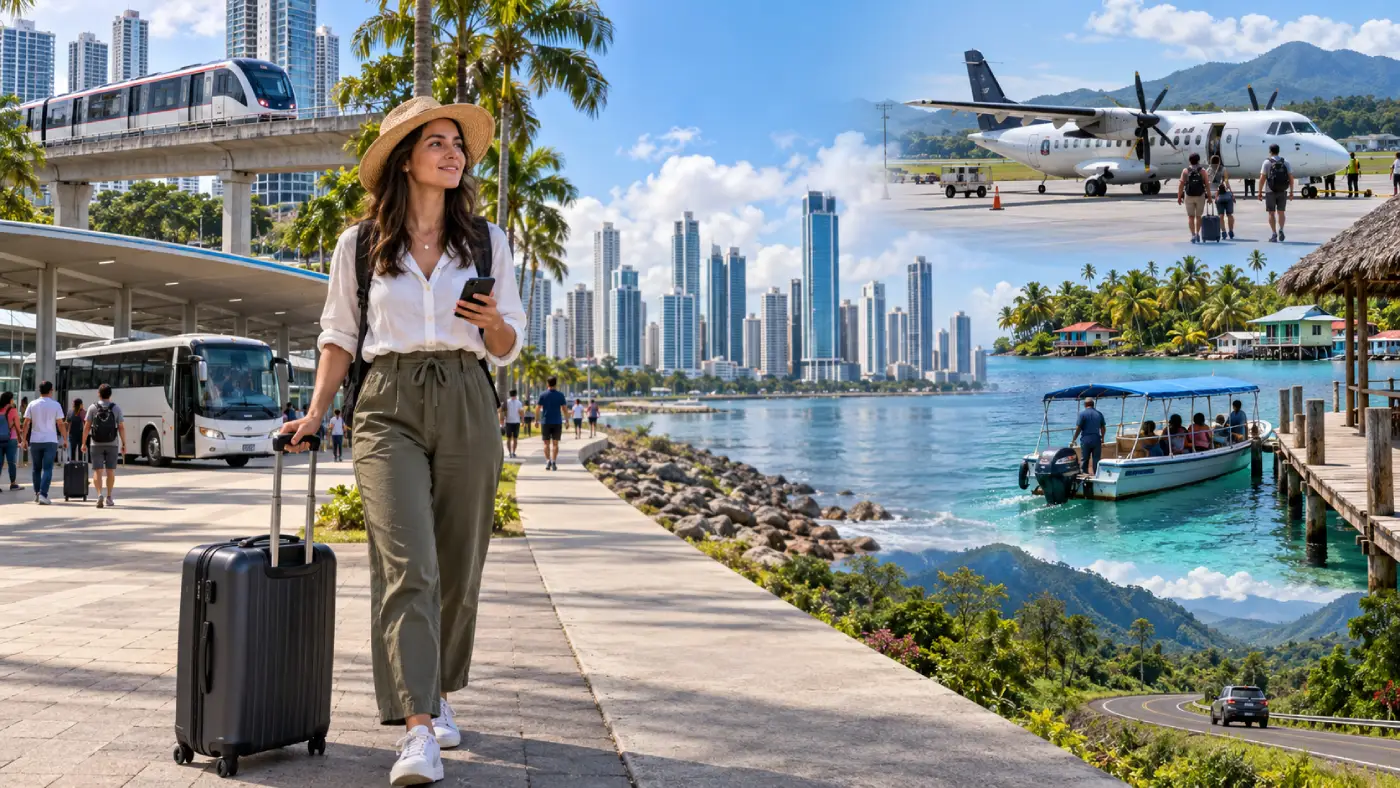
Panama City, Boquete and Bocas del Toro need different transport plans. Use the capital’s Metro for journeys along its lines, then fill the gaps with buses or an app-booked ride. Beyond the city, compare intercity buses with domestic flights and tourist shuttles. Rent a car for the mainland places you want to explore independently.

Lena Hartley
Updated Sep 5, 2026
10 min read
Save 15% on your Roafly eSIM
Stay connected on your next trip. Use the code below at checkout.
View All DestinationsJump to section
👇Save 15% on your Roafly eSIM
Stay connected on your next trip. Use the code below at checkout.
View All Destinations
Manage your eSIM in the app
Install, top up and track data.
The important exception is island travel: reaching the mainland port does not necessarily get you to your accommodation. Bocas del Toro and San Blas both require you to think about the water crossing and the final drop-off.
Build your journey around the destination, your luggage and the number of connections you are comfortable making.
| Transport | Best use | Payment or booking | Main limitation |
|---|---|---|---|
| Metro | Panama City journeys along the rail network | Transit card or supported contactless payment at enabled gates | Your hotel or attraction may need an onward connection |
| MiBus | City routes beyond Metro stations | Reloadable transit card; newer payment options are being introduced | Buses share road conditions and traffic |
| Taxi or app-booked ride | Door-to-door journeys and airport arrivals | Confirm the taxi’s total and payment method; check the app before booking | Prices and journey times depend on the trip |
| Intercity bus | Mainland travel on a tighter budget | Individual operator’s ticket counter or confirmed booking channel | Some destinations require another bus or boat |
| Domestic flight | Reducing a long overland travel day | Airline booking, with fare-specific baggage rules | Departure airport and baggage allowance matter |
| Tourist shuttle | Connections between established visitor destinations | Advance booking with the operator | Pickup point, boat inclusion and operating days vary |
| Rental car | Several mainland stops or accommodation away from transport routes | Rental agreement, deposit and required protection | Parking, one-way charges and unused island days add costs |
The simplest plan can combine several rows. You do not need to commit to either public transport or a rental car for your entire holiday.
Tocumen International Airport is PTY. Marcos A. Gelabert Airport in Albrook is PAC. They are separate airports, and an arrival at PTY followed by a departure from PAC requires a transfer across the city.
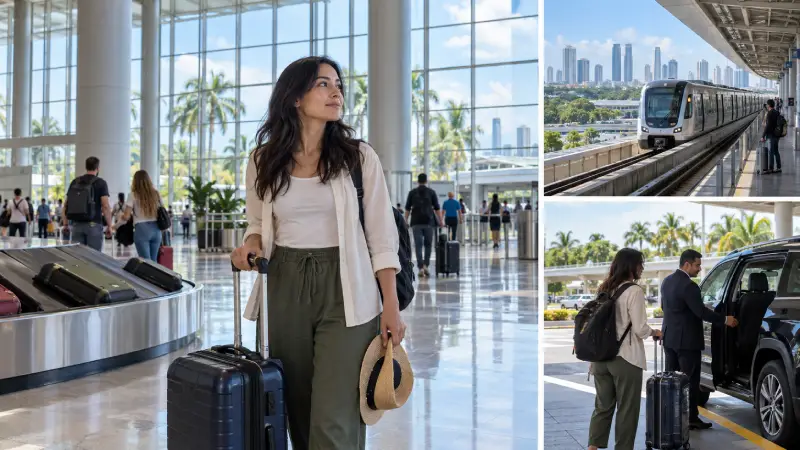
The airport connection uses the Line 2 branch. From Aeropuerto station, travel to Corredor Sur, change to the main Line 2 service toward San Miguelito, then change to Line 1 if your destination requires it.
Corredor Sur is an actual train change in this journey. The Metro’s airport-branch instructions explain how the branch connects with the main line.
Follow airport signs for the station and allow time to reach it from your arrival terminal. Check the final leg from your destination station to your hotel before choosing this option.
Prearranged transfers, taxis and app-booked rides can justify their extra cost with children, bulky luggage or accommodation inconvenient for the Metro. Compare the total for your group, including luggage and any disclosed tolls or airport charges.
Late arrivals also need a road option if the Metro has finished operating. Check the service hours for your arrival day rather than assuming trains run overnight.
If you have a separate onward flight from PAC, allow for immigration, baggage collection, road travel and the next airline’s check-in deadline. The flight time between cities tells you very little about how much connection time you need on the ground.
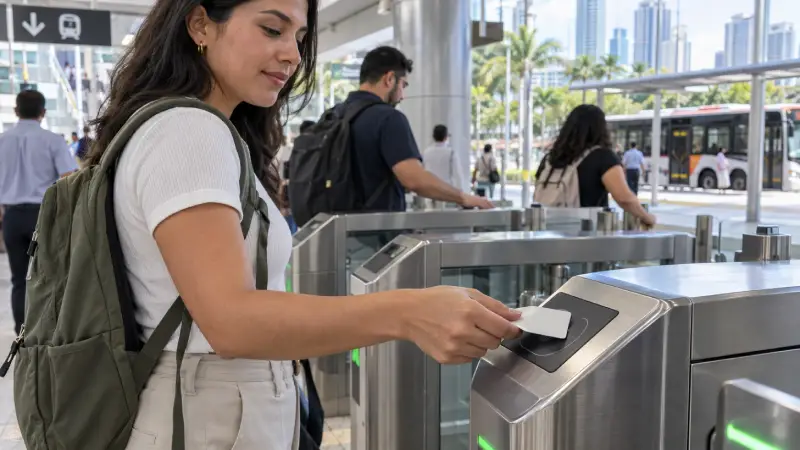
Standard adult Metro fares are US$0.35 on Line 1 and US$0.50 on Line 2. A journey using both lines costs US$0.85, before any onward bus or taxi. The published fare breakdown distinguishes the two lines and the combined journey.
The Metro supports contactless bank-card travel at enabled gates, including Visa and Mastercard. Use the same card or device throughout the journey, and follow the entry and exit reader instructions. Keep a backup payment method in case your card or a particular reader does not work.
MiBus lists US$0.25 for regular trunk routes and US$0.75 for corridor services. These are city-bus fares, not prices for long-distance coaches leaving Albrook. Its passenger guide also explains transfer charges.
The reloadable transport card remains useful if you will use both buses and the Metro. Buy and top it up through transport-card sales points and recharge facilities. Carry small cash for a top-up instead of depending on access to a Panamanian banking app.
SONDA’s payment-system FAQ announces expanded Visa and Mastercard payments, including foreign-issued cards, plus Apple Pay and Google Pay from September. It also confirms that existing transport cards and cash top-ups will remain available.
The announcement does not establish that every MiBus vehicle already accepts every new method. Until you confirm the available payment option on your service, keep a loaded transport card as your fallback.
On the new validators, wait for the green confirmation mark. SONDA says these readers confirm visually rather than with a sound, so repeated tapping because you did not hear a beep can create confusion.
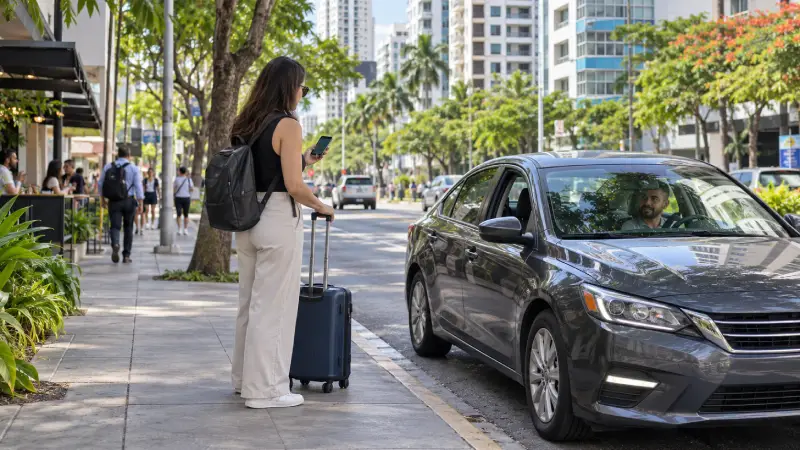
Door-to-door transport is useful when the walk from a station becomes the awkward part of the journey. Check the actual hotel entrance or attraction pickup point, especially with luggage.
Uber publishes Tocumen pickup instructions, but follow the directions shown for your own booking and terminal. Match the driver and vehicle details before boarding. Someone offering an “Uber” inside the terminal is not a substitute for a booking in your account.
Before taking a taxi, confirm the destination, total fare, whether that total covers everyone, and the accepted payment method. Airport tourism taxis and ordinary street taxis should not be treated as one universal price category. Likewise, do not assume an app’s Panama City availability guarantees a car in a smaller town.
Save your accommodation pin and enable mobile data before requesting a pickup; Panama eSIM data plans are one option for a compatible, unlocked phone. Download an offline map too, so your saved location remains accessible when connectivity drops.
Before choosing an unfamiliar route or travelling after dark, consult Panama’s tourist safety guidance.
Albrook’s Gran Terminal Nacional de Transporte brings together intercity buses, city transport and the Metro. The terminal is distinct from nearby Albrook airport: specify “bus terminal” or “airport” when arranging a ride.
Use the terminal’s destination and operator directory to identify the correct company. Its Bocas listing includes Almirante, while David is the principal connection to consider for onward travel toward Boquete.
Confirm the actual departure with the operator. Ticket-office opening hours are not a bus timetable, and a ticket labelled “Bocas del Toro” needs a precise mainland arrival point.
Before paying, establish:
Which town or terminal the bus reaches.
Whether you have a reserved seat or a particular departure.
How your suitcase or oversized equipment will be carried.
Whether you must change buses or arrange a port transfer.
Keep payment flexibility until the operator confirms how you can buy the ticket. Do not assume your city transport card pays for an intercity journey.
Domestic flights deserve a comparison when your itinerary includes western Panama or Bocas del Toro. Check the airport code, not just “Panama City”: the domestic departure airports include PAC in Albrook for Air Panama and Tocumen for connections such as David.
Air Panama’s published schedule allows approximately one hour for the flight from PAC to Bocas del Toro. That is scheduled flight time: airport transfers, check-in, baggage collection and the onward journey to your accommodation all add to the total.
Baggage can change the price substantially. Air Panama’s fare conditions list a cabin allowance of up to 6 kg; its Básica fare charges extra for checked baggage. Verify the allowance attached to the ticket you are buying rather than assuming your international-flight luggage will fit the domestic fare.
Reaching Bocas Town on Isla Colón overland involves a boat crossing from Almirante. Flying to Bocas Town avoids that mainland crossing, but accommodation on another island can still require a water taxi.
Panama’s tourism authority puts the Almirante–Isla Colón boat crossing at approximately 35 minutes. Allow extra time to reach the dock, board and continue to your accommodation; the crossing time does not cover those separate legs.
Confirm the last suitable crossing for your arrival day. A bus arrival time is not a guarantee that you will reach an island hotel that evening.
The public-transport connection involves reaching David, continuing toward Almirante, and taking the boat to Isla Colón. Assess the whole sequence, including the move between the bus arrival point and the dock.
Tourist shuttles can reduce the number of arrangements. Hello Travel Panama’s Bocas-to-Boquete service advertised US$30 with the water taxi included when checked on September 5, 2026. The ground transfer uses a route that avoids David.
Treat that published price as a budgeting reference and confirm the fare for your travel date. “Direct shuttle” can describe one combined booking even though you change from a boat to a vehicle.
The usual road approach to San Blas, also called Guna Yala, is by four-wheel-drive vehicle to Cartí, followed by a small boat to your island. The official Guna Yala visitor page describes this connection.
Booking the road and boat together can simplify the trip. International visitors should bring their original passport: Native Panama Tours’ transfer instructions explicitly require it and say copies are not accepted.
Carry US-dollar cash for separately payable entry and port charges. These may be excluded from the headline package price, as shown in Panama Travel Unlimited’s package conditions. Your quote should identify the amount payable separately, luggage limits and arrangements if conditions prevent the crossing.
If you are considering driving yourself, confirm vehicle suitability, rental-company permission and parking before booking the boat. A car reservation alone does not arrange island access.
Consider a car when you want several mainland stops, accommodation outside town centres or flexibility between beaches and mountain areas. You can also rent for only one section—for example, collecting a vehicle in David for a Chiriquí stay.
City-and-island itineraries need a different calculation. Work out how many days the vehicle would sit parked while you are in Panama City or away on an island, then compare that cost with transfers and buses.
Request a full rental quote covering required protection, the deposit, taxes, additional drivers, toll handling and any one-way return charge. Confirm your licence and any translation or International Driving Permit requirement with the specific rental location.
Policies vary by company and vehicle. For example, Alamo’s Panama City conditions distinguish third-party liability protection from collision coverage and set their own documentation requirements. Credit-card collision cover should not be assumed to replace every required item.
Build some flexibility into mountain or coastal driving days. Panama’s regional weather patterns help you plan beyond a single countrywide “rainy season” label.
Check these details before locking in a connection:
Airport or terminal: PTY, PAC and Albrook bus terminal are different places.
Final destination: confirm the hotel entrance, town, port or island dock.
Payment: carry a backup to your preferred bank card or app.
Luggage: check domestic-flight limits and ask about boat or shuttle capacity.
Connection margin: allow for immigration, traffic and the final water crossing.
Accessibility: confirm the complete transfer, including boarding a minibus or small boat, with the operator.
Save tickets, booking references and operator contacts offline. If you need to compare roaming, local SIMs and other data options, use the guide to getting internet in Panama before departure.
