Download the App and manage your eSIMs easily
Create your order quickly
See your eSIM details
Track your remaining data
Download the App and manage your eSIMs easily
Create your order quickly
See your eSIM details
Track your remaining data
India’s customs allowances changed in February 2026, but the widely reported ₹75,000 limit does not apply to every visitor.

Lena Hartley
Updated Oct 24, 2026
10 min read
Save 15% on your Roafly eSIM
Stay connected on your next trip. Use the code below at checkout.
View All DestinationsJump to section
👇Save 15% on your Roafly eSIM
Stay connected on your next trip. Use the code below at checkout.
View All Destinations
Manage your eSIM in the app
Install, top up and track data.
Foreign-origin tourists arriving by air or sea generally receive a ₹25,000 allowance for eligible goods, separate from used personal belongings. Leave vapes at home, arrange any required medicine permissions before departure, and declare goods that need customs clearance.
| Item | Current rule | Best action |
|---|---|---|
| Personal belongings and gifts | Used daily necessities exempt; new goods depend on passenger category | Separate trip essentials from gifts |
| Gold and jewellery | Everyday personal jewellery and special allowances have different rules | Declare additional valuables where required |
| Vapes and e-cigarettes | Import prohibited, including nicotine-free devices | Leave devices and cartridges at home |
| Alcohol and tobacco | Quantity limits apply within eligible baggage allowances | Count purchases from every airport shop |
| Medicines | Limited personal-use route; controlled drugs need separate permission | Check ingredients and carry treatment documents |
| Food and plants | Animal products and plant materials require declaration | Check the product before packing |
| Foreign cash | Declaration above US$5,000 in notes or US$10,000 in total foreign exchange | Calculate the combined currency equivalents |
The ₹25,000 and ₹75,000 figures are allowances for eligible goods, not limits on the total value of everything in your suitcase. Used belongings needed for everyday life during the trip receive separate treatment.
Rules checked on 24 October 2026. Requirements can change; verify the linked official baggage guidance before travel.
The Baggage Rules, 2026 took effect on 2 February 2026. For arrivals by air or sea, the main allowances for eligible goods are:
₹25,000: tourists of foreign origin, excluding infants.
₹75,000: Indian residents and tourists of Indian origin, including eligible NRIs and OCI cardholders.
₹75,000: qualifying foreign nationals holding a visa other than a tourist visa and staying in India for more than six months.
Most international holidaymakers who are not of Indian origin fall into the ₹25,000 category. The higher allowance is not available simply because you hold a valid Indian tourist visa.
Used clothes, toiletries and personal electronics reasonably needed during your trip generally fall under daily personal effects. New purchases and gifts require a separate assessment against your allowance and any product-specific restrictions.
Passengers aged 18 or over, other than crew members, also have a concession for one new laptop or notebook computer. Keep receipts for new purchases so their value is easy to establish.
Allowances cannot be pooled. Two foreign-origin tourists cannot combine their individual ₹25,000 allowances to clear one ₹50,000 handbag duty-free. Each passenger’s entitlement is assessed separately.
Bringing your usual phone through customs and choosing how to connect it are separate preparations. Review the internet options in India before deciding between roaming, a local SIM and a travel eSIM.
Passengers entering through a land border have no general monetary duty-free allowance; used personal effects needed for daily life remain eligible for duty-free clearance. Do not apply the air-arrival shopping allowance to an overland crossing.
Infants, defined here as children no more than two years old, do not receive the general allowance for additional goods. Their used personal effects remain covered.
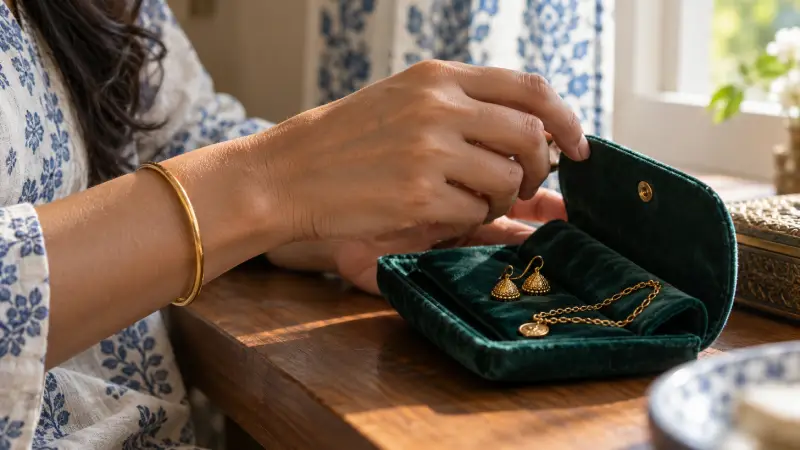
Used personal jewellery reasonably required for daily life can enter as personal effects. This is different from importing new jewellery, bringing gifts, carrying bullion or claiming the special weight-based jewellery concession.
The 40-gram allowance for female passengers and 20-gram allowance for other passengers applies to eligible Indian residents or tourists of Indian origin returning after residing abroad for more than one year. These are not universal jewellery limits for every foreign tourist.
The 2026 framework removed the old monetary caps from that special concession. Older pages quoting both a weight limit and a ₹50,000 or ₹100,000 value cap may describe the previous rules.
Ordinary worn jewellery and substantial wedding sets or additional valuables should not be treated as one category. Wearing an item on arrival does not by itself establish that it qualifies as a daily personal necessity.
Tourists bringing eligible valuables for their stay can declare them and request temporary import treatment. Customs may issue a Temporary Baggage Import Certificate, Form CBD-IV, which must be presented with the items when leaving.
The goods must be re-exported at the first departure from India or within six months, whichever comes first. Keep the certificate with your travel documents. Jewellery intended as a gift to someone in India does not meet that re-export condition.
Gold and silver bars or coins fall outside the ordinary duty-free baggage allowance. They should not be treated like everyday personal jewellery.
No. India prohibits the import of electronic cigarettes, including disposable and refillable devices. The prohibition covers complete products and their parts, and the legal definition includes nicotine-free devices and heat-not-burn products.
Personal use does not create a tourist import exemption. Pack neither the device nor its vape pods or cartridges.
Airline rules about where lithium batteries belong do not authorize an item to enter India. Moving a vape between cabin baggage and checked luggage therefore does not resolve the customs restriction.
This section concerns bringing the product across the border. Local rules on possession, sale or use are a separate question.
For eligible arrivals other than by land, the baggage quantities are up to two litres of alcoholic liquor or wine, plus one of the following tobacco allowances:
100 cigarettes.
25 cigars.
125 grams of tobacco.
The tobacco quantities are alternatives, not three allowances to add together. Their value, and the value of the alcohol, must fit within the general duty-free allowance applicable to your passenger category.
Purchases from departure-airport shops and arrival duty-free shops count toward the same limits. A duty-free receipt does not provide an additional Indian customs allowance.
Declare excess quantities. Their treatment depends on the applicable import restrictions and duty rules; do not assume every excess item can enter simply by paying tax. These border allowances also do not determine where drinking or smoking is permitted after arrival.
Keep medicines intended for your own treatment separate from products carried for someone else or for resale.
India’s personal-baggage provision under Rule 36 allows limited quantities for the passenger’s exclusive personal use, with a ceiling of 100 average doses of any single drug under that route. Customs can require a declaration, and larger quantities need exceptional authorization from the licensing authority.
That is a dose-based limit, not a blanket allowance for a 100-day supply. A medicine taken several times daily can reach the dose limit much sooner.
Carry your prescription and a doctor’s letter identifying the medicine, active ingredient, dosage and treatment need. Keeping medicines in their labelled packaging also makes identification easier. These preparations are useful evidence; they do not replace permission where a controlled ingredient requires it.
Medicines containing narcotic drugs or psychotropic substances follow a separate permission process. A prescription issued at home is not sufficient evidence that the medicine may enter India.
Apply well before departure for permission to bring controlled medicines from the Narcotics Commissioner, supplying the prescription and relevant supporting papers. Obtain the permission before traveling with the medicine.
Check the active ingredient rather than relying on the brand name, which can differ between countries.
India’s customs declaration specifically asks about meat and meat products, dairy products, fish and poultry products. It also asks about seeds, plants, fruits, flowers and other planting materials. Carrying these categories requires declaration and a visit to the Red Channel.
Animal products can require quarantine clearance, health certification or other import documentation. Plant requirements depend on the commodity and its origin, with phytosanitary controls applying to regulated material.
Sealed packaging is not an import exemption. Vacuum-packed meat, packaged cheese or a bag of seeds can still fall within a controlled category.
For a straightforward holiday, leave fresh produce, planting material and animal products at home unless you have established the requirements for the exact item. If you need a particular food for medical or dietary reasons, resolve its import conditions before departure instead of relying on a general “personal use” assumption.
Ordinary travel electronics should not be confused with equipment subject to additional import controls.
Complete drones are generally prohibited from import, with specified exceptions for authorized purposes such as research, defence and security. An ordinary holiday is not one of the listed exceptions. Do not assume a lightweight drone becomes admissible because it weighs less than 250 grams.
Satellite phones require prior Department of Telecommunications licensing and must be declared on arrival. A normal mobile phone and a satellite handset have different regulatory treatment.
For specialist equipment, settle import authorization before packing. Declaration identifies the item to customs; it does not create the missing permission.
Foreign exchange can be brought into India without a general maximum, but you must declare it when either threshold is exceeded: US$5,000 equivalent in foreign currency notes, or US$10,000 equivalent in aggregate foreign exchange, including notes and travellers’ cheques.
These are declaration thresholds, not amounts above which entry with the money is automatically prohibited. For example, US$6,000 entirely in banknotes requires declaration even though the total is below US$10,000.
Complete the Currency Declaration Form when required and retain it. It can be needed when exchanging the money or taking the unspent balance out of India.
Indian rupees have separate rules. Under the RBI’s currency-entry guidance, eligible non-resident visitors entering through an airport may bring up to ₹25,000. This permission excludes citizens of Pakistan and Bangladesh and travelers coming from or going to those countries. Separate provisions govern movement to and from Nepal and Bhutan.
Customs clearance normally follows immigration and baggage collection. Your visa or immigration arrival form does not replace a customs declaration. Check India’s visa and arrival requirements separately when preparing your entry documents.
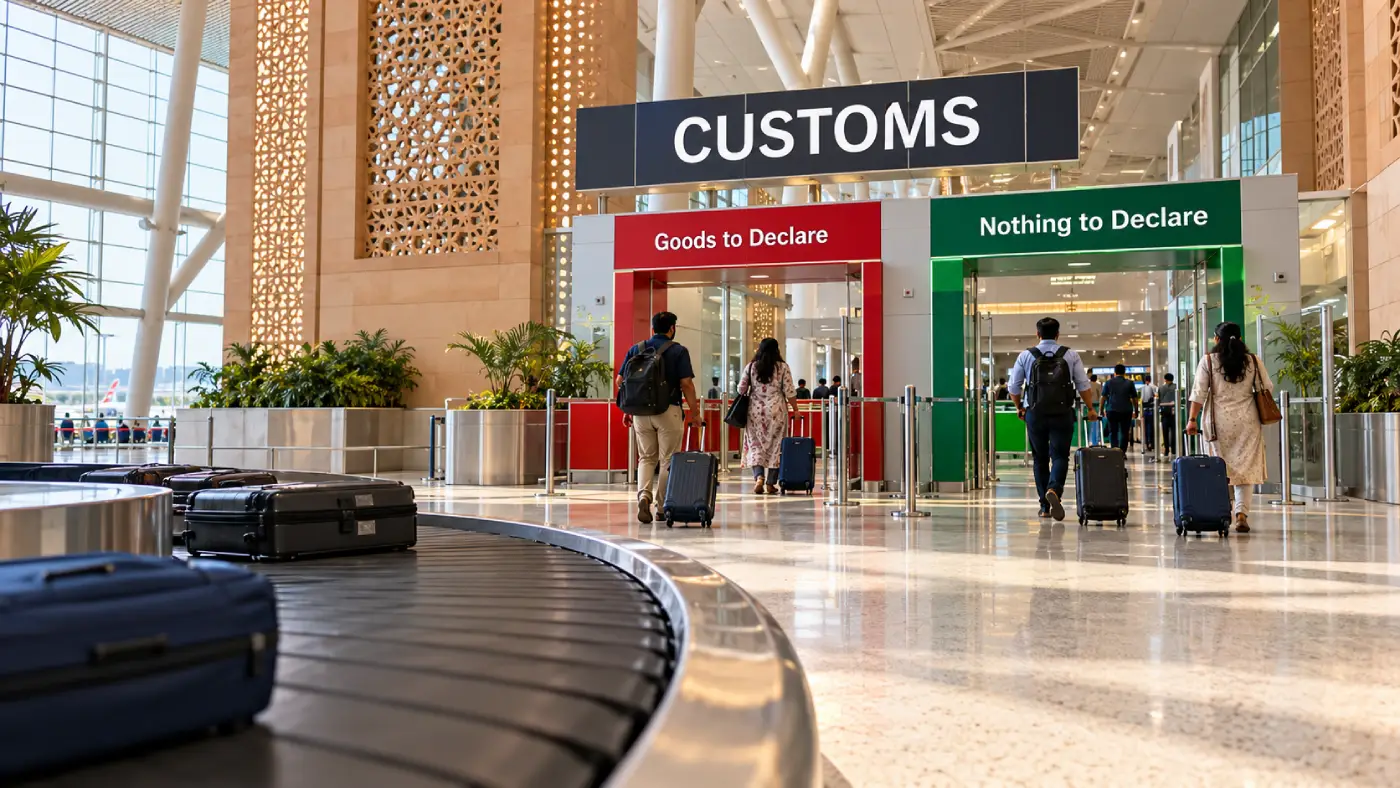
If you have goods to declare:
Prepare the details. Keep purchase receipts, permits and relevant supporting documents accessible.
Submit the declaration. The electronic process uses ICEGATE or the Atithi application. Accompanied baggage can be declared up to three days before arrival.
Report to the Red Channel. Present the declared goods and documents for customs assessment.
Keep the paperwork. Retain payment receipts and any temporary import or currency declaration documents needed later.
If you could not file electronically, ask customs for assistance on arrival. The Assistant or Deputy Commissioner may permit a declaration through another method.
Use the Green Channel only when you have no goods requiring declaration or restricted-item clearance. Passing through it does not prevent inspection.
Customs can assess duty on admissible goods above the relevant allowance. Restricted or prohibited goods require separate treatment, and failing to declare can lead to confiscation, penalties or prosecution depending on the circumstances.
A final check should focus on the documents and items you will need at the border:
Separate your own used belongings from gifts and new purchases, with receipts ready.
Keep medicine prescriptions and any import permissions together.
Remove vapes and resolve authorization for specialist equipment before departure.
Prepare declarations for relevant food, valuables and currency.
Save your accommodation address, transfer details and essential documents offline.
If you plan to use a travel eSIM, compare eSIM plans for India before choosing your allowance.
Once customs is complete, mobile data helps with maps, hotel messages and pickup coordination. Roafly’s India eSIM provides data on a compatible, unlocked phone; it does not include a local phone number.
Passengers arriving in Delhi who prefer to buy a SIM after landing can check the SIM options at Delhi Airport while organizing their arrival.
