Download the App and manage your eSIMs easily
Create your order quickly
See your eSIM details
Track your remaining data
Download the App and manage your eSIMs easily
Create your order quickly
See your eSIM details
Track your remaining data
Punta Cana resort days and a week exploring Samaná call for different transport plans. Decide when a rental car adds useful freedom, understand the insurance and deposit, and prepare for the roads beyond your hotel.

Lena Hartley
Updated Oct 20, 2026
11 min read

Save 15% on your Roafly eSIM
Stay connected on your next trip. Use the code below at checkout.
View All DestinationsJump to section
👇Save 15% on your Roafly eSIM
Stay connected on your next trip. Use the code below at checkout.
View All Destinations
Manage your eSIM in the app
Install, top up and track data.
Skip a full-trip rental if your holiday revolves around one resort and excursions with transfers. Consider renting for selected days if you want to explore independently, or for the regional part of a trip after visiting Santo Domingo.
Driving in the Dominican Republic suits confident, attentive drivers who can plan journeys in daylight. If unfamiliar traffic would make the holiday stressful, private transfers and organized excursions are sensible alternatives.
| Quick fact | What to know |
|---|---|
| Driving side | Drive on the right; distances and speed limits use kilometres. |
| Documents | Bring your original valid license and passport. IDP or translation requirements depend on your license and supplier. |
| Payment | Expect to need a credit card in the main renter’s name, with enough available credit for the deposit. |
| Vehicle choice | Match the car to your luggage and the final access roads, especially for rural accommodation. |
| Journey planning | Schedule longer drives in daylight and download maps before departure. |
Start with where you will sleep and what you want to visit. Moving between several scattered beaches creates a different transport problem from spending most days at a resort.
| Your trip | Our suggested approach |
|---|---|
| Punta Cana resort with one or two organized excursions | Use airport transfers and excursions with pickup. |
| Santo Domingo city stay followed by a coastal trip | Explore the city without a car, then collect one when leaving. |
| Las Terrenas or Las Galeras with independent outings | Consider a regional rental for the days with several stops. |
| A journey along the north coast or through the southwest | Compare a rental with a private driver, allowing for longer journeys and local access roads. |
Choosing where to stay in the Dominican Republic can reduce the amount of driving considerably. Accommodation close to the places you want to visit may be more useful than a cheaper room requiring repeated transfers.
Resort excursions also change the calculation. Saona Island trips involve a boat journey from the mainland, commonly from Bayahíbe. If your excursion includes hotel pickup, a rental car adds little to that day.
Scape Park provides another example: transfers are available from its listed pickup locations. Guests staying elsewhere may need to reach a designated meeting point, so the useful comparison is the complete journey from their accommodation.
Independent exploration has different benefits. Around Samaná, a car lets you combine stops without arranging a separate ride each time. Those benefits matter less if you plan one beach day and one guided excursion.
Our guide to getting around without a car covers the wider transport options. Include the journey from a bus terminal to your accommodation when comparing an intercity bus with driving.
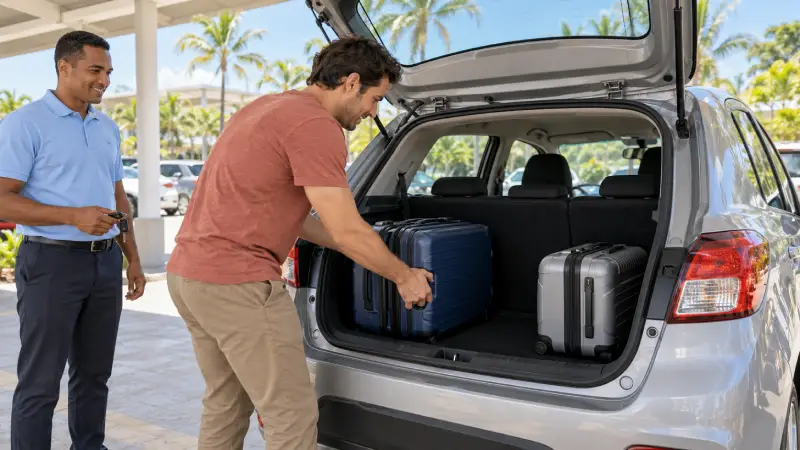
Punta Cana and Santo Domingo are practical starting points with airport and urban rental options. Alamo operates at Punta Cana Airport and in the Bávaro area; SIXT has locations in Punta Cana and Santo Domingo.
Airport collection makes sense when you are heading directly to another region. If your first few days are in Santo Domingo or at a resort, compare collecting later with paying for a car that will mostly remain parked.
Your arrival airport also affects the rental decision. Compare any airfare saving with the additional driving, fuel and possible one-way return charge.
Before booking, establish whether collection is at a terminal counter, an off-airport office or another meeting point. Include opening hours and any arrangements needed for a delayed flight.
Start with a standard car for a route based on paved main roads. An SUV becomes more useful when luggage, passengers or a rough final approach justify the extra size and cost. An SUV badge alone does not establish four-wheel drive or permission to use unpaved roads.
Send rural accommodation your intended approach and ask which entrance to use. A property's final kilometre can matter more to vehicle choice than the main highway leading there.
One-way rentals need an agreed return location and price. Keep the trip within the Dominican Republic: both Alamo’s checked local policy and SIXT’s country terms prohibit taking their rental vehicles across the border.
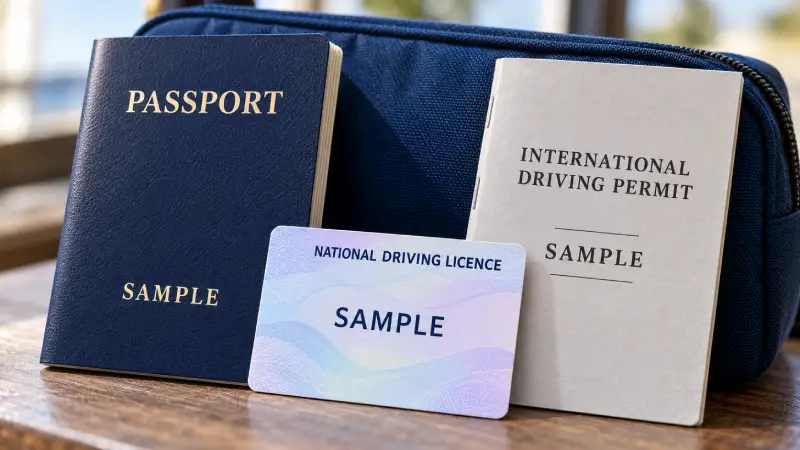
Short-stay visitors can generally drive with a valid home-country license during their lawful tourist stay. Keep driving eligibility separate from the company’s willingness to accept a booking.
Avoid assuming that every foreign license is valid for an unrestricted 90 days. The issuing country, document type and immigration status can affect the answer. If your visit extends beyond your initial permitted stay, resolve continued driving eligibility with INTRANT, your rental supplier and insurer before extending the rental.
Bring the following to collection:
Your original, full driving license.
Your passport and reservation confirmation.
A credit card in the main renter’s name.
An International Driving Permit or accepted translation where required.
The same required documents for every additional driver.
An IDP accompanies your national license; carry both. Non-Latin licenses trigger additional document requirements with the suppliers checked here. Alamo accepts an IDP or a notarized English translation in the relevant circumstances, while SIXT requires an international permit alongside a non-Roman-alphabet license.
Rental age limits are separate from legal driving age. Alamo Punta Cana accepts drivers from 21, with an additional fee for ages 21–24. SIXT’s eligibility varies by vehicle class and includes license-holding requirements.
Your Dominican Republic entry requirements also deserve attention before booking, particularly if the trip involves an extended stay.
Get the amount you will pay and the amount your card must support separately. The rental charge is expenditure. A refundable security deposit or authorization temporarily reduces your available credit.
Compare protection by what it covers:
Third-party liability: injury or damage caused to other people or their property.
Collision damage waiver: limits your contractual responsibility for damage to the rental vehicle, subject to its terms.
Theft protection: addresses theft-related responsibility.
Deductible or excess: the amount you may still owe on a covered claim.
Separate reimbursement cover: may require you to pay the rental company first and then submit a claim.
“Full coverage” is insufficient detail. Look for the remaining excess, excluded damage, authorized drivers and permitted roads.
The supplier examples below show why one countrywide insurance rule would be misleading.
| Supplier and scope | Deposit or authorization example | Liability arrangement |
|---|---|---|
| Alamo, Punta Cana Airport | US$500 plus the rental cost | Its TPL protection is required unless the Alamo Protection Package is purchased. |
| SIXT, selected car classes including EDAR and CDAR | US$1,000 with CDW included; US$4,000 without it | Basic third-party liability is included in all rates; supplementary cover increases protection. |
Terms checked on 20 October 2026: Alamo Punta Cana Airport and SIXT Dominican Republic rental conditions. These examples are supplier-specific; other vehicle groups and reservations can have different holds.
Credit-card collision protection needs particular attention. Alamo requires written proof to waive its CDW-TP purchase requirement and does not accept collision products purchased through third-party travel websites as a substitute. Its liability requirement is separate.
Both suppliers require an eligible credit card in the renter’s name under the checked terms. Do not rely on a debit card simply because it carries a Visa or Mastercard logo.
The complete trip cost also includes fuel, tolls, parking, any additional driver or child seat, and applicable airport or one-way charges. Compare that total with transfers and excursions when planning your overall trip budget.
Drive on the right and follow posted limits. At junctions, signs and traffic-officer directions matter more than assumptions based on driving at home.
Keep these rules in mind:
Right turns on red: permitted from the far-right lane on urban roads unless a sign prohibits them. Approach cautiously, stop for the red light and yield to pedestrians before turning.
Uncontrolled junctions: yield to a vehicle already entering the junction. At an equal-priority junction reached simultaneously, the driver on the left yields to the driver on the right. Main-road priority and traffic controls can change the situation.
Speed: posted limits govern. Without signs, the law specifies 30 km/h in residential urban areas, 60 km/h on avenues and rural roads, and 20 km/h in school zones. The 120 km/h statutory highway ceiling is not permission to drive at that speed everywhere.
Children: children up to 12 generally travel in the rear, with age-appropriate restraint requirements. Reserve a suitable seat before collection.
Buckle everyone in, put the phone in a secure mount and enter the route before moving. Plan drinking occasions around a taxi or designated driver.
Major highways connecting cities and tourist areas can be in good condition, while smaller roads and the final approach to accommodation vary considerably. Plan around the actual route rather than treating the whole country as one driving environment.
Samaná illustrates the distinction. Reaching Las Terrenas or Las Galeras is one part of the journey; finding a particular villa entrance or accessing a quieter beach is another. Playa Rincón can be reached by road or boat, giving you an alternative when you prefer to leave the car behind.
The southwest needs similar attention. Between Barahona and Pedernales, a car helps connect dispersed stops, but reaching a town does not establish that every nearby attraction is accessible in the same vehicle.
Keep longer journeys in daylight. Poor lighting, pedestrians, animals and vehicles without adequate lights make nighttime driving more demanding. An evening arrival is a good reason to stay nearby and begin the regional drive the next morning.
Leave room for motorcycles and unexpected lane movements, and slow down through settlements. A navigation estimate cannot account for every stop, road defect or difficult arrival.
Rain can also change the practical route. Follow closures, avoid flooded sections and ask your accommodation about the approach after heavy weather. Our guide to weather by region and season helps with timing; the broader safety guide covers concerns beyond driving.
Ask how tolls are handled before leaving the rental office. Paso Rápido uses an electronic tag, and the presence of a sticker on the windshield is not enough to establish that your rental has an active, funded service.
Find out whether the company bills individual crossings, adds an administration charge or expects you to manage payment. Use the appropriate lane and keep Dominican pesos available as a backup.
Budget tolls for the chosen route rather than applying one national amount. Our guide to cash, cards and Dominican pesos explains payment preparation for the rest of the journey.
At collection, record the fuel level and identify the correct fuel type. If your agreement requires a full tank on return, refuel near the return location and retain the receipt. Prepaid fuel can be convenient, but unused fuel may not be refunded.
Parking is part of accommodation selection. Establish whether your hotel or apartment provides a space and how to reach it before navigating into a busy centre. Use designated parking at attractions and keep bags and valuables out of sight.
Use Google Maps to save accommodation entrances, rental offices and planned stops. Download an area covering the entire drive before leaving Wi-Fi. Offline driving directions can work within that area, but live traffic and alternative routes require connectivity.
Waze is useful for traffic-aware navigation when connected. Treat its suggested shortcuts cautiously if they lead away from the established route onto a road unsuitable for your car or contract.
Compare Dominican Republic eSIM options before departure if you need mobile data between stops. Roafly’s Dominican Republic eSIM provides data through Claro for compatible, unlocked devices, supporting online maps and messages where coverage is available. Keep the downloaded maps as a backup.
Save your supplier’s breakdown contact and reporting procedure. 511 is the national roadside-assistance number for roads within the service’s operational coverage; 911 is the emergency number. Roafly’s data-only plans do not include ordinary voice calls, so retain a working way to contact your rental company by phone.
If an accident occurs, seek emergency help when needed, notify the rental company promptly and follow the police reporting process. Photograph the scene when safe and retain the incident details.
Before accepting the keys, inspect and record the bodywork, wheels, glass, interior, fuel level and mileage. Make sure existing damage appears on the handover record. Test the lights, air conditioning and phone charging connection while still at the office.
At return, photograph the car again, retain the fuel receipt and obtain a return record. Ask when the authorization will be released; the time before available credit reappears can also depend on your card issuer.
Keep the useful travel apps for the Dominican Republic ready for taxis, food orders and the days after you return the car.
