Download the App and manage your eSIMs easily
Create your order quickly
See your eSIM details
Track your remaining data
Download the App and manage your eSIMs easily
Create your order quickly
See your eSIM details
Track your remaining data
Dominican pesos make everyday spending easier, while cards suit many hotel and restaurant bills. Here’s how to handle dollars, ATM withdrawals, currency conversion and tips.

Lena Hartley
Updated Oct 5, 2026
9 min read
Save 15% on your Roafly eSIM
Stay connected on your next trip. Use the code below at checkout.
View All DestinationsJump to section
👇Save 15% on your Roafly eSIM
Stay connected on your next trip. Use the code below at checkout.
View All Destinations
Manage your eSIM in the app
Install, top up and track data.
Bring a payment card, a backup card and access to Dominican pesos. US dollars can be useful in Punta Cana and other tourist areas, but relying on them for every purchase leaves you accepting each business’s exchange rate.
Your itinerary matters more than a universal cash allowance. Someone staying at a prepaid all-inclusive resort mainly needs money for extras and tips. Someone exploring Santo Domingo, visiting small beach restaurants or traveling between towns needs a more practical supply of local cash.
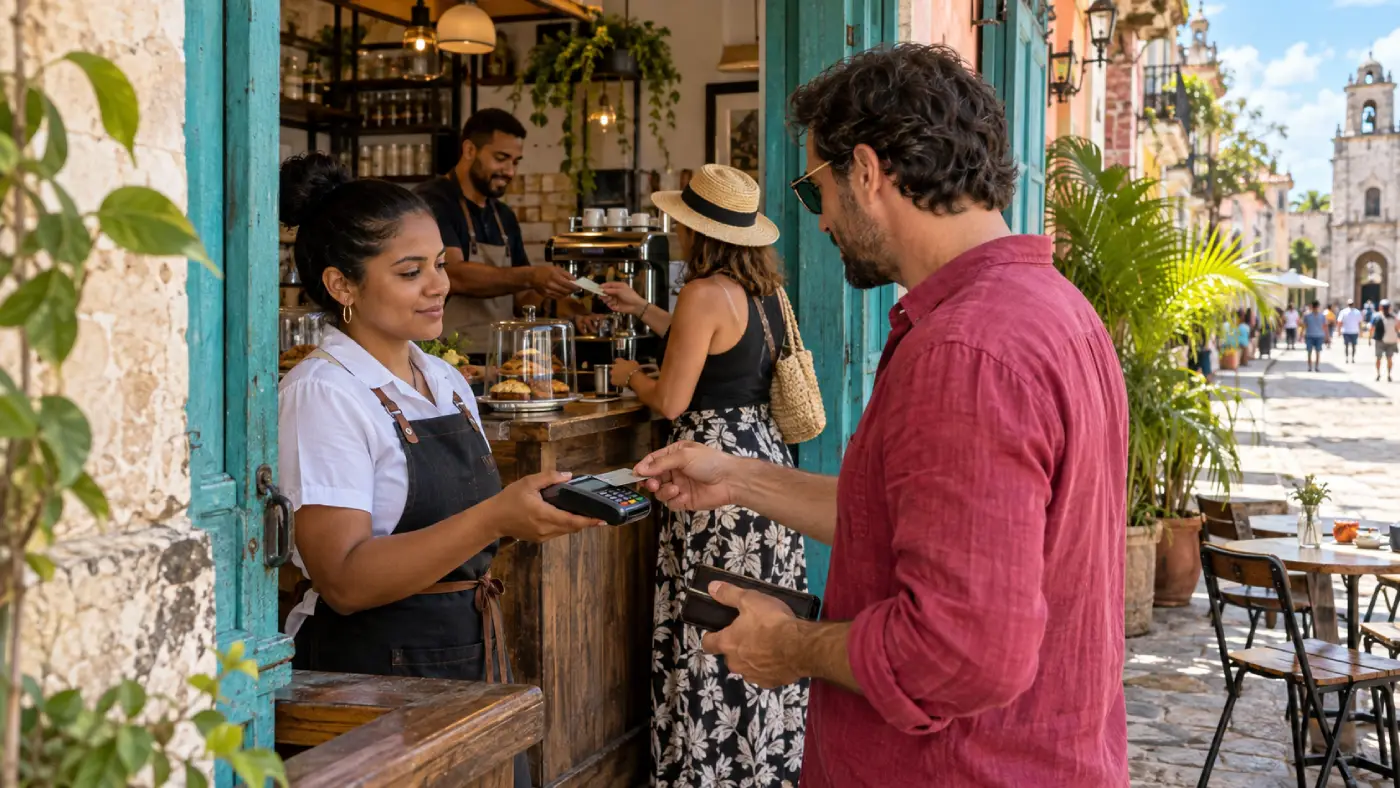
Cards are accepted at many hotels, restaurants and larger shops. Small purchases and informal services are where having pesos becomes especially useful. Keep physical cards available even if you normally pay with your phone.
| Situation | Practical payment approach | What to settle before paying |
|---|---|---|
| Prepaid all-inclusive stay | Card for chargeable extras, small notes for optional tips | Which activities and services are outside your package |
| Hotel or larger restaurant | Card, with pesos as a backup | Billing currency and whether taxes or service are included |
| Small shop, market or beach vendor | Carry small peso notes | Total price and available change |
| Taxi or privately arranged transfer | Use the payment method agreed with the operator | Currency, total fare and whether card payment is available |
| Travel beyond major tourist centers | Arrange access to pesos before leaving | Your next convenient cash withdrawal opportunity |
| Online excursion or transport booking | Supported card or advertised payment method | Final currency, inclusions and cancellation terms |
Before arrival, decide how you will pay for the first journey from the airport. Our Dominican Republic transport guide helps you compare transfers, taxis and other ways of getting around.
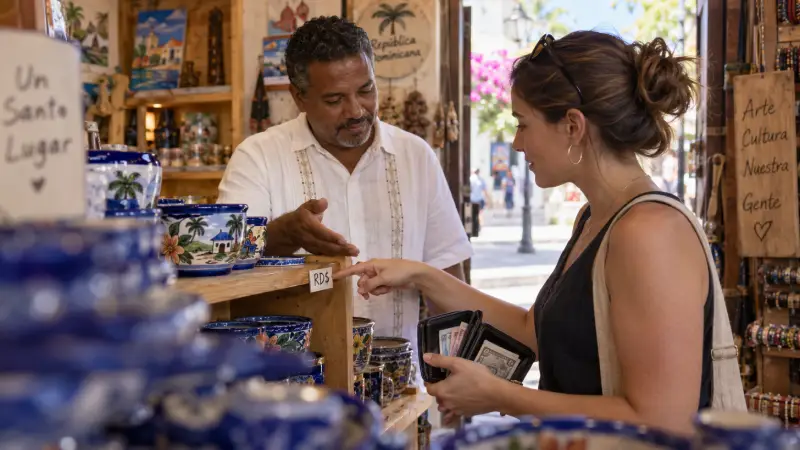
The local currency is the Dominican peso, written as DOP or RD$. Prices displaying only a dollar sign can be confusing, particularly around tourist businesses. Ask whether a quote is in pesos or US dollars before agreeing to it.
Tourist businesses may accept USD, but their conversion rate can be less favorable than a bank’s. Paying in pesos makes it easier to compare a local price with nearby alternatives.
Keep smaller notes for everyday spending. RD$100, RD$200 and RD$500 notes are more convenient for modest purchases than handing over a large banknote and hoping the seller has change.
If a transfer or excursion is explicitly quoted and agreed in USD, paying that dollar amount can be straightforward. Ask about the payment method and currency when booking, then keep the confirmation.
Distinguish that situation from buying something priced in pesos and letting the seller convert it into dollars at the counter. The second transaction introduces an exchange-rate decision that the original peso price did not contain.
Visitors arriving with euros, pounds or Canadian dollars should compare the cost of obtaining pesos directly with converting through USD. Buying dollars first can add another exchange margin. USD already in your wallet and USD bought specifically for the trip have different costs.
Visa and Mastercard are practical cards to bring for payments at established businesses. Acceptance still depends on the merchant, terminal and your card issuer, so avoid building the whole trip around one card.
Before departure, review your card’s foreign transaction fees, overseas-use settings and PIN. Keep a second card separately, preferably from another issuer, so a blocked account or lost wallet does not remove every payment option at once.
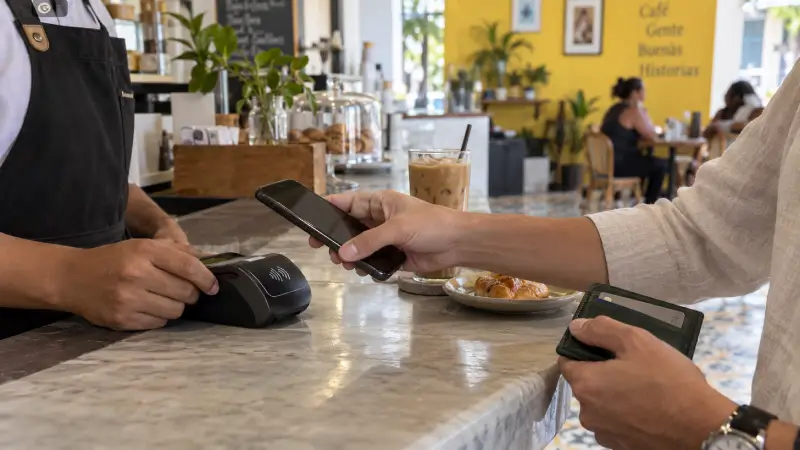
Apple Pay can work at compatible contactless terminals when the merchant accepts the underlying card network. However, even a terminal displaying a contactless symbol may not have that function enabled. Carry the physical card rather than depending entirely on your phone.
Banking access also deserves a quick test before you leave. Make sure you can sign in, receive the verification your bank requires and contact support. Our guide to internet options in the Dominican Republic explains the available connection choices.
Use a bank-operated ATM in a well-lit, attended location, ideally during the day. Bank branches and established shopping centers are sensible places to look. Banco Popular and Scotiabank are among the banks with ATM networks in the country.
Check that the machine supports your card’s network, then read the withdrawal terms before confirming. Neither the fee nor the limit should be assumed from another traveler’s experience.
Three separate costs can affect a withdrawal:
ATM operator fee: a charge imposed by the machine’s operator.
Your bank’s fees: overseas withdrawal charges, foreign transaction fees or other account-specific costs.
Currency conversion: the exchange rate applied through your card arrangement or an optional conversion offered by the ATM.
Declining the ATM’s currency conversion does not remove the other fees.
The amount available depends on the machine’s transaction limit, your bank’s daily limit and your available balance. Limits advertised for a Dominican bank’s own customers may not apply to a visitor using a foreign card.
Repeated small withdrawals can be expensive when each carries a fixed fee. Balance the number of withdrawals against how much cash you are comfortable carrying; withdrawing the machine’s maximum is not automatically the best choice.
A debit card is usually the more suitable starting point for cash withdrawals. Credit-card withdrawals may be treated as cash advances, with fees and interest determined by the issuer.
Airport exchange counters can solve an immediate need, such as paying for transport after landing. Exchange enough for that purpose, then compare options before changing a larger amount.
Banks and authorized exchange offices are the sensible alternatives in town. Ask for the net number of pesos you will receive after any commission, rather than judging the offer only by the large exchange-rate figure on display.
The Central Bank’s exchange-rate information provides a reference for comparison. It is not a promise that every counter, hotel or bank will exchange your cash at that rate.
Count the money before leaving the counter and request useful denominations where possible. Avoid exchanging your entire trip budget immediately, especially if accommodation and major activities are already paid.
If your purchase is priced in pesos, keeping the card transaction in pesos is a sensible default. Your card arrangement then handles the conversion instead of accepting a separate conversion offer at the terminal.
The offer to charge you in your home currency is called dynamic currency conversion, or DCC. It can appear at both payment terminals and ATMs.
Before accepting it, compare the displayed rate and markup with your card’s terms. Visa’s DCC guidance explains that the provider should show both currency amounts, the exchange rate and any additional charges, and leave the choice to you.
At an ATM, declining conversion is different from canceling the withdrawal. Read the full screen: wording and button placement vary.
Remember the distinction with a booking genuinely priced in USD. An agreed US$80 transfer is a different situation from an RD$ purchase that the terminal offers to convert into dollars. Establish the original billing currency first.
Restaurant bills can include 18% ITBIS and a 10% legal service charge, known as propina legal. Look at whether these amounts are already included in the displayed price before calculating what you owe.
If both apply and the menu price excludes them, this illustrative bill shows the calculation:
| Item | Amount |
|---|---|
| Food and drinks before tax and service | RD$1,000 |
| ITBIS at 18% | RD$180 |
| Legal service charge at 10% | RD$100 |
| Total before any voluntary extra tip | RD$1,280 |
Both additions in this example are calculated on the RD$1,000 base. Do not add them again to a price that already includes them.
Extra tipping is separate from the legal service charge. Read the bill before responding to an additional tip prompt, then decide what you wish to leave.
The 10% legal charge also has a scope: Pro Consumidor prohibits charging it for takeaway orders where customers do not use the premises to consume their purchase.
Our guide to eating out in the Dominican Republic covers dishes, ordering and dining choices beyond the payment itself.
Calculate cash from your unpaid plans rather than using a fixed amount per person per day.
Start with the next part of your itinerary and add:
Transport you have agreed to pay in cash.
Meals and purchases at places where you expect to need pesos.
Any tips you intend to leave.
A modest reserve for a declined card or an unavailable ATM.
Subtract services already paid for, then consider when you will next be near a convenient bank ATM.
A week at an all-inclusive resort and a week moving between guesthouses can have very different cash requirements, even if their total holiday costs are similar. Our Dominican Republic trip budget guide helps you estimate the wider spending total.
Keep the day’s spending money accessible and your reserve separately. At each payment, check the currency and amount before handing over cash or approving the terminal. The Dominican Republic scams guide covers deceptive situations that deserve closer attention.
If a card payment fails, ask whether the transaction was declined or is still pending before trying repeatedly. Check your banking app for a security prompt, spending limit or transaction notification, then use your backup payment method if necessary.
If the card is lost, freeze it through your issuer’s app or contact the issuer promptly. Keep its support details somewhere you can access without opening the missing wallet.
Mobile data can help you reach your bank, review transactions and arrange another payment. On a compatible unlocked phone, a Dominican Republic eSIM provides data for those tasks. It does not supply a local phone number or receive bank verification SMS; prepare access to your registered number or another bank-approved authentication method before traveling.
If you are still choosing a provider, compare allowances and network options in our best eSIM for the Dominican Republic guide.
Before leaving home, you should have three things settled: how to pay for your arrival transfer, how to obtain pesos, and how to access your bank if your main card stops working.
