

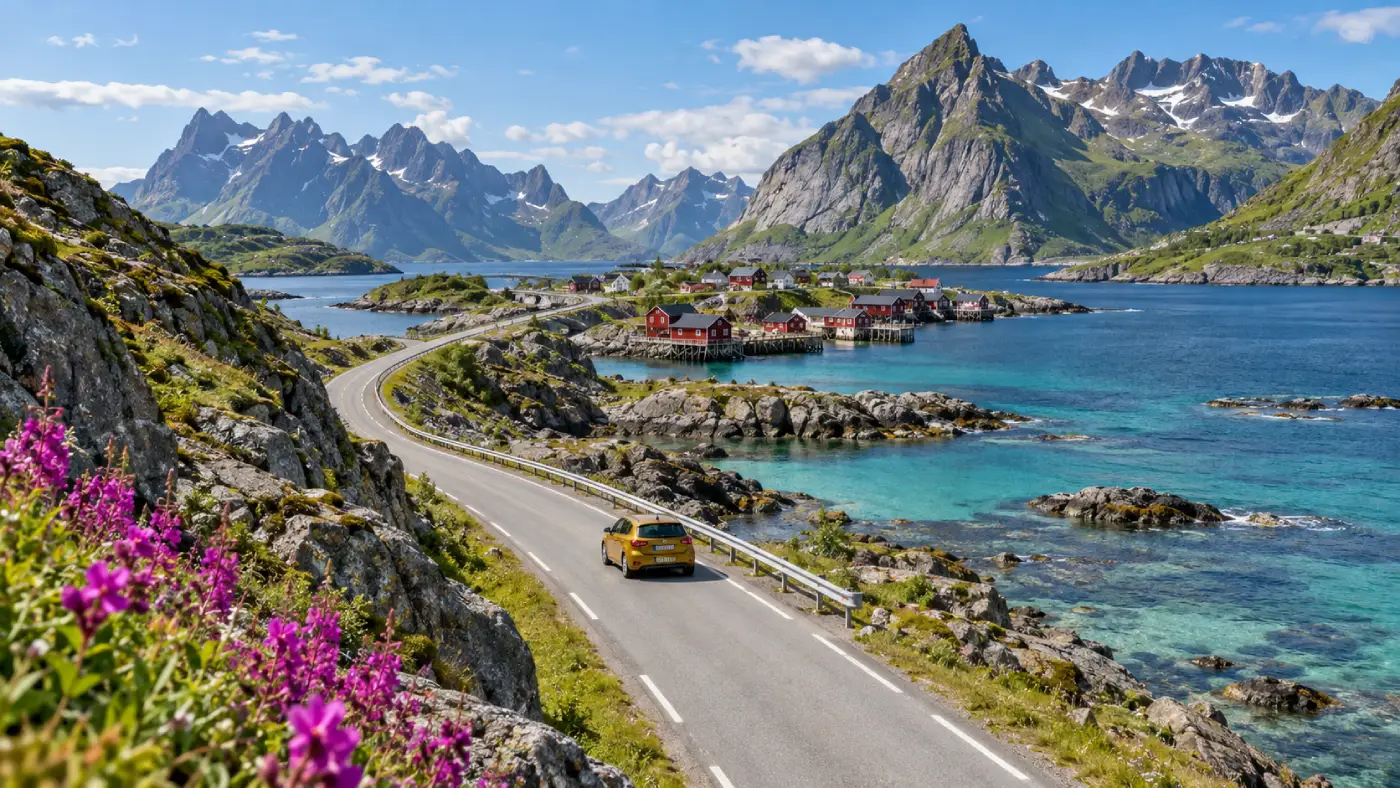

Rent a car for the days when it changes what you can reach. Oslo and Bergen usually need no rental, while countryside accommodation, several fjord stops or beaches away from Lofoten’s main bus routes can justify. The useful question is where public transport stops matching your itinerary. Staying in a city first, then collecting a car for a regional loop, can save both rental days and parking costs.
| Quick fact | What it means for your trip |
|---|---|
| Driving side | Keep right. |
| Traffic lights | Cars have no general right turn on red. |
| Licence | Eligibility depends on the issuing country and licence format. |
| Extra costs | Allow for fuel or charging, tolls, ferries, parking and rental fees. |
| Winter roads | Suitable tyres and the day’s road conditions matter more than the vehicle’s size. |
| Navigation | Download maps; use live information for closures and disruption. |
Do You Need a Car in Norway?
Norway has useful train, bus and boat connections, but their value depends on where you sleep and how many places you want to visit between bases.
| Your itinerary | Sensible starting choice |
|---|---|
| Oslo or Bergen city break | Use public transport and collect a car when leaving the city. |
| Oslo–Myrdal–Flåm–Nærøyfjord–Gudvangen–Voss–Bergen | Plan the train, boat and bus connections; this classic fjord journey works without a car. |
| Western fjords with scattered viewpoints and countryside stays | Rent for the rural section, keeping ferry crossings in the daily plan. |
| Lofoten with stops around central towns and the E10 | Compare buses with a short rental for the days spent farther from the main route. |
Lofoten’s buses are most useful when your accommodation and stops align with their routes. Route 300 connects Å, Leknes, Svolvær and Narvik, while other services reach places such as Henningsvær. However, some local routes are marked as school services, so the existence of a stop does not establish a useful holiday connection. Match the Lofoten bus timetables to your actual travel dates, including the return journey.
Rental dates should also fit the best time to visit Norway for your route. A trip built around mountain roads needs different seasonal planning from a city stay with rail excursions.
Where to Pick Up Your Rental Car
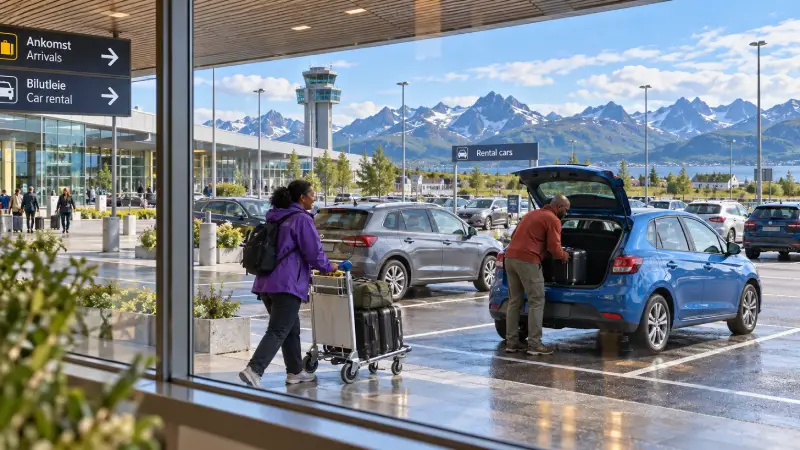
Collecting at the airport makes sense when you are driving straight into the region. Spending your first few nights in Oslo or Bergen changes that calculation: a later city pickup avoids paying for a car while it sits parked. Compare the complete quote, including the journey to the branch and its opening hours.
Northern Norway deserves its own decision. Evenes, Svolvær and Leknes offer rental locations, but they serve different arrival plans. The airport bus from Evenes to Svolvær takes roughly three hours; staying centrally before renting locally can work, while collecting at Evenes suits a trip with stops along the way.
Combining Bergen and Lofoten on a limited holiday does not automatically justify driving between them. Compare separate regional rentals with the time, accommodation and-way fee involved in a long drive. Treat a 24-hour key-return box as a return facility; it does not establish that staff can hand over a car at any hour.
Finish essential phone setup before leaving the pickup point. If you need a physical card, plan where to buy a tourist SIM in Norway before heading directly to a countryside overnight stop.
Driving Licences, Age Limits and Rental Documents
Valid EU/EEA licences are generally accepted in Norway. With many non-EU/EEA licences, tourist use is limited to three months after arrival, subject to the issuing country and licence requirements. Some countries have different arrangements, so nationality alone is not enough to settle eligibility.
Whether you need an international driving permit or an accepted translation depends on the licence’s language, photo and category format. Carry the original licence too: an IDP cannot replace it.
Rental conditions add another layer. Sixt Norway and Hertz Norway generally start at age 19 with a licence held for at least year, but selected vehicle groups require an older driver. Young-driver supplements also differ: Sixt applies below 23, while Hertz applies below 25.
Bring your physical licence, passport or accepted ID, and the payment card required by the booking. Sixt Norway excludes debit cards; Hertz allows them for some Norwegian vehicle groups. The card type and main driver’s name need to match the supplier’s requirements before you arrive.
Rental Costs, Deposits and Insurance
Compare the cost of the whole rental section, using the same dates, pickup location and vehicle category. The lowest daily rate can lose its advantage a-way return, parking and handling fees enter the calculation.
| Budget item | What to include |
|---|---|
| Car hire | Rental duration, mileage allowance and any-way or extra-driver charge |
| Insurance | Included cover, remaining excess and exclusions |
| Fuel or charging | Driving distance and the supplier’s return requirement |
| Tolls and ferries | Road passages, crossings and applicable handling fees |
| Parking | Overnight accommodation and planned city stops |
Keep the deposit separate from the trip’s expected spending. It is a security hold that reduces available funds or credit while it remains in place. Hertz Norway specifies a minimum security authorisation of NOK 3,000, but the actual amount depends on the rental; use the hold stated for your booking when planning available credit.
Collision and theft waivers can still leave an excess to pay. Compare that excess with the treatment of tyres, glass, wheels and the underbody, then read any conditions that could invalidate cover. Hertz Norway normally includes collision and theft protection, subject to the rate booked; this does not establish zero liability.
Photograph the car at collection, including existing damage, and record the fuel or battery level. Repeat the process on return and keep the handover evidence until the final charges are settled.
Driving Rules Visitors Need to Know
Drive on the right. Unless signs say otherwise, the general speed limits are 50 km/h in built-up areas and 80 km/h outside them. Narrow bends, weather and visibility may require considerably less than the posted limit.
-
Right turns on red: Stop behind the line and wait for a signal that permits your movement. Norway has no general rule allowing cars to turn right through a red light; follow any separate directional signal.
-
Priority from the right: At junctions without overriding signs or signals, traffic from your right generally has priority. Vehicles leaving a car park or private property must yield to road traffic.
-
Turning and changing lanes: Keep close to the right for a right turn; on a two-way road, position near the centre for a left turn unless markings direct otherwise. Yield to conflicting traffic when turning left, and watch for pedestrians and cyclists crossing your turn. Lane changes must yield to traffic already in that lane.
-
Roundabouts: Give way to circulating traffic and signal right before leaving. When using more than lane, a lane change still requires you to yield.
-
Lights: Dipped headlights or approved daytime running lights must be on while driving. Use suitable lighting in tunnels, darkness and poor visibility, including rear lights.
-
Alcohol and phones: Norway’s legal blood-alcohol limit is 0.02%. Avoid alcohol if you will be driving. Set navigation before moving; handheld phone use while driving is prohibited.
Mountain roads and fjord-side stretches can be narrow and winding. Use passing places thoughtfully, and pull into a suitable parking area for photographs rather than stopping on a blind bend or inside a tunnel.
Tolls, Ferries and Parking
Norway’s toll stations are automated. Norwegian rental cars commonly have a toll-tag arrangement, with charges passed on by the hire company. Establish how your supplier bills passages and handles administration fees when collecting the car; some charges arrive after the rental ends.
Avis Norway’s published arrangement, checked on 12 September 2026, includes a toll-tag administration fee of NOK 40 per day for up to five days. That caps this particular fee at NOK 200; the road tolls themselves are additional. Use it as an example of why a handling fee and the underlying road charges belong on separate lines.
Car ferries are part of many fjord itineraries. Build departures and possible waiting time into the day, especially before a fixed hotel arrival or another connection. Payment arrangements vary by crossing and rental agreement; keep receipts for crossings paid directly so you can reconcile later charges.
Pay parking as instructed at the location, using the correct registration number. If you add the rental car to a parking app, remove it after returning the vehicle. Accommodation with included parking can also change the comparison between two otherwise similar room rates.
Choosing a Car for Fjords and Winter Roads
Start with passengers and luggage, then consider the roads. Smaller cars can be easier to position on narrow village streets and in tight parking spaces. Extra size is useful if you need the space; it does not remove the need to slow down on winding roads.
Grip is the driver’s responsibility throughout the year. The minimum tyre tread depth rises to 3 mm from 1 November through the first Sunday after Easter Monday; in Nordland, Troms and Finnmark, that period is 16 October–30 April. Conditions can require suitable winter tyres or other traction equipment outside those dates too.
Four-wheel drive does not replace appropriate tyres or winter-driving experience. Snow and wind can close mountain crossings, including during spring and autumn. If driving on snow or ice is unfamiliar, a winter holiday based in place with guided outings may be a more comfortable choice than changing hotels every night.
When comparing Norway and Iceland for a northern lights trip, decide how much driving after dark you want to do before reserving a car for the whole stay. The choice of base and access to outings matter alongside the chance to see the aurora.
Should You Rent an Electric Car?
Electric cars fit well when your accommodation has usable overnight charging or charging stops fit naturally along the route. Confirm access to the hotel’s charger before relying on an overnight top-up.
Identify the car’s charging connector and the payment method for the chargers you expect to use. Keep a backup charging stop within reach. Check the required battery level at return as well as the cost of handing it back below that level.
If learning a charging routine would complicate a short trip with remote stops, compare a petrol or hybrid car as well. Judge the full route and return conditions instead of assuming an EV will always cost less.
Navigation and Road Checks Before You Drive
Download Google Maps areas covering the whole driving route before departure. Offline driving directions can work within downloaded coverage, but live traffic and alternative routes are unavailable offline. GPS positioning, stored maps and live mobile data do different jobs.
Review ferry settings when planning: avoiding ferries can produce a very different road journey. Save accommodation addresses and rental contact details somewhere you can reach without a connection.
If your existing roaming allowance will not cover maps, messages and bookings, compare mobile internet options in Norway before departure. Compatible, unlocked phones can use a Norway eSIM for mobile data; downloaded maps remain useful whenever the signal drops.
Before each driving day, use Vegvesen’s traffic map for current road information, closures and relevant ferry updates. A navigation app’s suggested route is not proof that a mountain crossing is open. Build the day around the roads and connections you can actually use.