

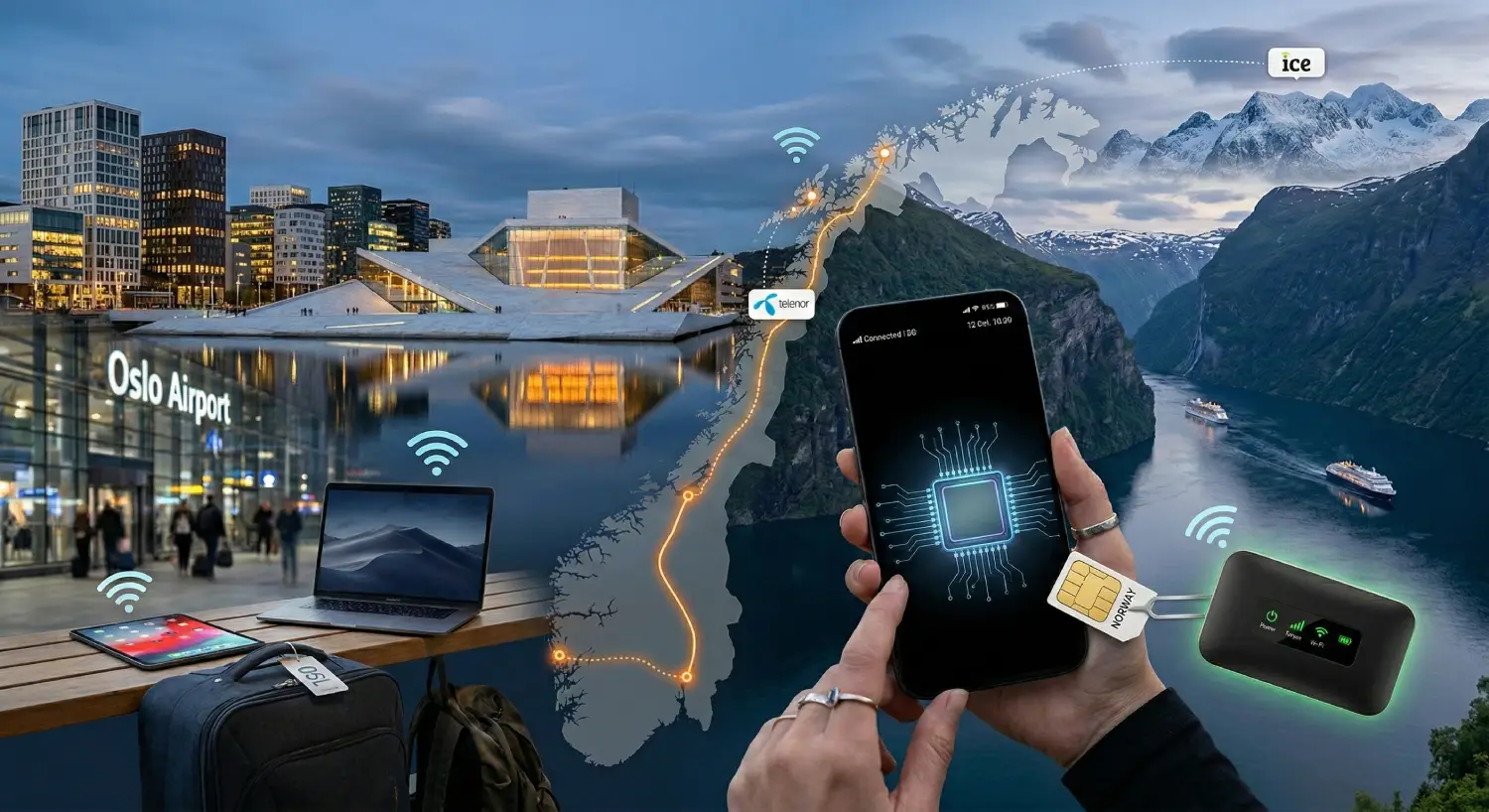

Below is a practical 2026 guide covering airport SIM options, local tourist SIM pricing, a simple eSIM route (Roafly), and backups like pocket WiFi and public WiFi.
Option overview: what most travelers choose
Here’s a quick comparison so you can pick the right setup for your trip style.
| Option | Best for | Typical cost range | Setup time | Notes |
|---|---|---|---|---|
| Airport physical SIM | You want a SIM immediately after landing | Often priced higher than city stores; travelers report ~229–349 NOK for airport-targeted prepaid offers | 10–30 min | Convenience premium at airports is common. |
| Local prepaid/tourist SIM (city stores/kiosks) | Longer trips, heavy data, or you want local support | Starter packs can be low-cost; then you top up data packs | 15–45 min | Availability is better in Oslo/Bergen/Trondheim than remote areas. |
| eSIM (Roafly) | Fastest setup, no physical SIM, keeps your home SIM in place | From $3.90–$49.90 depending on data/validity | 3–10 min | Works on eSIM-compatible unlocked phones, runs on Telia network. |
| Pocket WiFi rental | Groups / multiple devices (2–10 devices) | Often from ~€3.95/day+ depending on provider | 10–30 min | You carry/charge a device; some rentals offer airport pickup/delivery. |
|
Public WiFi + hotel WiFi |
Light users (messages + occasional browsing) | Free | Instant | Coverage varies; not ideal for transport/navigation in rural areas. |
Need data in Norway? Get an eSIM!
Choose the perfect data plan for your trip

Manage your eSIM in the app
Install, top up and track data.
Buying internet at the airport (what to expect)
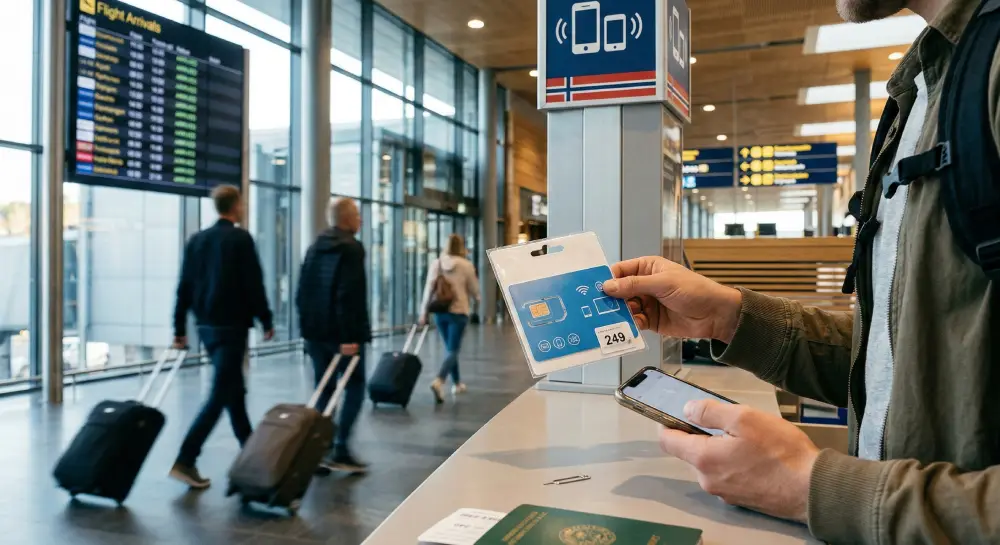
Oslo Airport (OSL) and other major airports
In Norway, the “airport SIM” experience is often less about a dedicated telecom shop and more about convenience stores/kiosks where you can buy starter packs. At airports you’ll typically see brands like Narvesen and 7-Eleven in public areas (arrivals/departures), which are the kinds of places that may stock prepaid SIM starter packs depending on location and inventory.
Airport pricing: convenience premium is normal
Airport-focused travel guides commonly cite prepaid options starting around 229–349 NOK for tourist-style prepaid offers at/near airports.
Real-world availability changes, so the key point is: airport purchase is convenient, but rarely the cheapest.
Airport SIM checklist (so you don’t get stuck)
-
Bring ID: Some prepaid activations may require ID verification depending on the provider and how the SIM is registered. Travelers frequently report ID checks for activation in Norway.
-
Check what’s included: Some starter packs include minimal data (example: Telia states its start pack includes calls/SMS/MMS and 250 MB for 14 days, then you must top up).
-
Ask about top-ups: Make sure you understand how to buy data (app/SMS/top-up portal) before walking away.
Local tourist SIM cards in Norway (prices and where to buy)
If you can wait until you reach the city (or you’re already starting your trip in Oslo/Bergen), local prepaid is usually better value than airport convenience pricing.

Where to buy local prepaid SIMs
-
Carrier stores (best for support and activation help)
-
Electronics retailers and kiosks (often cheaper starter pack pricing for the same SIM)
-
Convenience chains: Telia notes you can buy a lower-priced start pack at Narvesen, 7-Eleven, and selected grocery groups.
Example: Telia prepaid (Kontant) starter pack pricing
Telia publishes two common entry points:
-
99 NOK start pack (available in Telia stores and some big electronics retailers)
-
29 NOK start pack (includes 30 NOK credit) sold via Narvesen/7-Eleven and selected stores
Telia also states that after the initial start pack allowance, users typically choose a data bucket (they list 3/7/12/20/50 GB choices for 31 days, but they don’t show the full price table publicly on that page without login).
Typical “tourist data pack” price levels (what travelers commonly see)
While official price lists can be fragmented across apps/logins, independent travel WiFi guides commonly summarize ranges like:
-
Telia top-up bundles ranging roughly 269 NOK (3GB) to 649 NOK (50GB), and data-only bundles around 119 NOK (1GB) to 319 NOK (10GB).
-
MyCall prepaid SIM availability is broad (they advertise 7,000+ resellers), which can be helpful outside city centers.
Important reality check: Norway prepaid can be excellent, but it’s not always “cheap” compared to some other European destinations. If you plan to use maps all day, upload photos, and stream in transit, it’s smart to budget for a bigger data bucket.
The simplest setup: Roafly eSIM for Norway (no physical SIM needed)
If your phone supports eSIM and is unlocked, eSIM is usually the fastest way to get—especially if you don’t want to hunt down a store, handle activation steps, or swap physical SIMs.
Need data in Norway? Get an eSIM!
Choose the perfect data plan for your trip
Manage your eSIM in the app
Install, top up and track data.
| Roafly Norway eSIM | Validity | Price (USD) |
|---|---|---|
| 1 GB | 7 days | $3.90 |
| 2 GB | 15 days | $5.50 |
| 3 GB | 30 days | $7.50 |
| 5 GB | 30 days | $9.90 |
| 10 GB | 30 days | $14.00 |
| 20 GB | 30 days | $20.00 |
| 50 GB | 180 days | $49.90 |
How to install Roafly (3 ways)
Roafly supports common installation methods:
-
iOS & Android Direct Install
-
QR Code
-
Manual installation
Quick eSIM setup tips (so it works immediately after landing)
-
Install the eSIM before your flight (airport WiFi can be crowded).
-
Keep the eSIM turned off until you arrive, if your plan starts validity when it first connects to a supported network (Roafly states validity starts when it connects).
-
After landing: turn on the eSIM line + enable Data Roaming for that eSIM (common requirement for travel eSIM profiles).
If you want a deeper comparison article specifically focused on Norway eSIMs, you can also read best eSIM for Norway.
Pocket WiFi in Norway (best for groups and multiple devices)
Pocket WiFi (portable hotspot) is a strong option if:
-
You have 2–5+ devices (phones + laptops + tablets)
-
You’re traveling as a family or group
-
You want shared connection instead of multiple SIM/eSIM plans
Typical pocket WiFi costs in Norway
Pricing depends on provider, delivery method, and whether “unlimited” is truly unlimited (some have fair-use policies). Many providers advertise ranges like:
-
From around €3.95/day for European rentals (pricing varies by plan/shipping).
-
Some services offer Oslo Airport pickup options.
Pocket WiFi pros/cons
Pros
-
Connect multiple devices at
-
Keeps your phone number/SIM unchanged
-
Easy for non-tech travelers it’s powered on
Cons
-
Another device to carry and charge
-
If it dies, everyone loses internet
-
Pickup/return logistics (unless delivered to your hotel)
Airport WiFi and public WiFi in Norway (useful, but not your main plan)

Airport WiFi
Major airports in Norway typically provide WiFi, and it’s good enough for messages, email, and downloading an eSIM QR code when needed. But it’s not a substitute for having mobile data you leave the terminal.
Public WiFi in cities
In Oslo, Bergen, and Trondheim, you’ll often find WiFi in:
-
Hotels and hostels
-
Cafés and restaurants
-
Museums and transport hubs
Why public WiFi isn’t enough in Norway
-
On scenic routes, ferries, fjord roads, hikes, and cabins, WiFi access can be inconsistent.
-
Public WiFi is not always ideal for banking or private logins unless you’re using a VPN.
-
Route changes and real-time transport updates are easiest with always-on mobile data.
Coverage reality in Norway (cities vs fjords)
Norway is generally well-connected, but coverage can change quickly you leave the main corridors. The mix of mountains, tunnels, deep valleys, and scattered islands means even strong national networks can have pockets with weak or no signal—especially on scenic routes and in remote areas.
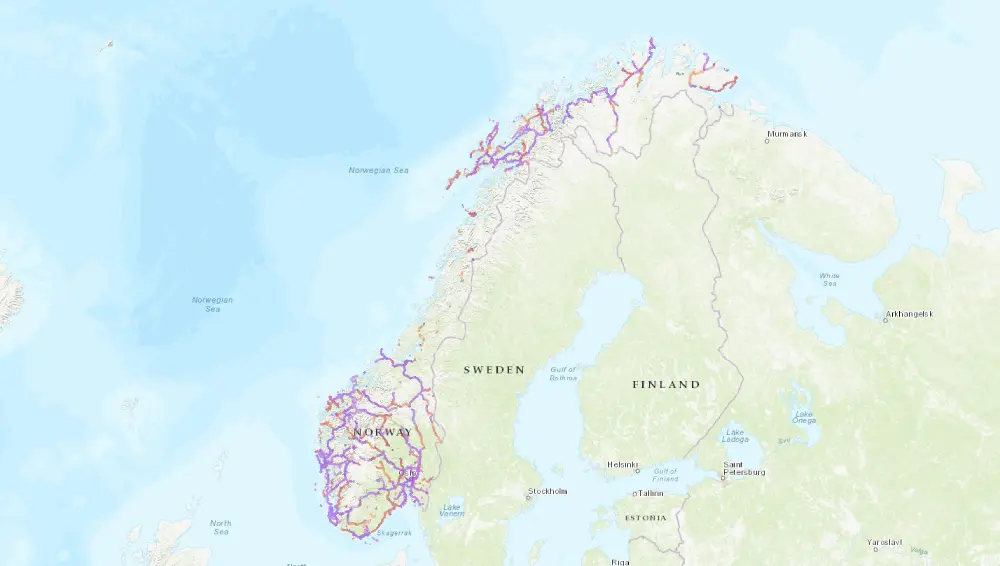
Norway’s main mobile networks (what travelers should know)
Telenor
-
Often considered the “default” nationwide network in Norway, with strong performance across major roads and populated regions.
-
A solid pick for long drives and rural stretches, but you can still hit dead zones in valleys, tunnels, and remote coastal areas.
-
If your itinerary includes lots of road travel outside cities, Telenor coverage is typically of the safer bets.
Telia
-
Very strong urban and regional coverage, and Telia has publicly stated its 5G rollout reaches close to 99% of the population.
-
In practice, Telia performs well across most cities and common tourist routes.
-
Roafly’s Norway eSIM uses Telia, which is a good match for typical travel itineraries (Oslo–Bergen–Trondheim routes, major towns, and popular attractions).
ice
-
ice is a major operator in Norway, but traveler experience reports often rate its coverage as less consistent in more remote areas compared with the two largest networks—worth keeping in mind if you’re heading far off the beaten path.
-
That said, in big cities and many towns, ice can still be perfectly usable—your experience will depend heavily on where you’re going.
Where coverage is usually strong
-
Oslo, Bergen, Trondheim, Stavanger and surrounding commuter areas
-
Main highways and major rail corridors
-
Most urban coastal zones and high-traffic tourist areas
Where you’re most likely to notice gaps
-
Fjord regions with steep valley walls (signal can drop suddenly as you switch sides of a fjord)
-
Mountain passes and high plateaus (weather + terrain can affect performance)
-
Long tunnels (some tunnels have coverage, many don’t, and it varies by route)
-
Remote islands and sparsely populated northern stretches (coverage exists, but it won’t be uniform)
Which option should you pick?
Choose airport SIM if…
-
You want a physical SIM immediately and don’t have eSIM support.
-
You’re arriving late and want something right away, even if it costs more.
Choose a local prepaid SIM if…
-
You’ll stay 2+ weeks and want local customer support.
-
You need a large data bucket and don’t mind visiting a store/kiosk.
Choose Roafly eSIM if…
-
You want the quickest setup (install, land, connect).
-
You want to avoid store visits and physical SIM swapping.
-
You want predictable pricing in USD and easy installation options.
Choose pocket WiFi if…
-
You’re a group with many devices.
-
You want a shared connection and are fine carrying/charging extra device
A practical “do this and you’ll be fine” plan
For most Norway trips in 2026:
-
Install a Roafly Norway eSIM before departure (so you’re connected right after landing).
-
Use hotel/café WiFi for large uploads and backups.
-
If you’re traveling as a family, consider pocket WiFi instead of buying multiple plans.
If you’re not sure how much data you’ll use, a data usage calculator can help estimate GB needs based on maps, social media, video calls, and streaming habits.
Check the latest eSIM packages for Norway and set up your connection before you land.