


Italy’s main-city itineraries usually work well by train. Renting becomes more useful when your accommodation and daily stops spread beyond convenient public transport routes—and that may mean hiring a car for part of your holiday.
| Quick question | What to know |
|---|---|
| Which side of the road? | Drive on the right; normally overtake on the left. |
| Should you rent for city sightseeing? | Usually unnecessary for a Rome–Florence–Milan itinerary. |
| What documents matter? | Your original valid licence, identification and any required IDP or official Italian translation. |
| Can you turn right on red? | There is no general permission to do so. |
| What is a ZTL? | A restricted traffic zone with locally defined access rules. |
| What belongs in the budget? | Rental charges, fuel, tolls, parking and applicable extras. |
Do You Need a Car in Italy?
Rome, Florence and Milan are connected by rail, and central sightseeing rarely gives a rental car much useful work. Staying near convenient public transport lets you move between cities without arranging overnight parking or negotiating restricted streets around your hotel.
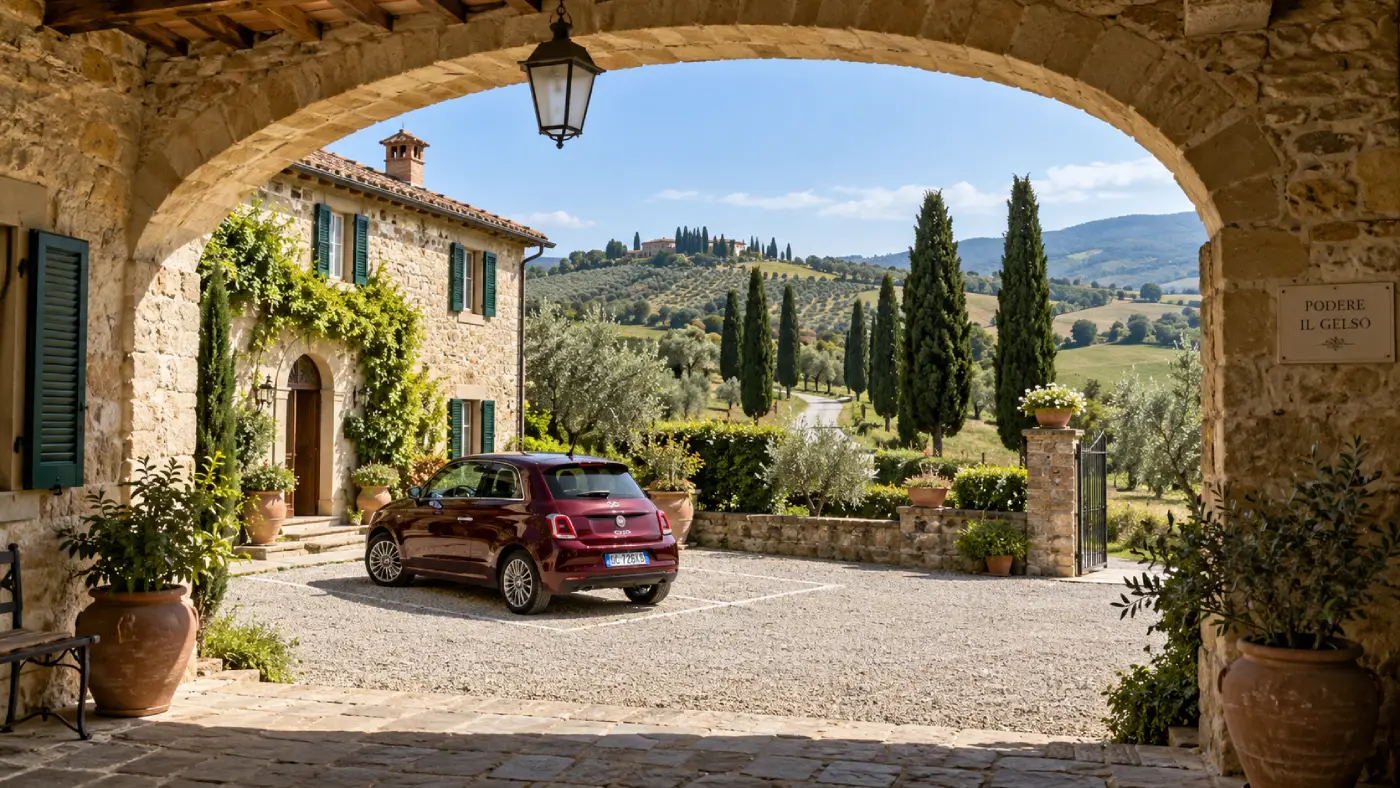
Tuscany changes the calculation you leave the main towns. Rural accommodation, scattered villages and vineyard visits can make a car worthwhile, especially when bus timetables leave long gaps between your intended stops. countryside excursion may be easier as an organised tour or a booked car with a driver; several days of independent touring give a rental more purpose.
Mixed itineraries suit a partial rental. Spend your Florence days without a vehicle, then collect when you leave for the countryside. Compare that arrangement with keeping the car throughout, including city parking and any fee for returning it to a different branch.
The Dolomites need a closer look at your base. Val Gardena has public buses and lift access, so staying within easy reach of those services can support days without driving. Participating accommodation also provides a guest pass covering many local public transport journeys. Compare seasonal timetables with your actual trailheads and return times: moving between dispersed valleys presents a different transport problem from staying in village.
Where to Pick Up Your Rental Car and Which Car to Choose
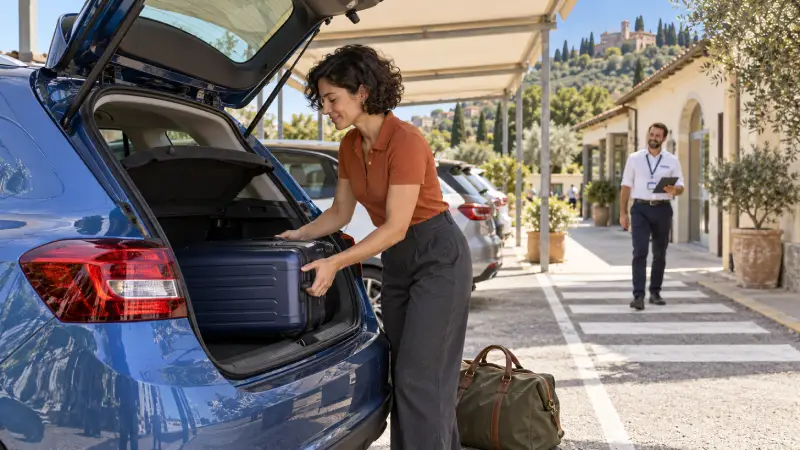
Airport collection makes sense when you are heading directly into a region where you will drive. If your trip starts with several city nights, a later collection near your departure point can save unused rental days. Compare the complete journey, including transfers to the branch, opening hours and the route out.
Taking a train first can also shorten the driving portion. Travel between the major cities by rail, then rent near the area you want to explore. Returning to the same branch may reduce fees, but a different drop-off location can be worth paying for if it removes a substantial backtrack.
Compact cars are easier to place on narrow village streets and in tight parking spaces. Still, allow enough boot space for everyone’s luggage; the smallest category becomes inconvenient if bags occupy passenger seats. Reserve an automatic explicitly if that is what you drive comfortably, and read the booked category rather than relying on the example photograph.
Mountain scenery alone is no reason to book a large SUV. Match the vehicle to the roads and accommodation access you will actually use, with seasonal equipment considered separately.
Rental Documents, Deposits and Insurance Explained
Start with your licence’s issuing country. EU/EEA-issued licences can generally be used during a tourist visit. With a licence issued elsewhere, Italy’s default requirement is a valid domestic licence accompanied by an International Driving Permit or an official Italian translation, subject to applicable international agreements. The foreign-licence rules make the supporting document additional to your licence; an IDP cannot replace it.
Arrange any required IDP before departure through an authorised issuer. Bring your original licence and identification, and send the rental company any document question before booking if your circumstances are unusual.
Rental eligibility is a separate matter. Minimum age, how long you must have held a licence, young-driver charges and accepted cards depend on the supplier and vehicle category. Every intended driver needs to meet the conditions and be included in the agreement.
Many bookings require a credit card in the main driver’s name with enough available credit for the deposit. Debit cards are possible with some products: Sicily by Car, for example, offers a dedicated debit/prepaid-card booking option that includes a specified protection package. Select the appropriate option at booking and review its accepted-card conditions.
Keep three amounts separate when comparing quotes:
-
Rental cost: the hire charge plus applicable extras, such as another driver, child seats,-way return or permitted cross-border travel.
-
Security deposit: money held or charged under the contract, affecting the funds available during your trip.
-
Damage or theft excess: the amount you may remain responsible for under the relevant cover, subject to exclusions and contract conditions.
Third-party liability, damage protection and theft protection serve different purposes. Read what remains payable and whether tyres, glass, keys or other items are excluded. If you buy separate reimbursement cover, establish whether you would first have to pay the rental company and then claim the money back.
Before leaving, have existing damage recorded and photograph the car, wheels, glass, fuel level and mileage. Save the agreement and the supplier’s roadside-assistance contact somewhere accessible offline.
ZTL Zones and Parking: Reaching Your Hotel Without Guesswork
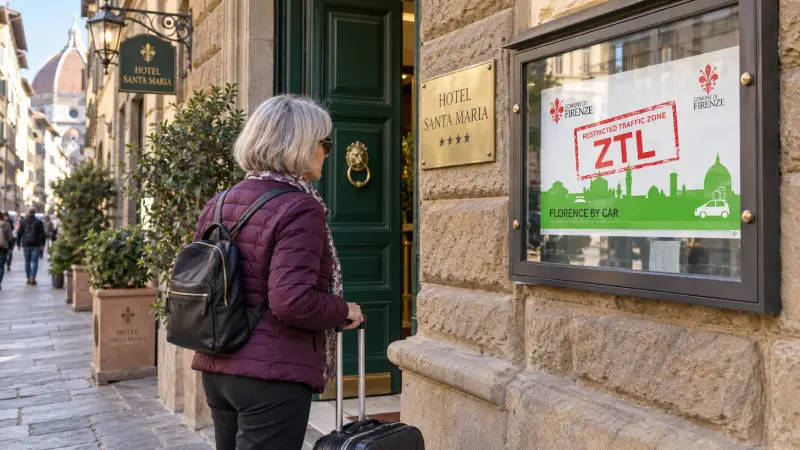
ZTL stands for Zona a Traffico Limitato: a zone where vehicle access is restricted. Hours, exemptions and registration procedures are local, and cameras can record entries. On signs using the wording, varco attivo means the restriction is active.
Hotel access needs arranging before you reach the gate. Ask for the authorised approach, where you may unload, and whether the property or garage must register your number plate. In Florence, accommodation and garages can transmit plates through the local procedure; follow the official Florence ZTL guidance and the property’s directions.
Keep the hotel’s written instructions and any registration confirmation. Permission for a specific arrival route should not be treated as freedom to drive through the whole centre. Bus lanes, pedestrian streets and low-emission restrictions may have separate rules.
Parking outside the historic centre often makes village and city visits simpler. Street markings provide an initial clue:
-
Blue: usually paid parking.
-
White: generally free, potentially with time limits or other conditions.
-
Yellow: reserved spaces requiring the relevant entitlement.
Read the accompanying signs for hours, resident restrictions and payment instructions. Parking payment and permission to enter a restricted zone are separate requirements.
If you stop between hotels, plan where your bags will go. Keeping passports and valuables out of a parked car belongs among the basic safety precautions for your Italy trip.
Driving Rules Tourists Ask About
Right turns on red: stop behind the line. Italy has no general right-on-red rule. Follow any separate signal controlling your direction.
Left turns: use the permitted lane and signal in advance. With an ordinary green light, yield to opposing traffic and pedestrians or cyclists whose path you cross. Leave the junction clear if traffic beyond it is backed up.
Uncontrolled junctions: give way to vehicles approaching from the right unless signs or another applicable rule establish different priority. Do not assume that a wider-looking road has priority.
Roundabouts: approach according to the signs. Where you face a give-way sign, yield to circulating traffic. Without signs changing priority, the right-hand rule applies, so entering traffic can have priority. Signal your exit and make lane changes when safe.
Passenger-car speed limits normally follow these road categories:
| Road category | General limit in normal conditions |
|---|---|
| Built-up areas | 50 km/h |
| Secondary and local roads outside built-up areas | 90 km/h |
| Main extra-urban roads | 110 km/h |
| Motorways | 130 km/h |
Posted limits and any driver-specific restrictions take precedence. In precipitation, the motorway ceiling falls to 110 km/h and the main extra-urban-road ceiling to 90 km/h. Newly qualified drivers have additional restrictions.
Use dipped headlights in tunnels and outside built-up areas; daytime running lights can replace them outside towns in suitable daytime conditions. Everyone must use the appropriate seat belt or child restraint, and the driver should leave phone handling to a passenger or stop safely.
Wine-tasting itineraries are easier to organise around a designated non-drinking driver or a booked transfer. During sightseeing stops, other tourist rules in Italy can also affect behaviour around monuments and public squares.
Tolls, Mountain Roads and Seasonal Driving
Many Italian motorways charge tolls. At a ticketed entrance, take and retain the ticket for payment at the exit. Approach payment lanes early enough to read their symbols, and use a cash or card lane matching your payment method. Electronic-toll lanes require the appropriate active service; ask how any rental-car device is billed before using it.
If a machine issues an unpaid-toll receipt, keep it and use the road operator’s official payment procedure. Do not assume the rental company has settled it. Use the assistance button for trouble at a barrier rather than reversing.
Fuel and parking belong in the route budget alongside tolls. At collection, establish the car’s fuel type and return policy; plan a suitable refuelling stop before drop-off.
Mountain journeys need time for bends, gradients and changing conditions. Schedule unfamiliar rural approaches in daylight where possible, and obtain the accommodation’s directions if the final access road is narrow or steep.
Winter requirements depend on the road and dates. Review the relevant winter equipment requirements, including the roads approaching your mountain destination, then arrange suitable tyres or compatible chains with the supplier. Four-wheel drive does not replace required equipment or make a closed pass available.
Season also affects which trip you can build. Use the best time to visit Italy to narrow your travel window, then match mountain roads, lifts and bus services to those dates.
Navigation, Offline Maps and Returning the Car
Download the areas you will drive through before departure, and save accommodation details, parking locations and rental return instructions. Pin the actual vehicle entrance: a hotel’s main address may lead to a pedestrian street while its parking access is elsewhere.
GPS positioning can work without mobile data, but offline functions vary by app. Live traffic, searches and route updates may require connectivity. Compare mobile internet options in Italy before deciding whether to use roaming, a local SIM or an eSIM.
With an unlocked, compatible phone, an Italy eSIM can provide data for navigation and travel messages. Keep downloaded maps available for signal gaps, and follow roadside restrictions even when an app suggests a route through a ZTL.
Allow time at return for refuelling, finding the correct entrance and recording the handover. Photograph the vehicle again, including fuel level and mileage, and request a return record when staff are present. With an out-of-hours drop-off, follow the designated parking and key-return procedure and retain your timestamped photos.
Keep the final invoice, fuel receipt and handover records until the deposit and any later charges have been resolved.