

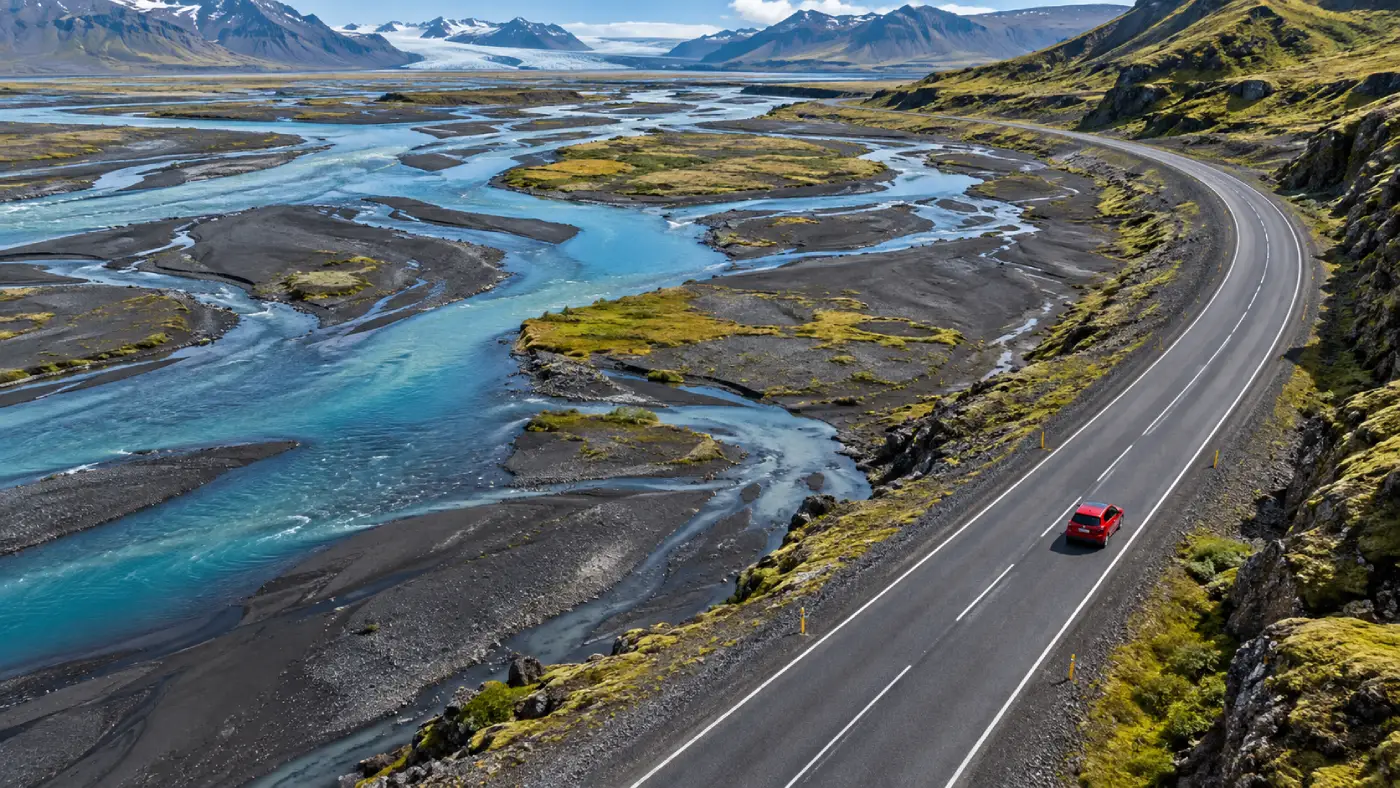

Rent a car in Iceland if you want independent stops along the South Coast, a Ring Road journey or accommodation beyond convenient tour pickup points. Reykjavík stays with organized excursions can work without. You can also explore the city first and collect a car when your road trip begins.
Your route and season should decide the vehicle. Summer trips on suitable paved roads often work with a 2WD car. Highland routes require closer attention to vehicle capability, road access and rental permission; winter adds another decision about whether you should drive at all.
| Quick question | What to know |
|---|---|
| Which side do you drive on? | The right. |
| Can you turn right on red? | There is no general permission to turn against a red light. |
| What are the usual speed limits? | 50 km/h in urban areas, 80 on rural gravel roads and 90 on rural paved roads, unless signs specify otherwise. |
| What catches visitors at roundabouts? | In two-lane roundabouts, the outer lane must yield to vehicles exiting from the inner lane. |
| What needs budgeting beyond the car? | Protection options, road-use charges, fuel, parking and any applicable tolls. |
| What should you download? | Offline maps covering your route, plus your booking and arrival instructions. |
Do You Need a Car in Iceland?
Reykjavík makes a workable base for a short visit without driving. Walking covers many central sights, while booked excursions can take you farther afield. Golden Circle tours operate throughout the year, visiting Þingvellir, Geysir and Gullfoss without requiring you to handle the driving.
Self-driving becomes more useful when you want to combine attractions at your own pace, stay in rural guesthouses or continue beyond a day tour's itinerary. Compare the actual stops you want: reaching a town by bus and reaching a particular waterfall, trailhead or isolated hotel are different journeys.
Consider renting for selected days. Two nights in Reykjavík followed by a South Coast trip could mean collecting the car on the morning you leave the city. Add the airport transfer and any different-location return fee to that comparison, alongside the rental days and parking you save.
Highland sightseeing also has alternatives. Seasonal Highland Bus services reach Landmannalaugar and Þórsmörk, with intermediate boarding points on relevant routes. That can let you keep a smaller rental for the rest of your holiday.
Where to Rent: Keflavík Airport or Reykjavík?
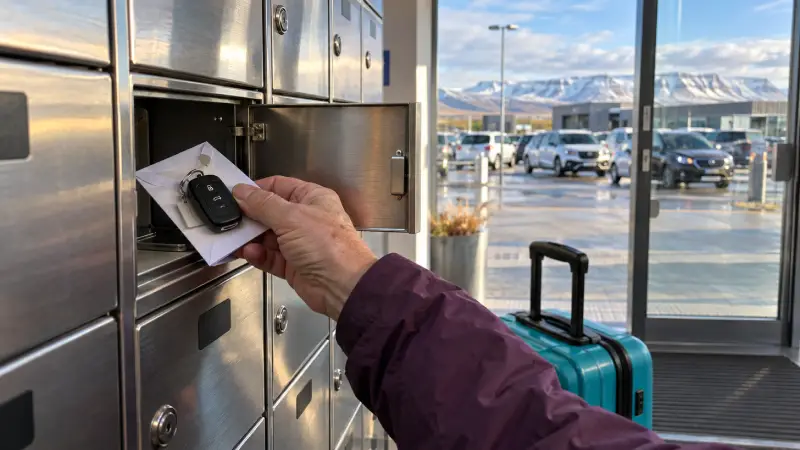
Keflavík pickup fits a trip that starts outside the capital, provided you are rested enough to drive. City pickup suits a Reykjavík stay followed by regional exploration. After an overnight flight, build recovery time into your arrival day before committing to a long drive.
Look closely at the collection instructions. An airport-area office may involve walking or a shuttle rather than a desk inside arrivals. Blue Car Rental, for example, collects cars at Blikavöllur 3 across the airport parking area and also operates a Reykjavík office at Fiskislóð 22.
Blue Car Rental and Höldur/Europcar are options to compare against your dates and vehicle needs. Match transmission, luggage space, cancellation terms, protection and mandatory charges. If you book through an intermediary, identify the company that will actually supply the car and apply the collection rules.
Keep the pickup address and access instructions available offline. If you want mobile data ready for arrival, compare eSIM options for Iceland before reaching the rental office.
At handover, photograph existing damage, wheels, glass, the fuel level and odometer. Repeat the record at return, including where and when you left the vehicle if the office is unattended.
Is a 2WD Enough, or Do You Need a 4x4?
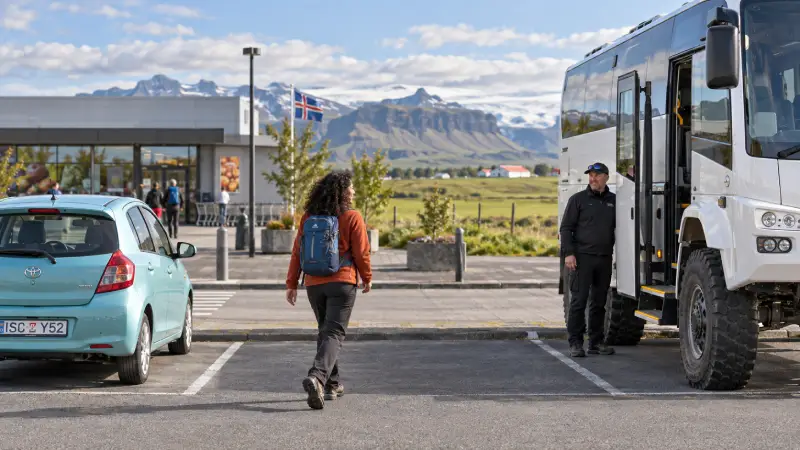
Summer driving on the main paved routes often suits a 2WD. The Golden Circle, South Coast and Ring Road do not automatically require an SUV. Include your accommodation access and planned detours in the decision: the main road can be straightforward while the final approach is rougher.
Size and drivetrain answer different questions. Extra luggage or three adults in the back may justify a larger vehicle even on an entirely paved trip. Book an automatic explicitly if that is what you are comfortable driving.
Winter calls for suitable tyres, a realistic route and experience in the expected conditions. Four-wheel drive can help with traction, but ice, poor visibility and strong winds may still make postponing the journey the sensible choice. If winter driving is unfamiliar, consider a Reykjavík base with guided excursions.
Could a smaller car plus a Highland Bus work?
Suppose most of your summer trip follows paved roads and Landmannalaugar is your Highland stop. Compare the cost of upgrading the whole rental with keeping a 2WD and buying bus tickets for that day.
The published 2026 Landmannalaugar service runs from 13 June to 20 September, with boarding in Hella as well as Reykjavík. Its timetable allows a little over four hours at Landmannalaugar. Match the service dates, boarding point and time at the destination to your plans before choosing this approach.
Driving Licence, Deposits and Rental Insurance
Bring your original, valid driving licence. Short-stay visitors can use a qualifying foreign licence showing their photograph, licence number and validity dates in Latin letters. If yours uses another script, carry an International Driving Permit alongside it. The permit supplements your licence; it does not replace it.
Rental eligibility is a separate matter. At Blue Car Rental, the usual minimum is 20 for a 2WD or medium-sized 4WD/AWD, rising to 23 for larger SUVs and certain other categories. Drivers must have held their licence for at least a year, and a physical licence is required. Other suppliers can set different conditions.
Before paying, establish:
-
Which payment cards the supplying company accepts at collection.
-
Whether a deposit or card authorization is required, and its amount.
-
The excess you could owe for covered damage.
-
Which drivers are named on the agreement.
-
Whether your intended roads are permitted for that vehicle.
Keep a refundable deposit separate from your trip budget: it affects available funds but is not automatically a final cost. Some suppliers use a different security arrangement. Blue, for example, uses a card imprint rather than holding a deposit; liability for chargeable damage still remains.
Read protection by damage type
Gravel chips, wind-damaged doors, sand and ash, tyres, underbody damage and water damage deserve specific attention. CDW, an additional waiver and a third-party reimbursement policy can leave you with different payment and claim procedures.
Avoid treating “full cover” as permission to cross a river. Get written clarification covering the particular vehicle, route and protection package if your itinerary includes water crossings. Closed roads, prohibited use and negligence can still leave you responsible. Roadside recovery may also be charged separately from repairs.
Driving Rules: Turns, Roundabouts and Speed Limits
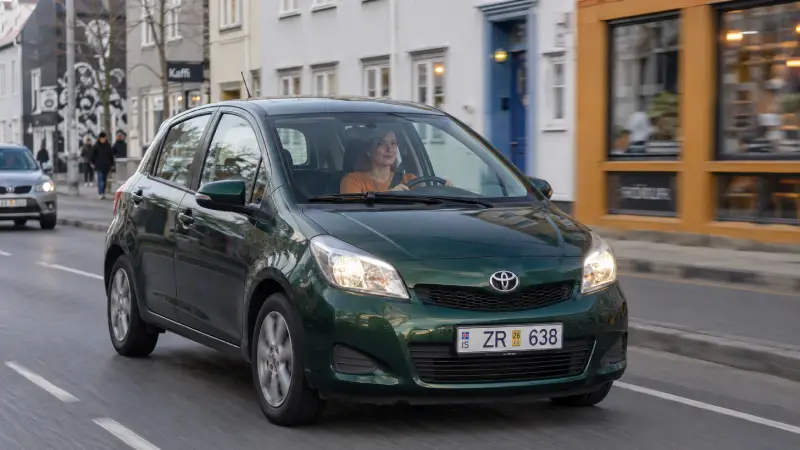
Drive on the right and follow the signal governing your lane. Stop at red; do not import a North American assumption that turning right is generally allowed. On a left turn, yield to opposing traffic and people crossing the road you are entering.
At otherwise uncontrolled junctions, give way to traffic approaching from your right. Signs, signals and rules for entering from places such as car parks take precedence.
Two-lane roundabouts need particular care
Yield to traffic already circulating. Use the outer lane when taking the first exit. Within the roundabout, the outer lane must let a vehicle in the inner lane exit. Do not change between the inner and outer lanes inside the roundabout; select your lane before entering and signal your exit.
Speed limits are maximums, not targets for every condition. Reduce speed for gravel transitions, limited visibility and narrow sections even when a higher limit is posted.
Keep headlights and taillights on throughout the day; an automatic setting may leave some lights off. Everyone must wear a seat belt, and children under 135 cm need a suitable child restraint. Keep alcohol out of driving days, and let a passenger handle the phone or stop somewhere appropriate before using it.
F-Roads, Gravel and Winter Driving
F-roads are designated mountain roads. They can involve rough surfaces and unbridged rivers, and vehicle requirements vary considerably between routes. Some suit an approved smaller 4WD; others require much greater clearance or a modified vehicle.
Treat Highland access as three separate questions:
-
Is this particular road open?
-
Is the vehicle suitable for its current conditions?
-
Does the rental agreement permit that vehicle on the route?
The absence of an F prefix is not enough to establish rental permission. Blue's restrictions also name Highland routes such as Kjalvegur beyond Gullfoss on road 35 and Kaldidalur on road 550.
Highland roads generally have a short summer access season, with opening and closing governed by conditions. Plan around the actual road status. Stay on authorized roads: driving moss, beaches or unmarked ground is a different activity from following an open mountain road.
Everyday hazards beyond the capital
Slow down before asphalt changes to gravel. Approach single-lane bridges ready to yield; where no signs establish a different priority, the nearer vehicle has priority, but assess the other driver's movement before entering. Give a vehicle already crossing room to clear the bridge.
Watch for sheep near the road, especially animals separated from the rest of the flock. Use designated stopping places for photos, and hold doors firmly when opening them in wind.
Snow and ice can affect spring and autumn trips too. Allow flexibility in overnight stops instead of building a schedule that requires every road section to remain usable. If aurora viewing drives your destination choice, our comparison of Norway vs. Iceland for northern lights helps put the wider trip in context.
Road access is part of planning a stop. Read about Iceland's volcanic and coastal hazards before combining your drive with eruption-area visits or exposed beaches.
Road Tax, Tolls, Parking and Fuel
Build your budget from the complete rental quote, then add fuel, parking and route-specific tolls. Separate optional extras from mandatory charges and establish whether road-use fees are already included.
Daily versus distance-based road charges
Iceland's 2026 road-use charging system can appear differently on rental bills. Blue Car Rental charges 1,550 ISK per rental day. Höldur's published calculation for cars and SUVs up to 3.5 tonnes totals 8.81 ISK per kilometre, including its administration fee and the VAT on that fee.
Here is how those charging methods compare for two hypothetical trips:
| Road-use charge | Seven days, 1,000 km | Seven days, 2,000 km |
|---|---|---|
| Blue: 1,550 ISK per day | 10,850 ISK | 10,850 ISK |
| Höldur: 8.81 ISK per kilometre | 8,810 ISK | 17,620 ISK |
Calculated from Blue Car Rental and Höldur policies checked on 14 September 2026. These figures exclude the vehicle rental, protection, fuel, parking and separate tolls.
Driving farther changes which of these two fee methods costs less. The cheaper complete rental still depends on the rest of the quote. Likewise, “unlimited mileage” is a reason to examine how road-use charges are billed, rather than assuming every kilometre-related cost is included.
Separate tolls and parking payments
Vaðlaheiði tunnel near Akureyri has its own toll. The official tunnel payment service uses the vehicle's registration number.
The Hornafjarðarfljót crossing on the new Ring Road section near Höfn also carries a separate toll. As checked in September 2026, a single trip costs 1,500 ISK for vehicles under 3.5 tonnes. The operator's rental-car payment instructions specify payment within 12 hours after passage; settle it promptly.
Establish whether you or the rental company will handle tolls so you avoid duplicate payments or a later handling charge. Keep payment confirmations until the final rental bill is settled.
Parking charges apply at various attractions and in parts of Reykjavík. Follow the payment method displayed at each location and enter the rental registration accurately. Parka is useful at participating sites, but the sign at your particular car park determines how to pay.
Plan fuel stops alongside sightseeing stops, especially before remote stretches. Identify the correct fuel at collection and retain the final refuelling receipt if your agreement requires a full-tank return.
Navigation and What to Check Before Each Drive
Use navigation for directions and official road information for access decisions. Google Maps can guide you offline when the entire route falls within your downloaded area, but offline driving lacks live traffic information and alternative routes. Download the whole corridor you intend to travel, including likely detours.
Before setting out, use SafeTravel's current travel conditions and the Icelandic Road Administration's Umferðin map to review closures and conditions along your route. Weather, road access and the final approach to your accommodation matter more than the fastest suggested arrival time.
Mobile data helps with updated alerts, parking payments and messages to your accommodation. An Iceland eSIM can support those tasks on a compatible phone; keep your offline preparation because reception varies by location.
If you are comparing a rental Wi-Fi device with your own mobile connection, review the internet options for an Iceland road trip before paying for an extra device.
Save your accommodation's entrance instructions, the rental company's assistance number and your booking details. Before each drive, make sure the road is usable, you have enough fuel and daylight for the plan, and there is room to change it if conditions deteriorate.