

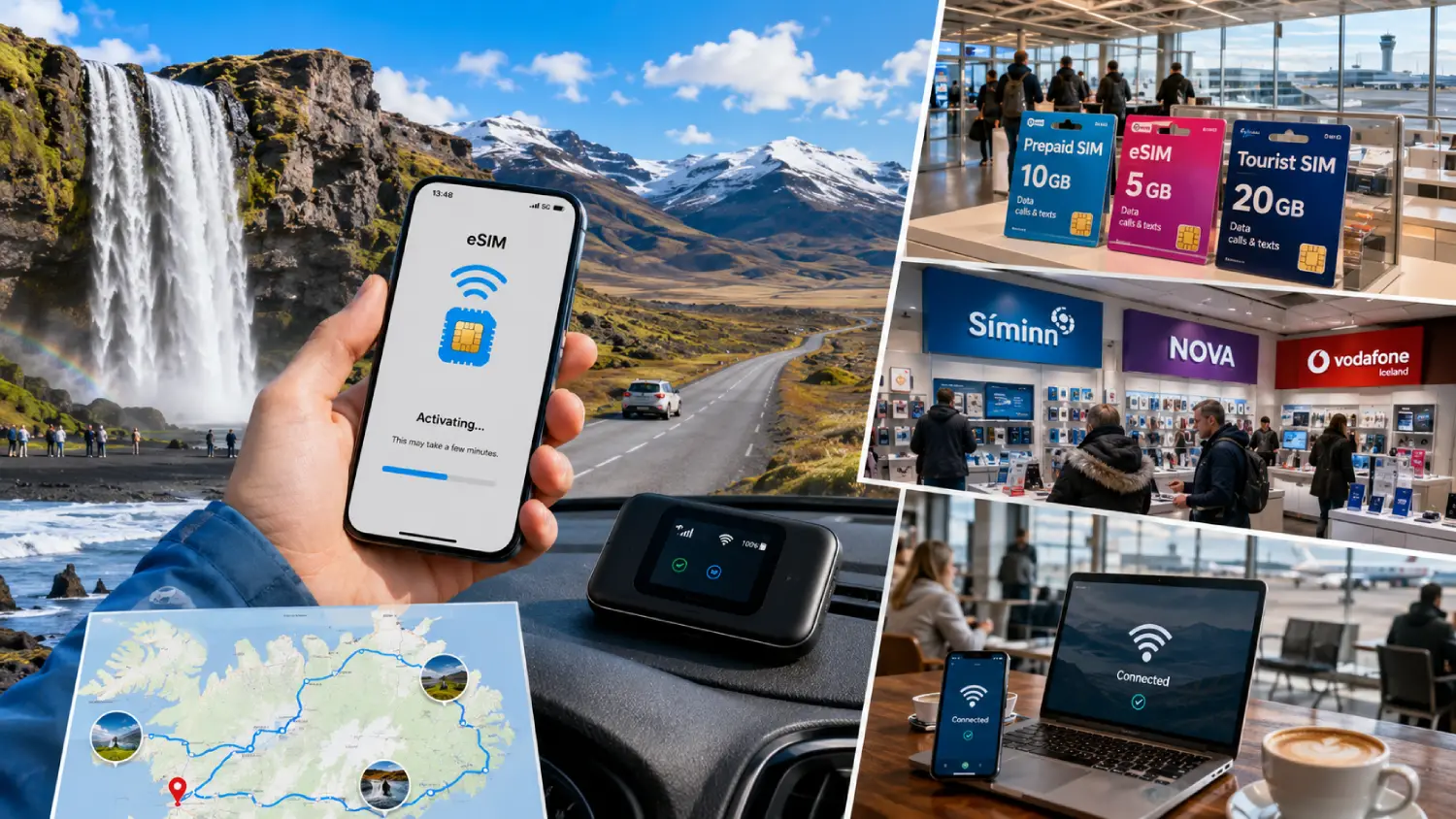

In 2026, the best ways to stay connected in Iceland are an eSIM, a local prepaid SIM card, pocket WiFi, or free public WiFi. Each option works, but the right choice depends on your phone, your route, your data usage, and whether you need internet immediately after landing.
Mobile Internet in Iceland: What Travelers Should Know First
Iceland has a strong mobile network for such a remote country. The main mobile operators are Síminn, Nova, and Sýn/Vodafone Iceland, and all three provide 4G and 5G coverage in populated areas. Coverage is generally reliable in Reykjavík, Keflavík, Akureyri, the Golden Circle, the South Coast, and much of the Ring Road. Coverage can become weaker in remote valleys, mountain roads, parts of the Westfjords, and the Central Highlands. nPerf’s Iceland coverage maps list 2G, 3G, 4G, and 5G layers for Síminn, Nova, and Vodafone, while operator pages also point travelers to their own coverage tools.
The most important rule is simple: download offline maps before driving outside towns. Iceland’s weather changes quickly, and mobile signal can drop in remote areas even when the main road has coverage nearby. This is especially important if you plan to visit F-roads, highland areas, glacier lagoons, isolated campsites, or rural guesthouses.
Iceland is also moving further toward 4G and 5G. Sýn announced that remaining 3G transmitters in Iceland are scheduled to be switched off in March 2026, so travelers using very old phones should check device compatibility before departure.
Need data in Iceland? Get an eSIM!
Choose the perfect data plan for your trip
Exclusive Reader Bonus!
Enjoy an extra %10 OFF your first Roafly eSIM purchase as a thank you for reading.

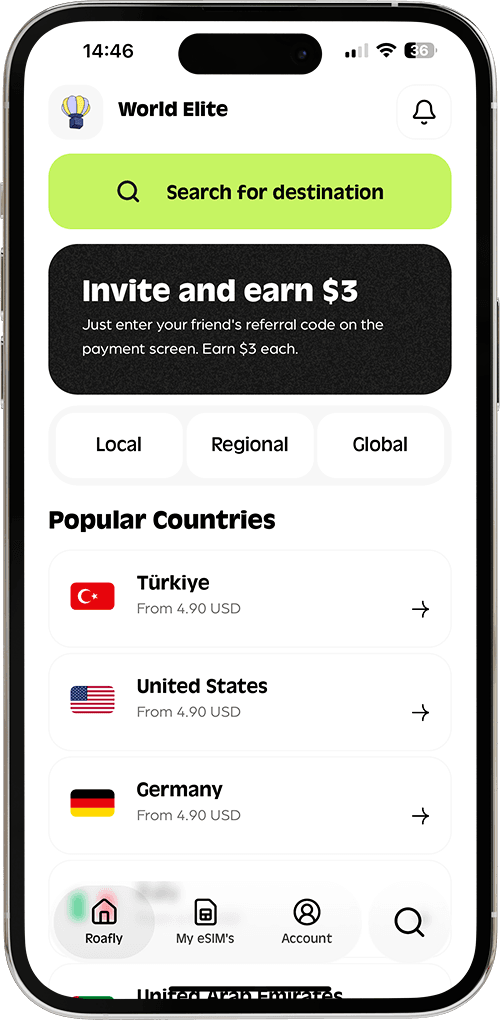
Manage your eSIM in the app
Install, top up and track data.
Quick Comparison: Best Ways to Get Internet in Iceland
| Internet option | Best for | Typical 2026 cost | Setup time | Main advantage | Main limitation |
|---|---|---|---|---|---|
| Roafly Iceland eSIM | Most travelers, short trips, Ring Road trips, digital setup | From $4.90 | A few minutes | Install before arrival, no store visit, no physical SIM | Requires an eSIM-compatible unlocked phone |
| Airport or local prepaid SIM | Travelers who want a local SIM or calls/SMS | Around 2,000–3,790 ISK for common starter/data options, about $16–$30 | 10–20 minutes | Local operator access, physical SIM option | Requires store purchase and SIM swap |
| Pocket WiFi | Groups, families, multiple devices | Around $8–$10 per day or about 1,200 ISK/day | Pickup required | Connects several devices | Extra device, battery, return process |
| Airport and public WiFi | Light use at airport, hotels, cafés | Free | Instant where available | No purchase required | Not useful while driving or in remote nature areas |
Prices checked in July 2026. Local ISK-to-USD estimates use the Central Bank of Iceland’s listed USD reference rate of 1 USD = 125.75 ISK. Local retail availability can vary by store, airport stock, and package changes.
Option 1: Buying a SIM Card at Keflavík Airport

For many travelers, Keflavík Airport is the first place to look for mobile internet. KEF has retail stores in the terminal, and ELKO operates two stores at Keflavík Airport, including in Arrivals on the 1st floor. The airport’s official shopping page lists ELKO as an electronics retailer, and Nova states that travelers whose phones do not support eSIM can get a plastic SIM card at ELKO at KEF Airport or at Nova stores.
Airport SIM availability can change depending on stock and opening hours. In practice, KEF is convenient, but it is not always the cheapest or most flexible place to compare every local package. If your flight lands late, if a specific SIM is out of stock, or if you want help setting up the SIM, you may spend more time than expected.
For 2026 budgeting, use the official local prepaid prices below as a realistic reference:
Need data in Iceland? Get an eSIM!
Choose the perfect data plan for your trip
Exclusive Reader Bonus!
Enjoy an extra %10 OFF your first Roafly eSIM purchase as a thank you for reading.
Manage your eSIM in the app
Install, top up and track data.
The main advantage of using an eSIM is control. You can install it on WiFi before flying, land at Keflavík, turn on mobile data for the eSIM, and start using maps, messaging apps, hotel apps, ride services, and car rental details immediately.
A 3GB or 5GB plan is usually enough for light users who mainly need maps, messaging, weather, and occasional browsing. A 10GB plan is a safer choice for a-week trip with daily navigation, social media, restaurant searches, and photo uploads. A 20GB or 50GB plan is better for heavy users, remote workers, hotspot sharing, or longer road trips.
For a deeper eSIM-focused breakdown, the Best eSIM for Iceland guide is useful before choosing your data size.
When Roafly eSIM is the best choice
Roafly eSIM is the strongest option if you want internet ready before arrival. It is also ideal if you want to avoid airport counters, keep your main phone number active, use WhatsApp or iMessage as usual, and manage everything digitally.
It works especially well for:
- Travelers arriving late at night
- Travelers renting a car immediately
- Ring Road and Golden Circle itineraries
- Couples or solo travelers who do not need a pocket WiFi device
- Visitors who want a clean setup without changing SIM cards
Option 4: Pocket WiFi in Iceland
Pocket WiFi is a small portable router that connects to the mobile network and creates a private WiFi network for your devices. It can be useful for families, groups, road trips with laptops and tablets, or travelers who want shared connection in the car.
In Iceland, pocket WiFi rentals are commonly offered by dedicated providers, car rental companies, and travel services. Visit Reykjavík lists Trawire with an $8 per day offer and support for up to 10 devices via portable 5G WiFi. Hotspot.rent lists portable WiFi rental at 1,200 ISK per day, which is about $9.50 per day using the July 2026 Central Bank reference rate.
Pocket WiFi can be cost-effective for a group when several people share device. For example, four travelers sharing a $8–$10 daily hotspot may pay less per person than buying separate data plans.
But pocket WiFi has trade-offs. You need to pick it up, keep it charged, carry it during the day, return it after the trip, and avoid loss or damage fees. If the person carrying the router walks away, everyone else loses internet. It also depends on the same mobile coverage realities as SIM cards and eSIMs, so it will not magically work in every remote highland area.
For most solo travelers and couples, an eSIM is simpler. For groups with several phones, tablets, and laptops, pocket WiFi can still be worth considering.
Option 5: Airport WiFi and Public WiFi in Iceland
Free WiFi is widely available in Iceland’s travel infrastructure, but it should be treated as a backup rather than your main connection.
Keflavík Airport offers internet access, and the airport’s own data protection page refers to processing data to provide a free internet connection and manage access to guest networks. KEF’s Saga Lounge also lists free WiFi among its services.
In Reykjavík, WiFi is common in hotels, cafés, coffee houses, bookstores, and bars. Nordic Visitor’s Iceland travel guide notes that WiFi access is available throughout Reykjavík city centre, usually with free connection in places such as hotels, cafés, bookstores, and bars.
Public WiFi is useful for checking messages at your hotel, downloading a map before leaving a café, or uploading photos in the evening. It is not reliable for navigation, road trips, emergencies, or rural travel.
Do not rely on public WiFi if you are driving in Iceland. Weather alerts, road closures, fuel stops, accommodation access codes, parking apps, and navigation often matter most when you are away from public hotspots.
How Much Data Do You Need for Iceland?
Data usage depends on how you travel. Iceland is a highly visual destination, so many travelers use more data than expected for maps, weather, photos, videos, and route planning.
- A light user may need 1GB to 3GB for a short trip. This is enough for messaging, basic browsing, Google Maps, restaurant searches, and checking the weather. It is not ideal for heavy Instagram use, TikTok, YouTube, cloud photo backup, or hotspot sharing.
- A typical traveler should consider 5GB to 10GB for a 5–10 day trip. This gives more flexibility for daily maps, social media, attraction research, email, and some photo uploads.
- A heavy user should consider 20GB or more. This is better for remote work, video calls, laptop tethering, cloud uploads, streaming, or sharing data with another device.
For a Ring Road trip, 10GB is often a comfortable minimum. For a two-week trip, van travel, or frequent hotspot use, 20GB or 50GB gives more breathing room. The Data Usage Calculator can help estimate a better package before departure.
Coverage Tips for the Ring Road, Golden Circle and Highlands
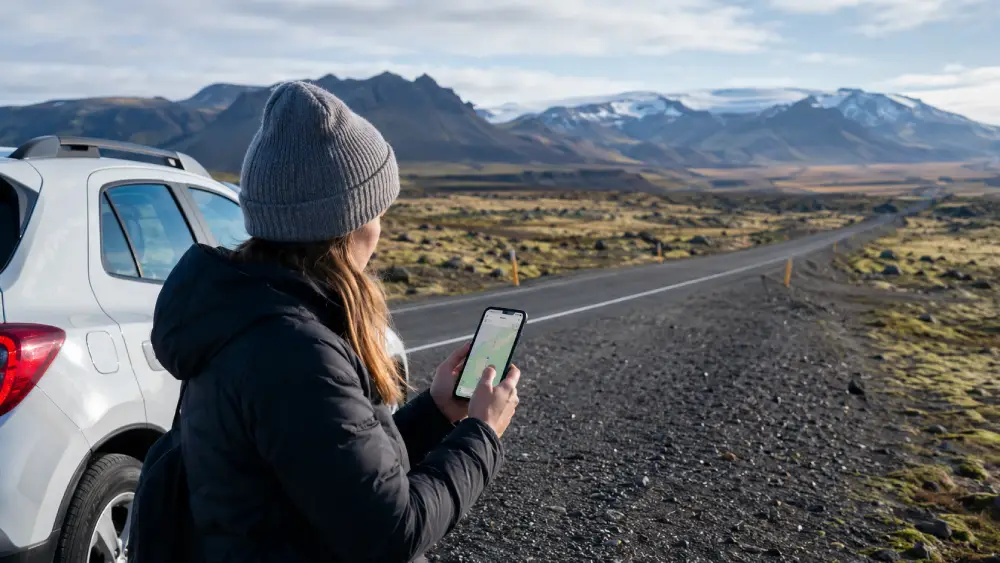
For Reykjavík, Keflavík, the Blue Lagoon, Golden Circle, and South Coast, mobile data is usually straightforward. You should expect usable coverage in most towns, around major attractions, and along common tourist routes.
The Ring Road is also generally well served, especially near towns and popular stops. However, coverage can drop between settlements, in valleys, near mountains, and in poor weather. The further you move away from Route 1, the more important offline preparation becomes.
The Central Highlands are different. Many highland areas are remote, seasonal, and sparsely covered. Even if a coverage map shows signal near a route, conditions can change quickly. If you plan to drive F-roads, hike remote areas, or travel in winter, do not treat mobile internet as your safety tool.
Before leaving Reykjavík or a major town, download:
- Offline Google Maps or Apple Maps areas
- Offline accommodation details
- Road.is and weather information
- Emergency and rental car contacts
- Fuel station locations
- Hiking route files, if needed
Mobile internet is very useful in Iceland, but safe travel also depends on offline planning.
eSIM vs Local SIM vs Pocket WiFi: Which Should You Choose?
Choose Roafly eSIM if you want the easiest setup, internet on arrival, no physical SIM card, and flexible data packages in USD. This is the best fit for most short-term visitors, road trippers, and travelers who already use WhatsApp, FaceTime, iMessage, Telegram, Google Maps, and booking apps.
Choose a local SIM card if your phone does not support eSIM, if you want a local Icelandic number, or if you prefer a physical SIM with calls and SMS. It is practical, but less convenient on arrival.
Choose pocket WiFi if you are traveling as a group and want to connect several devices through shared router. It can be good value, but it adds another device to charge, carry, and return.
Use free WiFi as a backup. It is useful at the airport, hotels, and cafés, but it is not enough for road trips or nature-heavy itineraries.
Final Tips Before You Travel to Iceland
Set up your mobile internet before the day you fly. If you use an eSIM, install it at home on a stable WiFi connection. If you plan to buy a local SIM, make sure your phone is unlocked. If you rent pocket WiFi, check pickup and return instructions carefully.
Keep offline maps downloaded even if you have a large data plan. Iceland’s landscapes are remote, and mobile coverage can vary by terrain. Charge your phone before long drives, carry a power bank, and check weather and road alerts before leaving each stop.
For most travelers in 2026, the smoothest option is to use an eSIM for arrival and daily travel, with public WiFi as a backup at hotels and cafés.
Check the latest Iceland eSIM plans before your trip and choose the data size that matches your route.