Download the App and manage your eSIMs easily
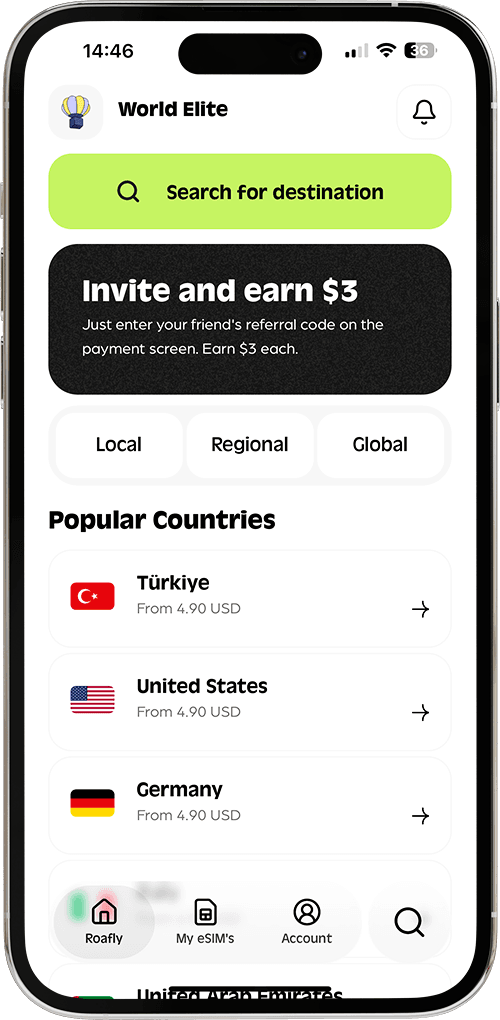
Create your order quickly
See your eSIM details
Track your remaining data
Download the App and manage your eSIMs easily
Create your order quickly
See your eSIM details
Track your remaining data
Argentina allows many visitors to enter without a tourist visa, while others need an approved AVE or a consular visa before departure. Your passport nationality comes first; an eligible U.S. visa or Green Card changes the answer for a small group of travelers.

Sophie Callahan
Updated Nov 11, 2026
9 min read

Save 15% on your Roafly eSIM
Stay connected on your next trip. Use the code below at checkout.
View All DestinationsJump to section
👇Save 15% on your Roafly eSIM
Stay connected on your next trip. Use the code below at checkout.
View All Destinations
Manage your eSIM in the app
Install, top up and track data.
As of 11 November 2026, those routes have different conditions and stay limits. Start with the passport table below, then prepare the documents for your route—including medical insurance and evidence of your travel plans.
These examples cover ordinary passports and short tourist visits. Residence in another country, a diplomatic passport or a different purpose of travel can change the requirements.
| Entry route | Passport examples | Main condition | Tourist stay |
|---|---|---|---|
| Visa exemption based on nationality | United States, United Kingdom, Canada, Australia, Germany, Türkiye | Valid passport; meet the conditions for admission as a tourist | Up to 90 days or three months, depending on nationality; entry permission controls |
| Exemption using qualifying U.S. documents | India, Dominican Republic | Valid eligible U.S. visa or valid U.S. Green Card | Up to 90 days |
| Exemption using qualifying U.S. documents | People’s Republic of China | Valid eligible U.S. visa or valid U.S. Green Card | Up to 30 days |
| Electronic Travel Authorization, or AVE | Indonesia, Philippines, Vietnam | Eligible nationality, qualifying U.S. visa and an approved AVE before travel | Up to three calendar months from first entry |
| Consular tourist visa | Pakistan, Bangladesh, Egypt | Obtain the visa through an Argentine consulate before departure | Up to 90 days, according to the visa and admission granted |
The examples are not a complete nationality list. Use Argentina’s official visa eligibility table to find your passport country. Read the ordinary-passport, AVE, U.S.-visa and Green Card columns separately: each describes a different route.
If you need an AVE or consular visa, obtain it before traveling. Arriving at the border with an application still pending does not complete that requirement.
The conditional exemption in the table accepts these U.S. visa categories: B1/B2, B2, J, B1, O, P1, P2, P3, E and H-1B, as well as a valid U.S. permanent resident card.
Eligible visitors under this exemption do not need a separate Argentine tourist visa or AVE. Use the country-specific limit in the table when planning your itinerary, even if your U.S. document is valid for much longer.
Keep the following conditions in mind:
Your U.S. visa or Green Card must remain valid throughout your stay.
Other U.S. visa categories and dependent categories are not covered simply because they allow you to live in the United States.
Form I-797 extending a Green Card’s validity is not accepted for this exemption under the Argentine consular guidance.
Indian applicants should also allow for the consulate’s warning that at least 90 days of remaining validity on the qualifying U.S. document may be required from arrival.
Without the qualifying U.S. document, passport holders in these three groups need the appropriate consular visa. Do not use an older AVE checklist as a substitute.
Argentina’s AVE is an electronic travel authorization for eligible visitors who would otherwise need a tourist visa. Being able to access the application website does not establish eligibility.
Passport holders in the AVE examples above need a qualifying valid U.S. visa. A Schengen visa alone does not satisfy the U.S.-visa condition. The official system also describes a separate provision for eligible nationals of U.S. visa-exempt jurisdictions, involving ESTA or qualifying recent U.S. travel; it is not a general exemption for every ESTA holder.
Apply through the official AVE portal. The published decision period is 20 working days, and processing can take longer. Allow for that before committing to departure.
Two separate clocks apply:
Authorization validity: three calendar months from issue.
Permitted tourist stay: three calendar months from the first entry, with multiple entries and exits permitted under the authorization.
Your qualifying U.S. visa must cover the processing period, the authorization’s validity and your intended stay. Crossing the border again during that period does not restart the AVE’s clock.
If your nationality is not eligible for an exemption or AVE—or you lack the document needed for a conditional route—contact the Argentine consulate handling your application.
The standard tourist visa requirements include:
A passport valid for at least six months from intended entry, with at least one blank sheet comprising two sides.
Two recent passport photographs and a completed, signed FSV application.
Evidence of sufficient funds.
A return travel reservation.
Hotel reservations and a tourist itinerary, or an invitation where applicable.
A consular interview.
Submit reservations as instructed; the application process does not require you to commit to nonrefundable flights before a decision. Appointment availability and document review add time beyond completing the form.
The standard consular fee is USD 150 or EUR 150, depending on the consulate, payable in local currency. Nationality-based exemptions can apply. Chinese citizens applying at consulates in China follow separate treaty-based requirements, so they should use that post’s instructions.
Argentina does not impose a universal six-month remaining-validity rule on every visitor entering without a visa. Argentine consular guidance distinguishes a valid passport for entry from the six-month requirement used in tourist visa applications.
Keep your passport valid throughout the trip and check the requirements of any transit country. A connection elsewhere can introduce a passport-validity condition that does not come from Argentina.
Alongside your passport and any required visa or authorization, keep these documents accessible:
Qualifying U.S. document, if you are relying on it for an exemption or AVE.
Return or onward itinerary, showing how you intend to leave Argentina.
Accommodation details, including your first address and relevant reservations or invitation.
Evidence of funds, such as an accessible bank statement or other supporting financial documentation.
Medical insurance certificate, showing cover for Argentina and your travel dates.
Save copies offline so you can retrieve them at a check-in desk or border without relying on Wi-Fi. Keep the original passport and qualifying immigration documents with you.
If you want mobile data ready for the journey, compare the best eSIM for Argentina before departure, while you have time to check phone compatibility and select an allowance.
Arrange health insurance covering medical care in Argentina for your entire visit and carry the policy certificate. Argentine consular guidance identifies full-stay medical insurance as an entry requirement, so treating it solely as optional trip-cancellation cover misses the point.
The insurance and the declaration are separate preparations. Decree 366/2025 introduced a sworn statement covering the purpose of entry and possession of health insurance. Article 123 bis of the immigration law makes that declaration enforceable once its implementation is regulated.
Follow the declaration instructions provided by your Argentine consulate or carrier for your departure date. The legal provision does not, by itself, establish an online form that every tourist must submit 48 or 72 hours before arrival.
Keep your insurer’s assistance number with the certificate. Choose cover that includes your planned activities and any relevant medical conditions, rather than assuming every travel policy covers the same trip.
The entry rules apply at authorized air, land, river and sea crossings. Traveling by ferry or crossing a land border does not remove the need for the correct visa or authorization.
Citizens of Brazil, Bolivia, Uruguay, Paraguay, Chile, Peru, Venezuela, Ecuador and Colombia may use eligible valid national identity documents under Argentina’s regional travel-document arrangements. This is a nationality-based exception; a foreign residence card does not give every traveler the same option.
At immigration, have your accommodation address and departure plans ready. Keep a record of the stay granted, especially if you plan to move between Argentina and neighboring countries during the trip.
Once you arrive, Roafly’s Argentina eSIM can provide mobile data on a compatible phone for transfer messages, maps and booking updates. Keep your essential documents downloaded as well.
Plan the journey from the terminal to your accommodation before departure, including your pickup arrangement and how you will carry your bags. Review our safety advice for Argentina for the practical precautions that apply after border formalities.
Immigration admission and the goods you bring are separate checks. Before packing, review Argentina’s customs rules for baggage, restricted items and cash declarations.
Argentina has a specific continuing-journey arrangement for passengers departing within 12 hours. It requires a confirmed onward ticket and the carrier to declare the passenger under that category.
Passengers arriving and departing through the same entry point must remain within the airport, station or other designated place during the connection. Arrange this with the airline as a transit journey; do not assume any ticket within 12 hours grants permission to leave the airport.
Changing airports between Ezeiza and Aeroparque requires travel across Buenos Aires. Check the entry permission needed for that itinerary before booking, rather than relying on the same-airport transit arrangement.
Longer connections and visits outside the transit conditions require the appropriate permission. Visa-exempt tourists may qualify for ordinary tourist admission; others may need a visa. The separate consular transit category allows a stay of up to ten consecutive days, subject to its conditions.
Tourist stays can be extended in eligible cases through the Dirección Nacional de Migraciones. Approval depends on your admission category and circumstances; the initial allowance is not an automatic entitlement to stay twice as long.
The published application window for a standard tourist stay is within the ten days before the authorized stay expires. Prepare your valid travel document, evidence of your current permission and the applicable fee.
Use the expiry date recorded for your admission when planning the application. If your permission has already expired, contact Migraciones about the required departure authorization instead of treating the extension process as a grace period.
Tourist permission is for the visit you declared and does not authorize paid work. Longer-term work, study or residence plans need their own immigration route. During an ordinary holiday, the separate local laws for tourists guide covers conduct and restrictions beyond the entry formalities.
