

'/%3e%3cuse xlink:href='%23a' transform='rotate(45 400 250)'/%3e%3cuse xlink:href='%23a' transform='rotate(67.5 400 250)'/%3e%3cpath id='b' fill='%2385340a' d='M404.31 274.41c.453 9.054 5.587 13.063 4.579 21.314 2.213-6.525-3.124-11.583-2.82-21.22m-7.649-23.757 19.487 42.577-16.329-43.887'/%3e%3cuse xlink:href='%23b' transform='rotate(22.5 400 250)'/%3e%3cuse xlink:href='%23b' transform='rotate(45 400 250)'/%3e%3cuse xlink:href='%23b' transform='rotate(67.5 400 250)'/%3e%3c/g%3e%3cuse xlink:href='%23c' transform='rotate(90 400 250)'/%3e%3cuse xlink:href='%23c' transform='rotate(180 400 250)'/%3e%3cuse xlink:href='%23c' transform='rotate(270 400 250)'/%3e%3ccircle cx='400' cy='250' r='27.778' fill='%23f6b40e' stroke='%2385340a' stroke-width='1.5'/%3e%3cpath id='h' fill='%23843511' d='M409.47 244.06c-1.897 0-3.713.822-4.781 2.531 2.136 1.923 6.856 2.132 10.062-.219a7.333 7.333 0 0 0-5.281-2.312zm-.031.438c1.846-.034 3.571.814 3.812 1.656-2.136 2.35-5.55 2.146-7.687.437.935-1.495 2.439-2.067 3.875-2.094z'/%3e%3cuse xlink:href='%23d' transform='matrix(-1 0 0 1 800.25 0)'/%3e%3cuse xlink:href='%23e' transform='matrix(-1 0 0 1 800.25 0)'/%3e%3cuse xlink:href='%23f' transform='translate(18.862)'/%3e%3cuse xlink:href='%23g' transform='matrix(-1 0 0 1 800.25 0)'/%3e%3cpath fill='%2385340a' d='M395.75 253.84c-.913.167-1.563.977-1.563 1.906 0 1.062.878 1.906 1.938 1.906a1.89 1.89 0 0 0 1.563-.812c.739.556 1.764.615 2.312.625.084.002.193 0 .25 0 .548-.01 1.573-.069 2.313-.625.36.516.935.812 1.562.812 1.06 0 1.938-.844 1.938-1.906 0-.929-.65-1.74-1.563-1.906.513.18.844.676.844 1.219a1.28 1.28 0 0 1-1.281 1.281c-.68 0-1.242-.54-1.282-1.219-.208.417-1.034 1.655-2.656 1.719-1.622-.064-2.447-1.302-2.656-1.719-.04.679-.6 1.219-1.281 1.219a1.28 1.28 0 0 1-1.281-1.281c0-.542.33-1.038.843-1.219zm2.09 5.69c-2.138 0-2.983 1.937-4.906 3.219 1.068-.427 1.91-1.27 3.406-2.125 1.496-.855 2.772.187 3.625.187h.031c.853 0 2.13-1.041 3.625-.187 1.497.856 2.369 1.698 3.438 2.125-1.924-1.282-2.8-3.219-4.938-3.219-.426 0-1.271.23-2.125.656h-.031c-.853-.426-1.698-.656-2.125-.656z'/%3e%3cpath fill='%2385340a' d='M397.12 262.06c-.844.037-1.96.207-3.563.688 3.848-.855 4.697.437 6.407.437h.03c1.71 0 2.56-1.292 6.407-.438-4.274-1.282-5.124-.437-6.406-.437h-.031c-.802 0-1.437-.312-2.844-.25z'/%3e%3cpath fill='%2385340a' d='M393.75 262.72c-.248.003-.519.005-.813.031 4.488.428 2.331 3 7.032 3h.03c4.702 0 2.575-2.572 7.063-3-4.7-.426-3.214 2.344-7.062 2.344h-.031c-3.608 0-2.496-2.421-6.22-2.375zm10.1 6.94a3.848 3.848 0 0 0-3.846-3.846 3.848 3.848 0 0 0-3.847 3.846 3.955 3.955 0 0 1 3.847-3.04 3.952 3.952 0 0 1 3.846 3.04z'/%3e%3cpath id='e' fill='%2385340a' d='M382.73 244.02c4.915-4.273 11.11-4.915 14.53-1.709.837 1.121 1.373 2.32 1.593 3.57.43 2.433-.33 5.062-2.236 7.756.215-.001.643.212.856.427 1.697-3.244 2.297-6.577 1.74-9.746a13.815 13.815 0 0 0-.67-2.436c-4.7-3.845-11.11-4.272-15.81 2.138z'/%3e%3cpath id='d' fill='%2385340a' d='M390.42 242.74c2.777 0 3.419.642 4.7 1.71 1.284 1.068 1.924.854 2.137 1.068.213.215 0 .854-.426.64s-1.284-.64-2.564-1.708c-1.283-1.07-2.563-1.069-3.846-1.069-3.846 0-5.983 3.205-6.41 2.991-.426-.214 2.137-3.632 6.41-3.632z'/%3e%3cuse xlink:href='%23h' transform='translate(-19.181)'/%3e%3ccircle id='f' cx='390.54' cy='246.15' r='1.923' fill='%2385340a'/%3e%3cpath id='g' fill='%2385340a' d='M385.29 247.44c3.633 2.778 7.265 2.564 9.402 1.282 2.136-1.282 2.136-1.709 1.71-1.709-.427 0-.853.427-2.564 1.281-1.71.856-4.273.856-8.546-.854z'/%3e%3c/svg%3e)
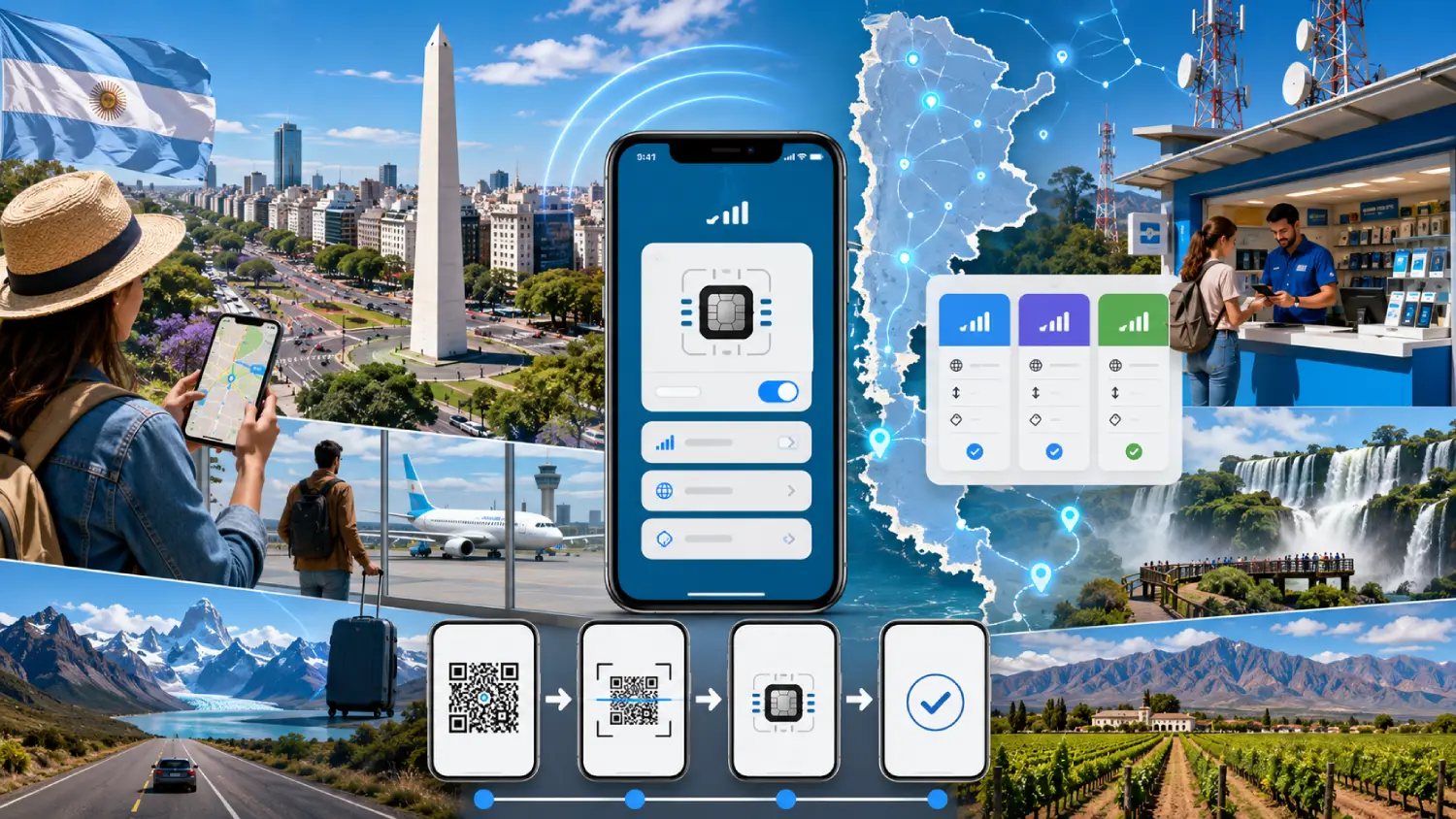
This guide compares the best eSIM options for Argentina, explains local SIM card alternatives, and breaks down what travelers should know about coverage across the country.
Why Use an eSIM in Argentina?
An eSIM is usually the easiest way to get mobile internet in Argentina because it can be installed before arrival. You do not need to visit a store, register a physical SIM, or wait for activation support after a long flight.
For most travelers, the biggest advantage is convenience. You can land at Ezeiza International Airport, turn on mobile data, and use ride-hailing apps, WhatsApp, Google Maps, hotel check-in details, and translation tools immediately.
Argentina’s main mobile networks are Movistar, Claro, and Personal. Travel eSIM providers usually connect through of these networks or through roaming agreements. Coverage is generally strong in major cities and tourist routes, but it can be more limited in remote parts of Patagonia, mountain roads, and rural areas.
The official Argentina tourism website notes that Claro, Movistar, and Personal are the main choices for mobile internet, with 4G LTE broadly available and early-stage 5G in selected areas. It also highlights that Movistar tourist prepaid plans may offer around 5 GB for 30 days at roughly ARS 6,000, though local prices can change frequently.
Need data in Argentina? Get an eSIM!
Choose the perfect data plan for your trip
Exclusive Reader Bonus!
Enjoy an extra %10 OFF your first Roafly eSIM purchase as a thank you for reading.

Manage your eSIM in the app
Install, top up and track data.
Best eSIM for Argentina: 30-Day Price Comparison
The table below compares Argentina eSIM plans from Roafly, Airalo, Saily, Flexiroam, and Holafly. All prices are in USD. The listed 5 GB, 10 GB, and 20 GB plans are valid for 30 days unless otherwise noted.
| eSIM Provider | Network / Operator | 5 GB / 30 Days | 10 GB / 30 Days | 20 GB / 30 Days | Best For |
|---|---|---|---|---|---|
| Roafly | Movistar | $16.90 | $27.90 | $44.90 | Best overall value with Movistar coverage |
| Airalo | Movistar | $17.00 | $30.00 | $47.00 | Travelers already using Airalo |
| Saily | Not specified | $16.99 | $29.99 | $46.99 | Simple app-based setup |
| Flexiroam | Not specified | $18.50 | $36.10 | $71.40 | Flexible global travel users |
| Holafly | Not specified | Not sold as fixed 5 GB plan | Not sold as fixed 10 GB plan | Not sold as fixed 20 GB plan | Unlimited-style short trips |
| Holafly | Not specified | 7-day unlimited plan average: $35.90 | 7-day unlimited plan average: $35.90 | 7-day unlimited plan average: $35.90 | Heavy short-term data use |
Prices checked on June 30, 2026. Operators, package availability, fair usage policies, and prices may change.
Roafly
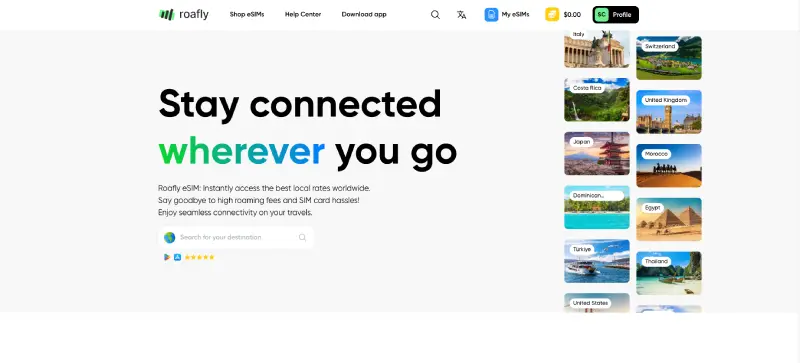
Roafly is the strongest overall choice for Argentina because it combines competitive pricing with Movistar network access. The 5 GB plan is slightly cheaper than Airalo and Saily, while the 10 GB and 20 GB plans also offer strong price-per-GB value for travelers staying longer than a few days.
Roafly is especially practical for visitors who want a simple eSIM setup before departure. Installation options include Direct Install, QR Code, and Manual setup, which makes it easier to activate the plan based on your device and travel style.
For Argentina specifically, Roafly’s Movistar-based access is a good fit for Buenos Aires, Mendoza, Córdoba, Bariloche, Salta, Rosario, and other major visitor areas. Check the latest Argentina eSIM packages on the Roafly Argentina eSIM page.
Need data in Argentina? Get an eSIM!
Choose the perfect data plan for your trip
Exclusive Reader Bonus!
Enjoy an extra %10 OFF your first Roafly eSIM purchase as a thank you for reading.
Manage your eSIM in the app
Install, top up and track data.
Airalo
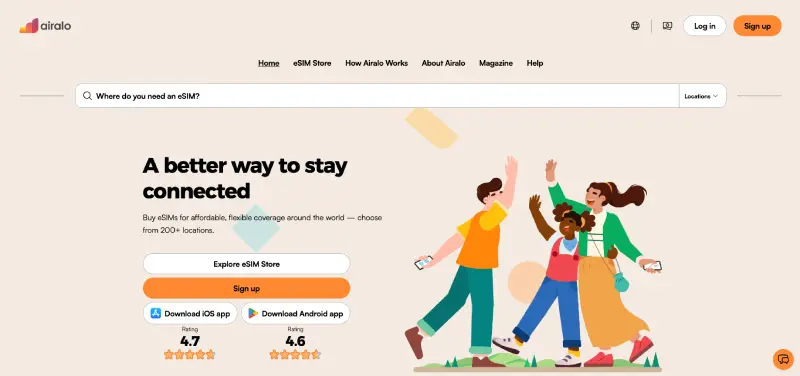
Airalo is a well-known travel eSIM provider and also lists Movistar as the operator for its Argentina plans. Its pricing is close to Roafly on the 5 GB plan, but Roafly has a lower listed price across 5 GB, 10 GB, and 20 GB in this comparison.
Airalo can be a familiar option for travelers who already use its app. It is suitable for visitors who want a standard fixed-data plan instead of an unlimited-style package.
Saily
Saily offers simple fixed-data plans for Argentina, with pricing very close to Airalo. Its 5 GB option is slightly higher than Roafly’s, while its 10 GB and 20 GB options are also competitive.
The main limitation is that the operator is not specified in the provided plan details. For travelers who care about knowing the exact local network before purchasing, this may be a factor to consider.
Flexiroam
Flexiroam provides Argentina eSIM plans across the same 5 GB, 10 GB, and 20 GB data levels, but it is more expensive than Roafly, Airalo, and Saily in this comparison.
The 20 GB plan is the biggest difference. At $71.40, it is significantly higher than the other fixed-data options listed here. Flexiroam may still appeal to travelers already using its global platform, but for Argentina-only travel, it is not the best value based on these prices.
Holafly
Holafly is different from the fixed-data providers because it focuses on unlimited-style plans. The listed average price for a 7-day unlimited Argentina plan is $35.90.
This can work for short trips where travelers want to stream, video call, upload content, or avoid checking data usage often. However, unlimited-style plans may include a fair usage policy. That means speeds can sometimes be reduced after heavy use, depending on the provider’s terms and network conditions.
For travelers staying 10 to 30 days, a fixed-data plan may offer better value if daily usage is predictable.
How Much Data Do You Need for Argentina?
The right data plan depends on how you travel. Argentina is large, and data use can increase quickly if you rely on maps, transport apps, cloud backups, or social media uploads.
- For a short city trip to Buenos Aires, 5 GB is usually enough for maps, messaging, restaurant searches, email, and light social media. It is a good choice for travelers staying less than a week or those who use hotel Wi-Fi regularly.
- 10 GB plan is better for a- to two-week trip. This gives more room for Google Maps, Instagram, WhatsApp calls, travel planning, and occasional video streaming.
- 20 GB plan is ideal for longer trips, remote work, or multi-city travel. If your itinerary includes Buenos Aires, Mendoza, Bariloche, El Calafate, and Iguazú, the extra data makes the trip easier. You will probably use maps more often, check transport updates, upload more photos, and spend more time away from reliable Wi-Fi.
Travelers unsure about their usage can estimate it before buying. Roafly’s Data Usage Calculator can help match your expected apps and habits with the right data amount.
Need data in Argentina? Get an eSIM!
Choose the perfect data plan for your trip
Exclusive Reader Bonus!
Enjoy an extra %10 OFF your first Roafly eSIM purchase as a thank you for reading.
Manage your eSIM in the app
Install, top up and track data.
eSIM vs Local SIM Card in Argentina
Both eSIMs and local SIM cards can work well in Argentina, but they serve different types of travelers.
An eSIM is better if you want connection on arrival, avoid store visits, and keep your primary SIM active for calls or banking verification. It is also useful if your trip includes more than country.
A local prepaid SIM card may be cheaper for long stays, but it requires more effort. Tourists usually need to buy a SIM from an operator store, kiosk, or authorized point of sale, then complete activation. Some providers may require passport registration or staff assistance.
Movistar’s tourist SIM page says visitors can get a prepaid SIM in kiosks or points of sale, activate it through WhatsApp support, and then choose a suitable pack. Claro also lists a prepaid tourist SIM process where visitors go to a Claro customer service center and request a tourist prepaid chip.
For travelers who do not speak Spanish, local SIM activation can be less convenient. Store hours, ID checks, payment methods, and activation delays can vary. That is why many short-term visitors prefer installing an eSIM before departure.
Airport SIM Cards in Argentina

Buenos Aires Ezeiza International Airport is Argentina’s main international gateway, but buying a SIM at the airport is not always the most efficient option. Availability can vary by terminal, arrival time, and store opening hours.
Airport SIM cards can be useful in emergencies, but they are often less predictable than buying an eSIM before travel. You may need to compare packs in Spanish, wait in line, show your passport, and ask staff to help with activation.
Local prepaid pricing can look cheaper than travel eSIM pricing, but the final experience depends on the package, taxes, activation process, and whether the SIM is immediately usable. Argentina’s official tourism site notes that Movistar tourist prepaid options may be available around 5 GB for 30 days at approximately ARS 6,000, while other sources also describe basic prepaid SIMs as inexpensive but highly variable.
For travelers who need basic data and do not mind visiting a store, local SIM cards can work. For travelers who want reliable internet as soon as they land, an eSIM is usually simpler.
Local Mobile Operators in Argentina
Argentina has three main mobile operators: Movistar, Claro, and Personal. Each has strengths depending on location and travel route.
Movistar Argentina
Movistar is of the most common choices for travelers because it has strong city coverage and tourist-friendly activation options. Movistar’s prepaid page also lists eSIM support for compatible devices, with QR delivery by email for eligible customers.
Movistar is a practical network for Buenos Aires, Córdoba, Mendoza, Rosario, Bariloche, and many popular tourist destinations. For this reason, travel eSIM plans using Movistar can be attractive for visitors who want a balance of coverage and value.
Claro Argentina
Claro is widely used in Argentina and is often considered strong for national coverage. The official Argentina tourism site says Claro typically leads for the widest national signal, followed by Movistar and Personal.
Claro also offers prepaid services and tourist SIM options through its customer service centers. Its prepaid terms page lists pay-as-you-go prices such as daily internet pricing and call/SMS rates, while its general prepaid page mentions data packs with WhatsApp included.
Claro can be a good local SIM option for travelers who plan to spend time outside large cities, though the exact experience still depends on the region.
Personal Argentina
Personal is another major network with strong availability in many parts of the country. Opensignal’s Argentina mobile network report found Personal leading for Availability and 4G Coverage Experience in its measured results, while Claro and Movistar also had high availability scores.
Personal can be a good option for local prepaid users, especially in areas where it performs strongly. Its official prepaid page includes current service pricing validity periods, and its help page references monthly packs such as 5 GB and 10 GB options with WhatsApp included.
Argentina Coverage: What Travelers Should Expect
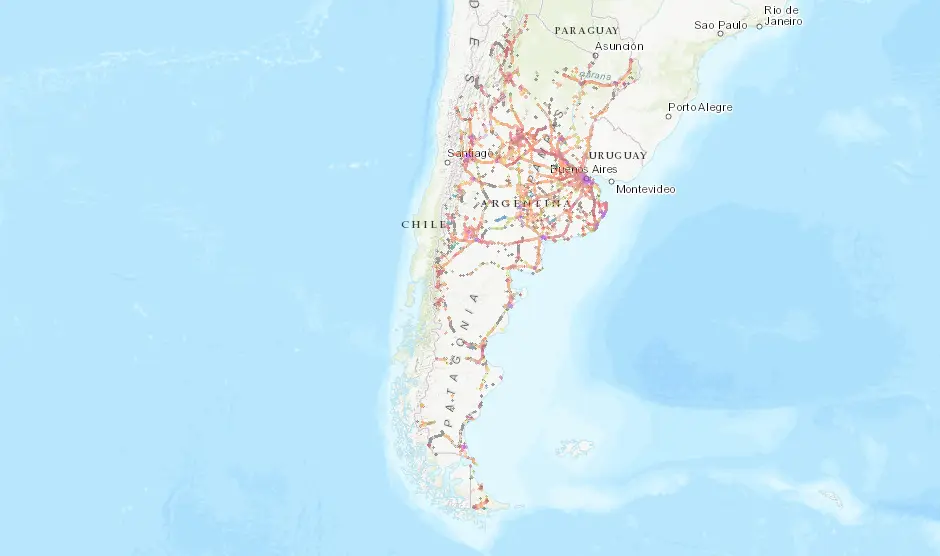
Coverage in Argentina is generally good in cities and established tourist destinations. Buenos Aires, Mendoza, Córdoba, Rosario, Salta, Bariloche, Ushuaia, El Calafate, and Iguazú are the kinds of places where travelers can usually expect usable 4G service.
However, Argentina is huge. Signal can become weaker in remote Patagonia, national parks, mountain roads, desert areas, and long-distance bus routes. Even when a town has coverage, rural roads between towns may not.
nPerf’s Argentina coverage map tracks 2G, 3G, 4G, and 5G coverage for Claro, Movistar, and Personal, showing that coverage varies by operator and geography. Opensignal also offers coverage map data based on crowdsourced app measurements for Argentina’s major operators.
For most travelers, the safest approach is to download offline maps before leaving major cities. This is especially useful for Patagonia road trips, hiking routes, wine regions outside Mendoza, and long bus journeys.
Best eSIM for Buenos Aires, Patagonia, Mendoza, and Iguazú
Buenos Aires is the easiest destination for mobile internet. All major operators usually perform well in central neighborhoods such as Palermo, Recoleta, San Telmo, Microcentro, Belgrano, and Puerto Madero.
Mendoza also has good coverage in the city and many winery areas, but signal can vary in mountain routes toward the Andes. A reliable eSIM is useful for navigation, reservations, and transport coordination.
Patagonia requires more planning. Cities and towns such as Bariloche, El Calafate, El Chaltén, and Ushuaia generally have mobile service, but coverage can drop on roads, trails, and remote viewpoints. Do not rely on mobile data as your navigation tool in remote areas.
Iguazú Falls is a major tourist destination, so mobile coverage is usually available around Puerto Iguazú and the main visitor zones. Still, crowds and border-area roaming behavior can affect speeds.
For a typical Argentina itinerary, a Movistar-based eSIM such as Roafly is a practical choice because it offers strong value and access to of the country’s major networks.
Is an Unlimited eSIM Worth It in Argentina?
An unlimited eSIM can be worth it for a short Argentina trip if you use a lot of data every day. It may suit travelers who upload videos, work from a phone hotspot, use video calls, or do not want to monitor data usage.
However, unlimited does not always mean unlimited high-speed data. Some plans can include fair usage policies, speed management, or hotspot restrictions. This is why fixed-data plans are often better for travelers who want predictable value.
For example, a 10 GB or 20 GB Roafly plan may be more cost-effective than a 7-day unlimited plan if your data use is moderate. If your trip is longer than week, fixed-data pricing becomes even more attractive.
How to Install an Argentina eSIM
Installing an eSIM is usually simple, but it is best to complete the setup before your flight while you still have stable Wi-Fi.
First, check that your phone supports eSIM. Most recent iPhones, Google Pixel models, Samsung Galaxy flagships, and many newer Android devices support it, but compatibility depends on the exact model and region.
After purchase, Roafly supports three setup methods: iOS Direct Install, QR Code, and Manual installation. iOS Direct Install is the fastest option for compatible iPhones. QR Code setup is useful if you want to scan from another screen. Manual setup is helpful when you need to enter the eSIM details yourself.
Keep your primary SIM active if you need to receive SMS messages from your bank or airline. you arrive in Argentina, turn on the eSIM line, enable data roaming for that eSIM, and select it as your mobile data line.
Final Verdict: Which Argentina eSIM Should You Choose?
Roafly is the best overall eSIM for Argentina based on the listed 30-day prices, Movistar network access, and setup flexibility. It offers the lowest price in the 5 GB, 10 GB, and 20 GB comparison, making it a strong choice for both short trips and longer stays.
Airalo is also a solid option, especially for travelers already using its app. Saily is close on pricing but does not specify the local operator in the provided details. Flexiroam is more expensive, especially at 20 GB. Holafly can be useful for short trips with heavy data use, but travelers should check fair usage details before buying.
For most visitors, a 10 GB plan is the safest middle option. Light users can choose 5 GB, while longer trips across Argentina are better with 20 GB.
Check the latest eSIM packages for Argentina before your trip and choose the data amount that fits your route.