



Fair Usage Policy is of the most misunderstood parts of unlimited eSIM plans. Many travelers notice it when their internet suddenly slows down. In this guide, we explain how FUP actually works, why it often feels frustrating, and what it realistically means for international eSIM users.
What Is Fair Usage Policy in Mobile Networks?
Fair Usage Policy is a standard practice used by mobile network operators worldwide. Its purpose is simple: to prevent a small number of users from overloading the network at the expense of everyone else.

Instead of cutting off your internet entirely, FUP usually works by temporarily reducing speeds unusually high usage is detected. This ensures stable connectivity for all users on the network, especially in busy areas such as airports, city centers, or popular tourist destinations.
It is important to understand that FUP is not unique to eSIMs. The same principle applies to:
-
Local SIM cards
-
Home broadband connections
-
Public Wi-Fi networks
How Fair Usage Policy Applies to eSIM Plans
eSIM plans rely on local partner networks in each country. These networks apply their own traffic management rules, which is where Fair Usage Policy comes into play.
Speed Throttling vs. Data Cutoff
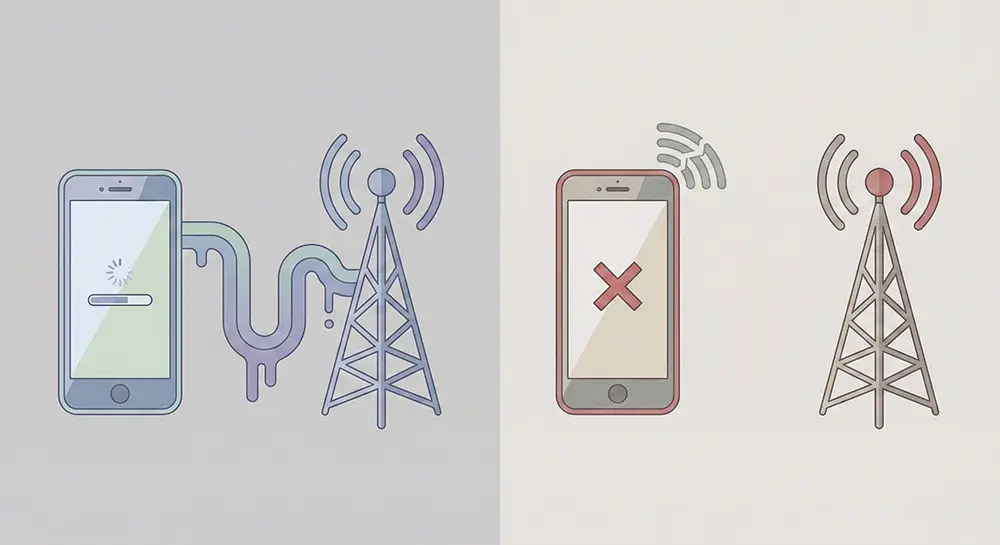
Most travelers worry that FUP means losing internet access completely. In reality, this is rarely the case.
-
Speed throttling: Your connection continues, but at reduced speeds suitable for messaging, maps, and basic browsing.
-
Data cutoff: Access stops entirely. This is uncommon for modern eSIM plans and typically applies to fixed data packages the allowance is fully used.
For most eSIM users, FUP results in temporary speed adjustments, not disconnection.
Daily Fair Usage Limits and Reduced-Speed Thresholds
In some unlimited eSIM plans, fair usage is applied through daily high-speed data thresholds rather than monthly limits. This means a certain amount of data is available at full speed each day. that threshold is reached, the connection usually continues, but at a reduced speed.
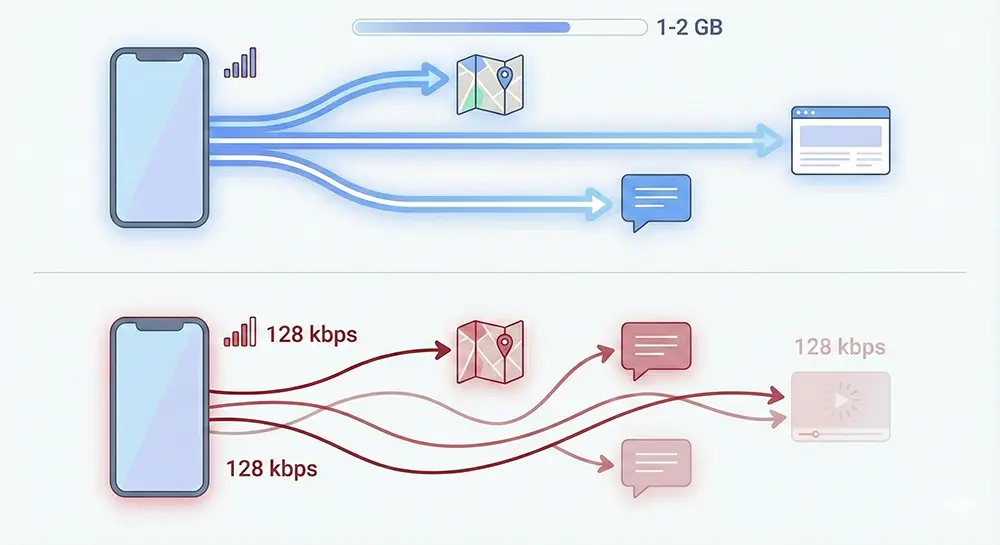
Common reduced-speed levels after fair usage is triggered include:
-
128 kbps
-
256 kbps
-
Similar “basic connectivity” speeds depending on the local network
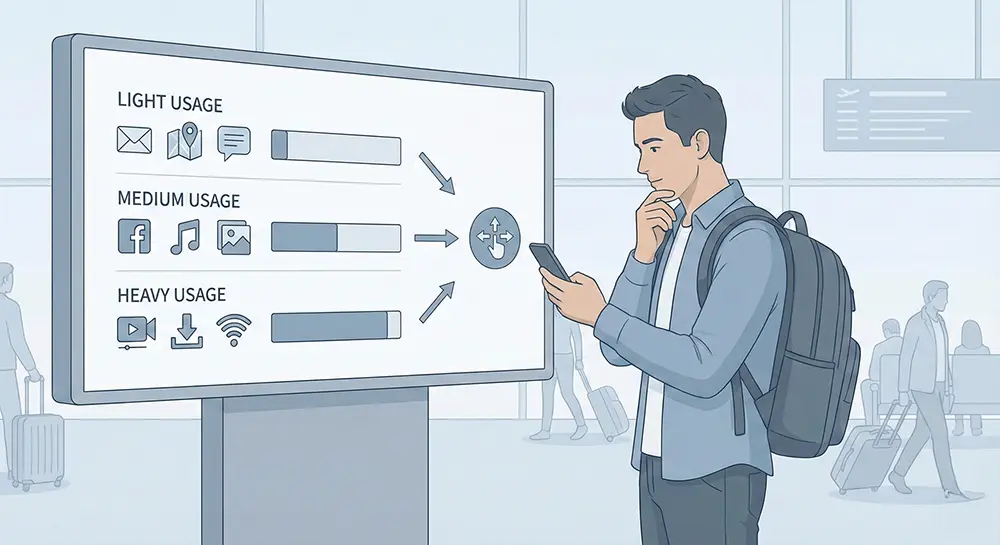
At these speeds, essential services such as messaging apps, email, maps, and ride-hailing apps typically continue to work. However, data-intensive activities like video streaming, image-heavy social media feeds, or large file downloads may become slow or impractical.
This type of fair usage implementation is commonly used during peak usage periods, especially in high-traffic travel locations, where data demand increases sharply. For most travelers, the reduced-speed phase is temporary and resets after a defined period, often within 24 hours.
Understanding this behavior helps set realistic expectations for unlimited eSIM plans and explains why connectivity may feel different after periods of unusually high data consumption.
Why “Unlimited” eSIM Plans Often Feel Misleading
One of the biggest frustrations travelers experience with eSIMs is not fair usage itself, but how it is marketed.
Many so-called unlimited eSIM plans include a small daily amount of high-speed data, followed by a sudden drop to 128 kbps or 256 kbps. This behavior is often buried in fine print or not clearly explained at the time of purchase.
From a traveler’s perspective, this feels misleading. Most users understand “unlimited” as unrestricted, usable internet — not connectivity that becomes barely usable after normal daily use.
This gap between marketing language and real-world performance is the main reason unlimited eSIM plans frequently disappoint travelers.
Unlimited eSIM Plans: Setting the Right Expectations

The term unlimited can be misleading without context. In the eSIM world, unlimited usually means:
-
No extra charges for high usage
-
No need to track every megabyte
-
Continued connectivity throughout your trip
However, unlimited does not always mean unlimited high-speed data at all times. Networks may apply FUP after sustained heavy usage, especially activities that consume large amounts of data in short periods.
For light usage such as messaging or navigation, this limitation may be manageable. However, it often becomes noticeable during normal daily travel use, especially when expectations are based on the term “unlimited.”
What Triggers Fair Usage Policy While Traveling?
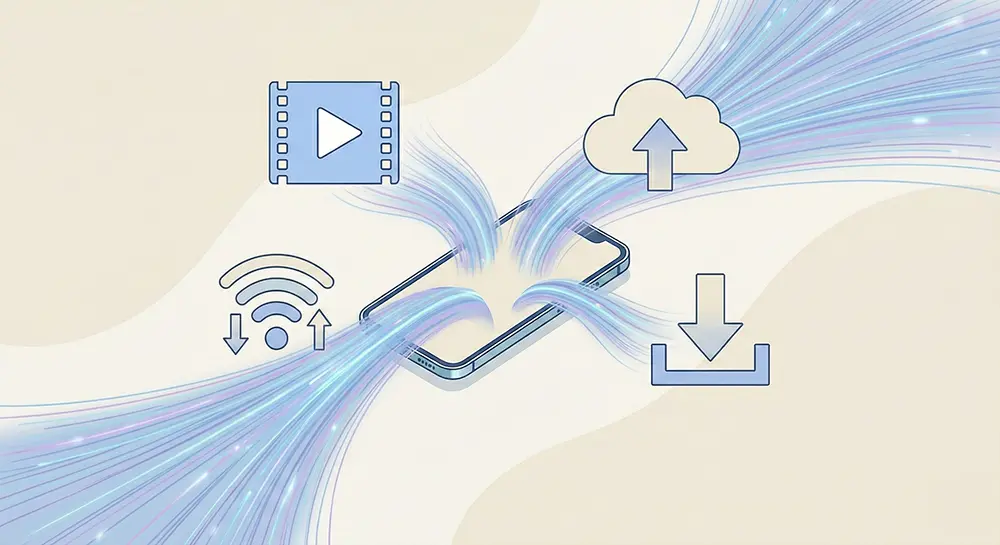
Fair Usage Policy is generally triggered by usage patterns, not by a specific number displayed on your phone. Common triggers include:
-
Long hours of HD or 4K video streaming
-
Using your phone as a hotspot for laptops or tablets
-
Cloud backups running continuously in the background
-
Large app updates over mobile data
These activities can quickly consume more data than typical travel usage.
If you want to plan ahead, using a data usage calculator can help estimate how much data your daily habits require and which type of eSIM plan best fits your trip.
How to Avoid Speed Drops on an Unlimited eSIM
Most speed-related issues can be avoided with a few simple habits:
-
Limit video streaming quality when on mobile data
-
Turn off automatic cloud backups while abroad
-
Avoid prolonged hotspot usage unless necessary
-
Update large apps when connected to Wi-Fi
These adjustments help you stay well within normal usage ranges, where Fair Usage Policy is unlikely to affect your connection.
Choosing the Right eSIM Plan for Your Trip
Understanding your travel style is key. Short city breaks, navigation-heavy trips, and social media use typically work perfectly with unlimited eSIM plans. Travelers who work remotely or stream frequently may prefer larger fixed-data packages instead.
Many travelers also value transparency when choosing a provider. Services that clearly explain how Fair Usage Policy works tend to deliver a smoother experience with fewer surprises. Roafly, a global eSIM provider, focuses on travel-friendly data policies designed specifically for international users, with coverage in over 200 countries and simple installation options such as iOS Direct Install, QR code, and manual setup.
Some travelers prefer fixed-data eSIM plans specifically to avoid this type of uncertainty. With fixed packages, all data is delivered at full speed until it is fully used, without hidden daily thresholds or sudden slowdowns. This approach offers clearer expectations and more predictable performance throughout a trip.
Is Fair Usage Policy a Problem for Most Travelers?
For the vast majority of travelers, Fair Usage Policy is not an issue at all. It becomes noticeable in cases of exceptionally heavy usage that goes beyond typical travel needs.
When expectations are clear, unlimited eSIM plans remain of the most convenient ways to stay connected abroad. They remove the stress of tracking data while still providing reliable coverage in busy destinations.
Final Thoughts
Fair Usage Policy is a technical reality of mobile networks, but problems arise when it is hidden behind unclear or misleading “unlimited” claims. When travelers understand exactly how their data will behave, they can choose plans that match their needs. For many users, this means prioritizing clarity and predictable performance over vague unlimited promises.