


The useful distinction is whether someone misrepresents a service, changes an agreement or pressures you to pay an undisclosed charge. Bargaining, clearly advertised prices and legitimate fees need a different response from deception. Keep these situations in perspective alongside broader Thailand safety advice.
| Situation | Warning sign | Before you commit |
|---|---|---|
| Temple visit | Someone says the attraction is closed and immediately offers another tour | Check the attraction's own schedule or ticket office |
| Taxi or tuk-tuk | The agreed journey changes into unrequested shopping stops | Confirm the route, stops and payment basis |
| Scooter or jet-ski rental | Existing damage becomes your responsibility at return | Record the condition and read the agreement |
| Bar or show | Entry or drinks are promoted without a clear explanation of charges | Check admission, drink prices and other charges |
| TDAC application | A website presents payment as an official arrival-card requirement | Use the government portal |
| Card payment | An unfamiliar transaction appears on your account | Contact your card issuer through its own app or number |
The Grand Palace closure claim and shopping detour

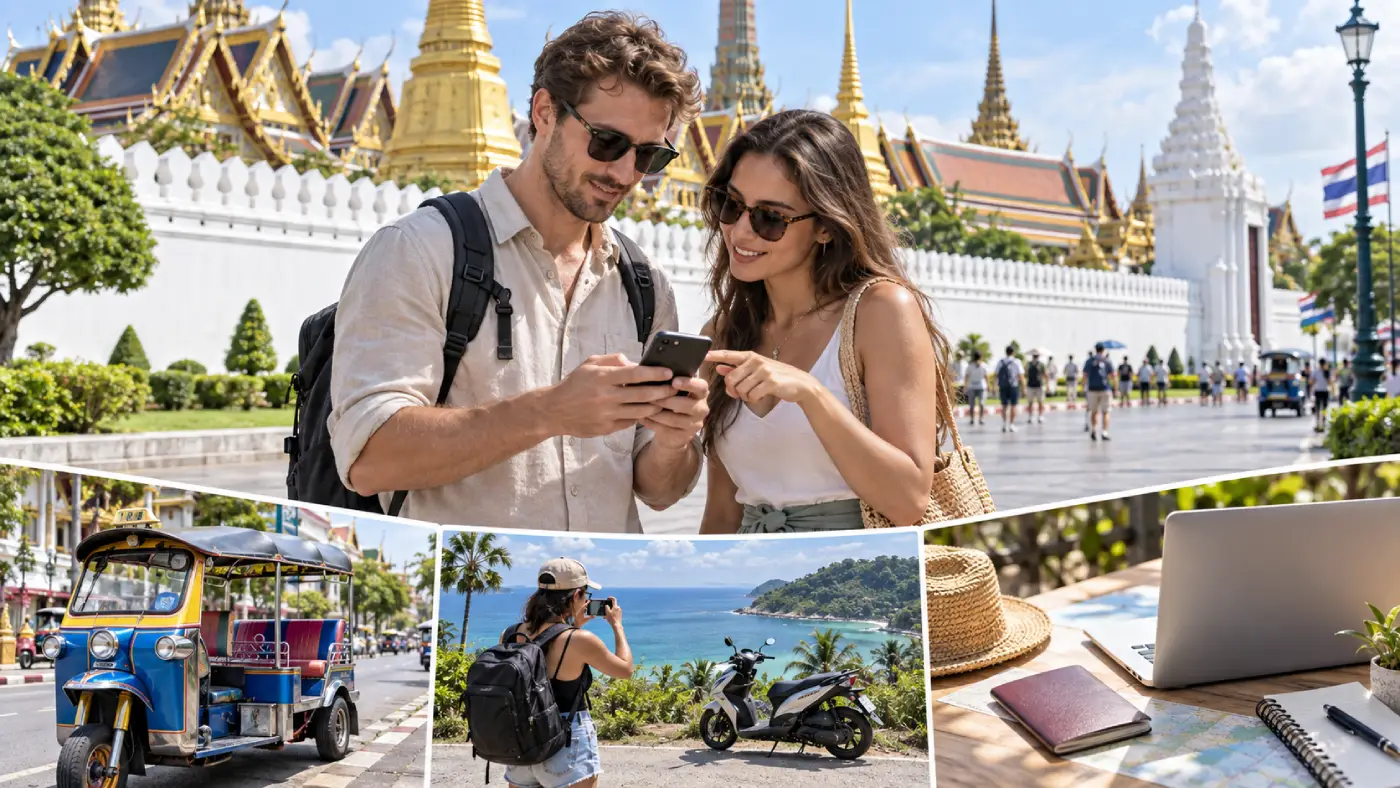
Near Bangkok's Grand Palace, the closure story gives you a reason to abandon your plan: there is supposedly a ceremony, a special event or a temporary restriction. Someone then offers a cheap ride to other temples. The diversion can lead to a shop, where the visit becomes a sales pitch.
Treat the closure claim and the replacement tour as two separate decisions. Check the Grand Palace's official visitor calendar or ask at the ticket office before changing your route. Genuine closures and restrictions can happen; advice that the palace is “never closed” is unreliable too.
The shopping pitch deserves particular attention if you are offered gemstones with a promise of easy resale profits. Canada's Thailand travel advice describes lower-quality gems sold at inflated prices on that premise, with guarantees that may not be honored. The appearance of a showroom does not establish the value of what you are buying.
Decline unplanned purchases you cannot assess independently. If you have already joined a tour, you can refuse the purchase and request an end to the visit. Prioritize getting somewhere safe if the interaction becomes threatening.
You can buy Grand Palace tickets at the entrance or through its official service, as explained in the palace's visitor information. You do not need to accept a stranger's shopping itinerary to arrange admission.
Taxi and tuk-tuk fares that change after you agree
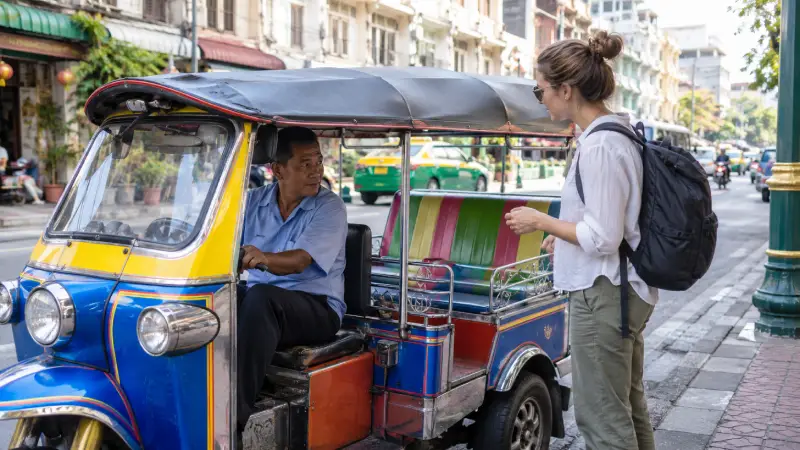
The warning sign is a mismatch between what you agreed and what happens next: an unexpected shopping stop, a changed destination or a different payment demand. High quotes by themselves do not establish fraud.
Before boarding, confirm the destination and how the fare will be calculated. Request the meter in a metered taxi; for an unmetered ride, agree on the fare and route first. Ask whether the quote covers the whole group and what additional charges are expected. Australia's taxi and tuk-tuk guidance also warns about cheap tours that deliver passengers to shops paying the driver commission.
With an app booking, check the vehicle and driver details against the booking and keep the trip record. Review the fare information for your selected service instead of assuming every displayed amount includes every possible charge.
Our guide to getting around Thailand covers the wider transport choices. Set up your maps and ride apps before heading out; Roafly's Thailand eSIM plans are option for mobile data when checking a route or reopening a booking away from Wi-Fi.
Scooter and jet-ski rental damage claims
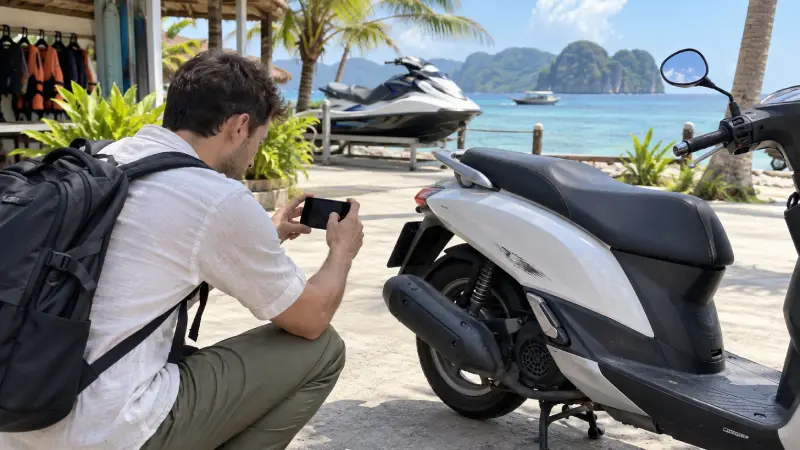
Rental fraud can involve an accusation that you caused damage already present when you collected the vehicle. The pressure is harder to escape if the rental company is holding your passport. Official warnings cover both motorbike and personal-watercraft rentals, including demands accompanied by threats.
Before accepting a scooter or jet ski:
-
Read the agreement, including the deposit, damage procedure and any insurance exclusions.
-
Inspect the vehicle together and record existing marks in photos or video.
-
Ask for existing damage to be noted on the rental paperwork.
-
Keep a copy of the agreement and payment receipt.
-
Find another operator if leaving your original passport is a condition of hire.
The UK's passport and rental guidance specifically advises against handing over a passport as a guarantee. Showing identification and leaving the original document behind as collateral are different things.
Photos are useful evidence, but they do not guarantee that a dispute will be resolved in your favor. If damage is alleged, ask which damage is being claimed and request a written explanation of the charge. Avoid a confrontation if you feel threatened, and seek Tourist Police assistance. Genuine damage and contractual liability still need to be assessed.
Unexpected bar bills and cover charges
In a bar or entertainment venue, the problem may become clear when the bill arrives. Drinks or admission can cost more than the initial explanation suggested, and a payment dispute may become threatening. The U.S. State Department's Thailand guidance explicitly warns about bar-tab scams and threats over drink and cover charges.
Before ordering, establish the price of your drinks, whether admission is charged separately and whether any other services carry a fee. “Free entry” does not answer all those questions. Keep track of what you order rather than letting an unclear tab accumulate.
If the bill differs from the agreement, ask for an itemized explanation while it is safe to do so. If someone threatens you or prevents you from leaving, prioritize assistance over arguing about the amount. Do not follow someone to a more isolated place to settle the dispute.
Fake TDAC websites and misleading payment requests
The Thailand Digital Arrival Card is free through the official Thai Immigration portal. An official-looking page asking for an arrival-card payment should prompt you to stop and check where you are submitting your details. Australia's travel advice specifically warns about fake websites charging for TDAC.
Some travelers describe opening fee-charging pages while rushing through travel formalities. Another arrival account describes confusion after selecting a paid form and needing help to find the correct. These are personal accounts, but the practical lesson is useful: bookmark the government portal before you are under time pressure at the airport.
Keep these distinctions clear:
-
The government TDAC submission has no fee.
-
Optional assistance with a separately disclosed charge is not automatically proof of fraud.
-
Pretending to be the government, inventing a mandatory payment or taking unauthorized payments are different concerns.
If you have already used another website, check what service you purchased and whether you received a valid submission confirmation. Contact your card issuer if you suspect misuse of your payment details. Avoid sending additional documents or payments merely because a follow-up message creates urgency.
Check Thailand entry requirements separately for the arrival-card process and any visa requirements relevant to your trip.
Card skimming and unauthorized transactions
Card fraud and ATM skimming are included in the UK's Thailand travel warnings. Keep your card in sight during a payment, shield your PIN and use an ATM inside a bank where possible. If a card reader appears loose, altered or unusual, use another machine.
Review transactions during your trip so that an unfamiliar charge does not sit unnoticed until you return home. Save receipts for payments you make, particularly rentals, tours and larger purchases.
ATM withdrawal fees shown before you accept the transaction are different from unauthorized debits. Currency-conversion offers also require you to assess the stated terms; an unfavorable rate alone does not establish a scam.
If you spot a payment you did not authorize, use your bank's own app or the contact number on your card to report it. Ask the issuer whether the card should be frozen or replaced and what information it needs to investigate.
What to do if you have been scammed in Thailand
Respond to the immediate situation first, then gather what is needed to report it.
-
Get somewhere safe. If you feel threatened, seek help from staff in a public place or the police. Do not prolong a confrontation to collect evidence.
-
Keep the records you already have. Save receipts, booking messages, rental agreements, transaction details and the location and time of the incident. Preserve originals where possible.
-
Contact the appropriate police service. The Tourist Police number is 1155; call 191 for urgent police assistance. The Tourist Police hotline operates around the clock with multilingual assistance.
-
Report suspected payment misuse to your bank promptly. Explain whether the issue is an unauthorized transaction or a payment you made for a disputed service. Those are different situations; ask what evidence the issuer requires.
-
Ask about a formal police report. Report the incident in the jurisdiction where it happened and retain any report or reference provided. Your insurer or payment provider may request documentation, but a report does not guarantee reimbursement.
If you cannot place a call, ask your accommodation to help or use the Thailand Tourist Police app's live chat, which includes English assistance. Data-only eSIM plans do not include ordinary voice calls to these hotlines.
Contact your embassy or consulate if your passport has been taken or withheld. Keep any refund discussion within your bank, insurer or booking provider's official channels.