Download the App and manage your eSIMs easily
Create your order quickly
See your eSIM details
Track your remaining data
Download the App and manage your eSIMs easily
Create your order quickly
See your eSIM details
Track your remaining data
Strasbourg’s cathedral squares and Colmar’s old-town markets belong on the same Alsace trip. Find the 2026 dates, decide where to stay and build a route that leaves time to enjoy both after dark.

Roafly Editorial Team
Updated Nov 4, 2026
9 min read
Save 15% on your Roafly eSIM
Stay connected on your next trip. Use the code below at checkout.
View All DestinationsJump to section
👇Save 15% on your Roafly eSIM
Stay connected on your next trip. Use the code below at checkout.
View All Destinations
Manage your eSIM in the app
Install, top up and track data.
Give Strasbourg and Colmar one full day each, including an evening in both. Strasbourg offers a larger spread of market squares around its cathedral and historic centre; Colmar brings the experience into a compact network of decorated streets, craft stalls and canals.
The two cities are roughly half an hour apart by direct train, so you can visit both from one hotel. Add a third day if you want a village market, but choose the date before choosing the village: some open only on particular weekends.
Christmas Eve changes this trip. Strasbourg’s market season ends on 24 December, while Colmar’s markets continue through 29 December, including Christmas Day.
| Destination | 2026 market dates | Normal opening hours | Holiday exceptions |
|---|---|---|---|
| Strasbourg | 27 November–24 December | Daily, 11am–9pm | Opens at 2pm on 27 November; closes at 6pm on 24 December |
| Colmar | 23 November–29 December | Monday–Thursday, 11am–7pm; Friday–Sunday, 10am–8pm | 24 December: 11am–5pm; 25 and 26 December: 10am–8pm |
| Kaysersberg: optional village visit | 27–29 November; 4–6, 11–13 and 18–20 December | Friday–Sunday on those dates, 10am–8pm | The craft market ends on 20 December |
Our preferred window for the two-city itinerary is 28 November–23 December, giving you full operating days in both places. Weekdays suit a trip centred on Strasbourg and Colmar; a Friday, Saturday or Sunday is needed for the Kaysersberg extension.
Travelling on 25–29 December? Stay in Colmar and make its markets the focus. Strasbourg can still be a city sightseeing trip, but its market stalls will have closed.
Colmar’s gourmet market and big wheel continue until 3 January 2027, beyond the main markets’ closing date. That later programme is a smaller experience than visiting the full Christmas market circuit.

Strasbourg rewards a walking route with a few deliberate stops. Start around Place de la Cathédrale and Place du Château, where the cathedral gives the market streets their scale. Continue to Place Broglie, home to the Christkindelsmärik, and leave time for the great Christmas tree at Place Kléber.
Save part of this central circuit for after dark. You can explore the streets in daylight, stop for a proper meal and return to the illuminated squares without turning the whole day into one continuous shopping walk.
Petite France adds a different setting, with markets around Place Benjamin Zix and Place Saint-Thomas. Work it into your day according to your hotel location rather than crossing the centre repeatedly to follow a rigid checklist.
The temptation is to count every market as a separate attraction. We would spend longer in the cathedral area, Broglie and Kléber, then use the remaining time for Petite France and whichever stalls catch your attention. Several unhurried stops make a better day than rushing between all eight market areas.
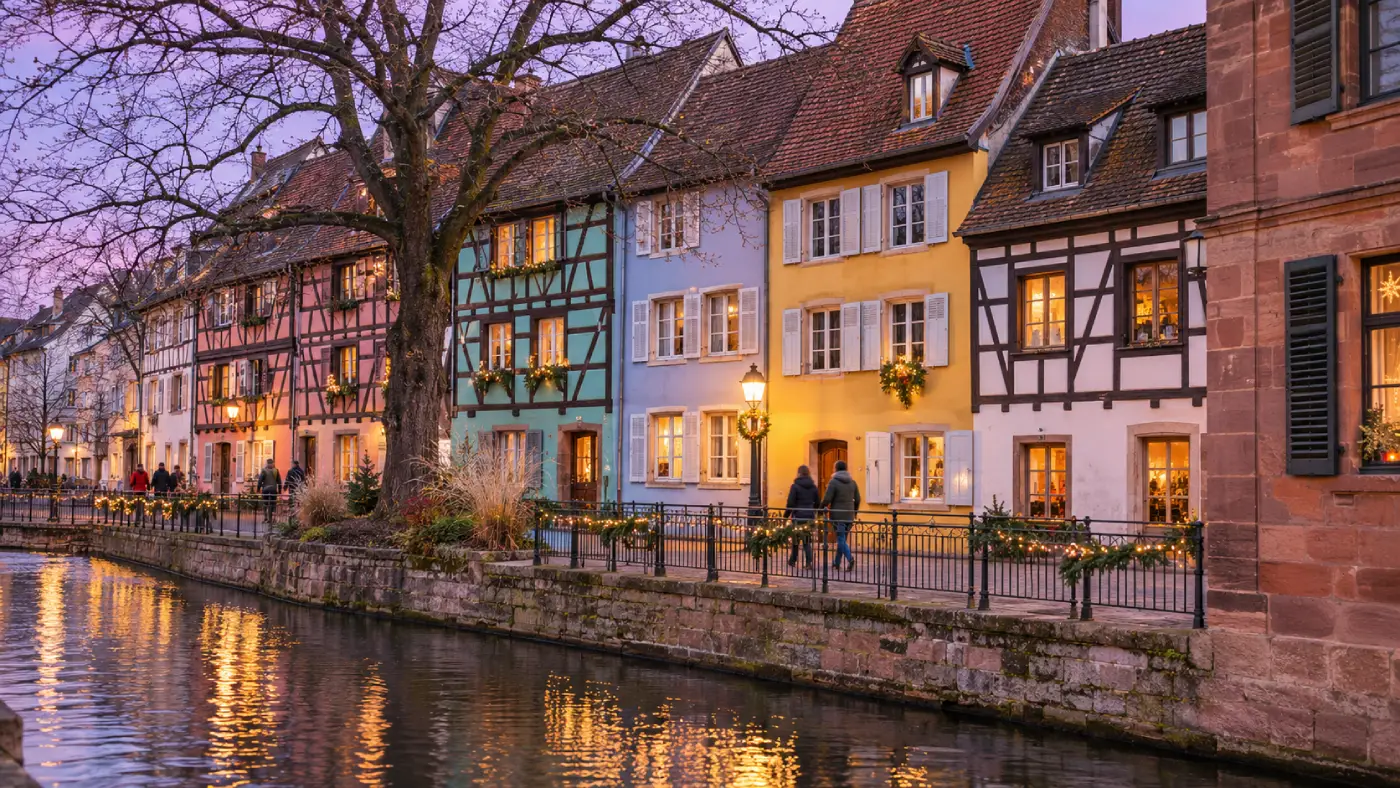
Colmar’s market circuit changes character from square to square. Place des Dominicains has the church as its backdrop, with illuminated stained glass adding to the evening scene. Around Place de l’Ancienne Douane, stalls sit beside the historic Koïfhus building.
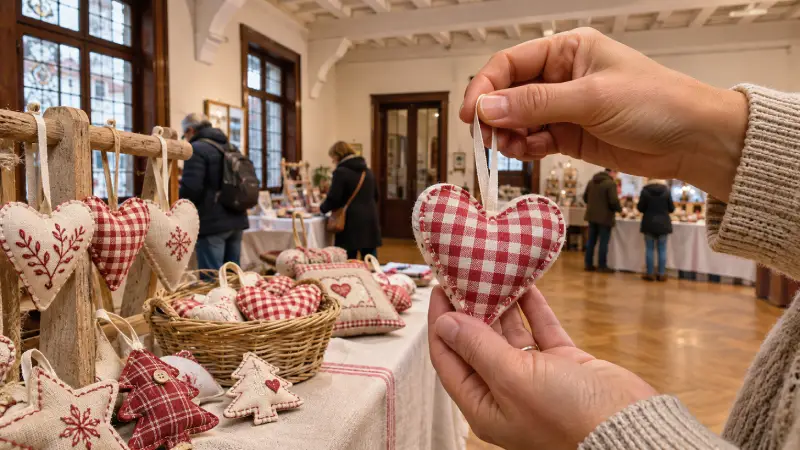
Inside the Koïfhus, the emphasis is on regional arts and crafts. Give this stop time if you want to browse handmade objects rather than simply walk past outdoor stalls. Place Jeanne d’Arc is particularly useful for regional food products, while Petite Venise brings a more child-focused selection of gifts, sweets and activities.
Link these areas into a loose walking circuit and pause wherever you want to eat or shop. Colmar’s appeal comes from seeing the old town between the markets as much as from the stalls themselves.
If you arrive from Strasbourg, stay into the evening before taking the train back. Leaving immediately after lunch misses the change in atmosphere as the buildings and market squares light up. Staying overnight in Colmar makes that evening easier, especially with children or shopping bags.
Strasbourg is our first choice for a two-city trip arriving by train from Paris. You can settle into one hotel, spend your first evening in the city and visit Colmar the following day. Look around the station-to-centre corridor if handling luggage and catching trains matter more than having a market square outside your door.
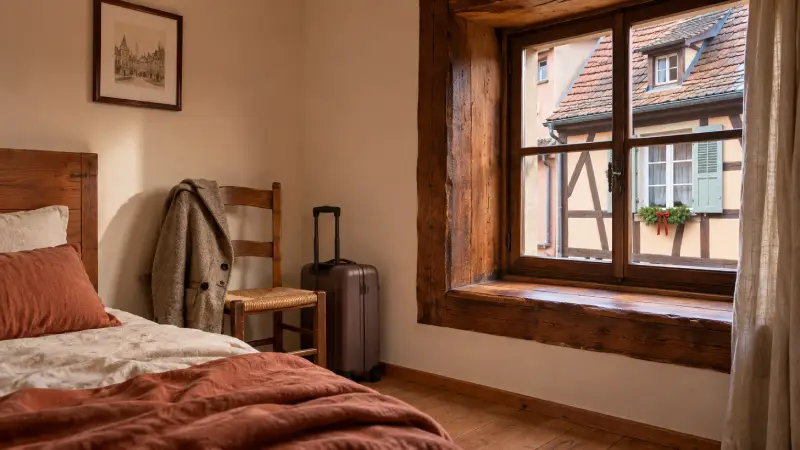
Accommodation in or near the historic centre puts evening walks close at hand. Before booking, compare the actual walking route from the station and ask how to reach the property with luggage during market-period traffic restrictions.
Colmar makes more sense when village visits are central to the trip, or when you are travelling after Christmas Eve. The Christmas shuttle network starts at Colmar station, and the city’s main markets remain open later in December.
Old-town accommodation favours evenings on foot. Staying nearer the station reduces the transfer at the start and end of a village excursion. Pick between those benefits rather than assuming that the most central hotel will suit every part of the itinerary.
Two nights in one base usually work better than changing hotels halfway through a short break. With three nights, splitting the stay can be worthwhile if you want an evening in each city without a return train journey.
Arrive early enough to leave your bags at your accommodation before heading into the centre. Begin around the cathedral, then continue to Place Broglie with time for browsing and lunch.
Spend the afternoon in Petite France or exploring the smaller streets between the market areas. Return to Place Kléber and the cathedral surroundings after dark. Book dinner separately if there is a restaurant you particularly want; a day of market snacks need not replace a seated meal.
Arriving late on the first day? Treat that evening as a first look and allow another full day for Strasbourg. The two-day route works best with two usable sightseeing days.
Take a morning train to Colmar. Start with the old-town squares, making time for the Koïfhus and Place Jeanne d’Arc before continuing towards Petite Venise.
Keep the late afternoon flexible. You may want more time for crafts, a warm indoor break or a return to a favourite square after the lights come on. Plan your train home around that evening visit rather than squeezing Colmar between arrival and an early departure.
It is possible to sample both cities in one day, but we would only do that with a very limited schedule. One day per city leaves room for meals, shopping and the evening atmosphere that brought you to Alsace.
Add Kaysersberg on one of its Friday-to-Sunday market dates. The craft market occupies the Arsenal courtyard and the area behind Sainte-Croix church, with a separate local-producers’ market at Place de la Mairie.
Build the day around this one village. Trying to fit every stop on a shuttle loop into the same afternoon leaves little time on the ground and makes the return depend on several connections.
If your third day falls outside Kaysersberg’s opening dates, use it for more time in Strasbourg or Colmar. A quieter city day is more useful than travelling to a village expecting stalls that are closed.
Fast trains from Paris Gare de l’Est to Strasbourg take around 1 hour 45 minutes to two hours on many services. Strasbourg–Colmar direct regional trains commonly take around 30 minutes. Compare the actual departure and journey duration when booking; slower services also appear in searches.
The core Strasbourg–Colmar itinerary works without a rental car. Both cities’ market areas are explored on foot, and driving introduces parking and pedestrian-zone access into a trip already connected by rail.
The 2026 Christmas shuttles run from 27 November to 20 December. Lines 1 and 2 link Colmar with Kaysersberg, Riquewihr and Ribeauvillé on Fridays, Saturdays and Sundays.
The full-network day ticket costs €17. Children under 12 travel free but still need a free ticket reserved. Online sales open on 12 November 2026 at noon CET; tickets are sold online rather than on board.
Use the Christmas shuttle booking and timetable page to choose the correct day, line and return stop. The service depends on road traffic, so leave a buffer before any onward train. A shuttle stop at a village does not establish that its Christmas market is open that day.
Save the return train options and your hotel’s walking route before leaving in the morning. Choose a comfortable evening departure, with a later service as a backup where the timetable allows. December and public-holiday services should be checked for the day you are travelling.
Mobile data is useful for changed departure platforms, shuttle information and finding your accommodation. A Roafly France eSIM provides prepaid data for those tasks on a compatible, unlocked phone. Keep downloaded tickets and your hotel address available offline too.
Alsace gives this trip a distinctive food tradition. Try pain d’épices, the region’s spiced gingerbread, and vin chaud, served with warming spices. Bakeries and food shops also offer kougelhopf, the fluted cake associated with the region.
Balance market grazing with time indoors over lunch or dinner. If you are visiting on 24–26 December, reserve meals with the restaurant directly: open market stalls do not establish a restaurant’s holiday hours.
Craft shopping deserves its own time, particularly in Colmar’s Koïfhus. Look for pottery, glass decorations, textiles and wooden items, and ask about the maker and origin when those details matter to you.
Planning larger purchases at participating shops? Read the France VAT refund rules before shopping so you know what paperwork to request. If you are bringing food, bottles or gifts into the country, review France’s customs allowances before packing.
Comfort makes a substantial difference when you spend hours walking and standing outside. Pack warm layers, gloves and shoes that remain comfortable on wet streets. If Alsace is part of a longer journey, compare France’s winter weather by region before deciding what else belongs in your bag.
In busy squares and on trains, follow the usual precautions against pickpocketing in France: keep valuables in a fastened bag and avoid leaving your phone in an open outer pocket while browsing.
Sort out mobile data before departure if your home plan’s roaming terms do not suit the trip. Comparing the best eSIM options for France lets you choose an allowance for your stay before you need it at the station.
