


eSIM technology has dramatically simplified that process—offering instant connectivity, strong coverage, and affordable prepaid data plans without the need for physical SIM cards.
But with so many eSIM providers competing for travelers—Airalo, Saily, Roamless, BNESIM, and Roafly —selecting the right can be confusing. Prices vary significantly, network partnerships differ widely, and coverage performance across France can change depending on which operator your eSIM uses.
This guide gives you a full comparison of the top eSIM options for France based on pricing, network quality, coverage, data reliability, and traveler needs. Every detail is updated to match the real plans and prices currently offered.
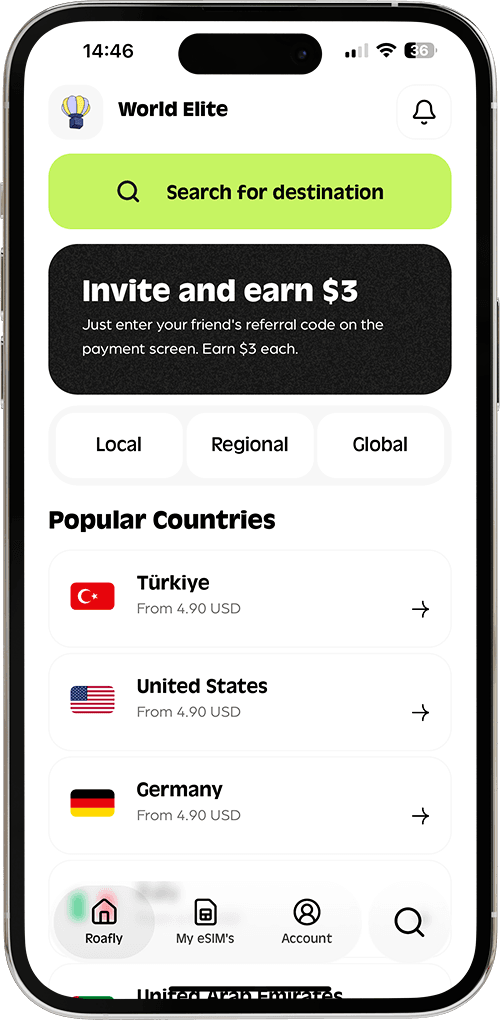
Need data in France? Get an eSIM!
Choose the perfect data plan for your trip

Manage your eSIM in the app
Install, top up and track data.
Why an eSIM Is the Smartest Way to Get Internet in France
France is of the most digitally connected countries in Europe, with near-universal 4G and fast-expanding 5G availability. That makes it the ideal destination to rely entirely on an eSIM rather than expensive roaming or physical SIM cards.
Key advantages of using an eSIM in France
-
Instant activation—no waiting in airport lines
-
No physical SIM swapping, no risk of losing your home SIM
-
No passport registration (common in some countries)
-
Multiple network support depending on provider
-
Lower prices than airport SIM shops
-
Works the moment your plane lands
And most importantly, the right eSIM ensures consistent reliability as you move between major cities, rural towns, and high-traffic tourist areas.
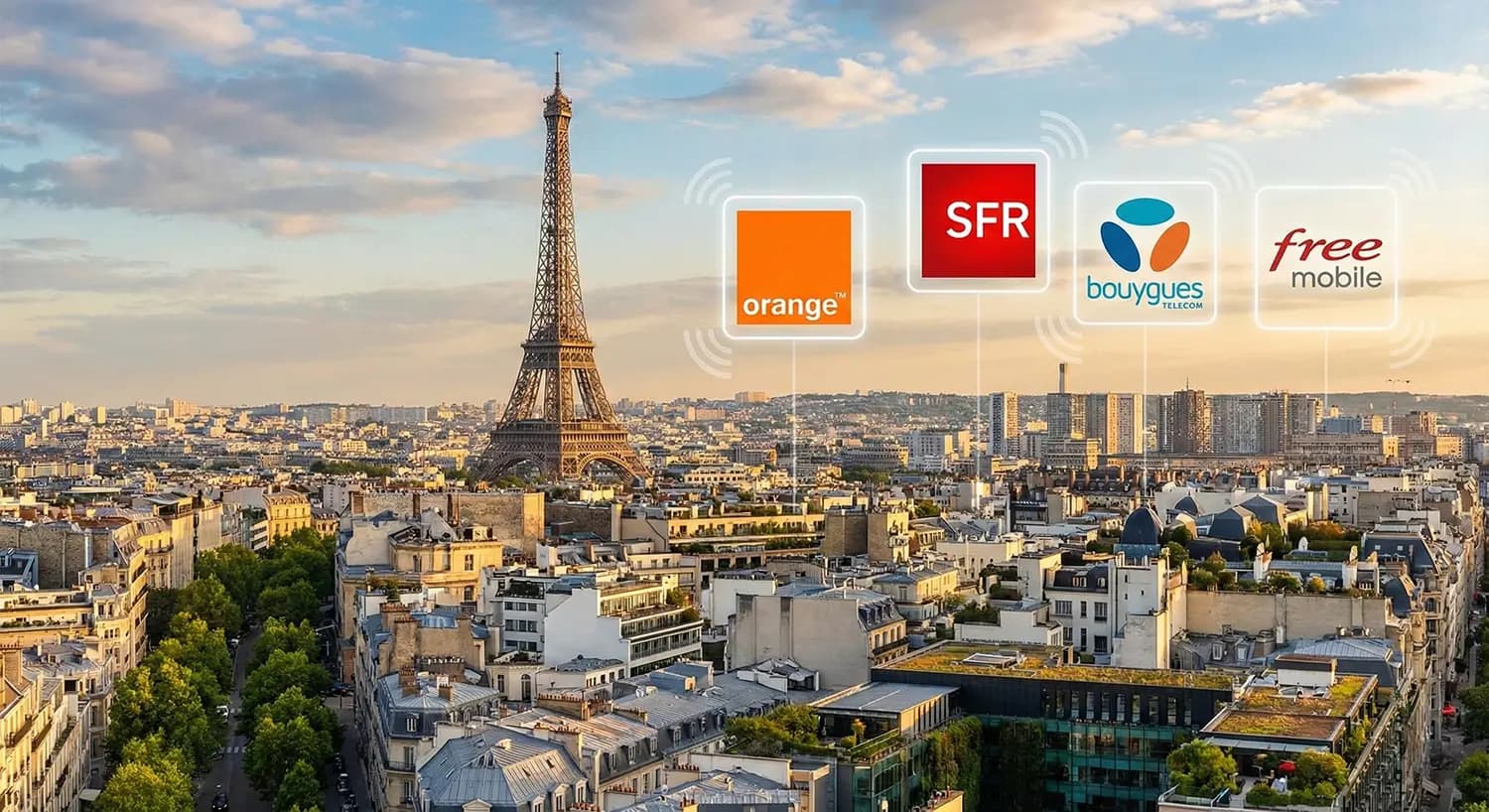
Roafly, in particular, stands out because it connects to all four major French networks: Orange, SFR, Bouygues, and Free Mobile. This provides superior coverage compared to most competitors that rely on a single network.
Overview of the Major Mobile Networks in France
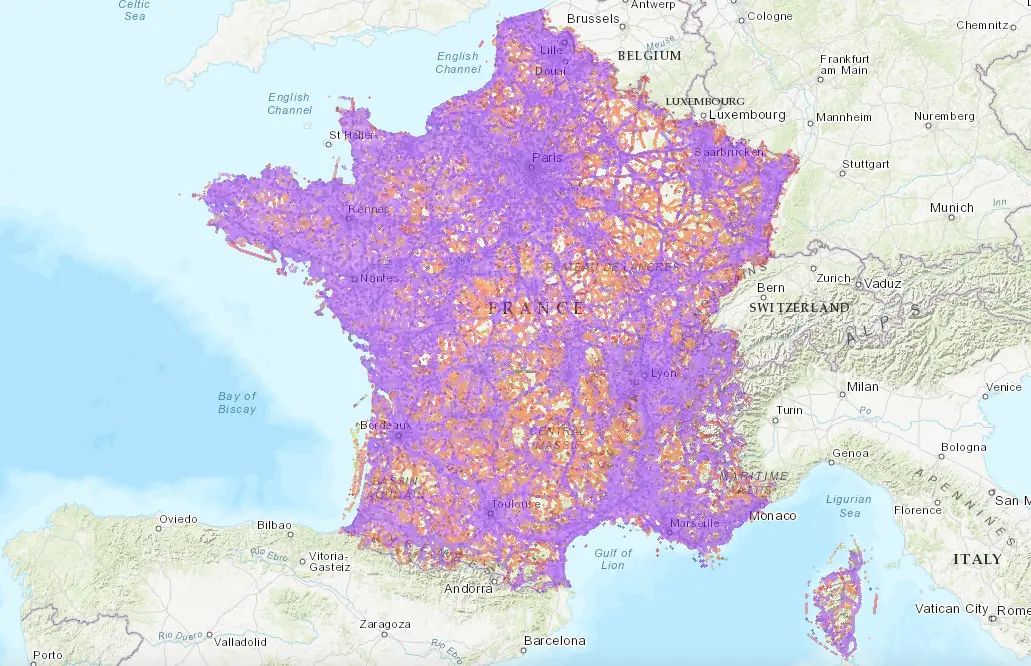
France operates four primary operators, and understanding how they differ helps you choose the right eSIM.
Orange
Widely considered the strongest network in France with excellent nationwide coverage. Particularly reliable in rural areas, highways, and small towns.
SFR
Strong performance in dense urban areas like Paris, Lille, and Lyon. Good speeds and stable indoor signal.
Bouygues Telecom
Balanced coverage, strong suburban reach, and solid 5G implementation.
Free Mobile
Competitive speeds in major cities and popular tourist regions, growing quickly with modern infrastructure.
A typical eSIM provider works with one of these networks—usually Orange or SFR.
Roafly works with all four, which gives it a unique advantage in real-world performance.
Roafly France eSIM Plans
Here are Roafly’s official France eSIM packages based on the data you provided:
Need data in France? Get an eSIM!
Choose the perfect data plan for your trip
This pricing structure places Roafly among the most cost-efficient providers in the France eSIM market.
Competitor Comparison: Airalo vs Saily vs Roamless vs BNESIM vs Roafly
Below is a direct comparison using verified competitor pricing you provided. To maintain fairness, equivalent 5 GB, 10 GB, and 20 GB plans are compared.
France eSIM Price Comparison (Fair, Plan-to-Plan)
| Provider | 5 GB (30d) | 10 GB (30d) | 20 GB (30d) | Networks Used |
|---|---|---|---|---|
| Roafly | $9.90 | $13.90 | $22.00 | Orange, SFR, Bouygues, Free Mobile |
| Airalo | $11.00 | $16.00 | $23.50 | Orange |
| Saily | $11.99 | $14.99 | $21.99 | Not disclosed |
| Roamless | $9.95 | $15.95 | $22.95 | Bouygues, Free, SFR |
| BNESIM | $7.83 | $15.00 | $29.33 | Free, Bouygues, SFR |
What the comparison shows
-
Roafly is cheaper than Airalo for all three data sizes.
-
Roafly has the lowest 10 GB price among all major competitors.
-
Roafly’s 20 GB price beats Airalo, BNESIM, and Roamless.
-
BNESIM’s cheap 5 GB plan becomes expensive at higher data limits.
-
Airalo relies solely on Orange, meaning no network backup.
-
Saily does not disclose its network partners, which can impact reliability.
-
Roafly is the only provider offering all four national networks at.
This makes Roafly extremely competitive in both pricing and coverage quality—the two factors that matter most to travelers.
Why Multi-Network Coverage Matters in France
Travelers who visit Paris often assume any provider will perform well. But France has of Europe’s most varied topographies:
-
Mountain regions (Alps, Pyrenees)
-
Coastal areas (Brittany, Normandy, Côte d’Azur)
-
Rural villages
-
Vineyards and countrysides
-
High-speed rail routes (TGV)
Coverage reliability can fluctuate dramatically.
When single-network eSIMs struggle
Providers like Airalo (Orange) may drop signal when entering valleys, tunnels, or areas where Orange performs poorly but Bouygues or SFR excels.
When multi-network eSIMs excel
Roafly’s ability to switch between Orange, SFR, Bouygues, and Free Mobile means:
-
Fewer dead zones
-
Better indoor performance at hotels
-
More stable speeds on highways
-
Smoother streaming and tethering
In mobility-heavy travel (road trips, train trips, campervan travel), Roafly’s multi-network system is notably advantageous.
France Airport SIM Cards vs eSIM: A Practical Comparison
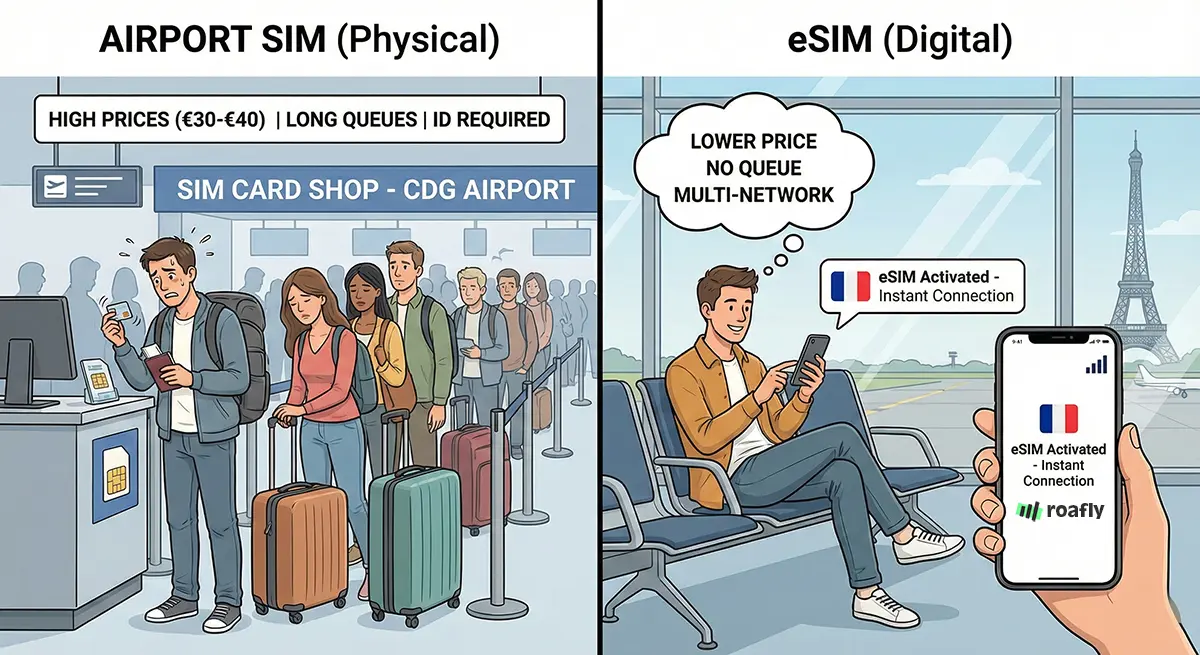
Many travelers still buy SIM cards at Charles de Gaulle (CDG), Orly, or Marseille Airport. But airport SIMs come with typical drawbacks:
Airport SIM disadvantages
-
€20–€40 for basic data packages
-
Limited validity periods
-
Long queues during peak hours
-
Occasional ID registration requirements
-
Physical SIM swap required
-
Variable customer support
eSIM advantages
-
Activate before takeoff
-
Lower pricing (Roafly 10 GB = $13.90 vs ~€30 airport)
-
No physical SIM, no risk of losing your home SIM
-
Multi-network capability
-
Works instantly on landing
For anyone traveling with an eSIM-compatible device (most smartphones released after 2018), eSIM is the clearly superior choice.
How Much Data Do You Need for a Trip to France?
Your data needs depend on how you travel. Below is a realistic estimate of daily usage for common activities.