Download the App and manage your eSIMs easily
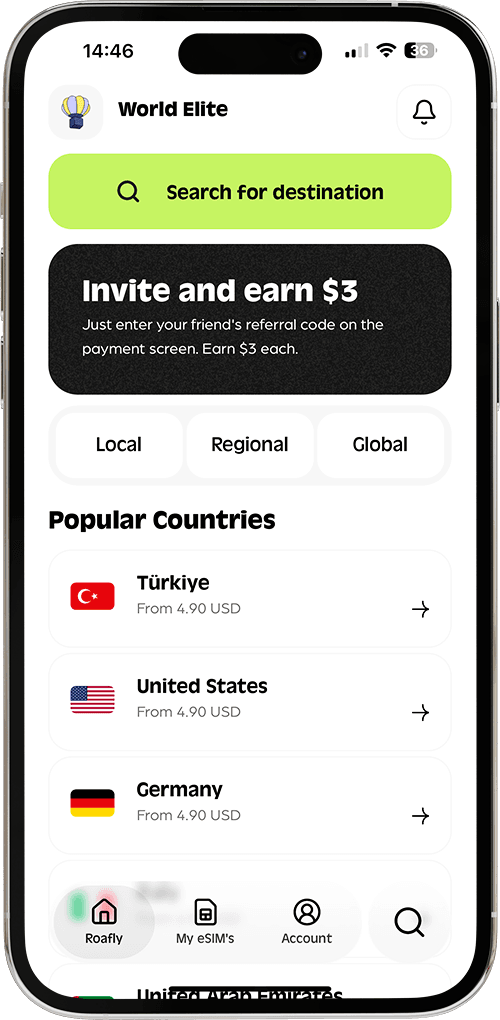
Create your order quickly
See your eSIM details
Track your remaining data
Download the App and manage your eSIMs easily
Create your order quickly
See your eSIM details
Track your remaining data
Saudi Arabia’s entry rules depend on your passport, where you hold residence and why you are visiting. GCC citizens can enter without a visa, while other visitors need an appropriate visa or travel authorization. Some qualify through nationality; others through a residence permit or a previously used foreign visa.

Lena Hartley
Updated Nov 10, 2026
10 min read
Save 15% on your Roafly eSIM
Stay connected on your next trip. Use the code below at checkout.
View All DestinationsJump to section
👇Save 15% on your Roafly eSIM
Stay connected on your next trip. Use the code below at checkout.
View All Destinations
Manage your eSIM in the app
Install, top up and track data.
The routes below reflect the requirements checked on 10 November 2026. Start with your eligibility, then match the permission to your trip: a sightseeing holiday, a short stopover and a Hajj pilgrimage require different preparation.
Use the official Saudi visa eligibility checker with your passport nationality and residence status. These examples concern ordinary passports; diplomatic, special and emergency travel documents need separate treatment.
| Your situation | Available route | Main condition |
|---|---|---|
| Citizen of Bahrain, Kuwait, Oman, Qatar or the UAE | Visa-free entry | Travel with an accepted national ID or passport |
| Passport from an eligible country, including the US, Canada, Germany, Australia or Türkiye | Tourist eVisa or visa on arrival | Meet the conditions for the selected route |
| British citizen | ETA, with tourist-visa alternatives | Apply for the ETA before travel; it allows multiple visits over 730 days |
| Foreign national legally resident in a GCC country | Residence-based tourist eVisa | GCC residence must remain valid for at least three months beyond entry |
| Holder of a qualifying US, UK or Schengen tourist/business visa | Tourist eVisa or visa on arrival | The foreign visa must meet validity and previous-use requirements |
| Permanent resident of the US, UK or an EU country | Tourist eVisa or visa on arrival | Hold the qualifying permanent-residence document |
| Passport from India, Pakistan or the Philippines without a qualifying alternative | Embassy/consular application | Obtain approval before travel; some passports also qualify for the package route below |
| Passport from India, Pakistan, Bangladesh, Indonesia, Egypt, Jordan or Mexico | Package Visa | Purchase an eligible flight-and-hotel package through an approved provider |
Living in Dubai, Doha or another Gulf city does not give a foreign passport holder the visa exemption available to GCC citizens. Residence can open an application route, but you still need the Saudi permission issued.
Getting your tourist eVisa before flying gives you an approved document to present at check-in and removes the visa-application step from your arrival. Visa on arrival remains an option for eligible visitors, but eligibility must also satisfy the airline carrying you.
Complete the application with the passport you will use for the journey, enter your Saudi accommodation address and review the details before paying. Keep the issued visa accessible offline. Payment alone is not approval, and the eVisa application fee is non-refundable, including after refusal.
Parents or authorized guardians should handle applications for minors. Each family member needs the appropriate travel documents; a parent’s permission does not cover the whole family.
Medical insurance is part of tourist-visa preparation, but it is not bundled into every quoted price in the same way.
At the date checked, Visit Saudi’s US and UK tourist eVisa options were listed at SAR 395 including application fees and medical insurance. Its India GCC-resident application route was listed at SAR 339.44 before medical insurance. These are route-specific examples, so use the total shown for your own application.
Keep the insurance policy with your visa documents and read its benefits and exclusions before deciding whether to buy additional travel cover.
The US, UK or Schengen visa route requires an eligible tourist or business visa that has already been used to enter its issuing country. On your first Saudi entry through this route, the qualifying foreign visa or residence permit must still be valid. Carry the underlying document and evidence of the qualifying entry.
Visit Saudi’s current instructions require an entry stamp and exclude digital entry stamps for the foreign-visa route; if your previous admission was recorded only electronically, resolve that point with the Saudi mission before relying on it. Returning visitors who have already entered on the same, still-valid Saudi visit visa are treated differently: the underlying foreign visa or residence permit does not have to remain valid.
Permanent residence is a separate qualification. A temporary residence permit in Europe should not be treated as equivalent to permanent residence in an EU country.
GCC residents apply using their residence details, with at least three months’ residence validity remaining beyond arrival and the relevant passport validity. Select the residence-based route rather than submitting an application as a GCC citizen.
British citizens can apply for the Saudi Electronic Travel Authorization before departure. It is valid for 730 days, permits multiple entries and has a SAR 50 non-refundable fee. Submit a separate application for each person, including children.
Current UK government guidance describes a maximum of 180 days in total across the authorization’s validity. Plan against the conditions on your issued authorization, particularly for repeated or extended visits.
The ETA does not include medical insurance. That makes its headline price different from a tourist-visa price that includes a policy. It can cover tourism and Umrah outside the Hajj season, but it cannot be used for Hajj or employment.
Existing permissions retain their own expiry dates and conditions. A previously issued single-entry electronic visa waiver should not be treated as a new multiple-entry ETA.
Without a qualifying nationality, foreign visa or residence status, the embassy/consular route remains relevant. Indian, Pakistani and Philippine passport holders are examples of applicants who may need this route when no alternative applies.
Prepare the supporting documents requested by the Saudi mission or authorized visa center. These can include:
Proof of lawful residence in the country where you apply.
Accommodation details and your address in Saudi Arabia.
Return flight details and an itinerary.
Employment evidence.
Bank statements or other evidence of financial means.
Use the document list for the particular application channel. Consular requirements should not be copied wholesale onto every nationality-based eVisa application.
The Package Visa connects your permission to an approved travel package. The eligible passport countries appear in the route table above; this is an additional option, not a requirement for everyone on that list.
The package must include return flights and accommodation in a Ministry-licensed hotel rated at least four stars. Its minimum value is SAR 4,000 per adult for the first two days combined, plus SAR 1,000 for each additional day. The published visa charge is SAR 402.21 including mandatory health insurance; review the provider’s total to see how that charge is presented.
Bookings must be completed at least 48 hours before departure, with accommodation covering the full flight itinerary. Packages run from two to 88 days. The visa is single-entry, valid for three months from the scheduled travel date; cancelling the associated package causes the visa to be revoked.
This route suits a trip you are willing to book through an approved provider. If you already qualify for an independent eVisa or ETA, compare that option before committing to the package’s hotel and spending requirements.
Six months of passport validity from arrival is the standard tourist-visa requirement. Saudi tourism guidance identifies an exception for US citizens with valid passports, while the eVisa portal’s general conditions retain the six-month wording. US passport holders with less than six months remaining should obtain confirmation from the Saudi mission and operating airline before relying on the exception.
Travel using the passport associated with your permission. If you renew or replace it after receiving a visa, resolve the document requirements before departure rather than assuming the permission transfers automatically.
The standard multiple-entry tourist eVisa is generally valid for one year, with a stay allowance of up to 90 days. The general tourist-visa regulation limits the multiple-entry route to three months during its validity; nationality-specific permissions can have different conditions.
Before planning repeated visits, identify three details on your issued document:
Validity: the period during which the permission can be used.
Entries: whether it permits one entry or multiple entries.
Duration of stay: how long you are authorized to remain.
Do not calculate a fresh 90-day allowance simply because you leave and return. If your document does not make the cumulative limit clear, obtain the permitted total from Saudi immigration before planning the next stay.
The standard tourist eVisa cannot be extended under its published terms. Depart within both the permitted stay and the document’s applicable validity. Overstaying can lead to fines and further immigration penalties.
Save your visa or ETA, insurance policy, accommodation address and onward itinerary offline. Add the foreign visa or residence permit if it is the basis of your eligibility, plus any required health certificates. Immigration officers may also collect biometric information on arrival.
Admission and customs clearance are separate checks. Review Saudi Arabia’s customs rules before packing medicines or goods that need approval or declaration.
The tourist visa can be used for Umrah outside the Hajj season. Hajj requires the dedicated Hajj visa and permit; a tourist visa or stopover permission does not replace them.
Arrange the relevant Umrah appointment through Nusuk. Seasonal restrictions can affect access to Makkah and travel through Jeddah, Madinah and Taif, so use the rules for your actual pilgrimage dates. A previous season’s entry deadline should not determine a later trip.
Health requirements depend on the purpose of travel and, for some measures, where you are arriving from. The current Saudi Ministry of Health requirements distinguish pilgrimage vaccination rules from other country-specific measures.
Umrah travelers must meet the meningococcal vaccination requirement, including the minimum interval of 10 days before arrival. Vaccine validity depends on its type. Yellow-fever and polio requirements can depend on the country of departure, and additional conditions apply to specified traveler groups. Review these early enough to obtain the required vaccination and documentation.
Entry permission also leaves local conduct and religious-site access rules in place. Read the local rules for visitors when deciding which places and activities to include.
Remaining in an airport’s international transit area is different from entering Saudi Arabia. Your connection can require a visa if you need to pass immigration, collect baggage and check in again, travel on separate tickets, or connect for more than 12 hours. Have the operating airline assess the full itinerary, including baggage transfer.
Eligible Saudia and flynas itineraries offer a stopover visa for up to 96 hours through the airline booking process. Apply for the permission as part of the itinerary; buying a connecting ticket alone is not the same as receiving it.
Tourist visas can support arrival through air, land and sea ports, but the issued permission must cover the entry mode you intend to use. This matters for a road trip over the King Fahd Causeway from Bahrain or another land crossing. Check the document before setting out, especially if it was arranged through an air-travel program.
Finish the practical preparation before check-in:
Match the visa or ETA details to your travel passport and intended entry point.
Keep copies of the permission and supporting documents somewhere accessible without internet.
Set your departure within the authorized stay, accounting for previous visits where relevant.
Complete any Nusuk booking and health-document preparation needed for your trip.
Arrange mobile data before departure if you want access to hotel messages and transport bookings after landing. Compare the best eSIM for Saudi Arabia for the trip length and allowance you need.
On a compatible, unlocked phone, you can install Roafly’s Saudi Arabia eSIM before leaving and use its data for arrival arrangements. Keep the visa itself downloaded offline so presenting it does not depend on a connection.
