

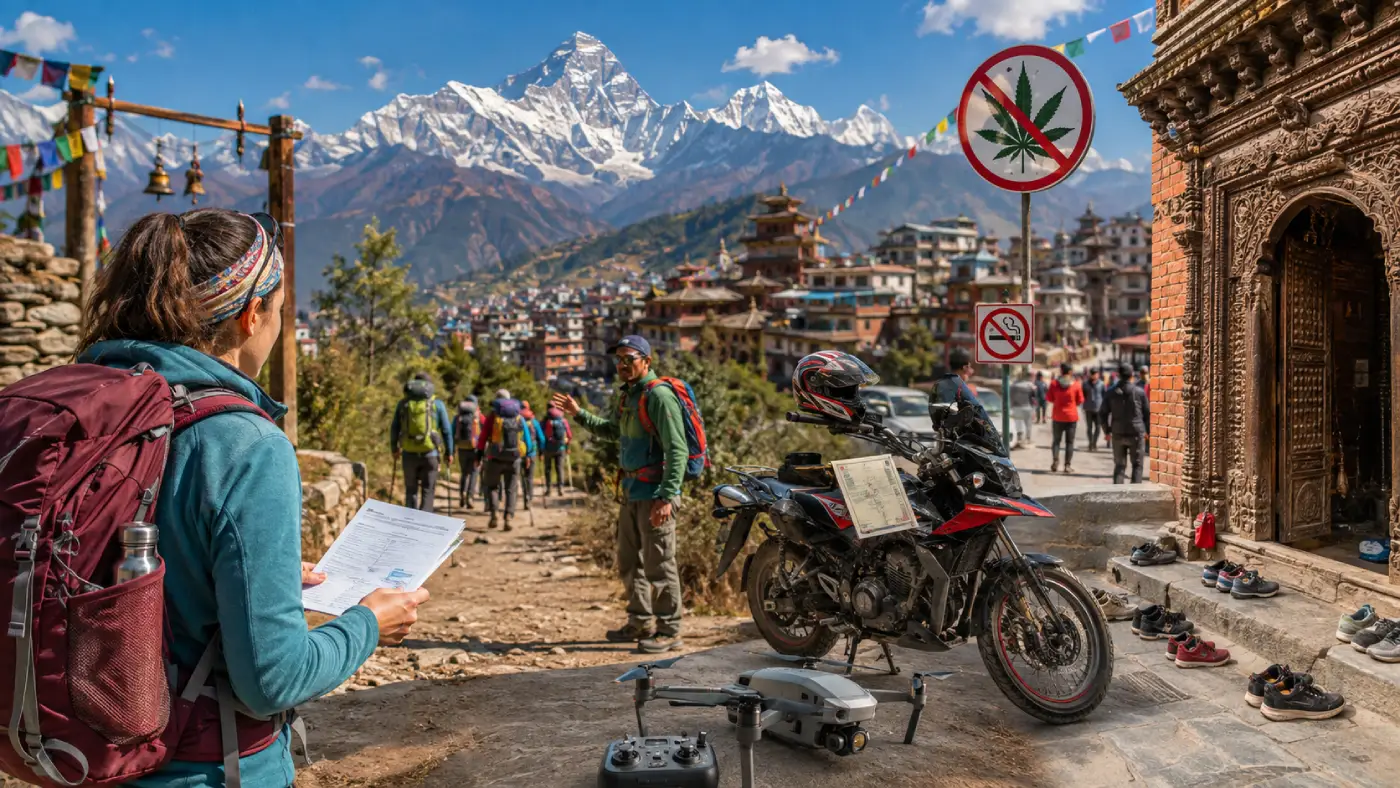

Nepal tourist laws at a glance
| Topic | Current status | What visitors need to know | Safest action |
|---|---|---|---|
| Trekking | Route-specific restrictions | Many listed trekking routes require a licensed guide and agency-issued TIMS card | Check your exact route before booking |
| Restricted areas | Special permit required | Restricted-area permits can apply in addition to TIMS and protected-area documents | Use a registered trekking agency |
| Cannabis and narcotics | Prohibited | Buying, possessing, transporting and using cannabis can fall under Nepal’s narcotics law | Do not buy, carry or use it |
| Drones | Registration and conditions apply | Foreign operators need temporary CAAN registration; location restrictions can also apply | Complete approvals before flying |
| Driving and motorbikes | Valid licence required | An IDP is expressly recognized when it covers the relevant vehicle class | Carry an appropriate IDP |
| Smoking and vaping | Smoking restricted; vaping requires caution | Smoking is prohibited in specified public places; vape rules should not be assumed identical | Follow signs and venue restrictions |
| Temples and heritage sites | Site-specific rules | Entry, shoes, leather items and photography can be restricted at individual religious sites | Follow posted site rules |
Nepal’s most important tourist restrictions are activity-specific. A rule applying to a restricted Himalayan route does not automatically apply to a city walk, while a temple entry condition should not be presented as a nationwide criminal prohibition.
Rules checked on September 3, 2026. Laws, local restrictions and penalties can change; verify the linked official guidance before travel.
Trekking permits and guide rules depend on your route
Nepal does not have permit rule covering every walk in the country. Under the Nepal Tourism Board’s revised TIMS system, effective since March 31, 2023, trekkers on specified routes in protected areas must be accompanied by a licensed trekking guide and carry a TIMS card issued through a government-registered trekking agency.
The official route list covers major itineraries in regions including Everest, Annapurna, Langtang, Manaslu, Mustang, Dolpo and Kanchenjunga. Check the Nepal Tourism Board TIMS guidance for the exact route rather than assuming every trail has identical requirements.
Before treating a trek as legally ready, check whether you need:
-
a licensed trekking guide and agency-issued TIMS card for the exact route;
-
a national park, conservation-area or other protected-area entry permit;
-
a Department of Immigration permit for a designated restricted area;
-
the required passport and permit documents available for checkpoints.
Restricted areas add another layer. The Department of Immigration states that foreign trekkers entering designated restricted areas need a trekking permit issued through a listed trekking agency. Its current FAQ also states that individual restricted-area permits are not issued and solo trekking in those areas is not permitted.
TIMS, protected-area entry documents and Immigration restricted-area permits are different requirements, but they are not mutually exclusive. Depending on the route, more than can apply to the same trek. Check the Department of Immigration trekking permit guidance before committing to a restricted-area itinerary.
Remote routes can also make it difficult to retrieve permit information or maps after departure. Saving official guidance in advance is useful; Best eSIM for Nepal compares data options, while Nepal eSIM is the country connectivity page.
Cannabis and recreational narcotics are not legal for tourists
Nepal’s historic and cultural association with cannabis can give visitors the wrong impression about current law. Nepal’s Narcotic Drugs (Control) Act classifies cannabis as a narcotic drug and prohibits activities including cultivation, production, preparation, purchase, sale, storage, transport and consumption.
For an ordinary visitor, the practical rules are straightforward:
-
do not buy or accept recreational cannabis or hashish;
-
do not keep it in accommodation, vehicles or luggage;
-
do not transport it between destinations;
-
do not use it because it appears openly available or culturally familiar.
The law contains limited provisions for legally authorized purposes, but they do not amount to general recreational legalization. Informal availability is not evidence that possession or consumption is lawful.
The controlling legislation is published by the Nepal Law Commission.
Rules for carrying cannabis, CBD products or other controlled substances across Nepal’s border are a separate customs question rather than a post-arrival possession rule.
Drones need more than permission from a hotel or tour guide
Foreign nationals intending to operate a drone in Nepal must obtain Temporary Drone Registration from the Civil Aviation Authority of Nepal’s Flight Safety Standards Department. CAAN’s current procedure requires foreign applicants to visit the department in person and present the drone for inspection.
CAAN’s current temporary-registration requirements include:
-
a valid passport with a valid Nepal entry visa;
-
a signed commitment letter covering compliance, the purpose of the operation, proposed flight locations and operating period;
-
presentation of the drone for inspection;
-
a valid CE Marking on the drone;
-
additional documents related to the intended operation where applicable.
Registration is not blanket permission to launch anywhere. Aviation restrictions can still apply around aerodromes, populated areas, prohibited or restricted airspace and other sensitive locations. A protected site or controlled location may also require permission from the authority responsible for that place.
Permission from a hotel, trekking company, guide or landowner therefore does not replace aviation compliance. A small or lightweight drone should not be assumed to be exempt from every Nepalese requirement.
Check the current CAAN guidance for foreign drone operators before building drone footage into an itinerary.
Driving and motorbikes: an IDP is the clearest option
Nepal’s Motor Vehicles and Transport Management Act expressly recognizes an International Driving Permit. A person holding an IDP may drive the vehicle classes listed on that permit in Nepal, so the category matters: authorization for a car should not be assumed to cover a motorcycle, scooter or another vehicle class.
A foreign domestic licence is treated differently. Nepalese law provides a route for someone holding a foreign licence to apply for a Nepalese licence without the usual driving test, but that is not the same as declaring every foreign domestic licence automatically valid for tourist driving.
A rental company handing over a vehicle is therefore not proof that your documents meet Nepalese legal requirements. The clearest option for a visitor planning to drive is to carry an IDP covering the exact vehicle class.
The relevant licence provisions are published in the Nepal Law Commission Motor Vehicles and Transport Management Act.
Nepal Police also instructs drivers to carry their licence and vehicle documents, obey traffic signals, avoid mobile-phone use while driving and not drive after drinking or using drugs. Seat-belt and motorcycle-helmet requirements also apply. Renting a scooter or motorbike does not remove those obligations.
Smoking is restricted in public places; treat vaping separately
Nepal’s Tobacco Products (Control and Regulatory) Act prohibits smoking and tobacco consumption in specified public places. These include government offices, educational and health institutions, airports, public transport, religious places, public-transport waiting areas and ticket counters.
The law allows managers to designate particular smoking areas in limited settings such as airports and tourist-standard hotels, subject to the applicable conditions. That exception does not mean smoking is generally permitted throughout those premises.
The public-place framework is set out in the Nepal Law Commission Tobacco Products Act.
Vaping needs more cautious wording. The published tobacco-law provisions do not provide a sufficiently clear basis for describing every e-cigarette possession and domestic-use situation as either completely legal or completely prohibited.
Do not assume cigarette and vape rules are identical. The safest approach is to avoid vaping wherever smoking is prohibited, where a no-smoking notice is displayed or where staff prohibit it. Bringing e-cigarettes, liquids or heated-tobacco products across the border is a separate issue; check Nepal Customs Rules: What You Can Bring for that customs decision.
Temple, heritage and photography rules can be site-specific
Religious etiquette and enforced site rules are not the same thing. Removing shoes before entering temples, dressing respectfully, walking clockwise around stupas and asking before photographing people or ceremonies are generally cultural practices visitors should respect, but they should not automatically be described as nationwide criminal laws.
Individual sites can impose firmer conditions. At Pashupatinath in Kathmandu, for example, access to the main temple complex is restricted to Hindus, while site guidance also restricts shoes, leather items and photography within the complex.
Those conditions are specific to Pashupatinath. They should not be generalized to every Hindu or Buddhist site in Nepal.
Heritage attractions, museums and protected places can likewise set their own entry, photography or equipment conditions. Read the notice at the specific attraction and follow staff instructions rather than assuming a rule from monument applies at the next.
Action checklist for visitors
-
Check the exact trekking route for TIMS, guide, protected-area and restricted-area permit requirements.
-
Use a government-registered trekking agency when the applicable route requires.
-
Do not buy, possess, transport or use recreational cannabis or illegal narcotics.
-
Complete CAAN registration and any additional location approvals before flying a drone.
-
Carry an IDP covering the vehicle class you intend to drive and follow local traffic rules.
-
Follow public smoking restrictions and treat vaping conservatively where the rule is not explicit.
-
Obey posted temple, heritage-site and photography restrictions while keeping cultural etiquette separate from criminal law.
-
Verify customs requirements separately before crossing the border with regulated products.
For most visitors, three actions matter most: verify the exact trekking requirements before committing to a route, do not mistake Nepal’s historic cannabis culture for recreational legalization, and arrange the required drone or driving documentation before using the equipment. Those checks are more useful than memorizing a generic list of things that are supposedly “banned” in Nepal.