

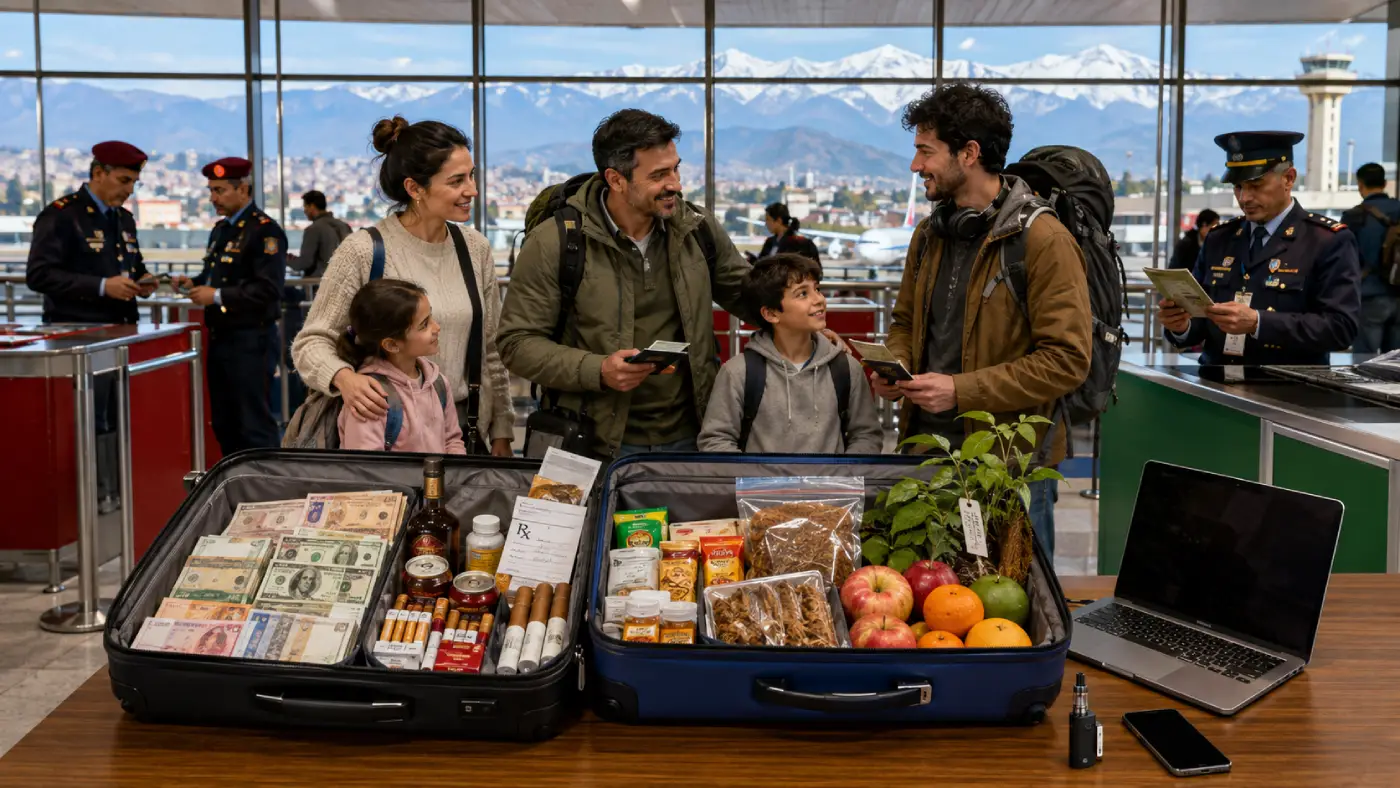
Declare convertible foreign currency above USD 5,000 equivalent, keep alcohol within the published passenger allowance, and check controlled medicines before departure. At Tribhuvan International Airport (TIA), use the Red Channel when you have dutiable, controlled or declarable goods.
What you can bring into Nepal at a glance
| Item | Current rule | Best action |
|---|---|---|
| Cash | Above USD 5,000 equivalent must be declared | Declare at Customs |
| Alcohol | 1 bottle up to 1 L; CAAN also lists 12 cans of beer | Choose published allowance |
| Tobacco | 200 cigarettes, 50 cigars, 250 g tobacco | Do not assume limits combine |
| Medicines | Up to NPR 10,000 duty-free for foreign passengers, except prohibited medicines | Check controlled ingredients |
| Food and plants | Food allowances exist; plant products may need quarantine clearance | Check fresh plant items |
| Phone and laptop | 1 personal phone; 1 laptop for ages 18+ | Check or declare extras |
| Vapes | No clear separate passenger allowance published | Verify the exact product |
Passenger duty exemptions do not override separate import controls. Medicines can fall under Nepal’s drug-control system, while plants and agricultural products may require quarantine documents even when their value is within a customs allowance.
Rules checked on August 28, 2026. Requirements can change; verify the linked official guidance before travel.
Cash declarations when entering Nepal
Nepal Rastra Bank states that Nepali and foreign citizens may bring up to USD 5,000 in convertible foreign currency cash, or the equivalent in another convertible currency, without making the higher-value customs declaration.
If you enter with more than USD 5,000 equivalent, you must make a self-declaration to Customs. The threshold is therefore a declaration trigger, not a legal maximum on incoming foreign currency.
Keep the declaration record if you arrive above the threshold. TIA also states that foreign citizens leaving Nepal generally cannot take more than USD 5,000 equivalent in foreign-currency cash unless the higher amount is covered by the declaration made when entering Nepal.
Check the current threshold with Nepal Rastra Bank before carrying a larger amount.
These are Nepal’s entry rules. Your departure country and the country you later return to may impose separate cash-reporting requirements.
Alcohol and tobacco allowances
TIA’s current FAQ says passengers may bring one liter of alcoholic liquor without paying customs duty. The Civil Aviation Authority of Nepal’s published passenger information describes the exemption as one bottle of up to 1 liter of liquor or up to 12 cans of beer.
Because the CAAN wording uses “or,” do not assume the liquor and beer allowances can be combined. Older TIA material still shows a 1.15-liter liquor figure, but the current airport FAQ and CAAN AIP support the lower 1-liter amount. Pack to the lower current figure.
For foreign passengers, the CAAN AIP publishes these tobacco duty exemptions:
-
up to 200 cigarettes;
-
up to 50 cigars; and
-
up to 250 grams of tobacco.
The official English wording does not clearly explain whether a traveler may combine the full quantities from several tobacco categories. If you intend to carry more than type, confirm the treatment with Customs instead of automatically adding the figures together.
Do not assume going over an allowance simply means paying duty. Nepal Customs states that alcohol above the permitted quantity can be confiscated, while treatment of excess quantities in other categories can depend on the applicable rule and circumstances.
For the newest passenger-baggage publication, check the Nepal Department of Customs passenger-goods notice. The Department published its current 2083 passenger-goods information on June 3, 2026.
Bringing prescription medicines into Nepal
Customs duty and drug-control approval are separate questions.
CAAN’s passenger information lists medicines worth up to NPR 10,000 among the duty-exempt goods a foreign passport holder may bring, except medicines whose import is prohibited under Nepalese law. Staying under that value does not override restrictions on a controlled ingredient.
Nepal’s Department of Drug Administration specifically handles import recommendations for narcotic, psychotropic and precursor substances. Its published controlled-drug material includes ingredients such as codeine, fentanyl, methadone, morphine, alprazolam, clonazepam, diazepam and zolpidem.
For medicines that require a personal-use import recommendation, DDA guidance can require:
-
an application stating the purpose and justification;
-
a prescription from a registered medical practitioner showing the personal-use quantity;
-
supporting documents requested during the review; and
-
the documentation required to complete the recommendation process.
Check the active ingredient, not just the brand name. The official material reviewed does not support treating every ordinary prescription medicine as if it automatically requires the same controlled-drug authorization process.
If your medication contains a narcotic or psychotropic substance, or you are unsure about its status, consult the Nepal Department of Drug Administration controlled-substance guidance before traveling.
Food, seeds, plants and fresh produce
For foreign passengers, CAAN lists a duty exemption for foodstuffs, including canned products, worth up to NPR 5,000. It separately lists fresh fruit worth up to NPR 2,000.
These are customs-value allowances. They do not mean every agricultural product is automatically permitted through plant quarantine.
Nepal’s Plant Quarantine and Pesticide Management Center regulates the entry of plants and plant products. Its quarantine offices issue entry permits, inspect imported agricultural and forest products and issue release orders when applicable.
Check before packing items such as:
-
plants, seedlings and cuttings;
-
seeds intended for planting;
-
fresh fruit and other plant products; and
-
agricultural material that may carry pests or plant disease.
Depending on the product, quarantine procedures can involve an entry permit and phytosanitary documentation. Nepal also operates quarantine controls at its entry points, including the international-airport system.
The Plant Quarantine and Pesticide Management Center explains the authority’s role and import-clearance functions.
A commercially sealed package does not by itself cancel a plant-health requirement. At the same time, ordinary processed food should not be treated as prohibited simply because fresh plants and agricultural goods may need specialist clearance. Check the specific product when its classification is unclear.
Phones, laptops, vapes and other personal goods
TIA’s current FAQ says travelers are normally allowed one mobile phone for personal use. It describes a separate additional-phone concession for qualifying Nepali citizens returning after at least six months of approved foreign employment, so ordinary visitors should not assume that exception applies to them.
The same FAQ states that a person over 18 may bring laptop for personal use without customs duty. CAAN’s passenger information also lists tablet or laptop among the duty-exempt personal goods for foreign passengers.
One clearly personal phone and qualifying laptop therefore fit the published traveler guidance. Multiple boxed phones, several similar new devices or electronics being carried for other people can fall outside straightforward personal-use treatment. Check or declare extras rather than assuming the single-item exemption multiplies.
What about vapes and e-cigarettes?
The current official passenger material reviewed does not clearly publish a separate traveler allowance for disposable vapes, refillable devices, e-liquids, cartridges, heated-tobacco devices, heated-tobacco sticks or nicotine pouches.
Do not assume the cigarette or loose-tobacco quantities automatically cover these products. Without a current product-specific passenger rule, the safest decision is to verify the exact device and consumable with Nepal Customs before departure.
This section covers import across the border. Rules governing possession, smoking, vaping or use after entry are local-law questions and are separate from customs clearance.
How customs declarations work at Tribhuvan International Airport
TIA uses Green and Red customs channels for arriving international passengers after baggage collection.
Use the Green Channel when you have no dutiable goods to declare and nothing exceeding your duty- or tax-free concession. Travelers using Green can still be selected for inspection.
Use the Red Channel when you have prohibited, controlled, dutiable or taxable goods that require a customs declaration or assessment. TIA says passengers carrying dutiable goods through the Green Channel may have those goods seized.
If you are unsure about an extra phone, controlled medicine, regulated plant product or another item whose treatment is unclear, approach Customs before leaving the customs area rather than assuming the Green Channel applies.
The Tribhuvan International Airport FAQ gives current traveler-specific answers on cash, liquor, mobile phones, laptops and customs channels. The Civil Aviation Authority of Nepal AIP provides the published foreign-passenger duty exemptions for alcohol, tobacco, medicines and food.
Mobile internet after customs
Once customs clearance is complete, mobile data can keep maps, hotel messages and transport information available. Best eSIM for Nepal is useful for comparing providers before choosing a Nepal eSIM.
If you are considering a physical tourist SIM instead, Nepal SIM Card for Tourists: Ncell vs NTC explains the main local operator options separately.
Nepal customs checklist before you fly
-
Check controlled medicines: review the active ingredient and contact DDA when narcotic or psychotropic controls may apply.
-
Avoid combining unclear allowances: do not automatically add alcohol, beer or multiple tobacco-category quantities together.
-
Prepare plant documents: confirm quarantine requirements before carrying seeds, plants or other regulated agricultural material.
-
Separate extra electronics: keep devices beyond the ordinary personal allowance ready for customs review.
-
Keep declaration records: retain paperwork for foreign currency or other goods formally declared when entering Nepal.
Use published passenger exemptions for the goods and quantities they clearly cover. Where a specialist regulator controls the item—or the official passenger guidance does not clearly address a newer product such as a vape—verify the exact item before departure rather than stretching a general baggage allowance.