


The useful distinction is whether you agreed to the service, price and product before committing. Bargaining and openly stated charges are part of ordinary transactions; deception begins when those terms are misrepresented or changed. This guide focuses on recognizing that moment. Broader questions about crime, solo travel and regional risks belong in our Morocco travel safety guide.
“That Road Is Closed”: Unwanted Guides and Medina Detours
Someone tells you the street ahead is closed, your destination is inaccessible or there is a special market worth seeing instead. They offer to lead you somewhere else. The walk can end with a demand for a guiding fee, a shopping stop or pressure to buy leather goods at a tannery.
Treat the closure claim and the offer of help as two separate things. Even if a route is genuinely blocked, you can arrange your own alternative. Contact your riad through the details in your booking, or ask inside an established business. Respect real barriers and official instructions; a line on a map cannot establish that a passage is open.
Some visitors describe being approached before they have even asked for help, with warnings about a wrong turn or a restricted area. These accounts explain why the offer can feel necessary, but they do not establish that every person giving directions has an ulterior motive.
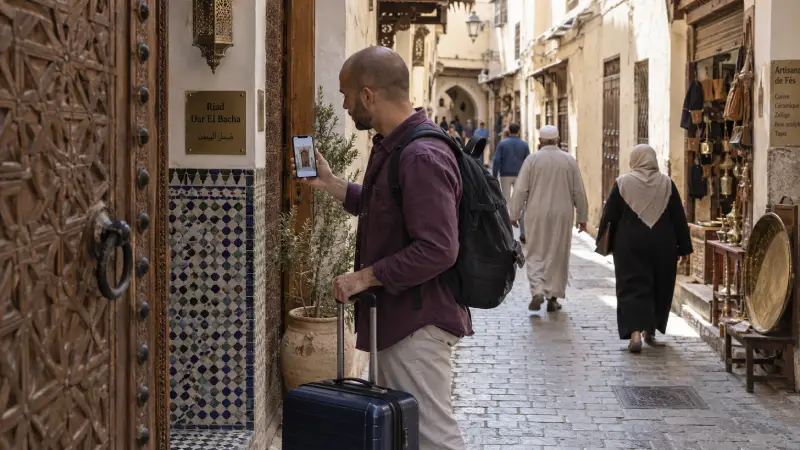
Before entering the medina with luggage, ask your accommodation for the nearest accessible drop-off point and a meeting arrangement. Save the address, entrance photo if available and contact details offline. Our guide to internet options in Morocco explains how to arrange mobile data for messages and live searches alongside that offline preparation.
If you want a guided visit, arrange it deliberately: ask for the guide’s official badge and agree on the duration, total fee and any shopping stops. An unsolicited escort should not get to decide those terms after the walk.
When the detour ends at a tannery or shop
The problem is the misleading invitation and pressure, not the tannery itself. Genuine visits and leather shopping can be enjoyable when you know what you are agreeing to.
Before entering a viewing terrace or accepting a demonstration, establish whether there is an admission charge, guiding fee or purchase expectation. You can decline an unexpected stop. If the encounter becomes intimidating, prioritize reaching a busy, staffed place rather than arguing over who owes what.
Taxi Tricks: Broken Meters, Changed Prices and Missing Change
Different journeys use different pricing arrangements. Marrakech’s city petit taxis and the airport’s organized booking service should not be judged by the same rule.
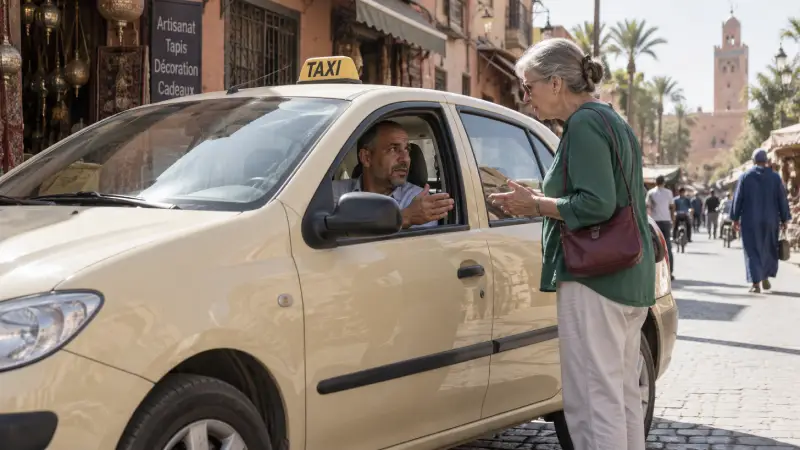
City journeys: Ask for the meter, often called the compteur, before setting off. If the driver says it is broken and proposes an unacceptable price, choose another taxi while you are still at the pickup point. Do not leave the basis of the fare unresolved until arrival.
Airport arrivals: Marrakech Menara has an organized taxi booking and prepayment system. Follow the airport signs to the designated desk, give your exact destination and keep the receipt or ticket. A fare established through this system is different from an unsolicited driver inventing a price outside the process. Use the amount quoted for your journey rather than an old fare copied from a blog.
A changed quote: Make clear whether an agreed amount covers the whole vehicle or each passenger, and whether it includes your luggage and destination. If the terms change before departure, resolve them before loading bags or boarding.
Missing change: Carry smaller notes and count the change before putting it away. A claim that the driver has no change should not silently become your agreement to leave the difference as a tip.
Keep the destination accessible on your phone. If you use a Morocco eSIM, it can provide mobile data for maps and booking messages on a compatible unlocked device. Roafly’s plan is data-only, so arrange a separate way to make ordinary phone calls if needed.
Henna and Photo Demands Around Jemaa el-Fna
Henna becomes a problem when someone starts without your consent, calls it free and later demands money, or extends an agreed design and charges for the extra work. These are among the documented tourist schemes in Morocco.
If you want henna, settle the design, where it will be applied and the complete price before application begins. Decline clearly if you do not want it, and step away before a demonstration turns into a service.
Photo charges require a separate decision. Photographing a performer or posing with an animal may involve a fee. An openly agreed payment is different from a demand introduced after you were told the photo was free. Ask permission and establish any charge first; skipping animal-handling photos avoids that particular interaction altogether.
Permission from a person also does not answer every question about photographing a location. Our Morocco tourist laws and photography guidance covers the broader rules to consider while sightseeing.
Food You Did Not Order and Bills That Do Not Match
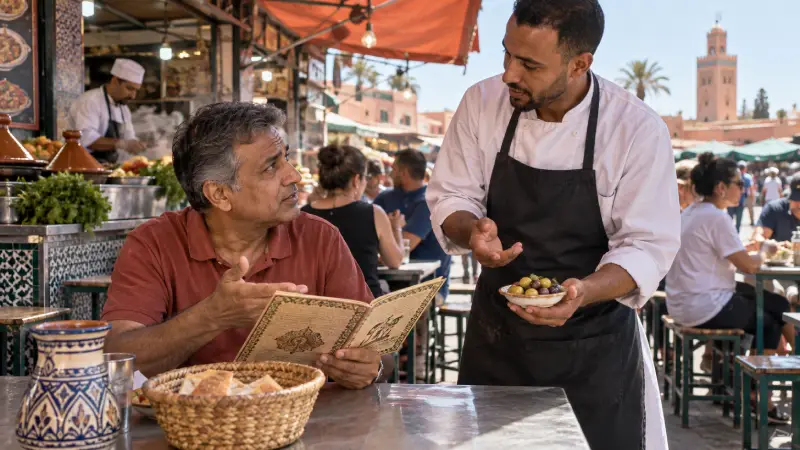
At Jemaa el-Fna’s food stalls, small dishes placed on your table can look like complimentary accompaniments. Bread, olives and other extras may be charged separately. Another warning sign is a bill that differs from the menu or the order you agreed on.
Before eating anything you did not request, ask whether it is included. Have unwanted extras removed and clarify portions: shared plate and two individual servings are different orders.
Keep the menu available until you have ordered. If the total looks wrong, ask for an itemized explanation and identify the specific discrepancy. “We ordered portion” is more useful than starting with a general accusation.
High prices printed clearly on a menu are a reason to choose somewhere else before ordering. They are not, by themselves, evidence of fraud.
Souk Purchases: Switched Goods and False Authenticity Claims
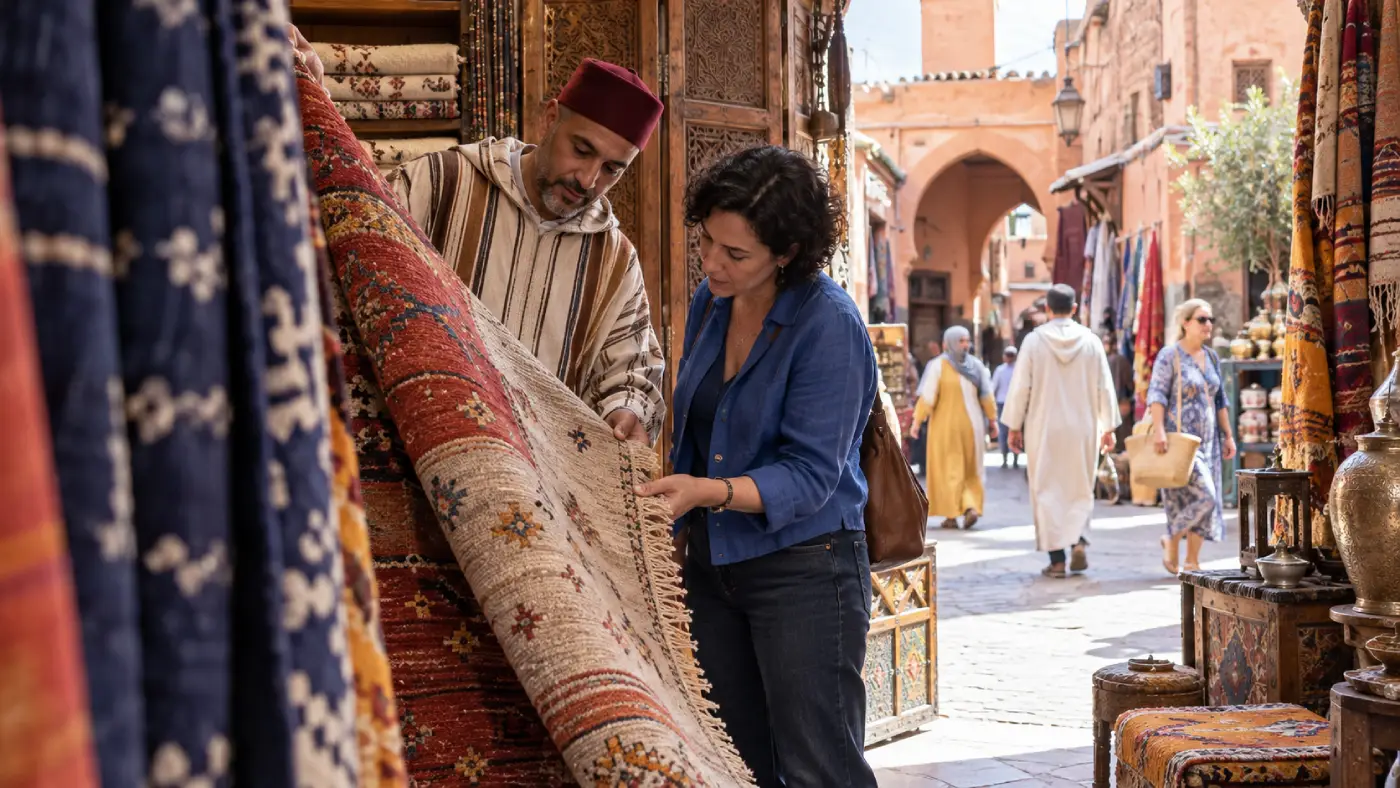
Two shopping problems deserve different responses: receiving something other than the item you selected, and buying an item whose materials or origin were misrepresented.
The item changes during packing
You inspect a product, agree on a price and receive a wrapped purchase. If a lower-quality item has been substituted, the bargain you negotiated is no longer the bargain you received.
Stay with the item through packing, especially after inspecting its stitching, finish, size or pattern. Open the parcel before leaving if it has passed out of sight. Keep a receipt identifying the purchase and seller.
The story is worth more than the product
Claims such as “antique,” “handmade” or “pure argan oil” can influence what you are willing to pay. A confident explanation or attractive demonstration is not independent proof of those claims.
Before an expensive purchase, ask for the claimed materials and origin in writing and allow time to compare sellers. If authenticity is central to the value, seek knowledgeable advice before paying. If you simply like an item as a souvenir, judge the purchase on that basis rather than an unverifiable investment story.
Hospitality does not require a purchase. You can appreciate a demonstration or conversation and still decide that the item is not right for you.
Duplicate Card Charges and Requests to Pay Again
Duplicate card charges and substituted goods are documented risks for visitors to Morocco. Keep your card in sight and read the terminal’s amount and currency before authorizing payment.
If a merchant says the first payment failed, ask to see the terminal result before trying again. Save receipts from both attempts and note the amount, time and merchant name.
Two entries in a banking app do not necessarily mean two completed charges or deliberate fraud. Ask your card issuer to clarify the transaction status. If you suspect an unauthorized payment, use the bank’s own app or a known contact number, and explain what happened. Keep the evidence needed to investigate without assuming a refund is guaranteed.
What to Do If You Are Pressured or Lose Money
Your immediate response should depend on whether you are dealing with a billing disagreement or intimidation. If someone threatens you or blocks your way, focus on reaching a staffed hotel, shop or other busy public place. Avoid following them elsewhere to resolve the matter.
Once you are somewhere secure:
-
Save the evidence. Keep receipts, booking messages, payment records and any taxi details already available. Do not prolong a confrontation to obtain a photograph.
-
Ask for local assistance. Your accommodation can help explain the situation or locate a police station. Report suspected crime and request a copy of the report.
-
Contact the relevant provider. Use your card issuer’s official channel for payment problems, or your booking provider for a service dispute. Notify your insurer when appropriate.
The police emergency number in Morocco is 190; the gendarmerie number is 177. Do not assume English assistance will be available. With a non-urgent complaint, visiting a police station with help from your accommodation may be more practical.
Before your trip, agree with your riad how to reach reception: ordinary phone call, message or another channel. If you plan to rely on WhatsApp, our guide to WhatsApp messaging and calls in Morocco addresses that specific connectivity question. Keep a second contact method available.
The most useful habit is to settle the terms while you still have a choice: before following a guide, entering a taxi, accepting a service or handing over payment. You can take time to decide without treating every friendly encounter as suspicious.