


Tourist scams in Greece include misleading charges and fraudulent booking requests, but an expensive meal or an unfamiliar taxi tariff alone proves little. Start with the fare, the priced menu or the original reservation, then compare the payment request against it.
Athens Taxi Overcharges: Know Which Fare Applies
Before leaving Athens International Airport, establish whether your destination falls within the city-centre inner ring covered by the regulated flat fare. The ordinary taxi rank is outside Exit 3 on the arrivals level.
| Journey | Flat fare |
|---|---|
| Airport ↔ Athens city-centre inner ring, arriving between 05:00 and midnight | €40 |
| Same route, arriving between midnight and 05:00 | €55 |
These official airport taxi fares include applicable extras and surcharges. The time you reach your destination determines the rate.
That distinction matters if you leave the airport shortly before midnight. It also means you should not apply the city-centre price to Piraeus, an airport-area hotel or every address in greater Athens. Separately booked private transfers can have their own agreed prices.
The warning sign is a charge that contradicts the applicable fare or booking terms: unexplained additions, a changing total or a demand for extra payment backed by intimidation. Ask which pricing arrangement applies before departure and request a receipt at the end.
Some recent visitor accounts describe disputed additions during stressful airport journeys. Their useful lesson is to preserve the receipt and vehicle details; the accounts cannot establish how frequently this happens.
Booking through a taxi app gives you a trip record and a support channel. Still read the fare conditions, because an estimate may differ from the final metered price. Our guide to getting around Greece covers taxis alongside metro, bus and ferry options.
Save your accommodation address before landing. If you will need live maps or booking access, compare the internet options in Greece while you still have time to arrange them.
Restaurant Bills and “Free” Sunbeds in Mykonos

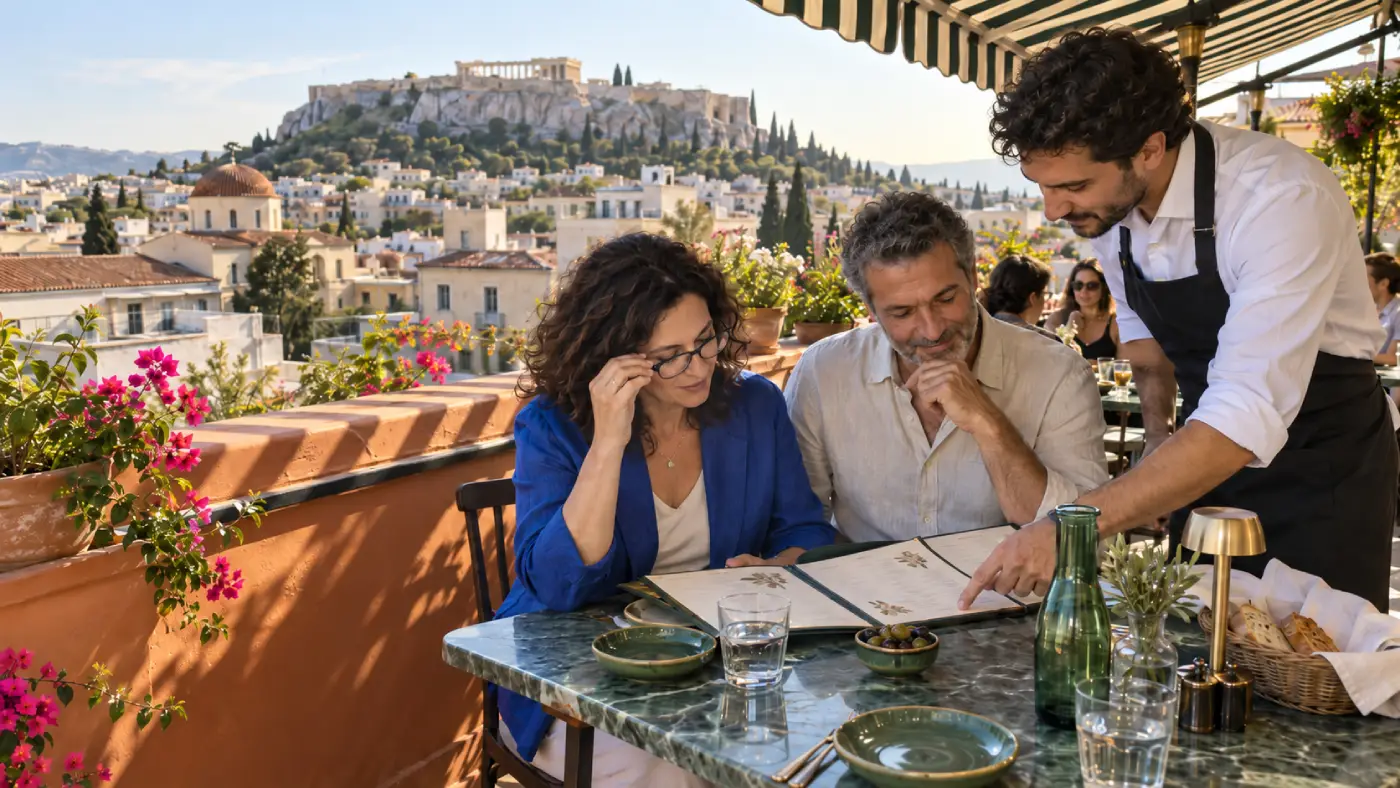
Reported disputes in Mykonos have involved sunbeds offered with food or drink purchases, unclear menu information and totals customers said they had not expected. Some operators have disputed those accounts and defended their displayed prices. The practical issue is whether you understood the complete purchase before accepting it.
Ask whether the sunbed has a rental charge, a minimum spend or a requirement to order. Establish whether the quoted amount covers person, bed or your whole group.
Treat the food and drink order as a separate decision. You need prices for the actual items and quantities being served. With seafood sold by weight, ask how that translates into the total for your order.
Before paying:
-
Compare the bill with the dishes and drinks you ordered.
-
Ask about an unfamiliar item or charge.
-
Match the card-terminal amount to the agreed total.
-
Keep the payment receipt.
Greek suppliers of goods and services must issue receipts. An itemised bill helps explain the calculation; retain the actual payment receipt as well.
If the price is clearly disclosed and you decide it is too high, leave before ordering. If the bill is wrong, request an explanation calmly. Move to the reporting steps below if the situation becomes threatening.
Bar Invitations That End With an Unexpected Bill
Older independent accounts from Athens describe social encounters in bars ending with unexpectedly large bills and pressure to pay. These are individual reports, not evidence that ordinary nightlife invitations are generally dishonest.
The decision point comes before additional drinks are ordered. See the menu, order for yourself and make clear whether anyone else’s drinks are being added to your bill. A stranger’s invitation does not explain who will pay.
If you meet someone and want to continue talking, suggest a venue yourself. Pressure to use particular bar, evasiveness about prices or unexpected orders on your behalf are reasons to reconsider.
Do not escalate a confrontation over the bill. Seek help from a safe public place if you feel threatened.
Fake Accommodation and “Verify Your Booking” Messages
Booking fraud can start before a reservation exists or after you have made a legitimate booking. Those situations require different checks.
The property or seller is not genuine
Fake listings can use convincing photographs and attractive prices to collect payments for accommodation the seller cannot provide.
Check the address, independent reviews and the identity of the business collecting your money. Photographs alone establish very little. If you book directly, obtain the property’s contact details independently rather than relying entirely on the person sending the offer.
Unexpected requests to move away from a booking platform and transfer money to secure a special discount deserve scrutiny. Pause until you can verify both the accommodation and the payment arrangement.
Your real reservation is used to request another payment
Greece’s tourism sector received warnings in June 2026 about messages using genuine reservation information to make fraudulent payment requests look credible. Knowing your hotel name and travel dates is therefore not proof that a sender represents the property.
Messages may claim that your payment failed or that you must verify your card immediately to avoid cancellation. They can arrive by email, SMS or WhatsApp.
Open the booking service yourself and review your original payment terms. Contact its support team or the property through independently verified details. Even a message appearing in an existing conversation should be questioned if it introduces an unexpected payment link.
Booking.com’s traveller security guidance covers fake properties and urgent requests to resubmit payment information.
Keep a copy of the reservation offline, including the address and payment status. If you need mobile access to your booking account while travelling, a Greece eSIM provides a data option on a compatible phone. Verify the sender separately before entering payment details.
Rental-Car Damage Claims and Unexplained Extras
Vehicle-hire scams are included in travel warnings for Greece, while damage charges, insurance and fuel policies are recurring European consumer-dispute issues. Distinguish an existing scratch attributed to you from damage you caused.
At collection, inspect the car with the rental representative. Photograph existing damage and have it recorded on the condition report before driving away.
Read the total rental price separately from the deposit hold. Establish what insurance or damage waiver you purchased, what remains excluded and which fuel policy applies. Optional extras should be identifiable in the agreement.
At return, retain the inspection paperwork. Photograph the car’s condition, especially with an unattended drop-off.
If a later charge appears, ask the rental company in writing for its explanation, the inspection evidence and the relevant repair documentation. Compare those with your collection photographs and contract. Ask your card issuer about available dispute options.
Card and ATM Fraud: Separate It From Ordinary Fees
Card and ATM fraud occurs in Greece. Keep your card in sight during payment, cover the keypad when entering your PIN and avoid a machine with an unusual or visibly altered reader.
Use an ATM inside a bank or another established business when practical. If the machine behaves unexpectedly, contact the bank through a number you obtain independently. Do not reveal your PIN to someone offering assistance.
Review transactions during your trip so an unfamiliar charge does not go unnoticed until you return home. If you suspect unauthorised use, freeze the card through your bank’s own app or contact its fraud team.
ATM fees and currency-conversion offers are separate pricing issues. Read the amount and terms before accepting; a disclosed fee alone is not evidence of fraud.
Deliberate Distractions on the Athens Metro
Organised thieves have used crowding and pushing around Athens metro exits to divert attention while belongings are taken. The deception is the distraction: you focus on moving through the doorway while someone else reaches for your bag.
Keep your bag closed and in front of you during boarding and alighting. If an unexpected disturbance develops, maintain contact with your belongings rather than setting them down to help or investigate.
Ordinary crowding does not identify a thief. The broader precautions for transport, accommodation and the rest of your trip belong in our safety advice for Greece.
What to Do If You Have Been Scammed in Greece
Prioritise getting somewhere safe over winning an argument or collecting another photograph. you can act without escalating the situation:
-
Preserve the evidence. Keep receipts, booking confirmations, messages and screenshots. Note the location, time, disputed amount and relevant vehicle or business details.
-
Contact the payment provider when money or card details are at risk. Use your bank’s official app or published contact number. Explain whether the issue is an unauthorised transaction, a misleading charge or a service that was never provided.
-
Report suspected crime to the police. Bring your evidence and retain the report details for any subsequent claim.
-
Notify the relevant business or platform. Use the original booking or trip record to open a complaint and keep the correspondence together.
The Hellenic Police contact lines include 1571 for tourist assistance, 100 for immediate police intervention and 11188 for cybercrime. The 1571 service operates around the clock in Greek, English, French and German. Call 112 for an emergency.
Data-only travel eSIMs do not include ordinary telephone calls. Use a phone with calling capability or ask hotel staff or another staffed business to help you reach the appropriate service.
Keep expectations realistic: a report or payment dispute starts a process, and recovery is not assured. Clear evidence gives the police, bank or booking service a better basis for assessing what happened.