Download the App and manage your eSIMs easily
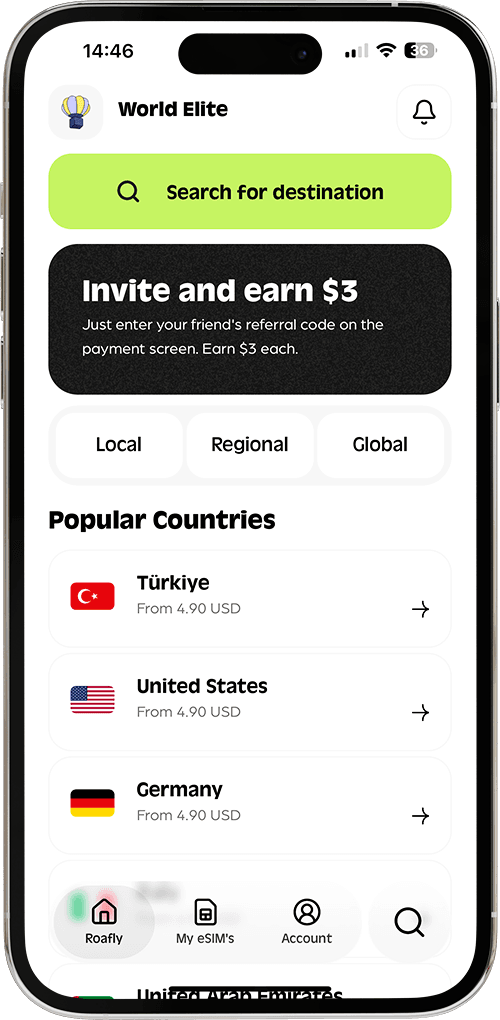
Create your order quickly
See your eSIM details
Track your remaining data
Download the App and manage your eSIMs easily
Create your order quickly
See your eSIM details
Track your remaining data
Many visitors can travel to France without applying for a tourist visa, but visa-free entry still comes with document and stay-limit requirements. Your accommodation arrangements also affect how much money you may need to demonstrate at the border.

Lena Hartley
Updated Nov 6, 2026
8 min read

Save 15% on your Roafly eSIM
Stay connected on your next trip. Use the code below at checkout.
View All DestinationsJump to section
👇Save 15% on your Roafly eSIM
Stay connected on your next trip. Use the code below at checkout.
View All Destinations
Manage your eSIM in the app
Install, top up and track data.
As of 6 November 2026, EES border registration is operating, while ETIAS is not yet operational. Visa-exempt visitors do not currently need to obtain an ETIAS authorisation.
This guide covers mainland France and Corsica. French overseas destinations, including Martinique, Réunion and French Polynesia, have separate entry rules.
Your nationality and passport type determine the starting point. Residence permits, existing visas and family status can change the answer.
| Passport or citizenship group | Examples | Route for a short tourist visit |
|---|---|---|
| EU, EEA and Swiss citizens | Germany, Ireland, Norway, Switzerland | No tourist visa; separate free-movement rules apply. |
| Visa-exempt non-EU passport holders | United States, United Kingdom (British citizens), Canada, Australia, Japan | Normally up to 90 days in any 180-day period across Schengen, subject to entry conditions. |
| Visa-required passport holders | India, China, Türkiye, South Africa | Obtain a short-stay Schengen visa before travelling, unless a specific exemption applies. |
These are representative examples for ordinary passports, not complete nationality lists. Diplomatic, official and special passports can follow different rules.
Use the official France-Visas wizard with your nationality, travel document, country of residence and exact destination. Living in the UK or United States does not, by itself, make a visa-required passport visa-exempt. Holding a valid residence permit or long-stay visa issued by a Schengen country can provide a separate exemption.
France does not offer a routine tourist visa-on-arrival service. If you need a visa, arrange it before departure.
France shares its short-stay allowance with the rest of the Schengen area. Time spent in Spain, Italy, Germany or another Schengen country counts towards the same limit.
The calculation uses a rolling 180-day window. Spending 20 days in Spain and 10 in Italy uses 30 days of the allowance while those visits remain within that window. Moving on to France does not give you another 90 days, and a brief trip outside Schengen does not reset the count.
Visa holders must also respect the dates, permitted duration and number of entries shown on their visa. If it authorises a 15-day stay, the general 90-day ceiling does not extend it.
Plan a holiday exceeding the short-stay allowance around the appropriate long-stay route before travelling.
Apply through France when it is your only destination or the main destination of your Schengen trip. For an ordinary multi-country holiday, that usually means the country where you will spend the most time. If stays are equal and there is no other main destination, apply through the country you will enter first.
Landing in Paris does not always make France responsible for your application. Five days in France followed by ten in Italy would normally mean applying through Italy.
Start the application online through France-Visas, then follow the instructions for submitting your passport and supporting documents to the responsible consulate or designated visa centre. Applications normally go through the country where you legally reside. Completing the online form is only one stage of the process; it is not an issued eVisa.
Applications can normally be lodged up to six months before travel and at least 15 days before departure. Standard processing takes around 15 days and can extend to 45 days. Appointment availability adds another scheduling constraint, so leave more than the minimum time.
The standard Schengen visa fee is €90 for adults and €45 for children aged six to under 12. Children under six are exempt from the visa fee. Other reductions or exemptions may apply, and visa-centre service charges can be additional.
Short-stay visitors from outside the EU, EEA and Switzerland should have the following available for border inspection, including when travelling visa-free:
Passport: issued within the previous ten years and valid for at least three months after your planned departure from the Schengen area.
Visa or qualifying residence document: where required for your entry route.
Accommodation evidence: covering the whole stay, such as hotel reservations or the appropriate certificate for a private visit.
Financial evidence: showing sufficient resources for the visit and return journey.
Return-travel arrangements: a return ticket or evidence that you have the means to obtain one.
Travel medical insurance: covering emergency treatment, hospital care and medical repatriation throughout the Schengen stay, with at least €30,000 of cover.
Keep essential confirmations available offline, with secure copies stored separately from the originals. Passport security also belongs in your plans for staying safe in France, particularly while moving between airports, stations and hotels.
Border officers can ask for supporting evidence even when your passport contains a valid visa. Keep the documents accessible in your hand luggage.
France’s funds and accommodation requirements use different daily amounts according to your accommodation evidence:
| Accommodation evidence | Daily amount |
|---|---|
| Hotel reservation covering the relevant days | €65 |
| No hotel reservation for the relevant days | €120 |
| Private stay supported by an approved attestation d’accueil | €32.50 |
Seven days covered by hotel reservations correspond to €455, compared with €840 at the rate for days without hotel reservations. These are resources you may need to demonstrate, not charges collected at the border.
If only part of your stay is covered by hotel bookings, apply €65 to the covered days and €120 to the remaining days.
Staying with a friend or relative requires particular preparation: the attestation d’accueil is arranged by your host and validated by the local town hall. An informal invitation message is not the same document.
Keep accommodation evidence for the whole visit. Meeting a financial threshold does not replace the other entry requirements.
The current EES and ETIAS rules distinguish border registration from advance travel authorisation.
EES, the Entry/Exit System, became fully operational on 10 April 2026. It records eligible non-EU visitors entering and leaving Schengen for short stays, including visitors who need a visa and those who do not. Electronic records replace routine passport stamping for travellers covered by the system.
Registration uses passport information and biometric data. Children under 12 are exempt from fingerprint collection. EU citizens and holders of Schengen residence permits or long-stay visas fall outside this ordinary short-visit registration requirement.
You do not need to submit an advance EES application before your trip.
ETIAS will be a separate pre-travel authorisation for eligible visa-exempt visitors. As of 6 November 2026, it is not operating and no website is issuing ETIAS authorisations. Do not pay for an authorisation that is not yet available. Check its launch status again close to departure if you are booking a later trip.
The route through the airport matters as much as the final destination.
Non-Schengen flight → Paris → non-Schengen flight, staying airside: you do not enter Schengen, but some nationalities still require an airport transit visa. Examples include Nigerian, Pakistani, Turkish and Philippine ordinary passport holders, subject to specific exemptions.
Arrival in Paris followed by a flight within Schengen: you enter the Schengen area in France and must meet the normal entry conditions there.
Transfer between Charles de Gaulle and Orly, or a hotel outside the international transit area: the journey involves entering France, so ordinary entry requirements apply.
Airport transit visas permit transit through the international zone; they do not authorise a visit to Paris.
Existing visas and residence permits can create transit exemptions, but the issuing country and document type matter. Use the France-Visas wizard for your precise connection rather than assuming that any foreign visa or residence permit is sufficient.
Martinique, Guadeloupe, Réunion and French Polynesia are outside the Schengen area. Their entry rules are not interchangeable with those for Paris or Corsica.
If your trip includes both European France and an overseas territory, assess each destination separately. Some visitors need both a Schengen visa and a visa valid for the overseas destination. Others qualify for an exemption based on nationality, residence status or a particular qualifying visa.
Select the exact territory in France-Visas. The words “French territory” alone do not establish that your existing Schengen visa is sufficient.
Keep the immigration decision separate from what is in your suitcase. Review France’s customs rules while packing so that baggage allowances, restricted goods and declarations are handled alongside your entry documents.
Arrange mobile data before departure if you want to access live transport information and booking changes after landing. Comparing the best eSIM for France can help you choose a plan for your trip.
With an unlocked, eSIM-compatible phone, Roafly’s France eSIM supplies data for maps, accommodation messages and onward travel arrangements. Keep the documents needed at the border downloaded regardless of how you plan to connect.
Before renting a car, packing smoking products or planning nights out, check the tourist rules in France relevant to those activities.
